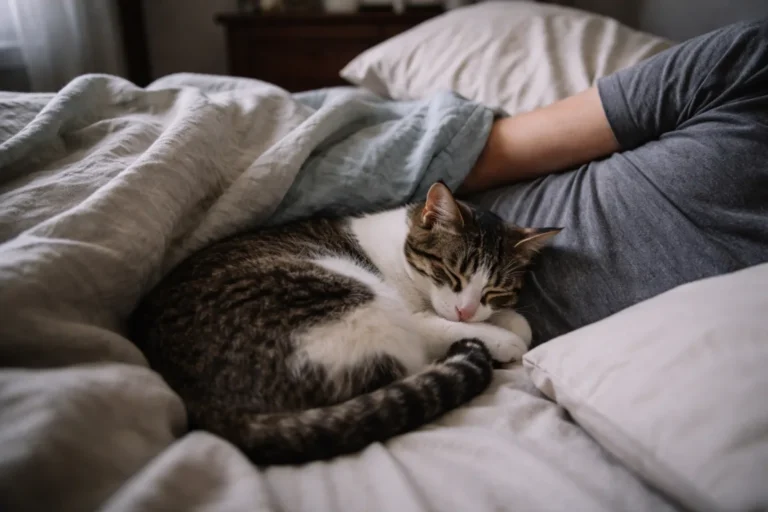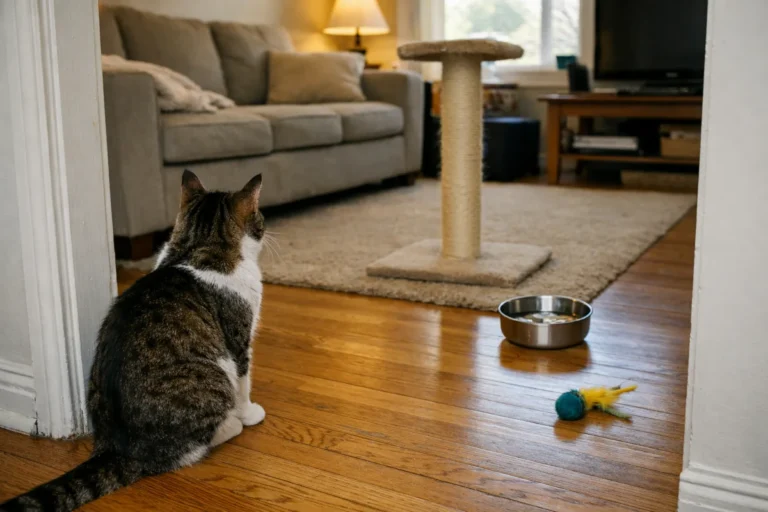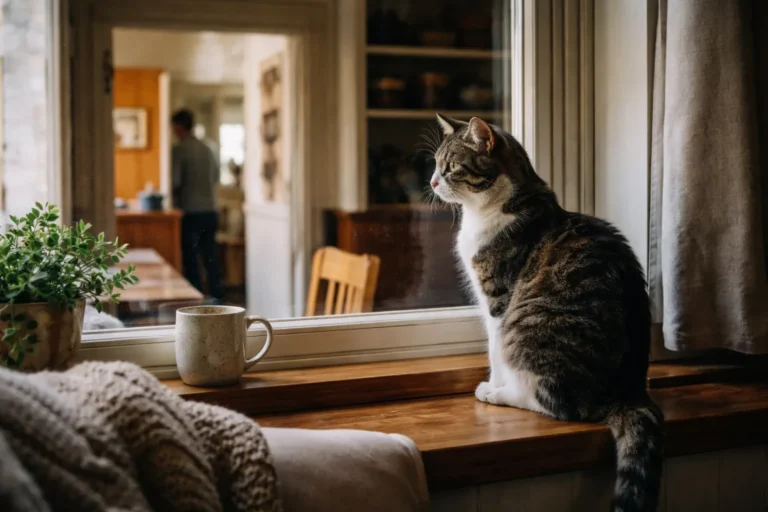
If you have ever sat down with a meal and noticed your cat suddenly appearing at your side, staring with quiet focus, you are not alone. Cats do this in a way that feels both ordinary and strangely intense. One moment they are sleeping on a chair or staring out a window, and the next they are fixed on your plate as if your dinner has become the most important thing in the room.
That look can seem simple on the surface, but it often carries several layers of meaning. Hunger may be part of it. Habit may be part of it too. So may curiosity, routine, and the strong connection cats build around predictable daily events. When a cat watches you eat, it is often responding to more than food alone.
Some cats sit quietly and observe from a few feet away. Others stand close, follow every hand movement, or even watch the path from plate to mouth with complete concentration. The behavior can feel affectionate in one moment and slightly demanding in the next. That mix is exactly what makes it so interesting.
What the Behavior Looks Like in Everyday Life
The way cats watch people eat is not always dramatic. In many homes, it starts with a small pattern. You open a container, unwrap food, pull out a chair, or begin cutting something on a plate. Your cat notices right away. Their ears turn toward the kitchen, their body shifts, and they are suddenly nearby.
Some cats stay at a respectful distance, sitting under the table or beside a chair. Others move in close enough to be impossible to ignore. A few will hop onto an empty seat, position themselves near the edge of the table, or maintain eye contact without blinking. It can feel like a silent negotiation.
The behavior is often strongest at the same times every day. Dinner, breakfast, and late-night snacks can become part of a cat’s mental schedule. If they have learned that food appears at those times, they may watch intently before, during, and even after the meal.
Common forms this behavior can take
- Watching from the floor while you eat at the table
- Sitting beside your chair with steady attention
- Waiting near the kitchen when food is being prepared
- Following your hands, plate, or fork with their eyes
- Meowing softly or offering a paw after staring for a while
- Hovering near the dining area long after the meal starts
Why Cats Show This Behavior in General
At the most basic level, cats watch you eat because food matters to them. Cats are highly aware of anything that might lead to a meal. Even when they are not truly hungry, the sound, smell, and movement of food can trigger strong interest. A cat’s attention is often shaped by experience, and mealtime is one of the clearest, most rewarding moments in a home.
Food is also tied to routine. Cats tend to notice patterns quickly, especially when those patterns involve something they value. If you eat at the same time every day, your cat may begin to track that schedule almost as carefully as you do. Watching becomes a way of staying ahead of the event.
There is also a social side to it. Cats may not eat like pack animals, but they still pay attention to the behavior of the beings around them. When you sit down to eat, you change the atmosphere of the room. The cat notices that shift. It may be a signal that something important is happening, and cats rarely ignore important changes.
For many cats, watching a person eat is part food-seeking, part routine tracking, and part social observation.
Possible Internal Reasons Behind the Behavior
A cat’s stare during mealtime can mean different things depending on the cat, the day, and the environment. Hunger is the most obvious reason, but it is not the only one. Some cats watch because they want a taste of whatever smells interesting. Others watch because they have learned that your meal often leads to their own food soon afterward.
Curiosity is another major factor. Cats are natural observers. They notice hands moving, utensils clinking, containers opening, and pieces of food changing shape. A meal gives them a lot to inspect. Every motion offers information, and cats tend to gather information before making decisions.
Sometimes the behavior has more to do with attention than appetite. A cat may want to be near you when you are focused on something else. If mealtime is one of the few times you sit still, your cat may treat it as an opportunity to be close and involved. The watching itself can become a form of connection.
There can also be a learned expectation behind the stare. Cats are smart about cause and effect. If past meals have involved dropped crumbs, shared bites, or a predictable treat, your cat may have built a strong association. The watching is then less about confusion and more about quiet confidence: something good might happen here.
What the behavior may reflect inside the cat
- Hunger or interest in food smells
- Expectation based on routine
- Curiosity about human behavior
- Desire for proximity and attention
- Learned associations with treats or leftovers
- Simple habit reinforced over time
How Context and Environment Influence It
The same cat may watch you eat more intensely in one home than another. Environment matters. A cat in a quiet household with consistent routines may settle into a strong mealtime pattern because nothing competes for attention. In a busier home, the behavior may be more intermittent, showing up only when the room is calm or when the smell of food is especially appealing.
Feeding schedule also plays a big role. Cats who eat on a dependable timetable often become more alert near human meals, especially if their own food comes before or after yours. If your cat is not getting enough structured feeding, the watching may become more persistent. It can turn into a repeated check-in whenever you sit down with food.
The type of food matters too. Strong smells can pull a cat into the room faster than a bland meal. Fish, poultry, warm meat, and anything with a rich aroma can catch attention quickly. Even cats that are usually indifferent may become fascinated by a particular scent.
Your own behavior may shape the pattern as well. If you have ever fed your cat from your plate, handed over scraps, or responded to staring with conversation and petting, the cat may have learned that watching works. This does not make the behavior manipulative in a human sense. It simply means the cat has connected your mealtime with reward.
What the Behavior May Signal About the Cat’s State
Most of the time, watching you eat is normal and harmless. The details matter, though. A cat’s posture, timing, and intensity can suggest whether the behavior is relaxed curiosity or something more urgent. A soft gaze from a cat lying nearby is very different from a tense cat pacing and staring from the kitchen doorway.
When a cat watches calmly, it often suggests interest without distress. The cat is alert but comfortable. Ears are neutral or gently forward, the body is loose, and the tail is still or softly moving. This is the kind of mealtime observation many owners see every day.
If the watching becomes intense, it may point more strongly to hunger, habit, or frustration. A cat that vocalizes, paces, climbs, or stares without settling may be asking for food in a more direct way. In some cases, the cat has simply learned that mealtime is worth monitoring closely. In others, it may be worth reviewing feeding portions and timing.
Stress can also affect the behavior. A cat who watches food with a rigid body, wide eyes, and little ability to relax may not be only interested in the meal. The dining area might feel like a place where the cat is uncertain, overstimulated, or unable to predict what happens next. Context is important here.
Calm watching usually means interest. Tense watching may mean hunger, expectation, or stress. The body tells the rest of the story.
Body language clues to notice
- Relaxed posture usually suggests casual interest
- Forward ears often mean attention and focus
- Repeated meowing may signal stronger expectation
- Pacing can suggest impatience or high food interest
- Tail flicking may reflect excitement or irritation
- A stiff body can point to tension, not just curiosity
Why Some Cats Seem to Watch More Than Others
Not every cat behaves this way with the same intensity. Personality plays a big role. Some cats are naturally observant and quiet, making them look as if they are studying your every move. Others are more laid-back and may glance over occasionally without making a scene. Both patterns are normal.
Age can matter too. Young cats often show stronger curiosity around anything involving movement and food. Adult cats may be more measured, though they can still become very focused if the food smells good or if their routine has taught them to expect something. Older cats may watch less often, or they may simply sit in a preferred spot and wait.
Past experience influences the behavior strongly. A cat that grew up being fed from the table, exposed to frequent snacks, or living with a family that eats at fixed times may be more likely to monitor meals. A cat who has learned that human eating never leads to rewards may show only mild interest. Repetition shapes the habit.
Some cats also watch more because they are deeply bonded with their people. They want to be nearby when you are active, seated, and accessible. Watching your meal can be part of a larger pattern of staying connected throughout the day.
How Owners Often Interpret It vs What It May Actually Mean
It is easy to assume a cat watching food is simply begging. Sometimes that is true. But the behavior is often broader than that. A cat may be asking for a bite, waiting for a crumb, or hoping for a routine treat. It may also be checking in because that is what cats do when they are interested in a person’s activity.
Owners sometimes read the stare as a sign of disrespect or stubbornness. In reality, cats are usually doing something much simpler. They are evaluating what is happening, what might happen next, and whether they need to move closer. Their attention is practical. It is not a challenge.
Some people also mistake quiet watching for boredom. Yet a cat can be deeply engaged without moving much. Stillness does not mean indifference. A cat that remains fixed on your plate may be completely absorbed in scent, timing, and expectation. The outward behavior is subtle, but the internal interest can be strong.
Another common misunderstanding is assuming that any food-focused stare means the cat is hungry enough to need more food immediately. That is not always the case. Cats often watch because they are tuned into the ritual, not because they need extra calories. Knowing the difference helps avoid overfeeding and helps preserve a healthy feeding routine.
How Mealtime Watching Connects to Cat Traits
This behavior fits neatly with several familiar cat traits. Cats are independent, but they are also highly observant. They can sit apart from a scene and still track every movement. Watching you eat allows them to stay involved without giving up their usual sense of control.
Cats are also sensitive to change. Human meals create small but predictable shifts in sound, smell, posture, and attention. A cat notices when the kitchen becomes active, when the table is set, and when a person sits still for longer than usual. That sensitivity is part of why the behavior shows up so clearly around food.
Observation is another major cat trait. They watch doors, windows, feet, and hands. Food simply gives them another target. If your cat seems especially focused during meals, it may be because your eating routine combines several things cats naturally track: movement, scent, timing, and your attention.
There is also a quiet social element to it. Cats often build their relationships through proximity and repeated shared moments. Sitting near you while you eat may not be dramatic, but it can be one of the clearest ways your cat stays included in daily life.
When the Behavior Becomes More Noticeable
Some cats become more watchful during certain periods. A change in schedule can make the behavior stronger. If you start working from home, eat later than usual, or spend more time in the kitchen, your cat may begin monitoring your meals more closely. Cats notice routine disruptions quickly.
The behavior can also intensify when a cat is feeling underfed or when its own feeding schedule is inconsistent. In those cases, the watching may shift from casual observation to repeated checking. The cat may appear early, stay longer, and return often. This does not necessarily mean there is a problem, but it is worth looking at the daily pattern.
New food smells can make a big difference. A cat who barely notices your lunch may suddenly become attentive when you roast chicken, warm soup, or open a package with a strong scent. Mealtime watching often follows odor as much as sight.
In multi-cat homes, the behavior can become even more noticeable. One cat may watch you while also keeping an eye on other cats in the room. Food creates a small competition for attention, and cats are very aware of that. The result can be a still, focused, and sometimes slightly tense scene around the table.
What to Look for in Different Types of Watching
Not all watching is equal. A calm, settled cat nearby is usually showing interest in a relaxed way. A cat that appears alert but comfortable is often simply participating in the household rhythm. This kind of behavior is common and typically low concern.
There is a different tone when the watching is sharp, repetitive, or insistent. A cat that cannot settle, repeatedly meows, or circles the same spot may be communicating stronger food interest. It may also be asking for consistency. If mealtimes are irregular, the cat may become more persistent because the routine feels unclear.
Occasionally, a cat will watch food while also seeming uncertain about the space itself. In those moments, the behavior may be less about the meal and more about awareness. The cat is taking in the room, the sounds, and the people around the food source. That kind of mixed signal is common in cats that are sensitive to activity.
| Type of watching | Common meaning | What it often looks like |
|---|---|---|
| Calm observation | Interest and routine | Quiet sitting, loose body, steady gaze |
| Persistent watching | Strong expectation or hunger | Repeated staring, meowing, moving closer |
| Tense watching | Possible stress or uncertainty | Rigid body, fixed posture, little relaxation |
| Social watching | Desire for closeness | Staying near you without obvious food-seeking |
What the Behavior Means Over Time
Watching you eat can become part of a cat’s lifelong pattern. Some cats do it from kittenhood and continue for years with little change. Others develop the habit after repeated exposure to human meals, special treats, or a particularly predictable household routine. Once learned, it is usually stable.
Still, the behavior can shift with life stage and household changes. A kitten may watch with scattered curiosity, then become more focused as it learns that food appears at regular times. An adult cat may settle into a dependable routine, while an older cat might simply prefer to rest nearby and observe less intensely. The pattern changes, but the underlying habit often remains.
The important thing is the consistency of the cat’s overall behavior, not one mealtime moment. A cat that watches, eats normally, relaxes afterward, and behaves as usual is simply showing a common daily habit. A cat whose watching is paired with other changes, such as weight loss, restlessness, or sudden changes in appetite, deserves closer attention to the bigger picture.
In most homes, the answer to why cats watch you while you eat is found in a combination of instinct, routine, and connection. Food catches their attention. Your habits teach them when to expect it. Your presence makes the whole event worth observing. That is usually enough to explain the look from across the room, the quiet seat beside your chair, and the steady eyes following every bite.
What seems like a small moment during dinner often reflects a cat that is alert, tuned in, and deeply aware of the rhythm of the home. The watching itself is rarely random. It is part of how cats keep track of their world, one meal at a time.