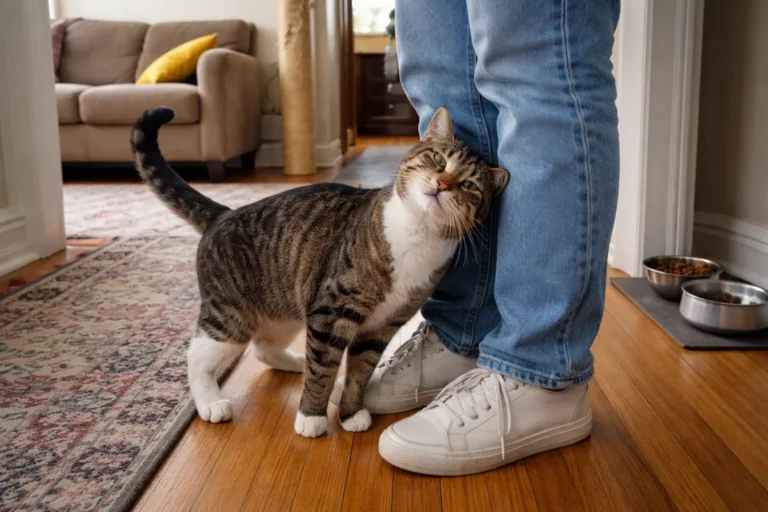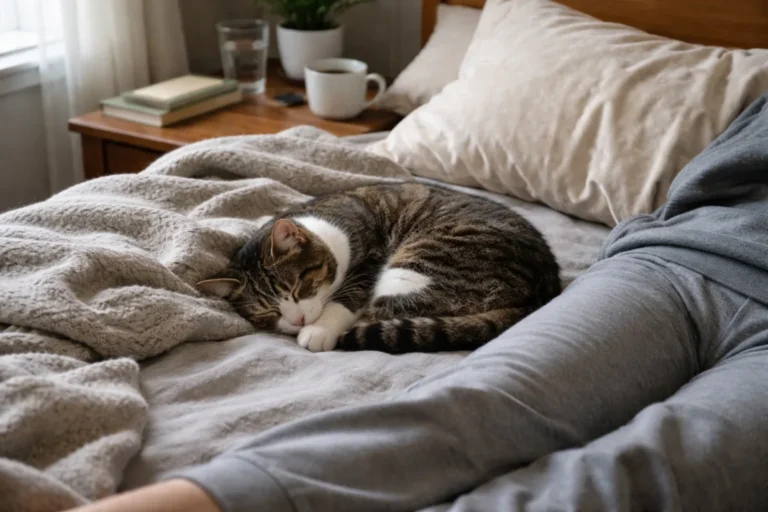
When a cat chooses to sleep next to you, it is not a random habit. It is usually a mix of comfort, trust, routine, and simple practicality. Some cats settle near your feet. Others press against your legs, tuck under your arm, or claim the spot beside your pillow. Each version says something a little different, but the basic message is often the same: this is a place where the cat feels safe enough to relax deeply.
That choice can feel flattering, and it often is. Cats are careful about where they rest, especially when they are fully asleep. Sleeping makes them more vulnerable, so a cat that stays close is making a quiet decision about safety and familiarity. The answer is rarely just one thing, though. Warmth, scent, habit, and attention all play a role.
What looks like affection may also be a practical cat decision. Your bed is soft, stable, warm, and smells strongly like the cat’s home group. If your evenings are predictable, your cat may have learned that your room is one of the calmest places in the house. That combination can make your side of the bed the easiest place to settle in.
Why cats choose to sleep nearby
Cat sleep is not casual. Even when a cat appears completely relaxed, part of the brain stays alert to sound, movement, and changes in the room. Sleeping next to a person can lower that sense of risk because the cat is choosing a space that already feels known. The body can rest more fully when the environment is predictable.
There is also a strong scent component. Cats rely on smell far more than people do, and your bedding carries a steady mix of your scent, their scent, and the familiar smells of home. To a cat, that can be reassuring in a way that words cannot match. It is one reason a cat may return to the same sleeping spot night after night.
Warmth matters too. Cats conserve energy, and a warm body or blanket is appealing. Even independent cats tend to seek comfortable spots that offer heat without effort. Your sleeping body gives off a stable source of warmth, which is hard for a cat to ignore.
Sleeping next to you usually reflects a mix of safety, warmth, scent familiarity, and routine rather than a single emotional reason.
What this behavior can look like at home
Not every cat expresses closeness in the same way. One cat may curl tightly against your stomach, while another lies at the foot of the bed and keeps a small gap. A cat that sleeps near your head is often choosing the highest concentration of your scent and movement, but some simply like the soft pillow area. Others prefer a position where they can leave quickly if they wake up.
In daily life, the behavior may be consistent or seasonal. A cat may sleep close only during colder months, then move a little farther away in summer. Another cat may follow your bedtime routine closely and appear on the bed the moment the lights go out. Some cats do not settle until they see you lying still, then slowly circle and choose a spot.
Common sleeping positions can reveal small preferences.
- At your feet: closeness with easy escape room
- Against your legs: warmth and gentle physical contact
- Near your chest or shoulder: strong scent preference and trust
- Beside your pillow: strong attachment to your scent and sleep routine
- Across your body: a comfortable, confident cat that feels settled
These positions are not fixed rules, but they help explain how cats balance closeness with personal space. A cat may love being near you while still avoiding direct pressure on its body.
Possible reasons your cat wants that spot
1. Comfort and trust
The simplest explanation is often the most accurate. A cat that sleeps beside you has usually decided that your presence is comforting. This is especially common in homes where the cat follows a routine, has regular meals, and experiences little nighttime disruption. Calm surroundings help the cat feel secure enough to sleep more deeply.
Trust does not always look dramatic in cats. It can show up as quiet behavior: choosing the same sleeping place, staying through the night, or relaxing with loose limbs and slow breathing. A cat that feels safe may knead the blanket, circle a few times, and then settle with little warning.
2. Bonding and social contact
Cats are often described as independent, but many are socially selective rather than distant. Sleeping next to a person can be one of the clearest signs that a cat accepts them as part of its social world. In multi-cat homes, cats that like each other may sleep pressed together or stacked in a small cluster. A similar instinct can extend to people.
That does not mean the cat is trying to behave like a dog. Cats usually show attachment in quieter ways. They may not seek constant interaction, but when they do choose contact, the moment can be meaningful. Bedtime is often one of the few times in the day when both cat and person are still enough for that closeness to happen.
3. Warmth and body heat
Heat has a strong influence on feline sleeping habits. Cats regulate body temperature differently from humans, and they often look for warm surfaces. Your body, blankets, and mattress create a layered heat source that can be more attractive than a standalone cat bed. If your room is cool, the preference can become even stronger.
Some cats also learn that the warmest place in the house is wherever their person is resting. That can make the habit feel personal, even when it is partly about temperature. In practice, both things are usually true.
4. Routine and predictability
Cats like patterns. If bedtime follows the same steps each evening, your cat may start to build an internal map of when the house becomes quiet. Lights dim, voices lower, movement slows, and the room becomes easier to predict. That regularity can make your bed a reliable resting place.
Once a pattern forms, it can be difficult to break. A cat that has spent weeks or months sleeping next to you may return automatically because the routine feels normal. Even small evening rituals, such as reading in bed or turning off a lamp at the same time, can become signals that sleep is near.
5. Safety and awareness
Cats often rest where they can monitor their environment without needing to remain fully active. Sleeping near you can help them feel protected, but it can also help them stay aware. If they wake to a sound or movement, your presence may help them interpret the room as stable rather than threatening. For some cats, being near a trusted human is part of feeling in control of the space.
A cat sleeping next to you may be both seeking comfort and using you as part of its sense of security.
What the timing can tell you
When the behavior appears matters. A cat that only sleeps beside you after a stressful day may be using closeness as reassurance. A cat that joins you every night at the same hour is likely responding to routine more than sudden emotion. Timing often reveals whether the behavior is occasional, seasonal, or part of a stable habit.
If your cat sleeps next to you after active play, it may simply be following the natural cycle of hunt, eat, groom, and rest. Many cats become sleepy after physical or mental stimulation. In that case, your bed may be the final stop in a predictable evening rhythm.
If the closeness increases during changes in the household, such as visitors, noise, travel, or a new pet, the meaning can shift slightly. The cat may be looking for reassurance because the environment feels less predictable. That does not automatically signal distress, but it is worth noticing the bigger pattern.
Signs that the sleep is relaxed rather than tense
- Loose body posture
- Slow, even breathing
- No constant repositioning
- Soft paws or gentle kneading
- Closed eyes with brief, calm waking
These signs suggest that the cat is comfortable enough to stay in a deep rest state. A tense cat usually looks more alert, changes position often, or chooses a spot with an easy exit.
How body language changes the meaning
Sleeping next to you can mean different things depending on how the cat is behaving before sleep. A cat that rubs against your hand, blinks slowly, and then settles nearby is showing a soft, deliberate form of contact. Another cat may jump onto the bed, circle once, and collapse in place. Both are normal, but the first usually looks more intentionally social.
If the cat keeps part of its body away from you while staying close, that often points to a balanced kind of trust. The cat wants proximity without full contact. That is still meaningful. Cats do not always need to be touching to feel connected.
On the other hand, if the cat starts close but remains stiff, flattens its ears, or reacts quickly to tiny sounds, the behavior may be less about comfort and more about uncertainty. In that case, the location alone does not tell the full story. You have to read the posture, not just the position.
Soft signals that often accompany closeness
- Tail wrapped loosely around the body
- Half-closed eyes
- Minimal startle response
- Gentle shifting before settling
- Quiet purring, in some cats
Why some cats are more likely to do it than others
Personality matters. Some cats are naturally social and enjoy close contact, while others prefer contact only on their own terms. A cat that spent time with people early in life may be more comfortable sleeping near a person later on. Adult cats that had a stable home environment often settle into bedtime habits more easily as well.
Past experiences can also shape the behavior. A rescue cat that came from a noisy or uncertain background may find comfort in closeness once trust develops. Another cat may have learned from kittenhood that sleeping near people is normal and safe. In both cases, the habit often reflects long-term learning as much as momentary mood.
Age can play a role too. Kittens often want contact because it reminds them of littermates and warmth. Adult cats may become more selective, but many keep the tendency if it has become part of their routine. Senior cats may seek extra warmth and familiarity, which can make sleeping beside a person more appealing.
Not every cat seeks the same kind of closeness, and that difference is usually normal rather than significant.
How your home environment shapes the habit
A quiet bedroom often encourages this behavior. Cats prefer places where sound does not change sharply and where the sleep environment feels stable. If your house becomes calm at night, your cat may treat your bed as the best resting zone in the home. The more consistent the environment, the more likely the habit becomes.
Temperature also changes the pattern. In colder homes, cats often press closer. In warmer rooms, they may stay nearby without touching. Bedding materials, room size, and the location of the bed all matter too. A bed placed in a quiet corner usually feels more secure than one near a noisy doorway or bright hallway.
Household activity can also influence the choice. In a busy home, a cat may wait until late evening to settle close. In a calm home, the cat may hop onto the bed as soon as the room quiets down. Either way, the sleeping location is often the result of a careful match between comfort and surroundings.
When the behavior changes
Sometimes a cat that used to sleep next to you starts choosing another spot. That change does not always mean something is wrong. Warm weather, a different blanket, more household noise, or a change in your own routine can be enough to shift the habit. Cats are sensitive to small environmental details.
If the cat suddenly avoids the bed and also seems withdrawn, restless, or unusually alert, the change deserves attention. A cat that is normally affectionate but stops resting near you may be responding to pain, stress, or a disruption in the home. The sleeping habit is one clue among many, not a diagnosis on its own.
Sometimes the pattern changes in the opposite direction. A cat that never used to sleep next to you may begin doing so after a move, a new schedule, or a period of illness. The cat may be seeking stability and a familiar scent. That shift can be quiet and gradual, but it often reflects a stronger need for reassurance.
What owners often misunderstand
Many people assume that a cat sleeping next to them is always a sign of deep emotional attachment. That can be true, but it is not the whole picture. Cats are practical creatures. They often choose the warmest, softest, safest available option, and a trusted person usually checks all of those boxes.
Another common misunderstanding is that a cat that sleeps nearby wants constant petting. That is not always the case. Some cats want proximity without active contact. They may enjoy the shared space more than touch itself. Pushing for more interaction than the cat wants can interrupt a habit that is actually working well.
It is also easy to overlook subtle stress signals. A cat may sleep next to you while still appearing tense if the room feels uncertain. That means the location alone should not be read in isolation. Posture, ear position, breathing, and how quickly the cat falls asleep all help explain the real reason for the behavior.
What the closeness usually means day to day
In everyday life, a cat sleeping next to you often says that your presence has become part of the cat’s normal sense of comfort. The cat knows where you are, knows what your sleep routine looks like, and has decided that staying near you is worth it. That decision can be based on affection, familiarity, temperature, and habit all at once.
The most useful way to understand the behavior is to look for consistency. A cat that regularly chooses your bed, settles calmly, and remains relaxed through the night is showing a stable preference. A cat that only does it sometimes may be responding to room conditions, stress, or seasonal changes. Both patterns are normal.
When a cat curls up beside you, it is usually making a simple choice: this is one of the safest, warmest, and most familiar places available. Cats are selective about rest, and that selection says a great deal without making any noise at all.