A cat that rubs against your legs, hands, furniture, or even door frames is doing more than asking for attention. This small motion carries scent, mood, and habit all at once. It can mean comfort, greeting, curiosity, or a desire to mark familiar places.
People often notice the behavior most when they come home, walk through a room, or stop near a favorite resting spot. The cat circles, presses its cheek or flank against you, and sometimes repeats the motion several times. It looks simple. It is not.
Cat rubbing behavior sits at the intersection of communication and comfort. The cat is not only reaching out physically. It is also using scent glands and familiar routes to shape its world. That is why the same cat may rub harder at one moment, then barely brush past you at another.
What Cat Rubbing Looks Like in Everyday Life
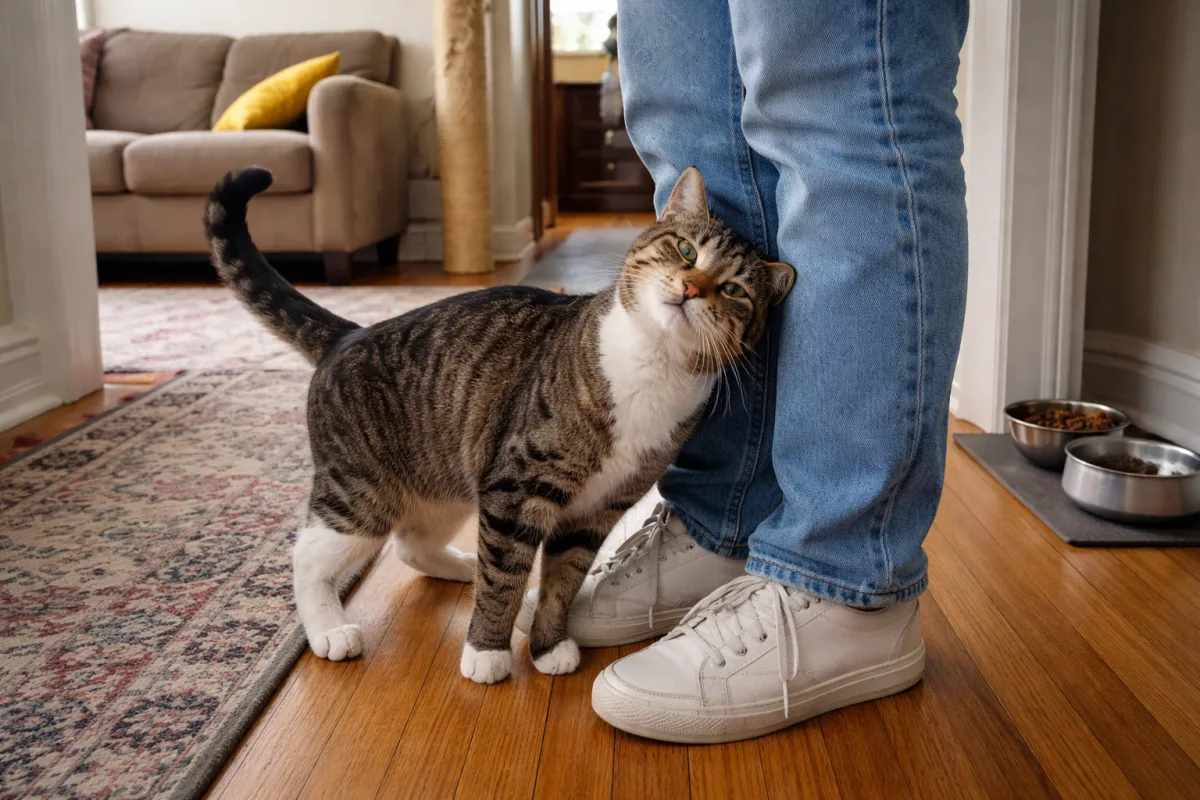
Rubbing is easy to recognize once you know the common forms. A cat may press its cheek along your hand, slide its body against your shin, or lean its head into a piece of furniture. Some cats do it gently and briefly. Others do it with a full-body pass that starts at the nose and ends at the tail.
In daily routines, the behavior often appears at predictable moments. Morning greetings, meal times, and returns after a quiet absence are classic examples. A cat may also rub against a couch arm after another pet has walked by, or against a carrier before a trip, as if to make the area feel familiar again.
It is useful to notice where the rubbing happens. Different contact points can suggest different things.
- Cheek rubbing often appears during greeting or bonding.
- Body rubbing against legs can mix affection with a request for interaction.
- Rubbing furniture, walls, or corners may be part of scent marking.
- Repeated rubbing near doors or windows may reflect territorial checking.
Some cats also rub and then pause to look at you. That brief pause matters. It can be part invitation, part assessment. The cat is checking whether the interaction will continue and whether the environment still feels settled.
Why Cats Rub in General
Rubbing is tied to scent. Cats have scent glands in the cheeks, chin, lips, temples, and around the tail area. When they press those zones against something, they leave behind scent marks that are impossible for us to notice directly but very meaningful to them. These marks can help the cat identify what belongs in its safe, familiar space.
That does not mean rubbing is only about territory. It is also social. Cats often rub against trusted humans, other cats, and familiar objects as part of everyday communication. In a multi-cat home, rubbing can help reduce tension by mixing scents and reinforcing group familiarity.
Rubbing is usually a sign that a cat is engaging with its surroundings, not ignoring them. The behavior often blends marking, greeting, and reassurance.
For many cats, rubbing is also self-directed comfort. The motion itself can be soothing. It gives them a way to pace an interaction, control distance, and make contact on their own terms. That sense of choice matters a lot in cat behavior.
Common Situations When Rubbing Appears
There are certain moments when rubbing shows up again and again. These patterns can help you understand what your cat may be trying to communicate in the moment.
When You Come Home
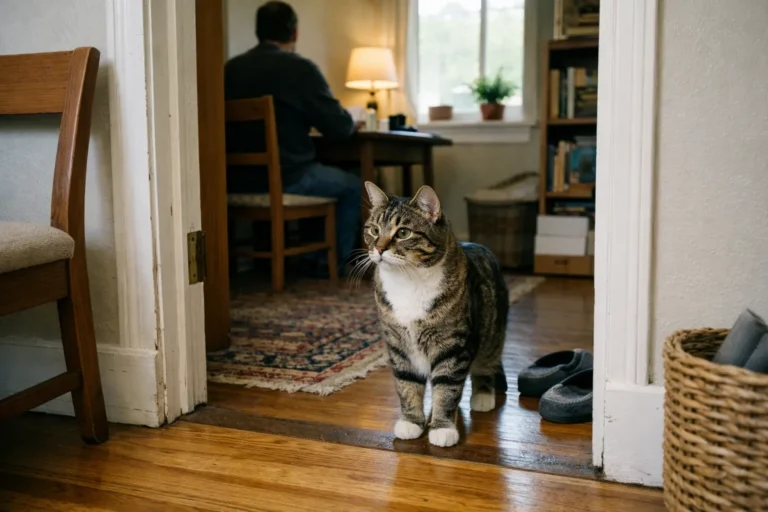
A cat may rush to the door and rub against your ankles as soon as you arrive. This is often a greeting, but it can also be a check-in. Your scent has changed while you were out. The cat is gathering information and restoring a familiar scent exchange.
Before Meals
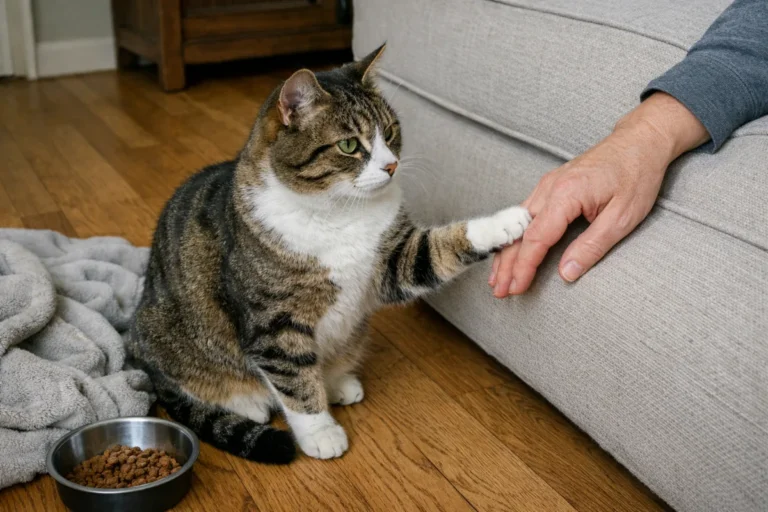
Some cats rub more strongly when food is involved. The behavior can be a mix of anticipation and social connection. The cat may be saying, in its own way, that your presence and the feeding routine belong together.
After a Stressful Event
Veterinary visits, visitors, cleaning, loud noise, or a changed routine can all lead to more rubbing once things settle down. The cat may be re-marking safe spaces, or it may be seeking reassurance through contact with a familiar person.
During Quiet Evening Time
Many cats become more physically affectionate when the home gets quiet. Rubbing at night or while you sit still on a couch can be a way to initiate closeness without a full request for handling or play.
Near New Objects
A shopping bag, suitcase, delivery box, or rearranged chair can draw a cat in for a close inspection and a rub. This often happens because the cat is trying to reclassify the object as familiar. Cats like a predictable map of their space.
What the Behavior May Signal About the Cat’s State
Rubbing alone does not tell the whole story. The meaning depends on posture, timing, and intensity. A relaxed cat with upright ears and an easy tail movement is usually expressing friendly intent. A cat that rubs while also tensing its body, flicking its tail, or moving in sharp bursts may be less relaxed.
Look at what happens before and after the rubbing. Does the cat settle beside you afterward, ask for petting, or walk away calmly? Or does it continue pacing, vocalizing, or repeatedly checking the same corner? Those details can change the interpretation.
Soft rubbing with loose body language usually suggests comfort and trust. Repetitive or forceful rubbing can still be normal, but it may reflect heightened interest, excitement, or a need to reset the environment.
Sometimes rubbing marks an emotional shift. A cat may rub more when it is transitioning from alertness to relaxation. That is why you may notice it after a visitor leaves, after play ends, or when the house becomes still. It can be part of the cat’s way of moving from active observation into a calmer state.
Subtle Signals That Travel With Rubbing
Rubbing rarely happens alone. Cats often pair it with other signals that refine the message. Reading the combination gives you a clearer picture than the rubbing itself.
- Raised tail: often linked to friendly confidence and greeting.
- Slow blinking: can appear when the cat feels safe and settled.
- Head bunting: strong cheek or forehead contact, often social and affectionate.
- Tail quiver or twitch: may suggest excitement or rising intensity.
- Flattened ears or stiff body: can point to discomfort, frustration, or overstimulation.
A cat rubbing against you and purring may be enjoying the moment, but purring alone does not guarantee comfort. The rest of the body tells the bigger story. If the cat leans in, relaxes its whiskers, and stays close, the interaction is likely welcome. If it rubs hard and then darts away, the cat may be handling mixed feelings or a strong urge to mark the area quickly.
How Rubbing Connects to Cat-Human Relationships
When a cat rubs against a person, it is often blending social connection with scent exchange. That matters because cats do not usually show attachment in the same broad, open way that dogs do. Their signals are more selective. Rubbing is one of the clearest of those signals.
Many cats choose specific people for more frequent rubbing. That preference is often based on history, routine, and how predictable the person feels. Cats notice who moves calmly, who respects space, and who responds consistently. A cat may rub against one family member before everyone else because that person has become part of the cat’s reliable map.
Owners sometimes assume rubbing always means, “Pet me now.” Sometimes it does. Sometimes it means something subtler: “I recognize you,” “You belong here,” or “This space feels better when we are both in it.” The difference is visible in how the cat lingers or moves on.
How Context and Environment Shape the Behavior
The same cat may rub differently in a quiet apartment than in a busy household. Environmental pressure changes how often a cat wants to re-mark familiar zones. More movement, more noise, and more changing scents can all increase rubbing. A calm, stable environment may lead to fewer dramatic displays, though the behavior will still appear at key moments.
Indoor cats often rub household items more noticeably because the environment is relatively fixed. Furniture, corners, and favorite resting spots become central scent stations. Outdoor-access cats may also rub on fences, porch rails, or entry points where they monitor the border between home and outside.
Routine has a strong influence too. Cats are quick to learn when doors open, meals happen, and favorite humans sit down. If the daily rhythm changes, rubbing may become more frequent as the cat tries to restore predictability.
Household Factors That Can Increase Rubbing
- New pets or unfamiliar animals in the home
- Recent furniture rearrangement
- Visitors or maintenance work
- Changes in feeding schedule
- Seasonal shifts in window access and outdoor smells
- Moving to a new home
Not every increase in rubbing is a problem. A cat that has more reason to mark and reassess its surroundings may simply be adapting. The key is whether the behavior fits the context and whether the cat otherwise seems comfortable.
When Rubbing Is Playful, Calm, or Defensive
Some rubbing is easy to read as calm affection. Other forms are more mixed. A cat may rub and then immediately pounce on a toy, which suggests the behavior is part of a broader aroused but positive state. The rubbing becomes one piece of a larger sequence.
In a playful mode, the cat may move quickly between rubbing, stalking, and batting at objects. The body stays loose, but energy is high. In a calm mode, the cat may rub slowly, pause, and then settle nearby. Defensive or uneasy rubbing looks different. The contact may be brief, the tail may lash, and the cat may seem more focused on the environment than on the person.
Rubbing is not always equivalent to affection. The same motion can reflect marking, excitement, uncertainty, or social contact, depending on how the cat carries its body.
That is why it helps to think in terms of patterns rather than single gestures. One rub means little by itself. Several signals together can show whether the cat is settling in, seeking closeness, or responding to a change in the room.
How Owners Often Misread the Behavior
One common mistake is assuming a cat rubbing on someone is ready for unlimited petting. Some cats do want that. Others prefer a brief exchange and then a return to personal space. If you keep petting after the cat has finished its greeting, it may step away or give subtle signs of irritation.
Another misunderstanding is thinking rubbing only happens because a cat is hungry or needy. Food can trigger it, but the behavior is broader than a request. Cats use rubbing in ordinary social life, not just when they want something.
It is also easy to overlook rubbing on objects. When a cat rubs a couch corner, a carrier, or a doorway, owners may dismiss it as random movement. In reality, the cat may be checking the scent profile of the environment and putting its own marks back in place.
If the rubbing becomes sudden, excessive, or tied to other changes such as appetite loss, hiding, scratching, or vocal distress, the context deserves a closer look. Behavior changes are most useful when viewed together rather than in isolation.
How the Behavior Can Change Over Time
Kittens often rub in shorter, less controlled ways. The motion may appear during clumsy greetings or as part of learning social boundaries. As cats mature, the rubbing usually becomes more deliberate. Adult cats often know exactly which person, object, or area they want to mark.
Older cats may continue rubbing, though some become gentler or less frequent in their movements. A senior cat might still greet a favorite person with a face press against the leg, then rest nearby. That change in intensity does not always mean a change in meaning. It can simply reflect age, comfort, and energy level.
Long-term patterns matter. A cat that has always rubbed the same chair at the same time of day is likely expressing a stable routine. A cat that suddenly stops rubbing entirely, or begins doing it with unusual urgency, may be reacting to a shift in health, stress, or household dynamics.
What to Notice in Long-Term Observation
Watching rubbing behavior over time can reveal what the cat values most. Some cats prioritize people. Others prioritize routes, corners, and particular pieces of furniture. Some cats rub more after sleep, while others are most active after meals or during evening quiet.
You do not need to track every detail, but a few consistent observations can help. Pay attention to where the cat rubs most often, who it rubs first, and whether the behavior changes with schedule disruptions. Those patterns can be surprisingly stable.
| Pattern | Likely Meaning |
|---|---|
| Morning rubbing at the door | Greeting and scent check |
| Rubbing after visitors leave | Reassurance and environmental reset |
| Frequent rubbing on furniture corners | Territorial marking and familiarity |
| Strong rubbing before meals | Anticipation plus routine connection |
| Brief rub then retreat | Social contact without extended handling |
These patterns are not fixed rules. Cats are flexible. Still, the repetition of a behavior in similar moments often says more than the moment itself.
When Rubbing Feels Stronger Than Usual
There are times when a cat rubs with unusual insistence. This can happen after travel, after a move, or when another animal has been near the cat’s preferred spots. The behavior may look almost urgent. In those cases, the cat is often trying to restore a sense of control over the space.
Strong rubbing can also appear in highly social cats. Some cats are simply more expressive. They may bump, nuzzle, and circle constantly. If the rest of the body language stays loose and the cat is eating, resting, and using the litter box normally, the behavior may just be part of its personality.
What matters most is change. A cat that has always rubbed frequently is different from a cat that suddenly becomes obsessed with rubbing every object in sight. New patterns deserve attention because they can reflect a new environmental pressure or an internal shift.
How the Home Environment Becomes Part of the Behavior
In a home, rubbing is not random contact. It becomes part of the household rhythm. Cats may use favorite corners, chair arms, and hallway turns like repeat markers. The home is a living scent map, and rubbing helps maintain it.
That is why some cats seem to “check in” with the same locations every day. They are not being repetitive for no reason. They are renewing a familiar arrangement that supports calm movement through the space. In homes with multiple cats, these shared scent zones can be especially important.
Even small changes can shift the pattern. A new laundry basket, a moved cat bed, or a recently cleaned rug may invite fresh rubbing. The cat is not decorating the room. It is updating the information it uses to navigate it.
When you see rubbing in that light, the behavior becomes easier to understand. It is part greeting, part marking, part comfort, and part routine. The balance changes from one moment to the next, but the logic stays familiar: the cat is shaping a world that feels readable and safe.