A gentle tap from a cat can feel oddly specific. It is usually lighter than a swat, softer than a paw grab, and more deliberate than a random brush-by. One moment your cat is sitting nearby, and the next a paw reaches out to touch your arm, leg, hand, or face as if to get your attention without making a scene.
That small gesture can mean several things at once. It may be affectionate, curious, impatient, playful, or simply practical. Cats use their paws to communicate, and a soft tap often sits right between a request and a reminder.
Many owners notice that the tapping happens in familiar routines: before breakfast, when they stop petting too soon, when they are talking on the phone, or when the cat wants to follow them into another room. The behavior looks simple, but the reasons behind it are usually layered.
Understanding the tap starts with watching the whole moment, not just the paw. The cat’s posture, ears, tail, face, and timing all help show what that touch is really saying.
What a Gentle Tap Looks Like in Everyday Life
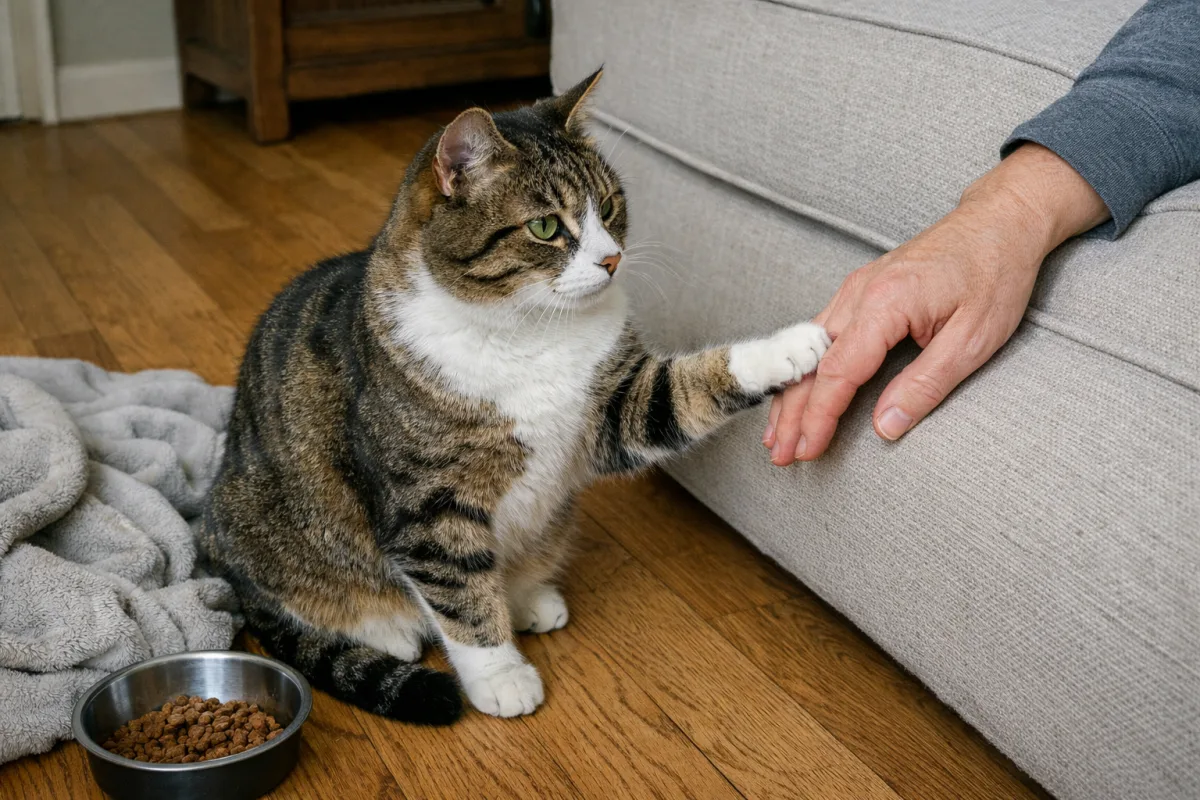
A gentle tap is usually brief and controlled. The cat extends one paw and touches a person with little force, then pulls back or repeats the motion. It often happens when the cat is already close by and wants some kind of response.
Sometimes the tap is barely more than a nudge. Other times it comes with a small hooked motion, like the cat is trying to keep a hand from moving away. The key difference between a gentle tap and a more demanding pawing behavior is pressure. A mild tap feels exploratory; a stronger pawing tends to feel insistent.
In daily home life, these taps can appear in very ordinary moments:
- when a cat is waiting for food
- when a person stops petting too early
- when the cat wants to move a hand back to its head or chin
- when the cat is curious about what a person is doing
- when the cat is ready to play
These moments are easy to overlook because they are so small. Yet cats often rely on small actions rather than loud signals. A paw tap is one of the clearest examples of that quiet style of communication.
Why Cats Show This Behavior at All
Cats do not usually tap for no reason. The behavior is tied to interaction. A cat has noticed something, made a choice, and used a paw to change the situation.
One common reason is attention-seeking. Cats learn quickly that touching a person often gets a reaction. Even a glance, a laugh, or a hand reaching back can reinforce the behavior. If a cat has learned that a light tap leads to petting, food, movement, or conversation, it may repeat the tap whenever it wants that result.
Another reason is affection. Some cats tap as a soft social gesture, especially with people they trust. The touch can be their way of saying, “I’m here,” or “Stay with me.” Unlike a head bump or full-body lean, a tap is more tentative. It can feel like a polite request rather than a full declaration.
Gentle tapping is often less about random pawing and more about purposeful communication. Cats rarely use their paws without a reason.
Curiosity is another strong motive. A cat may tap because it is trying to test a moving object, check whether a hand will respond, or examine something unfamiliar. Cats investigate the world with their paws just as much as with their noses and eyes.
Then there is the practical side. If a cat wants food, water, a door opened, or a sleeping spot adjusted, a tap can be a clean way to ask. It is not always emotional. Sometimes it is simply efficient.
Common Situations When the Tapping Appears
The same cat may tap in different ways depending on the setting. A soft paw on a leg during dinner means something different from a tap on a wrist during playtime. Context matters.
When food is involved
Food is one of the most common triggers. Cats are observant, and they notice patterns quickly. If tapping has ever led to breakfast, treats, or a refill, the behavior can become part of the mealtime routine.
Some cats tap more gently than others when hungry. They may sit beside a person and lift a paw in a measured, polite way before escalating to a meow if nothing happens. This sequence can make the tap feel almost like the first line in a conversation.
When petting stops too soon
A cat that enjoyed being touched may tap a hand if it wants the interaction to continue. The paw lands on the wrist or fingers, often just as the hand begins to move away. In that setting, the tap can mean, “not yet.”
This is common in cats that prefer controlled contact. They may enjoy attention, but only in short sessions or in specific areas. The tap becomes a way to manage the exchange.
When a cat wants to play
A playful tap often looks lighter and quicker. The cat may crouch slightly, ears relaxed, tail moving loosely, then touch a hand or foot as if inviting a game. If the person responds with movement, the cat may follow with another tap or a short pounce.
This kind of tapping can show up most often in younger cats, but many adults keep the habit. It is one of the easiest ways for a cat to turn an ordinary moment into interactive play.
When a cat is observing a person
Sometimes a cat taps because it wants to stay connected while still keeping some physical distance. It may be watching a person work, cook, read, or sit still, and the tap serves as a quick check-in. The cat is present, interested, and engaged, but not necessarily demanding anything dramatic.
What the Behavior May Signal About the Cat’s State
A gentle tap can reflect a cat’s mood, but it does not have a single meaning. The same motion can show contentment in one situation and frustration in another. Reading the whole picture is what matters.
Relaxed tapping often comes with soft eyes, loose body posture, and a tail held calmly. The cat may seem comfortable and socially open. In that case, the tap is usually a mild request or an affectionate touch.
More urgent tapping can appear when a cat is seeking a response. The paw may come out repeatedly, sometimes with a louder meow or a fixed stare. The mood shifts from casual to determined.
If the tap is paired with tense body language, flattened ears, or a twitching tail, the meaning may no longer be affectionate. The same paw movement can carry very different messages depending on the cat’s state.
Some cats also tap when they are uncertain. A light paw touch can be a cautious way to test an interaction. Instead of jumping into contact, the cat uses the smallest possible move and watches closely for what happens next.
That sensitivity is part of what makes cats so easy to misread. They often communicate in low volume, and the difference between relaxed, impatient, and unsure may be subtle. A cat that taps gently while remaining loose and calm is sending a different message from one that taps with fixed eyes and tight muscles.
How Body Language Changes the Meaning
The paw itself tells only part of the story. Ears, tail, whiskers, and posture provide the rest.
A cat with forward ears, a relaxed tail, and a soft expression is usually comfortable. A tap in this state often means friendly engagement. The cat is open to contact and using touch to extend the interaction.
If the tail is twitching hard or the body is stiff, the tap may have a sharper edge. The cat may be saying it is overstimulated or annoyed. This is especially important to notice when the tap happens during petting. What begins as affection can become irritation very quickly.
Whiskers can also offer clues. Forward whiskers often go with interest or anticipation. Pulled-back whiskers may show tension or caution. The same applies to ears: relaxed ears usually suggest ease, while ears that rotate sideways or back may show discomfort.
A cat’s eyes matter too. Slow blinking and soft gaze often go with calm attention. A fixed stare, especially in combination with tapping, can suggest that the cat is waiting for something specific. In a food context, that might simply be impatience. In a crowded or noisy environment, it may reflect unease.
How Owners Often Read the Tap, and Where Misunderstandings Happen
People often assume a gentle tap always means affection. Sometimes it does. But not always. Cats are capable of using the same behavior for different goals, depending on the moment.
A tap can be mistaken for a greeting when it is actually a request. It can be read as play when the cat is really trying to redirect a hand. It can even seem sweet when it is a sign that the cat has had enough attention and wants a break.
Owners sometimes miss the importance of repetition. A single tap is one thing. A series of taps, especially if paired with meowing or standing in a doorway, usually means the cat is trying harder to communicate. The behavior has likely moved from mild interest to active prompting.
Another common misunderstanding happens when a cat taps and then lightly scratches. That change in pressure can be a warning that the cat’s mood is shifting. What felt like a soft request can become a boundary-setting gesture if the interaction continues in a way the cat does not like.
How Home Environment Shapes the Habit
The setting around a cat can make tapping more or less common. Cats in calm, predictable homes often use the behavior as part of routine communication. In busier homes, tapping may appear more often because the cat has to compete with noise, movement, and distractions.
Indoor cats may tap more frequently simply because they spend more time interacting with people. Their world is smaller, and the human household becomes the main source of stimulation. A tap can be an efficient way to ask for attention, play, or access to another room.
In homes with regular schedules, tapping may become tied to predictable events. Cats notice timing. They learn when breakfast happens, when a person sits on the couch, and when a bedroom door closes. Once a pattern is established, the tap becomes part of the cat’s routine response.
Changes in the environment can also increase tapping. A new pet, a change in work schedule, visitors, or less time spent playing can all make a cat more likely to reach out physically. The tap may be a small adjustment in how the cat tries to keep contact steady.
Some situations make tapping more noticeable
- quiet mornings before feeding
- evenings when the household slows down
- moments when a person is using a phone or laptop
- times when the cat wants access to a favorite room
- after a nap, when the cat is awake and ready to interact
How This Behavior Connects to Typical Cat Traits
Gentle tapping fits well with the broader way cats move through the world. Cats are observant. They watch before they act. They prefer subtle communication over obvious demands, and a paw tap reflects that pattern.
Independence plays a role too. A cat that taps is choosing to engage on its own terms. It is not throwing itself into attention; it is initiating contact in a controlled way. That is very cat-like.
Sensitivity is another part of the picture. Cats notice small shifts in human behavior. If a person leans away, turns a shoulder, or changes pace, the cat may respond with a tap to restore attention. The behavior can be a sign that the cat is highly tuned in to the room.
Observation matters as well. Cats often study people before making contact. By the time the paw reaches out, the cat may already have assessed whether the person is likely to pet, feed, move, or respond. The tap is often the final step in a careful process.
When Gentle Tapping Becomes a Stable Pattern
Some cats are occasional tappers. Others do it often enough that it becomes part of their personality. A cat may always use the same paw, the same timing, or the same place in the house. That consistency usually means the behavior has become reliable for the cat.
Stable tapping patterns often develop because they work. If tapping gets attention, food, opening a door, or a favorite reaction, the cat learns to use it again. Over time, the behavior can become a very specific household habit.
That said, a change in tapping frequency can matter. If a cat suddenly starts tapping more, it may be seeking more interaction, reacting to changes in routine, or trying harder to communicate a need. If a cat that used to tap stops doing it, the reason may be emotional, environmental, or physical. Context again is essential.
Consistency in the behavior often reflects consistency in the cat’s needs or learned patterns. A sudden change is worth noticing because it can point to a change in comfort, routine, or health.
Reading the Tap Without Overthinking It
A gentle tap is usually a small social action, not a mystery to solve. The best reading comes from seeing it as part of a bigger conversation. Look at what happened just before, what the cat does next, and how the body looks during the touch.
If the cat is loose, calm, and close to a familiar person, the tap is often friendly or attention-seeking. If it happens around food, doors, or routine transitions, it is probably practical. If it appears during petting, it may be a way to ask for more or to say “enough.”
Cats rarely waste motion. A soft paw tap is usually intentional, even when it looks casual. It is one of the many ways a cat keeps everyday life coordinated with the people around it, using the smallest possible touch to get a message across.
And that is often what makes the behavior so easy to remember. It is quiet, specific, and unmistakably feline. A cat reaches out, makes brief contact, and waits to see what the world does next.