A cat’s paw on your arm, face, leg, or keyboard can feel gentle one moment and insistent the next. It may seem like a random tap, but this small gesture often carries a lot of meaning. Cats use their paws to explore, communicate, test reactions, and make contact in a way that feels natural to them.
Sometimes the touch is soft and careful. Other times it is repeated, a little heavier, or paired with staring, purring, or a tail that flicks at just the right speed. The same paw can signal affection, curiosity, impatience, or a request for attention, depending on what is happening around the cat.
Because paws are such an important part of how cats move through the world, touching with a paw is usually not meaningless. It is one of the simplest ways a cat can say, “I noticed you,” or “I want something,” without making a sound.
What a paw touch looks like in everyday life
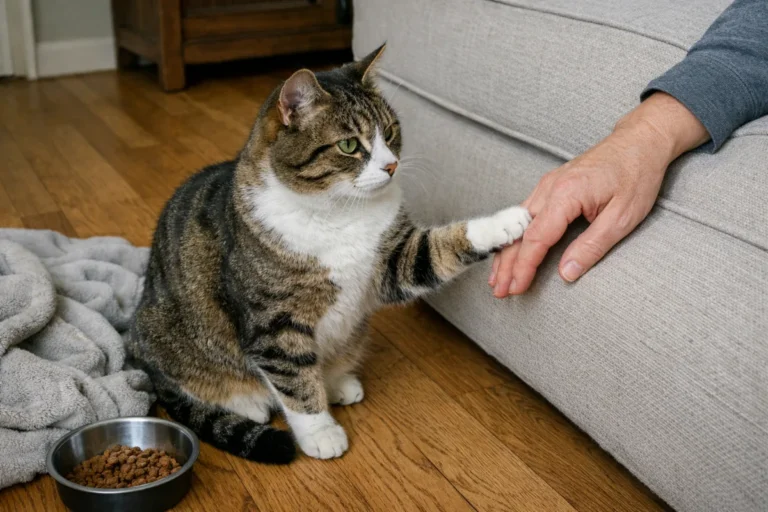
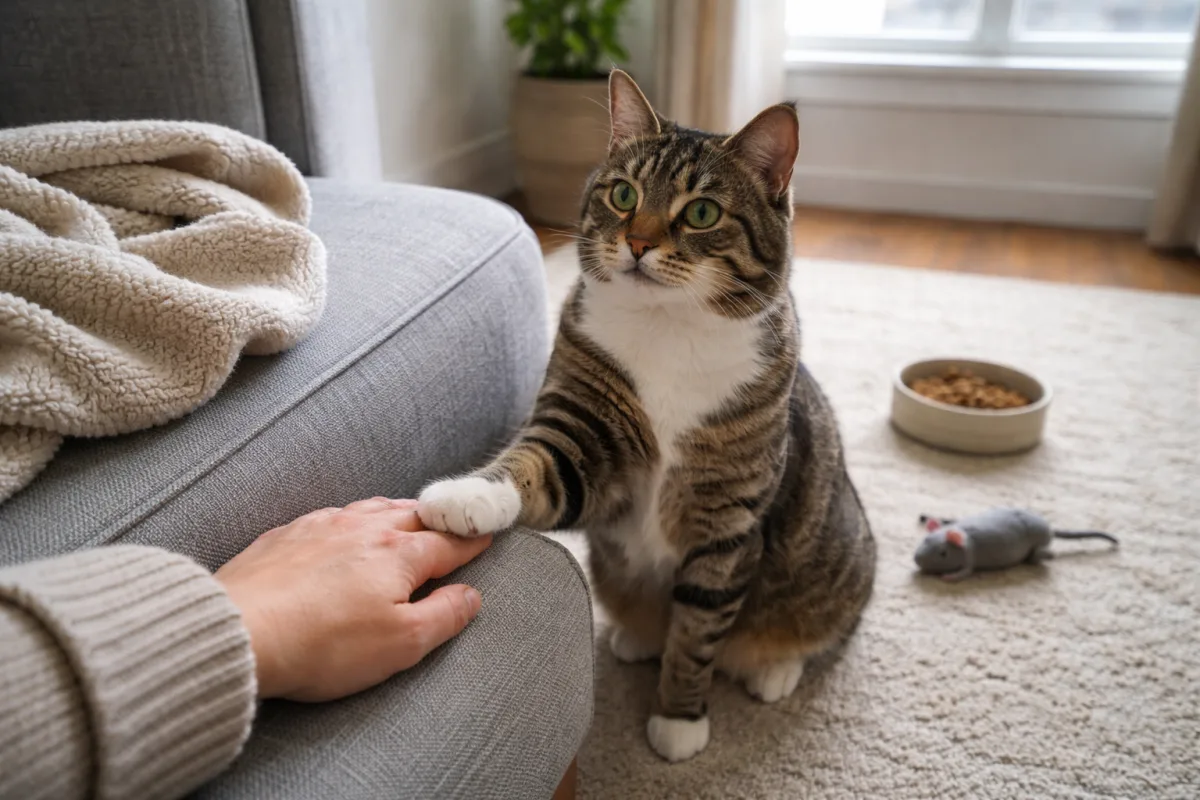
A cat may reach out with one paw while sitting beside you on the couch. It may tap your sleeve when you stop petting too soon. Some cats place a paw on your hand during quiet moments, almost as if they are holding you in place. Others will touch your face first thing in the morning, or pat your foot while you are walking past.
The behavior can happen in very different settings. A calm cat might use a soft paw to make contact and then settle right back down. A more active cat may tap repeatedly, especially if it wants play, food, or a response. A nervous cat may use a paw as a cautious test, touching briefly before deciding whether to stay close or move away.
That variety matters. The paw itself is only part of the message. Body language, timing, and pressure tell you much more than the tap alone.
Why cats use their paws to communicate
Cats rely heavily on physical contact because they do not communicate the way humans do. They cannot ask for attention in words, so they use posture, facial expression, scent, vocalizations, and touch. A paw touch is direct. It gets your attention fast.
In many cases, the behavior is linked to social contact. Cats often use gentle touch to connect with another cat or with a trusted human. It can resemble the way kittens knead or reach for their mother, though adult cats may use the gesture in a more practical, learned way. They quickly discover that a paw on your hand often gets a reaction.
That reaction becomes part of the pattern. If a cat touches you and you pet it, feed it, talk to it, or laugh and look back, the behavior is reinforced. Cats are observant. They remember what works.
A paw touch is often a cat’s way of starting a conversation, not ending one.
Affection and social bonding
One of the most common reasons cats touch people with a paw is simple affection. A cat that feels secure may use this kind of contact to stay connected while resting near you. It is a low-effort, low-risk way to maintain closeness. The cat does not have to climb into your lap or demand attention loudly.
In affectionate situations, the touch is usually soft and brief. The cat may purr, slow-blink, knead, or stay relaxed in the rest of its body. Ears are neutral or forward. The tail is still or moving lazily. The paw feels more like a point of contact than a demand.
Some cats are especially tactile and use their paws the way other cats use rubbing. They reach out to keep you within their comfort zone. It is a quiet form of social behavior, and it often appears when the cat feels safe enough to be vulnerable.
A request for attention
Cats learn quickly that a paw can work like a button. If they want petting, food, play, or a room door opened, a tap often gets faster results than waiting. That is why many cats start using this behavior at predictable times: before breakfast, during a work call, or when you are focused on your phone.
Attention-seeking paw touches usually repeat. One tap may become two, then three. The cat may combine the paw with meowing, staring, or positioning itself directly in your line of sight. If you keep ignoring it, the behavior can become more deliberate. The cat is not being rude in a human sense. It is using the best tool available.
How you respond can shape the pattern. If every paw touch leads to food, the cat may repeat it more often. If it leads to play, the cat may use it as an invitation. If it leads to nothing, the behavior may fade in some cats or become more persistent in others.
Curiosity and testing boundaries
A paw is also a useful investigative tool. Cats like to check objects before fully committing. They will tap a blanket, poke a bag, or touch your hand to see what happens next. This is part of how they examine the world. A paw touch can be a cautious first step rather than a social gesture.
This is especially common with new things. A cat may touch a visitor’s leg, a moving object, a dangling string, or even a new piece of furniture. The touch helps the cat gather information. Is this safe? Does it move? Will it make noise? Is it something to approach or avoid?
When curiosity is the main driver, the paw tends to appear with alert ears and a focused gaze. The cat may lean in, then pull back, then touch again. It is gathering data in small pieces.
Play behavior and hunting instinct
Many paw touches are playful. Cats are natural predators, and the paw is part of how they stalk, swipe, and capture. A light tap on your hand may be an invitation to play, especially if the cat is already energized. You may also see this near dangling strings, toy mice, or anything that moves unpredictably.
Playful pawing often has a different feel from affectionate pawing. It may come with quick movements, dilated pupils, an arched back, or a tail that swishes with interest. The cat may crouch, spring, retreat, and pounce again. Even a gentle cat can become more intense once the hunting instinct is activated.
Some cats use your hands as stand-ins for prey when they are under-stimulated or bored. That does not mean the cat is aggressive by default. It often means the cat needs a better outlet for energy.
Signs that the touch is calm, playful, or stressed
| Type of paw touch | Common body language | Likely meaning |
|---|---|---|
| Soft, brief tap | Relaxed body, neutral ears, slow blinking | Affection, mild attention-seeking, quiet contact |
| Repeated tapping | Focused stare, vocalizing, standing near you | Request for attention, food, or action |
| Quick swat without claws | Alert posture, energetic movement | Play, excitement, or testing limits |
| Stiff or sudden touch | Tense body, flattened ears, tail flicking | Stress, discomfort, or uncertainty |
These patterns are not absolute, but they help. The same paw can mean very different things depending on what the rest of the cat is doing. A relaxed cat touching you while purring is not sending the same signal as a cat that appears tense, frozen, or overstimulated.
It is worth paying attention to what happens right before and after the touch. Context often reveals the real reason.
How timing changes the meaning
When a cat touches you in the middle of petting, it may be asking for more. When it taps you after you stop interacting, it may be saying the session is not over. When it reaches out as you walk by, it may simply want connection. Timing can change everything.
Morning paw touches often mean routine. Cats are excellent at learning schedules. If a touch happens near mealtime, the cat may be reminding you of something important in its mind. If it happens during quiet evening hours, the cat may be seeking comfort or companionship after a day of low activity.
Some cats also use paw touches during transition moments. They reach out when you sit down, when guests arrive, or when the household gets noisy. In those moments, the behavior can act like a small anchor. It helps the cat stay connected to what is familiar.
Why some cats use their paws more than others
Not every cat touches people with a paw in the same way. Personality plays a major role. Some cats are naturally more physical and touch-oriented. Others prefer distance and may only use a paw when they have a strong reason.
Past experience matters too. A cat that learned touch gets a reward may use pawing more often. A cat that grew up around people may be more likely to reach out comfortably. Cats that are cautious by nature may use the behavior only in safe, familiar settings.
Breed tendencies, early socialization, and household routine can all shape how often the behavior appears. But even within the same home, two cats may use their paws very differently. One may tap constantly. Another may touch only during special moments. Both can be normal.
When paw touching is a sign of discomfort
Not every paw touch is friendly. Sometimes a cat uses its paw to create distance, block movement, or signal that it has had enough. A quick swat, especially if it comes with flattened ears or a twitching tail, can mean the cat is overstimulated or annoyed.
This happens often during petting. A cat may enjoy attention for a while, then suddenly decide it is too much. The paw touch can arrive before a bite or as a warning to back off. In that case, the cat is trying to communicate a limit before escalating.
If the paw touch feels stiff, abrupt, or paired with tension, treat it as a boundary, not an invitation.
Stress can also make a cat more likely to reach out with a paw in uncertain situations. New environments, loud noises, unfamiliar animals, or changes in routine can all make a cat more vigilant. The paw may be used to test, shield, or react.
How daily life shapes the behavior
Home environment has a strong influence on how often cats touch people with their paws. A quiet home with predictable routines may produce calm, intentional touches. A busy home with lots of movement may lead to more frequent tapping because the cat is trying to keep up with attention shifts.
Indoor cats often use paw touches in place of more varied environmental interactions. They have fewer chances to hunt, climb, or explore outside, so their contact with people may become a bigger part of daily stimulation. In active homes, a cat might learn to use the paw to interrupt work, ask for play, or remind you it is nearby.
Changes in routine can make the behavior more noticeable. A cat may start pawing more when meals are delayed, when someone is home more often, or when another pet changes the social balance. Small adjustments in the household can shape these habits quickly.
What owners often misunderstand
People sometimes assume a cat that touches them with a paw is always being loving. That can be true, but not always. Some paw touches are practical. Some are impatient. Some are playful, and some are clearly about limits.
Another common mistake is reading all repeated tapping as misbehavior. A cat that keeps reaching out is often trying to communicate more clearly, not acting out. The behavior may be asking for food, play, reassurance, or space. The better question is not whether the cat is “good” or “bad,” but what changed right before the paw came out.
It also helps to notice when the behavior stops. A cat that briefly taps you and then relaxes may have simply wanted acknowledgment. A cat that escalates into harder tapping is probably not getting what it needs, or it may be getting too much stimulation.
What the paw can reveal about the cat’s state
A single paw touch can say a lot about a cat’s emotional state if you look closely. Soft and slow usually points to comfort. Quick and repeated may point to urgency. A cautious touch can signal uncertainty. A firm swipe may mean irritation or a defensive response.
Look at the whole cat, not just the paw. Breathing, posture, tail position, ear movement, and eye shape all help explain the message. A cat with loose muscles and a relaxed face is sending a very different signal than one with a tight body and a fixed stare.
The behavior becomes easier to read once you start noticing patterns. Many cats use the same style of touch in similar situations. That consistency can tell you a lot about what the cat expects from the interaction.
Living with a cat that touches you often
For some cats, paw contact is simply part of their communication style. They may touch your hand while you work, your shoulder when you sit on the floor, or your arm when they want a little more closeness. Instead of trying to stop the behavior entirely, it helps to understand the pattern behind it.
If the touch is friendly, you can respond with calm petting, a quiet voice, or a short play session. If it is a demand for food at the wrong time, redirection may work better than reaction. If it is a boundary signal, giving space is the most respectful choice.
Over time, the paw touch becomes easier to interpret. The cat is not using a random habit. It is using a familiar method that has worked before, and it will usually keep using it as long as it gets a response that makes sense to it.
When cats touch you with a paw, they are often asking for attention, contact, or distance in the simplest way they know.
Reading the message without overthinking it
It is tempting to give every paw touch a big emotional meaning, but the truth is usually more practical. Cats use their paws because they are effective. The gesture can carry affection one day and frustration the next. The details matter more than the idea of a universal cat message.
Watch the rhythm of the touch. Watch what happens before it. Watch whether the cat stays, leaves, relaxes, or escalates. Those small clues help you understand whether the cat wants closeness, play, food, reassurance, or a pause.
Once you start reading those signals in context, the behavior becomes clearer. A cat that touches you with a paw is rarely being random. It is interacting on its own terms, in a language that is quiet but very intentional.