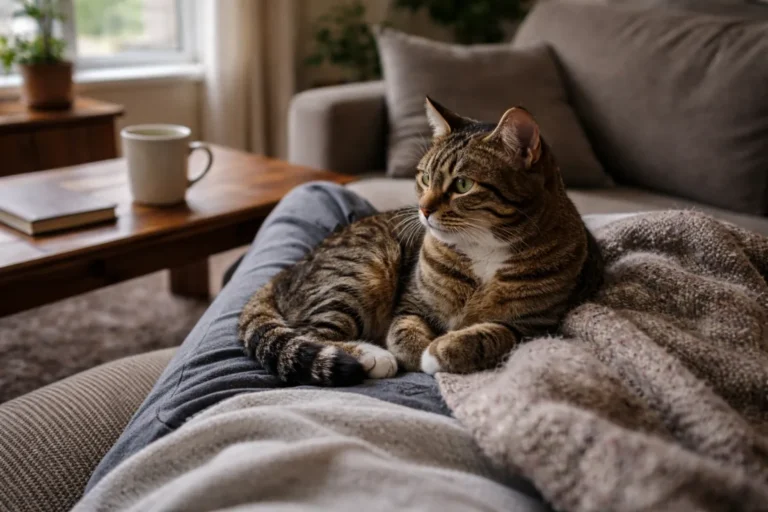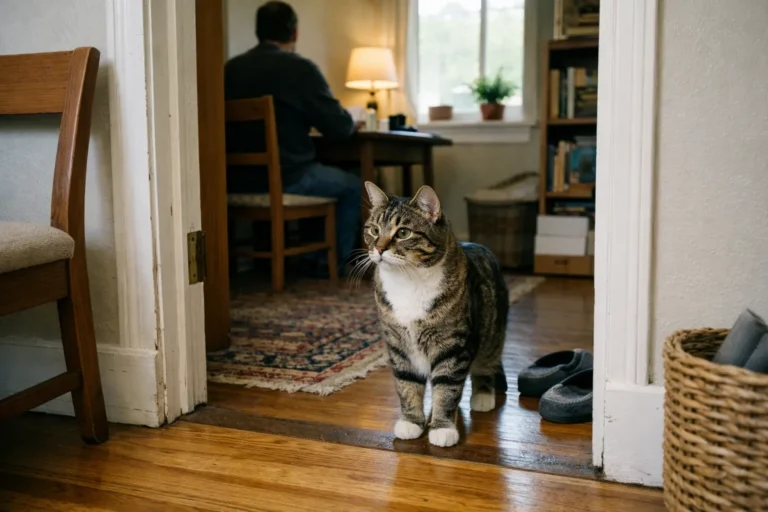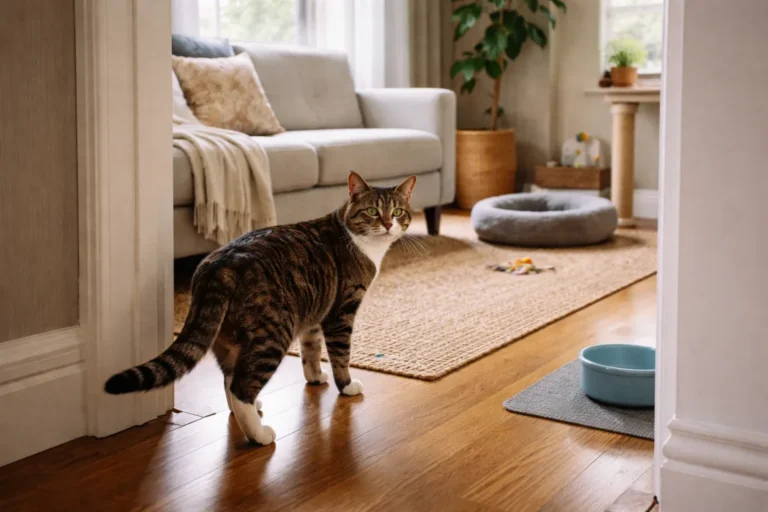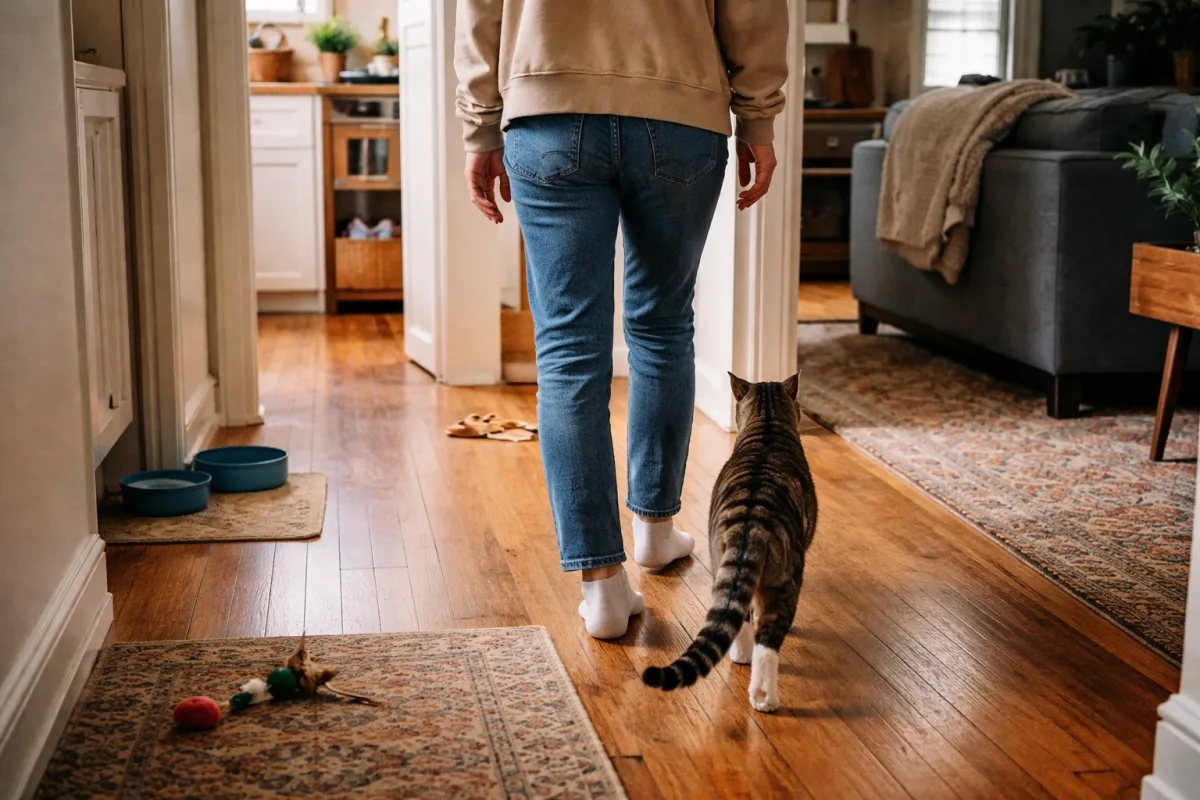
It can feel a little funny at first. You stand up to get a glass of water, and your cat gets up too. You go to the bedroom, and there they are. Later, you move to the kitchen, and the same bright eyes are watching from just a few feet away.
This kind of following is one of the most familiar cat behaviors in a home. It can look affectionate, curious, demanding, or simply odd. In most cases, it is not random at all. Cats are highly observant animals, and your movement often gives them information they care about.
Sometimes they want attention. Sometimes they are tracking routine. Sometimes they are checking for safety, food, warmth, or a chance to interact. The behavior can mean different things depending on the cat, the home, and the moment.
What matters most is the pattern. A cat that calmly trails you from room to room is usually communicating something consistent, even if it is subtle. The details of when, how, and how often they follow you can tell you a lot about what is going on.
Why This Behavior Shows Up So Often
Following movement is tied to several natural cat traits at once. Cats are alert hunters, careful observers, and creatures of habit. In a house, those instincts do not disappear. They just show up in quieter ways.
Your movements are often the most interesting event in the room. A cat notices when you stand, walk, open a cabinet, or head toward a certain area. That movement can signal food, play, a change in environment, or simply a social opportunity. To a cat, that is worth tracking.
Many cats also form strong associations with their people. If you usually feed them, open doors, play at certain times, or settle in predictable places, they learn to keep tabs on you. They are not just being nosy. They are collecting patterns.
When a cat follows you, the behavior often reflects a mix of curiosity, routine, social bonding, and environmental awareness.
What It Looks Like in Everyday Life
Following can be obvious or very subtle. Some cats stay glued to your heels and weave around your legs as you move through the house. Others simply appear in the next room a moment after you do. A few keep a careful distance but remain in sight.
Common examples include a cat leaving the couch when you get up, waiting outside the bathroom door, or pacing between rooms when you are doing chores. Some cats sit in doorways and watch. Others quietly shadow you from the hallway, then settle again once you stop moving.
There is also a difference between targeted following and general interest. A cat that only follows you at feeding time is probably responding to routine and expectation. A cat that tracks you throughout the day may be seeking companionship, security, or stimulation.
Typical moments when cats follow
- When you enter the kitchen
- When you walk toward the bedroom or bathroom
- When you stand up after sitting for a while
- When you are preparing food
- When the house becomes quiet
- When the cat is bored and looking for interaction
Curiosity Is a Major Driver
Cats are small investigators. Movement catches their attention because movement usually means something is changing. A cat does not need to know exactly what you are doing to decide it is worth checking out.
This is especially true in indoor homes, where your cat’s world is limited compared with the outside environment. If the room is quiet, your steps become the main source of novelty. The sound of a drawer opening, a bag crinkling, or a faucet turning on can be enough to pull them in.
Curiosity is not just about food or play. Some cats follow simply because they want to know what happens next. They notice routines, then test them by staying close.
A cat’s following behavior often starts with simple curiosity, especially in homes where daily activity is predictable and easy to track.
Routine and Prediction Matter More Than People Realize
Cats are extremely good at learning what comes next. If your movement often leads to something rewarding, the habit strengthens. That reward does not have to be a treat. It can be attention, a warm lap, a opened window, a play session, or the sound of dinner being prepared.
Many cats begin following because they have learned that certain actions are connected to certain outcomes. If you walk to the closet and then grab the laser toy, your cat remembers. If you head to the pantry and food appears, that association gets stronger. The cat is watching for clues.
Even if nothing happens every time, the pattern may still hold. Cats often prefer to stay near the source of possible good things rather than risk missing them. That is part caution, part habit, and part efficiency.
Routine triggers that make following more likely
- Feeding times
- Evening wind-down routines
- Morning bathroom or kitchen trips
- Work-from-home movement around the house
- Times when the cat has learned to expect play or petting
Bonding and Social Attention
Some cats follow because they genuinely want to be near their person. Cats are often described as independent, but that does not mean they are detached. Many cats are social in a quiet, selective way. They choose closeness carefully, and they often show it through presence rather than obvious affection.
Following you from room to room can be one of those forms of closeness. The cat may not want to sit in your lap or be held. They may just want to remain within a few steps of you. That distance still counts as connection.
This behavior is especially common in cats that spend a lot of time indoors with one person or one small household. If you are their main source of social interaction, they may naturally orient toward your movements. Your activity becomes part of their daily social map.
Body language helps clarify the mood. A relaxed tail, soft eyes, loose posture, and unhurried steps usually point to comfort. A cat that follows with those signals is often simply enjoying the company.
Security and Watching the Environment
Not every cat follows because they want interaction. Some cats follow because your movement makes them feel safer. In a home, people often act as anchors. The cat may prefer to stay near you because your presence makes the environment feel more predictable.
This is common in cats that are cautious, newly adopted, or sensitive to change. A cat may shadow you when guests are present, when household noise is high, or when the routine has shifted. They are not necessarily anxious in a serious sense, but they may be seeking reassurance.
Following can also be a way of monitoring the territory. Cats like to know where everyone and everything is. If you are moving around, the cat may be keeping track of the household flow. That helps them feel in control of their surroundings.
When a cat follows more closely during stress, noise, or change, the behavior may be about reassurance rather than attention-seeking.
Food, Resource Tracking, and Practical Expectations
Sometimes the explanation is wonderfully simple: the cat thinks you might be useful. Food is a powerful motivator. If you often walk toward the kitchen around feeding time, or if you have a history of dropping snacks, your cat will notice.
Resource tracking goes beyond meals. Cats also pay attention to water changes, litter box cleaning, access to windows, and opening doors to favored areas. If they follow you to a cabinet or room where something useful tends to happen, that behavior becomes more frequent.
This is why following often intensifies at certain times of day. A cat may not trail you all morning, then suddenly become attached at dinner time. That is not necessarily about affection, though affection can be part of it. It may simply be about expectation.
Common resource-related motivations
- Anticipating meals or treats
- Waiting for a fresh water bowl
- Wanting access to a favorite room or window
- Expecting play after your workday ends
- Checking whether a closed door will open
Boredom Can Make Movement More Interesting
Cats that do not have enough stimulation often become deeply interested in their human’s movement. If the house is quiet and nothing else is happening, following you may be the most engaging activity available. Your changing location becomes a kind of moving event.
This is especially noticeable in indoor cats with limited play or environmental variety. A cat may follow more when toys are ignored, windows are covered, or the day has been especially slow. Movement gives them something to do, even if it is just watching.
In these situations, following may be paired with other signs of restlessness. The cat might meow, paw at closed doors, sit near the place you just left, or circle between rooms. They may not be distressed. They may simply be looking for something interesting to happen.
Age and Personality Shape the Habit
Kittens often follow for playful reasons. They are learning the home, learning people, and learning what every sound means. Everything is new, and your movement is part of the game. A kitten may dart after your feet, hop ahead of you, or pop into a room right after you.
Adult cats tend to be more selective. Some become calmer and more deliberate about how they follow. Others keep the same curious habit but do it with less visible excitement. Older cats may still trail their people, especially if they are bonded closely or if they want to stay near familiar routines.
Personality matters a great deal. A bold, social cat is more likely to shadow you openly. A reserved cat may follow at a distance or only during specific parts of the day. Neither version is better. They are simply different ways of expressing interest.
How age can change the pattern
| Life stage | Common following pattern |
|---|---|
| Kitten | Playful, frequent, fast, and curious |
| Adult | More routine-based and purpose-driven |
| Senior | Closer to favorite people, often slower and quieter |
When Following Becomes Intense
There is a difference between a cat who accompanies you and a cat who seems unable to let you move alone. Intensity matters. A cat that follows with relaxed body language is different from one that appears tense, vocal, or overly focused on keeping you in sight.
Strong following can show up during life changes, schedule shifts, visitors, moving furniture, or periods of uncertainty. It can also happen when a cat is seeking more stimulation than usual. The behavior itself is not automatically a problem, but the context matters.
Watch for details like pacing, loud meowing, clingy behavior that is new for the cat, or sudden shadowing that seems out of character. Those signs do not always mean trouble, but they are worth noticing. The cat may be signaling discomfort, not just interest.
Sudden changes in following behavior are often more important than the behavior itself. A new pattern can point to stress, boredom, or a change in routine.
Soft Signals Versus Strong Signals
The same action can mean very different things depending on how it is done. A cat that quietly strolls after you with a relaxed posture is giving a soft signal. A cat that speeds ahead, vocalizes, and stays tightly attached is giving a stronger one.
Soft signals often include loose tail movement, calm blinking, and stopping nearby instead of directly underfoot. Stronger signals may involve rubbing against your legs, repeated meowing, blocking your path, or following even after you settle down. Those stronger signals can still be normal, but they deserve more attention.
It helps to look at the whole picture. One behavior rarely tells the full story. The cat’s ears, tail, pace, and timing all add context. A cat that follows at breakfast and then naps peacefully is not the same as a cat that follows, vocalizes, and seems unable to relax.
How Home Environment Changes the Pattern
The same cat may follow more in one home than in another. A small apartment can make movement more noticeable because there are fewer places to disappear. An active household can make the cat more alert and more interested in keeping track of everyone. A quiet home may make your steps stand out even more.
Indoor-only cats often display this behavior more often than cats with outdoor access, simply because they rely more on what happens inside. Their social world, entertainment, and routine are concentrated in a smaller space. That makes your movement a central part of their day.
Homes with predictable schedules can also create stronger following patterns. Cats quickly learn when breakfast starts, when work ends, and where people tend to gather. The more consistent the house, the easier it is for them to follow with purpose.
What the Behavior May Be Telling You
There is no single message behind every cat that follows its person. The meaning depends on timing and context. A cat following you at the kitchen entrance may be focused on food. The same cat following you to the bedroom may be seeking comfort or company.
Here are some practical ways to read the behavior:
- If it happens around meals, expect food-related anticipation.
- If it happens when the house is noisy, think reassurance.
- If it happens during quiet afternoons, boredom may be part of it.
- If it happens with relaxed body language, social closeness is likely.
- If it happens suddenly and intensely, look for a change in routine or environment.
That kind of reading is usually more useful than trying to force one explanation. Cats are flexible, and so are their reasons. A single cat may follow for different reasons at different times of day.
How Owners Often Misread It
People sometimes assume following always means a cat is needy or spoiled. That is too simple. In many homes, it is actually a normal blend of habit, observation, and social interest. The cat is not asking for constant attention every time they move after you.
Others assume the cat is guarding them, but that is not always the right lens either. Most of the time, the behavior is less dramatic than it appears. The cat is simply staying aware of a significant part of their world.
The most useful approach is to notice whether the following feels relaxed, routine-based, or reactive. Once you separate those possibilities, the behavior becomes much easier to understand. And often, a cat that follows a lot is also a cat that wants to be included in the household rhythm.
A Calm Ending to Read the Pattern
When a cat follows your movements around the house, they are usually responding to something familiar, useful, or reassuring. Sometimes they are tracking food. Sometimes they are collecting information. Sometimes they want closeness without demanding much else.
The behavior becomes clearer when you pay attention to timing, body language, and changes in the home. A cat that follows softly and consistently is often just doing what cats do best: observing, adapting, and staying close to what matters to them.
That quiet companionship can look different from one cat to the next. But the pattern itself usually says the same thing in a hundred small ways: you are part of their map of the house, and they are paying attention to where you go next.