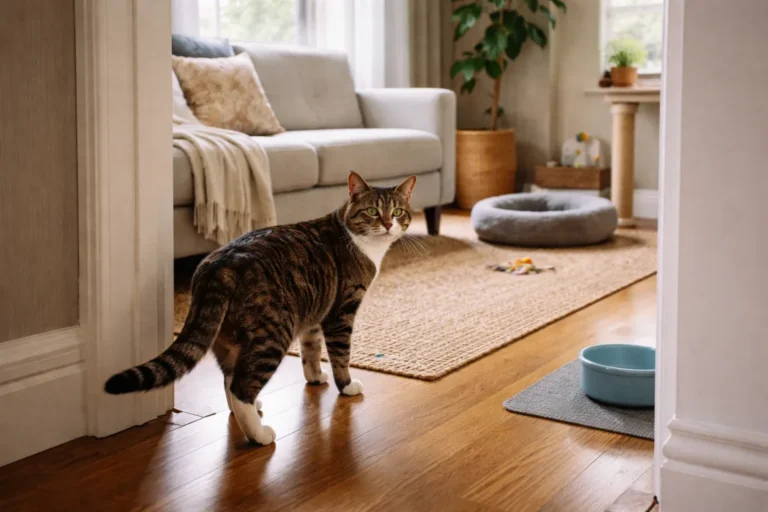
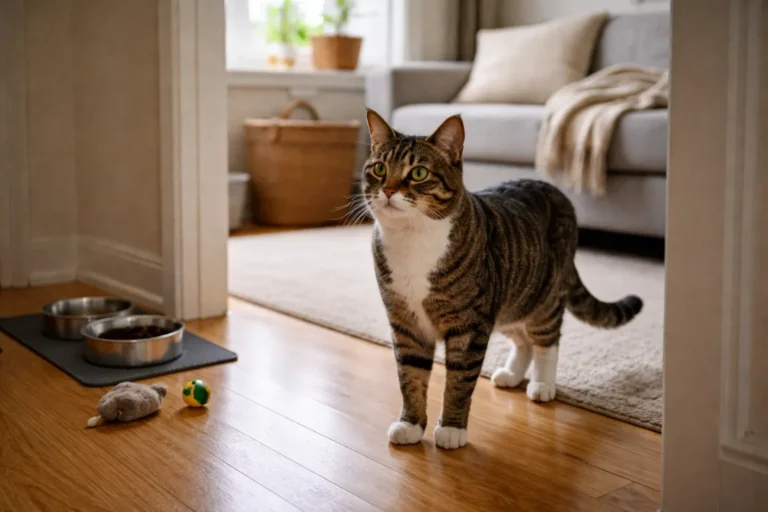
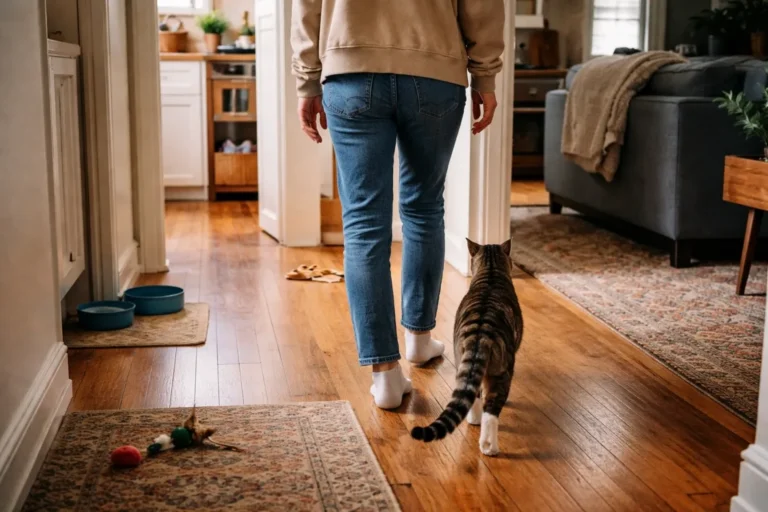
A cat that walks straight across your keyboard, plants itself on your book, or wedges its body between you and whatever has your attention is not being random. The timing often looks almost strategic. You finally settle into work, a call, or a meal, and suddenly the cat appears with a tail in your face and a firm refusal to be ignored.
This kind of interruption can feel funny one minute and exhausting the next. It can also mean different things depending on the cat, the moment, and the household rhythm. Some cats interrupt because they want contact. Others do it because they are bored, alert, restless, or highly tuned in to your routines.
What matters is not just the act itself, but the pattern around it. A cat that interrupts while staying relaxed is telling a different story from a cat that paces, vocalizes, or inserts itself with urgency. The same behavior can be playful, practical, needy, or stress-related.
What Cat Interrupting Looks Like in Everyday Life
In most homes, interruption is not one behavior but a cluster of small actions. A cat may sit on your laptop, tap your hand while you type, nudge a phone away, jump onto a book, or start walking across the room every time you shift your attention elsewhere. Sometimes the interruption is quiet. Sometimes it is impossible to miss.
It often happens at predictable times. Cats may interrupt when you are using a device, reading, talking on the phone, or focusing on a task that leaves your hands still. They may also appear the moment you get up from a chair, open a cabinet, or settle into bed. These timing patterns are part of the message.
Common forms of interruption
- Sitting on the object that has your attention
- Placing a paw on your arm or hand
- Walking across your workspace repeatedly
- Head-butting your face or shoulder
- Meowing until you respond
- Dropping toys near you at inconvenient moments
- Lying between you and the thing you are doing
Some interruptions are brief and gentle. The cat tests your attention, gets a response, and moves on. Others become persistent. The cat may escalate from touch to vocalizing to physical obstruction if the first attempt does not work. That escalation often reveals how important the moment feels to the cat.
Interruption is rarely just about inconvenience. It is usually a cat’s way of changing the situation so your attention, movement, or energy shifts in its favor.
Why Cats Show This Behavior in General
Cats are observant animals. They notice routines, body language, sound patterns, and the small changes that signal whether a person is available. If your cat interrupts your activity often, it may simply be responding to that awareness. You are not just a person in the room. You are part of the environment the cat has learned to navigate.
Many cats also dislike being outside the center of the action for too long. Even independent cats track what their people are doing. A cat may not want constant handling, but it still wants access. Interruption can be a way of saying, “I see what you are doing, and I would like to be included.”
There is also a practical side. Cats learn quickly which behaviors work. If stepping on a keyboard reliably gets your hand to reach for a pet, the cat remembers. If meowing interrupts your concentration and makes you look up, that becomes useful too. Behavior that gets results tends to repeat.
What the Behavior May Signal About the Cat’s State
The same interruption can come from several internal states. One cat interrupts because it is socially engaged. Another does it because it is under-stimulated. Another may be asking for reassurance. The body language and timing around the interruption help separate these possibilities.
Relaxed attention-seeking
A relaxed cat usually interrupts with a soft body, loose tail movement, and no signs of tension. It may jump onto your lap, place its chin on your notebook, or rest a paw on your wrist. This often means the cat wants contact, not control. The goal is connection.
Boredom or under-stimulation
When a cat has too little to do, your activity becomes a target. The interruption may be repetitive and slightly chaotic. The cat circles your seat, taps objects, or creates movement whenever you become still. It may also seem more energetic at certain times of day, especially when household activity is low.
Need for reassurance or closeness
Some cats interrupt more when the environment changes. Visitors, schedule shifts, moving furniture, loud noise, or tension in the home can all affect the way a cat seeks contact. The cat may stay close, follow you from room to room, and interrupt your task in a quieter, more clingy way than usual.
Overstimulation or frustration
Not all interruptions are gentle. A cat that is frustrated may move quickly, vocalize sharply, or physically insert itself in a more forceful way. It may seem as though the cat is demanding access, but the root issue can be pent-up energy, altered routine, or a strong preference for predictable attention.
When the interruption becomes sharper, more repetitive, or harder to redirect, it is often worth looking at the cat’s overall routine before assuming it is simply being difficult.
How Context and Environment Influence It
The environment matters a great deal. A cat living in a quiet apartment with limited climbing space may interrupt more often than one with more room, more windows, or more scheduled play. But even in a rich environment, some cats still choose people over toys. The difference is usually how often the behavior appears and how intense it becomes.
Indoor cats are especially likely to interact with human activity because that activity is a major source of stimulation. If you are the most interesting moving thing in the house, you become the center of the cat’s attention. That can be charming at first and disruptive later if the cat has no other outlet.
Household rhythm also shapes the pattern. Cats learn when meals happen, when people leave, when laptops open, and when the home quiets down. Many interruptions happen right before a routine event. The cat may start nudging you minutes before dinner time or step onto your desk when it senses your attention is about to shift away from the room.
Environmental factors that often increase interruption
- Long stretches with no play or interaction
- Highly predictable routines the cat can anticipate
- Limited window access or climbing options
- Noise, visitors, or household tension
- Working from home without enough structured breaks
- Meals or treats arriving at inconsistent times
In a busy home, interruption can become a form of survival strategy. The cat learns that if it wants attention, it must compete with phones, screens, tasks, and other people. In a quieter home, the same cat may interrupt less because it does not need to work as hard to be noticed.
How Different Activities Trigger Different Types of Interruption
Not every human activity provokes the same response. Cats often interrupt tasks that involve your stillness, your hands, or your focus. A cat may ignore you while you tidy the kitchen, then immediately jump onto your laptop once you sit down. To the cat, the difference is not subtle.
| Human activity | Common cat response | Possible meaning |
|---|---|---|
| Typing or working | Sitting on keyboard, pawing hands | Attention seeking, boredom, need for access |
| Reading | Lying on the book, nudging pages | Desire for proximity, interruption of stillness |
| Phone calls | Meowing nearby, climbing into lap | Trying to become the focus of your attention |
| Meal prep | Rubbing legs, jumping onto counters | Food association, anticipation, routine learning |
| Relaxing on the couch | Plopping down on you or between you and the screen | Seeking closeness, reclaiming attention |
Some cats also interrupt motion more than stillness. A cat may suddenly sprint in front of you when you stand up, block your path to the door, or weave around your ankles at the exact moment you are trying to move. This is often not aggression. It is an effort to influence the direction of the moment.
How Owners Often Read the Behavior vs What It May Actually Mean
It is easy to interpret interruption as “my cat is being rude” or “my cat wants to control me.” Those reactions are understandable, but they usually miss the simpler explanation. Most cats are not trying to be disruptive for its own sake. They are trying to achieve something specific, whether that is touch, play, food, warmth, or reassurance.
Sometimes the cat is asking for an interaction that has been delayed too long. Sometimes it has simply learned that interrupting is the fastest route to getting noticed. The behavior may look demanding, but the motive is often practical from the cat’s point of view.
A cat that interrupts your activity is usually communicating one of three things: “notice me,” “include me,” or “change what you are doing.”
That does not mean every interruption should be answered immediately. It only means the behavior is more informative than it first appears. If you understand what the cat may be trying to achieve, you can respond without rewarding every interruption in the same way.
The Difference Between Playful, Neutral, and Stress-Related Interruptions
Cat interruption is not one single category. The tone of the behavior matters. A playful interruption often feels light and social. A neutral one may simply be a cat checking in. A stress-related one usually carries a stronger edge and appears more often when the cat’s environment or routine has changed.
Playful interruption
Playful interruptions often involve quick movement, toy dropping, or gentle paw taps. The cat may look bright-eyed and ready to engage. It may interrupt a task and then immediately redirect toward a game if offered one. These cats are usually easier to satisfy because the underlying need is movement and interaction.
Neutral interruption
A neutral interruption is quiet and matter-of-fact. The cat may walk across the page, settle on your lap, or place its body where your attention lands. There is no strong demand behind it. The cat simply wants to be part of the space you are occupying.
Stress-related interruption
Stress-related interruption is more intense. The cat may be restless, vocal, and hard to settle. It may interrupt repeatedly without seeming satisfied by attention. In these cases, the behavior is often paired with other signs such as hiding, clinginess, changes in appetite, or increased startle response. The interruption is only one piece of the larger picture.
Body Language That Helps Explain the Moment
Looking at posture can make the behavior easier to read. A cat’s tail, ears, whiskers, and overall muscle tone often reveal whether the interruption is social, playful, or tense. The movement usually tells you more than the object being interrupted.
Signs of relaxed interruption
- Soft eyes
- Loose body posture
- Tail held naturally
- Gentle rubbing or brief contact
- Easy redirection to another spot
Signs of heightened interruption
- Rapid vocalizing
- Restless pacing
- Stiff body or tight movements
- Repeated return to the same spot
- Difficulty settling after being acknowledged
A cat may also combine signals. It can seem affectionate while also persistent. It can purr and knead while still preventing you from continuing your task. Mixed signals are common because cats often want closeness on their own terms, at their own pace, and in the middle of whatever you happen to be doing.
How Daily Routine Shapes the Pattern Over Time
Many cats build strong expectations around the household schedule. If interruption happens every evening while you make dinner, that moment becomes part of the cat’s mental map of the day. If your work hours shift, the cat may become more insistent because the old pattern no longer fits the new one.
Routine can make the behavior feel more predictable, which is useful. It also means the cat may start interrupting earlier and earlier to secure the same outcome. A cat that used to wait for your lap may eventually begin sitting on your book before you even sit down. That is learned behavior, not coincidence.
Some cats are more flexible than others. A flexible cat may adjust quickly when your schedule changes. A less flexible cat may show more interruptions during transitions, then settle once the new rhythm becomes familiar. Either way, the behavior often reflects how strongly the cat depends on routine to understand the day.
When the Behavior Becomes More Noticeable
Interruption often becomes more obvious during periods of reduced interaction. People working from home, long weekends indoors, rainy days, and illness can all change the dynamic. When the cat’s normal outlets shrink, your activity becomes more attractive.
It can also become more noticeable in multi-cat homes where access feels competitive. One cat may interrupt simply to secure a place near you before another cat gets there. In those settings, the behavior is partly social and partly strategic.
Age can matter too. Kittens interrupt because they are curious, energetic, and still learning what gets attention. Adult cats may interrupt out of habit, social need, or boredom. Older cats sometimes interrupt because they are more attached to predictable closeness or because changes in hearing, vision, or energy make human presence especially important.
Long-Term Patterns and What They Suggest
A stable pattern usually means the cat has found a reliable way to participate in your routine. If the behavior has remained consistent for months or years and the cat otherwise seems comfortable, it may simply be one of its social habits. Some cats are frequent interrupters by nature.
A changing pattern is more important to watch. If interruption suddenly increases, becomes intense, or comes with other behavior changes, the cat may be reacting to something new. That could be a routine disruption, household stress, pain, boredom, or a shift in social dynamics. The interruption itself is not the whole story.
What matters most is not how often a cat interrupts once in a while, but whether the pattern is steady, escalating, or paired with other changes in behavior.
Even in cats that have always been attention-driven, the tone can shift. A cat that used to gently sit nearby may start demanding access to your lap with urgency. A cat that only interrupted work sessions may begin interrupting sleep. Those changes deserve attention because they often reflect changing needs rather than personality alone.
Reading the Behavior Without Overreacting
It helps to respond to interruption without making it bigger than it is. A calm acknowledgment, a brief pause, or a shift to a more acceptable form of attention can go a long way. If the cat wants contact, a few minutes of focused petting may satisfy it better than allowing constant low-level interruptions throughout the day.
At the same time, not every interruption should automatically lead to direct attention. Cats are quick learners. If every keyboard walk results in a snack, the behavior may grow stronger. If every brief interruption is ignored but the cat gets regular play and interaction at other times, the habit may become less urgent.
The most useful question is not “How do I stop my cat from interrupting?” but “What is my cat trying to get from this moment?” Once that answer is clearer, the pattern usually becomes easier to live with.
A Calm Closing Thought
A cat interrupting your activity is often a small act with a clear purpose. It can mean affection, boredom, anticipation, or a request to shift attention away from your task and back to the cat. The exact reason depends on the cat’s mood, body language, routine, and environment.
When you start noticing the timing and shape of the behavior, it becomes easier to tell the difference between a casual check-in and a cat that is genuinely asking for more from the day. That distinction matters. It turns an inconvenient moment into useful information, and it gives the interaction a clearer place in daily life with a cat.