A cat answering your voice can feel ordinary one day and surprising the next. Sometimes it is a soft chirp from the hallway. Sometimes it is a full-bodied meow from another room, as if your cat has been listening for your exact tone and decided to reply on cue.
That response is not random. Cats often connect human voices with routines, attention, food, comfort, or simple curiosity. The meaning changes with the cat, the situation, and even the sound of your voice. A cat that answers back may be social, alert, bored, hungry, or trying to keep track of where you are.
What matters most is not just that the cat responds, but how. The volume, timing, body language, and setting all shape the message. One cat may answer softly while staying relaxed. Another may react sharply, with a tense tail or wide eyes, because the voice means something different in that moment.
What Cats Are Often Doing When They Respond to a Voice
A vocal response is usually part of a larger interaction. Cats rarely “talk” for no reason at all. They tend to use sound when they want contact, information, or a result. Your voice can become a cue that starts that exchange.
In many homes, a cat learns that a certain tone means dinner, playtime, or the return of a person. Over time, the cat may answer because the sound itself has meaning. The response can be simple recognition rather than a demand.
Common everyday moments
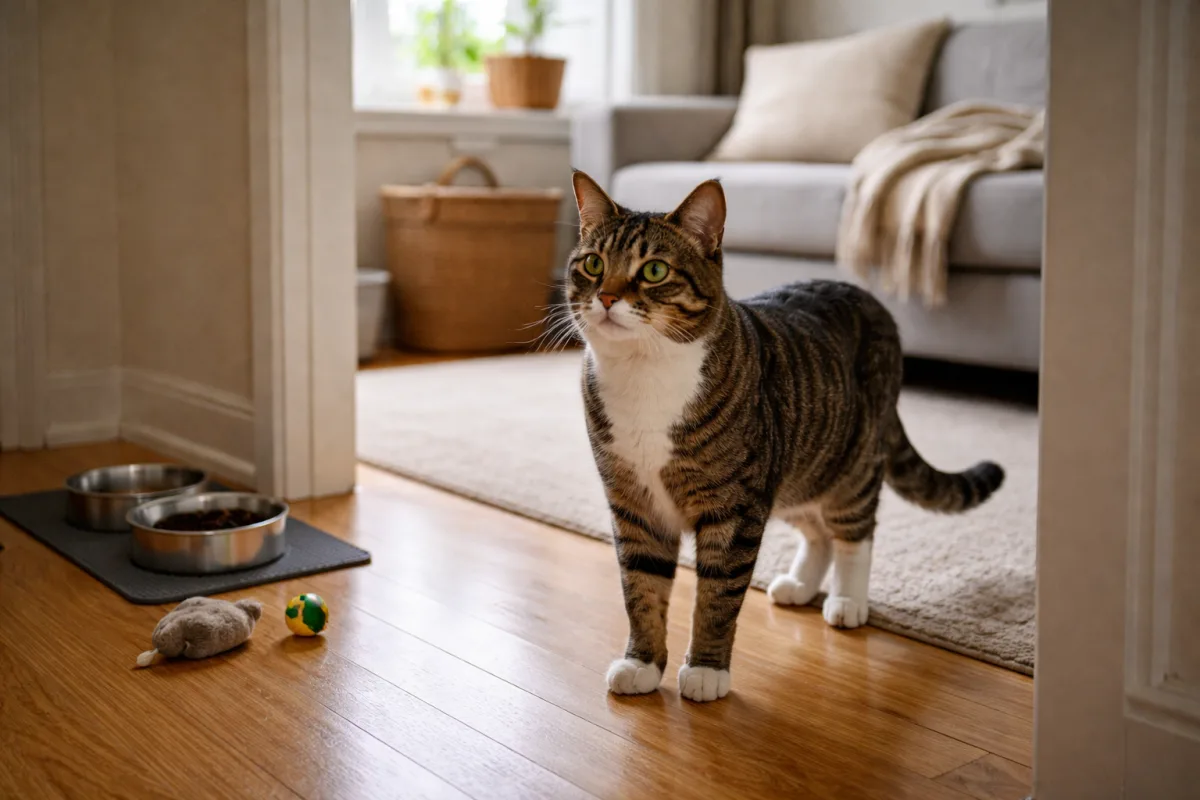
- You call your cat’s name and hear a meow from the next room.
- You speak softly, and the cat chirps back while walking toward you.
- You talk to someone else, and your cat interrupts with a short vocal reply.
- You ask a question, and the cat answers with a meow, trill, or purr-like sound.
- You speak near feeding time, and the cat becomes much more vocal.
These moments often look small, but they are full of information. A cat may be checking whether you are available. It may also be confirming that a familiar routine is about to happen.
When a cat responds to your voice, the sound itself is only part of the message. Posture, proximity, and timing often tell you more than the meow alone.
Why Cats React to Human Voices in General
Cats do not hear human voices the way people hear them. They notice pattern, tone, intensity, and timing. A cat can learn that your voice predicts specific events. That is one reason a cat may respond more strongly to one person than another.
Voice is also part of the cat’s social world. Even independent cats pay close attention to repeated sounds in their environment. A familiar human voice can become a stable signal in a busy household, especially if the cat relies on that voice to understand what happens next.
Some cats are naturally more verbal. Others are quiet but still responsive. A silent cat may still look up, come closer, or twitch an ear when you speak. The response does not have to be loud to be meaningful.
What the cat may be noticing
- Tone: warm, sharp, high, low, or urgent
- Familiarity: a household voice versus a stranger’s voice
- Routine: whether the voice usually appears before food, petting, or movement
- Distance: whether the sound is near, far, or approaching
- Emotion: whether the voice sounds calm, excited, tense, or playful
Cats are highly sensitive to tone. They may not understand words, but they often understand the emotional shape of speech. A cat can tell the difference between a relaxed greeting and a clipped call from across the room.
Different Ways a Cat May Answer You
Not every response looks the same. Some cats answer with a single meow. Others use a chirp, trill, or a sequence of short sounds. A few cats barely vocalize at all, but still respond by moving closer or turning their head.
The form of the response often reflects the cat’s mood and the context. A bright, quick chirp can look friendly and interested. A longer meow may suggest anticipation. A short, flat sound can be a low-key acknowledgment. If the cat’s body seems tense, the voice may not be as welcoming as it sounds.
Soft responses
Soft responses usually happen when the cat feels comfortable. The cat may stay relaxed, with loose muscles, a neutral tail, and ears pointed toward you. A gentle trill or quiet meow often means the cat is open to interaction.
This type of response is common in cats that are bonded to their people. It can also appear when a cat is resting but still wants to stay connected. The cat may not be asking for much. Sometimes it is just saying, “I hear you.”
Strong or intense responses
More intense vocalizing can mean the cat wants something specific or feels strongly about the moment. Hunger is a common reason. So is frustration, especially if the cat wants access to a room, a toy, or a person.
If the sound is loud, repetitive, or urgent, look at the whole picture. Is the cat pacing? Staring at the pantry? Following you tightly? The vocal response may be part of a demand rather than a simple greeting.
Quiet nonverbal answers
Some cats answer without much sound at all. They may blink, swivel their ears, lift their head, or walk toward you. This is still a response. In fact, for many cats it is the more natural one.
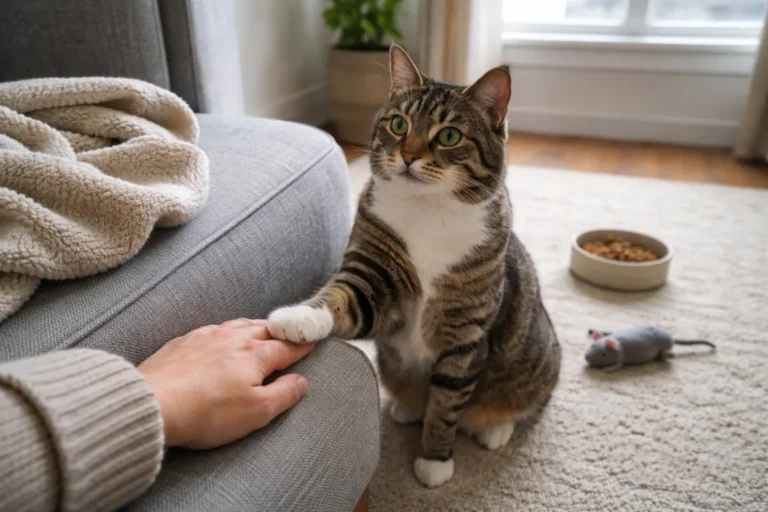
A cat that keeps eye contact and approaches calmly may be saying the same thing as a meow: I know you are there, and I am engaged.
What the Behavior May Signal About the Cat’s State
The meaning behind a cat’s answer depends heavily on emotional state. A voice response can point to affection, curiosity, anticipation, or stress. The same meow can mean different things on different days.
A calm response usually looks unhurried and balanced. A stressed response often comes with tension, restlessness, or a need to keep moving.
When a cat sounds relaxed, the response may reflect social interest. When the cat sounds sharp or unsettled, the response may reveal discomfort. Paying attention to the rest of the cat’s behavior helps separate simple communication from a sign that something is off.
Affection and social engagement
A cat that answers you in a soft, easy way may be reaching out socially. Some cats use their voices to stay connected to a person they trust. This is especially common in cats that follow their owners from room to room or settle nearby while they work.
These cats often respond to voice because your presence matters to them. They may not want direct handling. They may simply want shared space, sound, and attention.
Curiosity and orientation
Some responses are really about information. The cat hears your voice and wants to know what is happening. Where are you? Are you moving? Is food coming? Is play about to start? The reply may be a way of keeping track of the environment.
This kind of response often appears in cats that are observant and alert. They may not be clingy, but they are very tuned in.
Hunger or anticipation
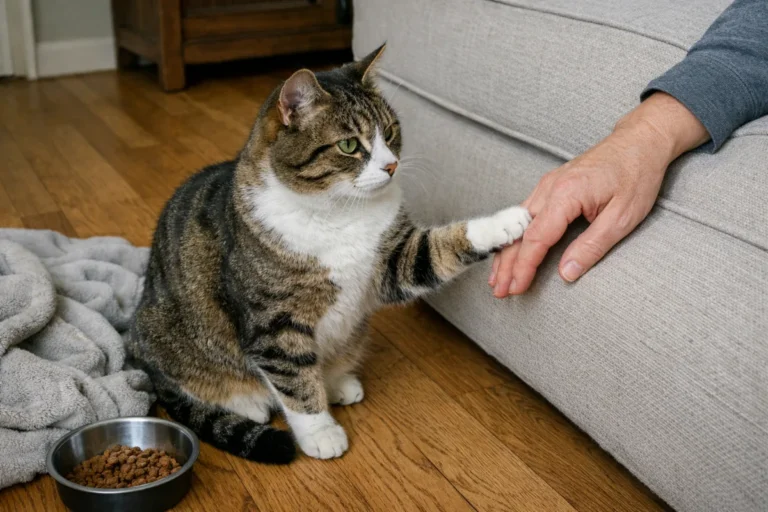
Many cats become more vocal around food-related routines. If your voice appears near meal time, the cat may answer because it expects something. The response may start before the bowl is even out of sight.
In this case, the cat is not necessarily being demanding in a negative sense. It is using a learned pattern. Your voice has become part of the feeding signal.
Stress or uncertainty
Sometimes a cat answers because it is uneasy. That response may be louder, shorter, or repeated more often. The ears may flatten slightly, the tail may flick, or the cat may stay at a distance.
Stress-related vocalizing can happen when the cat is startled, confused, or overwhelmed. If the voice response increases during changes in the home, it may be worth looking at the bigger environment rather than the voice alone.
How Body Language Changes the Meaning
A cat’s voice should never be read in isolation. Cats speak with their whole bodies. The same meow can mean very different things depending on the tail, ears, eyes, and posture.
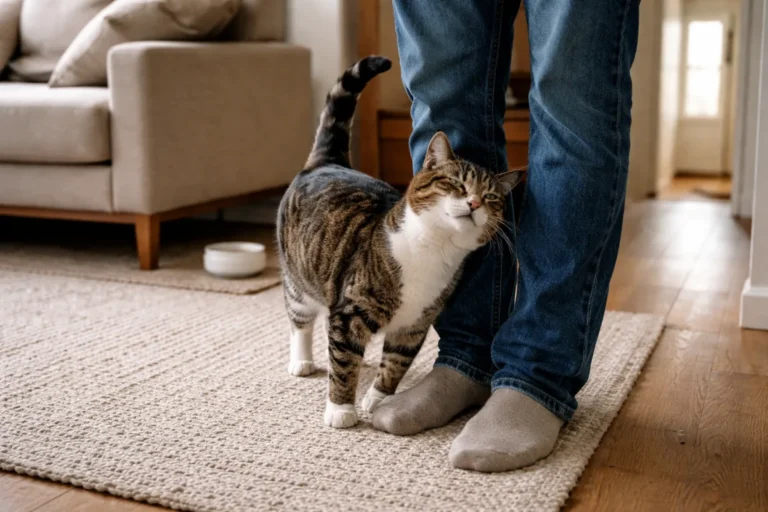
For example, a cat that answers your voice while rubbing against your leg is likely feeling friendly and confident. A cat that answers while crouched low, ears angled back, and tail twitching may be uneasy or defensive. The sound is only one layer.
Helpful signals to notice
- Tail up and loose: often friendly or confident
- Tail lashing or twitching: often irritated or overstimulated
- Soft eyes and slow blinking: usually calm
- Wide eyes and rapid scanning: often alert or anxious
- Relaxed ears forward: usually engaged
- Flattened ears: often defensive or stressed
Timing matters too. A cat that answers immediately may be tuned in and attentive. A cat that answers after a pause may be deciding whether to engage. A cat that keeps vocalizing after you speak may be asking for more than acknowledgment.
How Home Life Shapes the Response
Environment changes how cats communicate. A quiet home can make even a small meow seem noticeable. A busy home can create more vocal back-and-forth because the cat has to compete with noise and movement. Household rhythm matters a great deal.
Indoor cats often become very aware of human voices because the home is their main world. Outdoor-access cats may rely less on vocal contact and more on movement, distance, and scent. In both cases, voice response can reflect how the cat experiences the space around it.
Quiet homes
In a calm home, a cat may answer softly because there is no need to be loud. The voice may be a simple check-in. These cats often seem more subtle, but they are still highly responsive.
Active homes
In a busy household, a cat may develop stronger vocal habits. It may meow to stand out, claim attention, or respond to frequent human interaction. Some cats adapt by becoming more direct. Others withdraw and answer only when they really want something.
Change and disruption
Moves, visitors, new pets, schedule changes, and noise can all alter how a cat reacts to your voice. A cat that used to answer warmly may become quieter for a while. Another may become more vocal because the voice is one of the few steady parts of the day.
When the home changes, the meaning of the response can shift with it. A cat’s vocal reply may become more frequent, more cautious, or more insistent depending on what feels stable.
Common Misreadings of a Cat Answering Back
People often assume a vocal response always means affection. Sometimes it does. Sometimes it means something more practical. A cat may love you and still be asking for food, space, or a door to be opened.
Another common mistake is treating every response as obedience. Cats are not simply following commands when they answer. They are participating in communication. The response may be cooperative, but it can also be self-directed.
Do not judge the meaning of the sound alone. A cat that meows while moving toward you is giving a different message than a cat that meows while backing away.
Some owners also assume a quiet cat is less attached. That is not reliable. Many deeply bonded cats are not especially vocal. They show their connection through proximity, routine, and body language instead.
How Age and Personality Affect the Pattern
Kittens often respond to voices with more frequent vocalization. They are still learning how to interact with people and may use sound to get comfort or attention. Their responses can be quick, repetitive, and very expressive.
Adult cats often become more selective. A mature cat may answer only certain voices, only in certain rooms, or only when a routine is involved. The response can become more refined over time.
Senior cats may change again. Some become more vocal as hearing, comfort, or awareness shifts. Others quiet down. A new pattern in an older cat is worth noticing, especially if it comes with disorientation or restlessness.
Personality differences
- Social cats often answer often and readily.
- Independent cats may answer less but still recognize your voice clearly.
- Confident cats may use stronger, more deliberate vocal replies.
- Shy cats may answer quietly or only from a safe distance.
Personality shapes expression, but it does not erase connection. A reserved cat may still be listening closely every time you speak.
When the Response Becomes More Noticeable
Some times of day bring out this behavior more than others. Morning and evening are common. Meal times are obvious triggers, but not the only ones. Cats often answer voices when household energy shifts, when they are waiting, or when they want a predictable event to happen.
This is why a cat may seem especially talkative in the kitchen, near the bedroom door, or as soon as you return home. The voice is tied to routine. The cat has learned that your words often mean movement, attention, or change.
It can also become more noticeable when the cat is under-stimulated. A bored cat may respond to your voice simply because something finally happened. The interaction breaks the quiet.
What Consistent Voice Responses Can Tell You Over Time
Over weeks and months, patterns matter more than single moments. A cat that consistently answers your voice with relaxed body language is probably comfortable in that relationship. A cat that only answers during stress, mealtime, or conflict may be telling a narrower story.
Consistency also shows habit. Cats are skilled at learning what tends to happen next. If your voice reliably precedes a specific action, the cat may respond almost automatically. That does not make the response meaningless. It means the cat has organized the world around familiar cues.
If the pattern changes suddenly, pay attention. A cat that becomes much more vocal, much less vocal, or noticeably tense when you speak may be reacting to discomfort, confusion, or a physical issue. Changes in hearing, pain, or household tension can all affect response.
Reading the Whole Conversation
A cat answering your voice is rarely just making noise. It is reacting to a familiar sound, a routine, a mood, or a need. The answer may be affectionate, practical, uncertain, or simply habitual. Often it is a blend of more than one thing.
What makes the behavior useful is its consistency. Over time, you can learn the difference between a cheerful reply, a request, and a tense call. That understanding grows from watching how the cat moves, pauses, listens, and settles after the sound is made.
In daily life, the clearest meaning is often the simplest one: your cat heard you, recognized you, and decided to respond. That response may be tiny or very obvious, but it is part of how cats keep their lives organized around the people they live with.