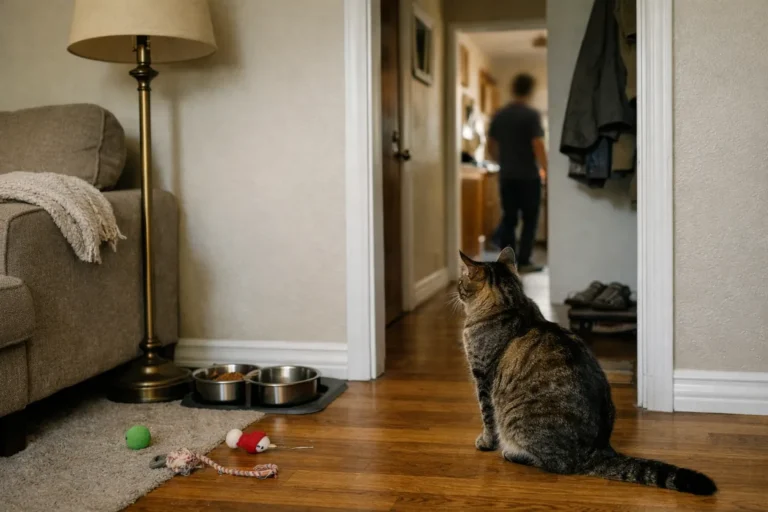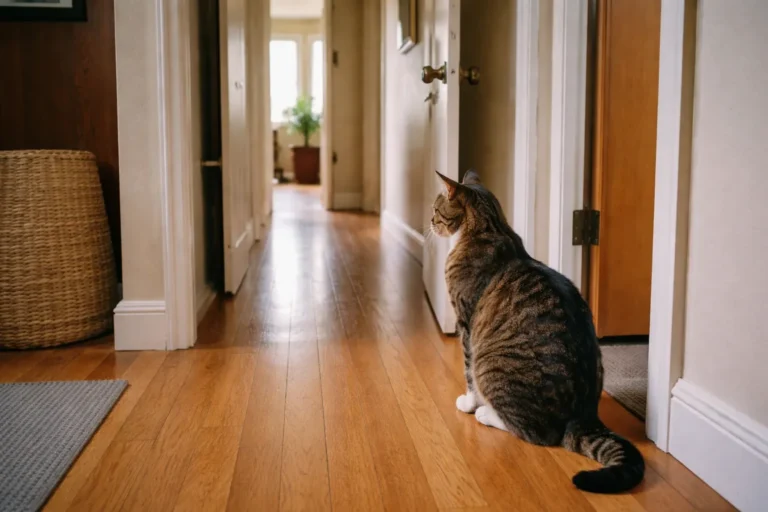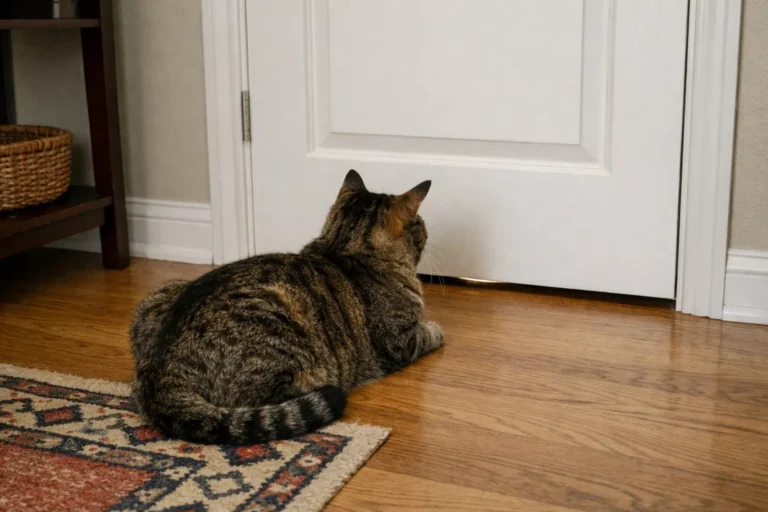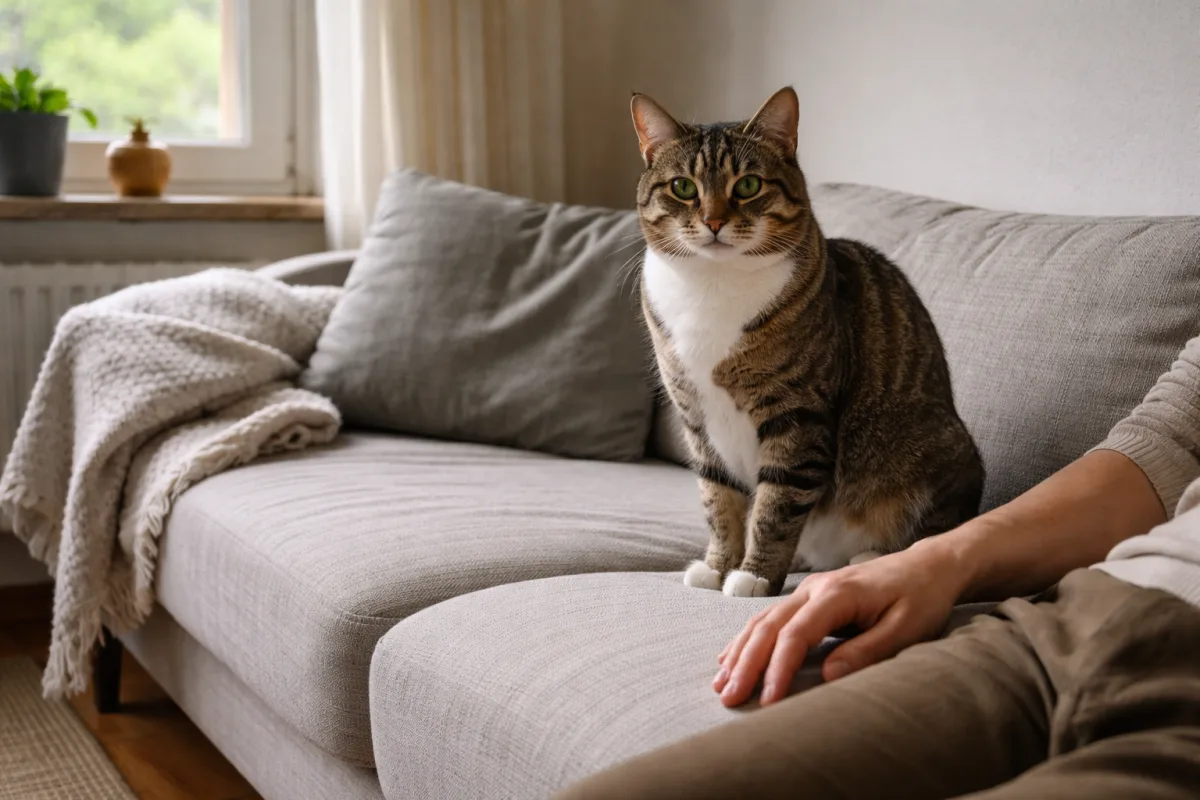
A cat can choose the same person every day, walk beside them from room to room, and still pull away the moment a hand reaches out. That pattern is confusing only if touch is assumed to mean the same thing as closeness. For many cats, it does not.
Being near someone can feel safe, familiar, and low-pressure. Being touched is different. It adds contact, pressure, and a loss of control over the moment, and some cats want companionship without that extra step.
This behavior is common in homes where a cat follows family members, settles nearby on the couch, or sleeps at the foot of the bed, yet rarely stays still for petting for long. The cat is not necessarily distant. Often, the cat is choosing a specific kind of connection.
What this behavior looks like in everyday life
In daily routines, the pattern usually appears in small ways rather than dramatic ones. A cat may sit in the same room as you, watch what you are doing, or even rub against a chair leg near your feet. But when you bend down to touch the cat, it moves away, shifts position, or accepts only one or two strokes before leaving.
Some cats stay close during quiet activities like reading, working at a desk, or watching television. They may sleep nearby, but not in your lap. Others greet you at the door and then choose a spot a few feet away instead of full contact. The message is often consistent: presence is welcome, but touch is negotiated.
This can happen with one person but not another. A cat may tolerate handling from the household member who feeds them, yet avoid touch from children or guests. It may also change with the time of day, the room, or the cat’s mood.
Common everyday signs
- Sitting close but not directly against you
- Following you from room to room without seeking petting
- Accepting brief contact, then stepping away
- Sleeping nearby but not on top of you
- Rubbing against objects near you instead of your hand
These are not contradictory behaviors. They are often part of the same preference profile. The cat wants connection on its own terms.
Why a cat may want closeness without touch
There is no single reason for this behavior. Cats are shaped by temperament, early experiences, environment, and the way they learned to interact with people. A cat that avoids touch while staying near may simply be cautious, highly aware of its surroundings, or selective about physical contact.
Some cats are naturally more touch-sensitive. Their skin, body, or nerves may make repeated petting feel overwhelming faster than it does for other cats. What feels comforting to a person can feel too intense to a cat, especially if the petting is on the back, belly, or tail area.
Closeness and touch are separate forms of social behavior in cats. A cat may enjoy your company without enjoying direct physical contact for long periods.
History matters too. Cats that were handled a lot as kittens may still become touch-limited as adults if they prefer control over affection. Cats that had little positive handling early in life may learn to trust people from a distance first. They may come closer over time, but still keep a boundary around touch.
Some cats simply do not like being restrained by hands. Even a gentle stroke can feel like being pinned in place if the cat is alert or busy observing the room. For these cats, standing nearby is a safer kind of affection.
Possible internal reasons behind the behavior
- Strong desire for control over movement and space
- Low tolerance for repeated petting or handling
- Learned preference for proximity without physical contact
- Sensitivity to certain touch areas or pressure
- Need to monitor the environment while staying social
Sometimes the explanation is simple: the cat likes you, but not the sensation of being touched right now. That can be true even on the same day the cat wants to sleep near you or follow you into the kitchen.
How context changes the meaning
The same cat can behave differently depending on where it is and what else is happening. A calm living room in the evening may invite closeness. A noisy home, guests, a barking dog, or sudden movement can make touch feel less welcome.
Many cats are more open to contact when they choose the moment. If they approach first, rub their face on you, or climb onto a nearby surface and pause, they may be inviting a very specific type of interaction. If you reach in before that invitation, the cat may retreat even if it wanted to stay close.
Timing also matters. Cats often tolerate less touch when they are waking up, eating, listening to outside sounds, or tracking activity in the room. During those moments, staying near you may be enough social contact.
Household structure can shape this behavior as well. A quieter home may make a cat feel safe enough to sit closer, while an active home may encourage the cat to keep a little more distance. The cat is not being inconsistent. It is adjusting to the environment.
Situations where avoidance becomes more noticeable
- When the home is busy or noisy
- When unfamiliar people are present
- After the cat has already had enough petting
- During meals or high-alert moments
- When the cat is trying to rest without interruption
If a cat is choosing distance only in certain settings, the environment may be shaping the behavior more than the relationship itself.
What the behavior may signal about the cat’s state
Close-but-don’t-touch behavior can mean many different things, and the details matter. A relaxed cat that sits near you with soft eyes, loose whiskers, and a slow blink is sending a very different message from a cat that stays nearby while watching every movement.
When the cat appears calm, the behavior usually reflects preference. The cat likes the company but wants a low-contact version of it. That is often the case with independent, mature, or sensory-sensitive cats.
When the cat seems tense, the same behavior can mean something else. The cat may want to remain near a safe person while still feeling too alert for handling. In that case, staying close is a form of reassurance, not a request for affection.
Soft signals vs stronger signals
- Soft signals: relaxed body, tail resting loosely, brief approach, voluntary settling nearby
- Stronger signals: ears rotating back, skin rippling, tail flicking, moving away after touch begins
- Mixed signals: approaching for attention, then leaving after one or two strokes
Mixed signals are especially common. A cat may genuinely want contact but only in very small doses. That can look like contradiction, but it is often just a narrow comfort range.
How owners often read the behavior
People tend to assume that a cat who avoids touch is either aloof or unhappy. Those are convenient interpretations, but they miss how subtle cat communication can be. A cat can be bonded, relaxed, and affectionate without wanting long petting sessions.
Owners also sometimes mistake proximity for an invitation to continue touching. A cat sitting nearby may be enjoying the shared space, not asking for extended handling. If the cat has already decided how close it wants to be, more contact can undo the comfort it was trying to create.
This is one reason so many cats alternate between contact and withdrawal. The cat approaches to reconnect, then steps away once the interaction crosses its limit. To a human, that can look like mixed emotions. To the cat, it may simply be good boundary control.
A cat that avoids touch is not automatically rejecting affection. It may be protecting a boundary while still choosing companionship.
How the behavior connects to typical cat traits
Independence is often mentioned in connection with cats, but it is more accurate to think of cats as selective. They can be social and self-directed at the same time. A cat that remains near you without asking for touch is showing exactly that balance.
Sensitivity is another key trait. Cats notice small changes in movement, sound, scent, and pressure. Because of that, touch is never just touch. It carries information, and some cats are careful about how much information they want at once.
Observation is also central. A cat may stay close because it wants to monitor you, the room, or the routine. Many cats like to be part of what is happening without being in the middle of it. Proximity lets them stay informed while maintaining personal space.
Typical cat traits involved
- Preference for choice and control
- Heightened awareness of movement and touch
- Interest in social contact without constant handling
- Comfort with observing before participating
These traits help explain why some cats seem affectionate in one way and reserved in another. They are not opposing behaviors. They are different expressions of the same animal’s comfort system.
When the home setup influences the pattern
A cat’s surroundings can shape how much touch it accepts. In a home with predictable routines, quiet resting places, and places to retreat, a cat may feel comfortable staying close without needing physical reassurance. When the environment is crowded or unpredictable, the cat may keep its body free while still staying near a trusted person.
Furniture layout matters more than many people expect. A cat that can sit beside you on a chair arm, window ledge, or nearby blanket may choose closeness in a way that feels controlled. Direct lap contact may be too confining, while sitting in the same area feels just right.
Other pets can also change the behavior. A cat may avoid touch more often if another cat competes for space or if a dog approaches too quickly. In that setting, staying near a person can be a way of staying safe without giving up mobility.
When a cat chooses a spot that keeps escape routes open, the cat is often trying to stay comfortable, not distant.
What to notice before reaching in
Small details often tell you whether a cat wants touch or just company. The cat’s body usually answers before the rest of the behavior does. A cat that leans in, head-butts, or pauses with relaxed muscles is different from one that is standing nearby but already preparing to move.
Many cats prefer predictable touch and brief sessions. A few strokes, then a pause, may be enough. Some want only head rubs and chin scratches, while others dislike being stroked along the back. Watching for patterns matters more than trying to force consistency.
Clues that the cat may be open to contact
- Approaching you first
- Rubbing the face or body against you
- Pausing with relaxed posture near your hand
- Returning after moving away
Clues that the cat may want space
- Turning the head away
- Walking past without stopping
- Flicking the tail after contact begins
- Keeping the body angled for an easy exit
These signals can be subtle, but they are usually consistent once you know the cat’s habits. The same cat may invite contact in the morning and avoid it at night. That does not make the behavior random. It makes it personal.
How long-term patterns tend to look
For many cats, this preference is stable. They remain social in a quiet, indirect way throughout life. They may become a little more comfortable with touch as trust grows, or they may become more selective with age.
Older cats sometimes prefer proximity because it lets them stay close without unnecessary movement. At the same time, they may become more protective of their comfort zones. A cat that once tolerated lots of petting may later prefer short contact only.
Life changes can also alter the pattern. A move, a new pet, a schedule shift, or a change in household energy can make a cat rely more on closeness without touch. In those periods, the behavior often reflects a need for stability.
How to interpret the balance between closeness and avoidance
The most useful way to read this behavior is to separate affection from access. A cat can be attached to a person and still prefer limited handling. It can be comfortable in the same space while protecting its right to choose when contact happens.
That balance often shows the cat’s trust more clearly than nonstop petting does. A cat that settles nearby without feeling pressured is making a deliberate choice. It is saying that being with you is enough for now.
When that pattern is respected, it usually stays clear and steady. The cat keeps coming close. The distance between comfort and touch remains manageable. And the relationship is built on the cat’s terms, which is often exactly what makes it sustainable.
For many cats, the real sign of trust is not constant touching. It is the decision to stay near while still feeling free.