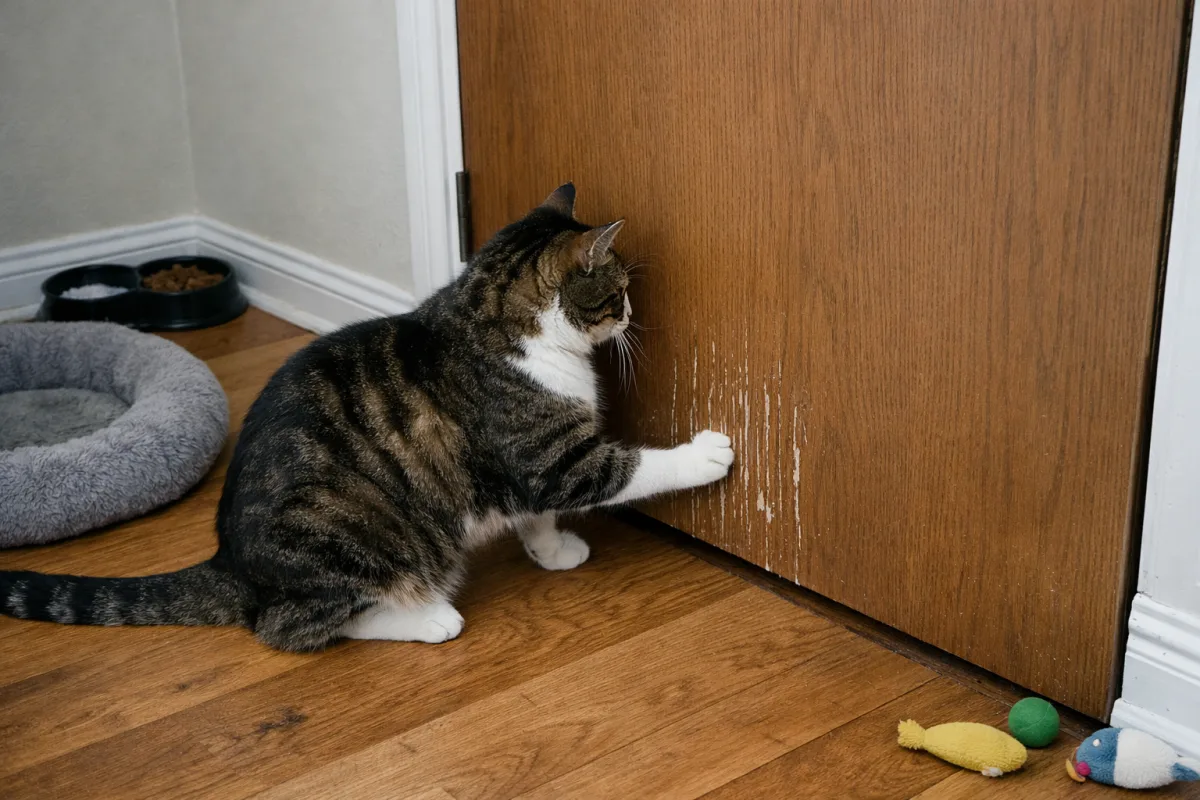
You close the door, and within seconds your cat is at it. A paw slides under the gap. Nails tap the wood. Sometimes there is a soft meow, sometimes a louder demand, and sometimes a full-body push as if the door itself has become the most important object in the house.
This behavior can feel baffling because it often seems to happen at the exact moment you want privacy, quiet, or just a little separation. But for many cats, a closed door is not a neutral boundary. It is a change in access, routine, and information. That alone can be enough to make them react.
When a cat scratches the door after you close it, the behavior may be about curiosity, frustration, attention, territory, or simple habit. The meaning depends on the cat, the room, the timing, and what usually happens next. A closed door can trigger several instincts at once, which is why the reaction sometimes looks dramatic even when the reason is ordinary.
What the behavior looks like in daily life
Door scratching usually does not appear in one single form. Some cats scratch lightly for a few seconds, then stop and listen. Others keep at it, pace, meow, or press their bodies against the door as if trying to reopen the space by force. A few cats combine scratching with under-the-door pawing, chirping, or sitting directly in front of the doorway in silence.
The exact pattern often tells you something. A brief scratch after you shut the bathroom door may be pure protest. Repeated scratching every night at the bedroom door may be a learned response to routine. Scratching that appears when you are on the other side of the door but disappears when no one is there can point to attention-seeking or social attachment.
Even the sound of the behavior matters in practice. Some cats use their claws more as a communication tool than a destructive one, making a noise that gets human attention quickly. Others dig more intensely, especially if they are highly aroused or upset by blocked access.
Why cats react so strongly to closed doors
For a cat, a closed door can mean something has changed without warning. Cats generally prefer to monitor their environment and choose their own level of participation. When a door shuts, they lose access to you, a room, scent information, sounds, or a favored resting spot.
That loss of access can feel significant. Cats are not always “wanting in” for the same reason a person might. Sometimes they simply do not like not knowing what is happening on the other side. A cat may be more interested in the fact that the door is closed than in whatever room lies beyond it.
Closed doors combine several triggers at once: blocked movement, reduced information, and a sudden change in routine. For many cats, that is enough to spark scratching.
There is also a strong territorial element. Cats use space in very personal ways. A door can interrupt that map, and the cat may respond by trying to restore access or mark the boundary with scent and claw action. In a home with multiple pets, this reaction can become more intense because the door may separate the cat from resources or from a person it monitors closely.
Possible internal reasons behind the behavior
Curiosity and the need to supervise
Many cats scratch at doors because they want to know what is happening. Cats are observant animals, and closed doors remove visual information. If you are on the other side making sounds, moving around, or doing something unusual, the cat may want in simply to stay informed.
This is especially common in social cats that prefer to follow their people from room to room. They may not be desperate to enter a specific space. They just dislike being excluded from the activity.
Frustration at blocked access
Some cats react because the closed door interrupts a plan. They may have been heading toward you, a food area, a favorite bed, or a sunny spot. When the door shuts, the path is gone. Scratching becomes a direct, physical attempt to undo the interruption.
Frustration tends to show up more clearly when the behavior is repetitive and urgent. The cat may scratch hard, pace, and vocalize. If the door opens, the cat may rush in, then lose interest quickly, which suggests the door itself was the problem more than the room.
Attention-seeking and learned response
Cats are fast learners when behavior produces results. If scratching a door has previously led to the door opening, a human speaking, or any other attention, the behavior can become stronger over time. The cat does not need to understand it in a human way; it only needs to notice the pattern.
This is why the behavior sometimes appears most often at predictable moments. A cat may scratch when you shut the bedroom door at night because that used to bring you back out. The habit can persist long after the original reason has faded.
Stress or uncertainty
Not every door-scratching episode is casual. When a cat feels unsettled, closed doors can intensify that feeling. A new pet, visitors, renovation noise, a changed schedule, or a recent move can make a cat cling more tightly to access and routine.
Stress-related scratching usually comes with other clues: more vocalizing, restlessness, hiding, over-grooming, loss of appetite, or sudden changes in litter box habits. The scratching itself may be only one part of a broader shift in behavior.
How context changes the meaning
The same action can mean different things depending on when it happens. A cat scratching the bedroom door at 6 a.m. may be asking for breakfast, company, or a return to routine. A cat scratching the bathroom door during a shower may simply object to being separated from you in a space that normally feels shared.
Timing often matters more than intensity. A few scratches right after you close a door may be a short protest. Scratching that starts every night at bedtime may be connected to separation anxiety, habit, or a strong preference for sleeping near you. Scratching that appears only when someone is inside a specific room may involve a desire for attention rather than access in general.
Household layout can also shape the behavior. In small apartments, doors are more likely to block the cat from the only person in sight. In larger homes, a closed door may cut off the path to litter boxes, food, water, or a social hub. In either case, the cat may respond to the practical barrier rather than the emotional one.
What the behavior may signal about your cat’s state
| Behavior pattern | Possible meaning | What often appears with it |
|---|---|---|
| Brief scratching once the door closes | Curiosity or mild protest | Listening, waiting, tail movement |
| Repeated scratching at the same time each day | Routine-based habit | Meowing, pacing, waiting near the door |
| Intense scratching with vocalizing | Frustration or urgency | Restlessness, following behavior, insistence |
| Scratching after household changes | Stress or uncertainty | Hiding, clinginess, changes in appetite |
| Scratching only when a person is behind the door | Attention or social attachment | Sitting close, pawing, meowing, waiting |
This kind of pattern reading is useful because the door itself is only part of the story. A cat that scratches a closed door does not automatically have a problem. The behavior becomes more meaningful when it repeats, escalates, or appears alongside other changes in daily life.
What owners often assume versus what may actually be happening
People often assume the cat is being stubborn or spiteful. That interpretation is understandable, but it usually misses the point. Cats do not scratch doors because they want to annoy anyone. They scratch because the closed door changes something important to them, and they are responding in the way that makes sense to their body and habits.
Another common assumption is that every cat scratching door behavior means loneliness. Sometimes that is true, but not always. Some cats want access to you. Others want access to a routine, a vantage point, or a room they consider part of their territory. The emotional tone of the behavior matters more than the label.
If the scratching stops quickly when the door opens, the cat may be reacting to blocked access rather than trying to damage the door itself.
It is also easy to overlook how much reinforcement can happen by accident. A cat scratches. The door opens. The cat wins. That sequence can repeat many times and quietly become a habit that feels intense but is actually well rehearsed.
How body language helps you read the behavior
Calm scratching
Calm scratching often looks measured. The cat may scratch a few times, then sit, wait, or look at you. The tail may stay fairly relaxed. The cat is making a clear request, not necessarily reacting with distress.
Playful or exploratory scratching
Some cats treat the door as a surface to test. They may scratch lightly, hop back, and return with little seriousness. This often happens in younger cats or in homes where the cat has plenty of energy and the door has become part of a game.
Defensive or high-intensity scratching
When the behavior is sharp, fast, or paired with growling, flattened ears, or a tense posture, the cat may be feeling threatened or overwhelmed. This can happen if the door separates the cat from a person during a stressful event, or if another animal is behind the door.
Intensity matters because it changes what the cat may need next. A calm, routine-driven scratch may respond to schedule changes. A tense, stressed response may require a quieter environment and more careful attention to what is happening around the cat.
Why some cats seem to care more than others
Not every cat reacts the same way to closed doors. Personality plays a role. Social, people-oriented cats often object more strongly because separation from their person is noticeable. Highly curious cats may scratch because they cannot tolerate missing information. Sensitive cats may react because the change in access feels abrupt.
Experience also shapes the pattern. A cat that has spent a lot of time with open access throughout the home may find closed doors especially irritating. Another cat, raised in a setting where doors are commonly shut, may accept them more easily unless the change interrupts a valued routine.
Age can matter too. Kittens and younger cats often scratch more because they are active, exploratory, and still learning boundaries. Older cats may scratch less frequently, but when they do, it can be because they have very clear preferences about where they want to be and when.
How the home environment influences the habit
In a busy home, closed-door scratching can become a communication style. People move in and out of rooms. Doors open and shut frequently. The cat learns to respond to these changes because they affect access to food, warmth, companionship, or quiet observation spots.
In a quieter home, the same behavior may stand out more because it is less diluted by other activity. A single closed bedroom door at night can feel especially significant in a calm environment, and the cat may develop a strong routine around it.
Multi-cat homes add another layer. A closed door can separate a cat from social contact, but it can also separate the cat from competition. Sometimes a cat scratches because the other side of the door has something desirable. Other times the cat scratches because the door is the only place where the household feels controllable.
When the behavior is simply part of a routine
Some cats scratch doors at the same time every day, not because they are upset, but because the behavior has become part of the household rhythm. You close the office door to work. The cat scratches. Later, the cat stops because it knows the pattern and expects access eventually.
This kind of repetition can be surprisingly stable. Cats are strong pattern followers. If the door closes after dinner and opens at bedtime, the cat may begin to guard that sequence with increasing confidence. What looks like insistence may just be a well-established daily expectation.
Routines become especially powerful when the cat gets what it wants on a predictable schedule. The cat does not need a perfect memory of events. It only needs enough consistency to form a strong association between the closed door and the next step in the day.
When the scratching deserves a closer look
Door scratching is common, but a sudden increase is worth noticing. A cat that has never bothered with doors and then starts scratching intensely may be reacting to a change in the home, discomfort, or increased stress. When the behavior appears together with reduced appetite, hiding, aggression, or litter box changes, it should not be dismissed as a simple nuisance.
Persistent scratching at doors that block access to food, water, or litter boxes also matters. The cat may be trying to reach basic needs, and the closed door is creating a practical problem. In homes with pets or children, this can happen more often than people realize.
Sometimes the most telling sign is not the scratching itself but the shift in timing. If a cat only scratches during storms, after guests leave, or when the household schedule changes, the behavior may reflect a larger emotional response to the environment rather than a preference for the room beyond the door.
A quieter way to think about the behavior
Door scratching is often less about the door and more about what the door represents. It can represent separation, blocked routine, lost information, or a boundary the cat did not choose. The cat is responding to that interruption in the only direct way it has available.
Once you start looking at the timing, body language, and context, the behavior usually becomes easier to read. A light scratch at bedtime is different from a frantic response during a stressful home change. A cat sitting calmly by the door is sending a different message from one that is pacing, vocalizing, and digging with tension in the shoulders.
That difference matters. Cats rarely make their feelings obvious in a human way, but they are consistent in their own language. A closed door may feel small to us. To a cat, it can be a meaningful shift in the shape of the day.
When that happens, scratching becomes less of a mystery and more of a message: the boundary is being noticed, and the cat has a clear opinion about it.