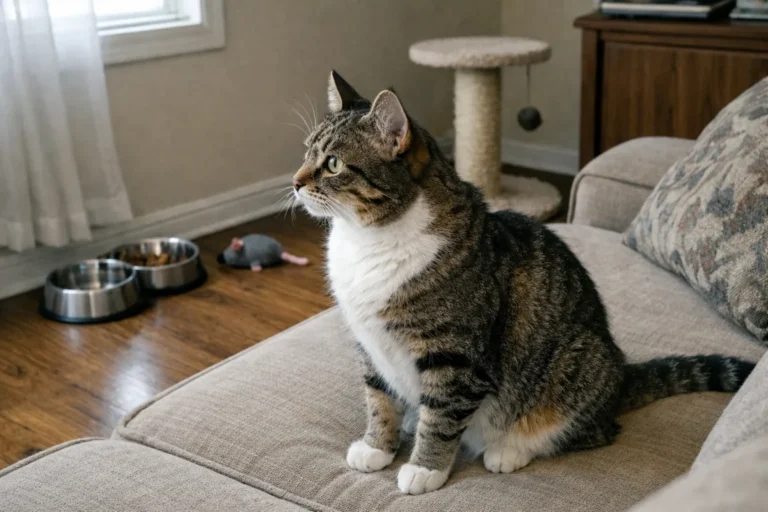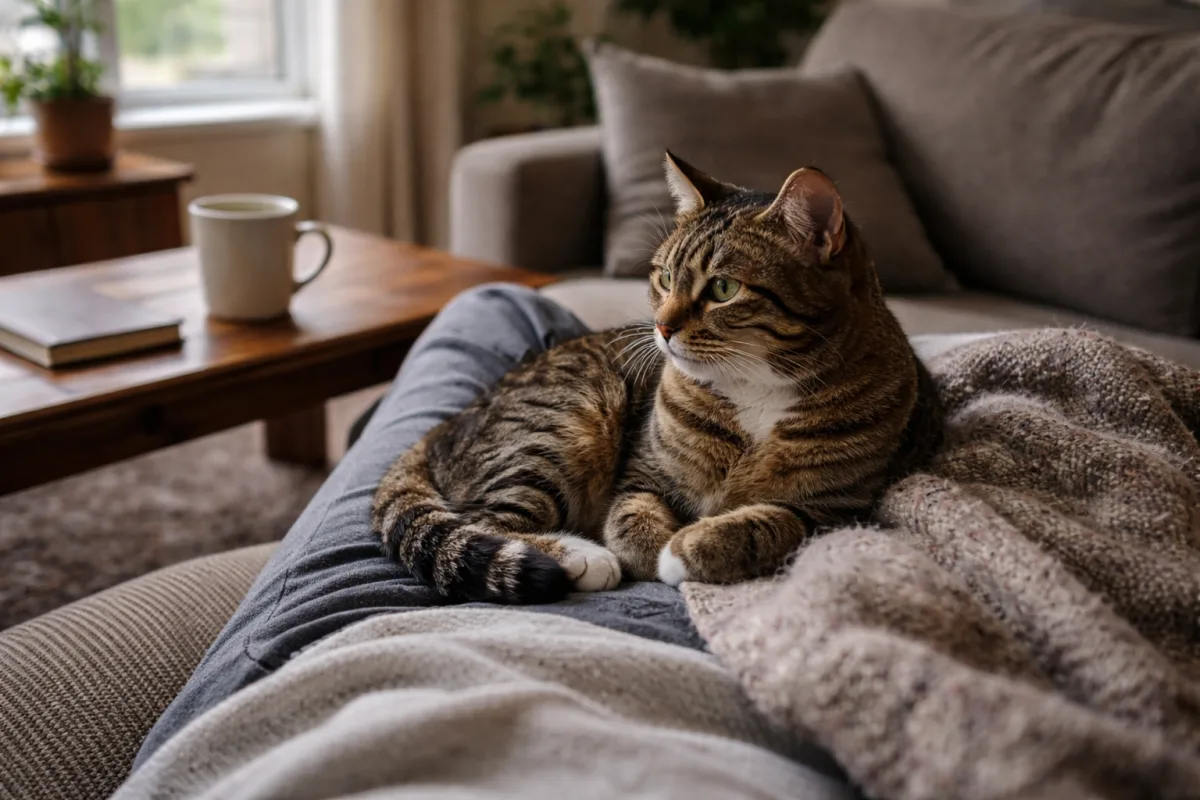
A cat that settles on top of an owner often seems to be making a simple choice: this spot, right now, feels right. But the behavior is rarely random. A cat may climb onto a lap, curl across a chest, sit on a shoulder, or plant itself squarely on the legs that were just about to move. Each version can mean something a little different.
For many cats, sitting on a person is part comfort, part communication, and part habit. It can happen when the house is quiet, when someone comes home, when a cat wants warmth, or when it wants attention without having to ask too loudly. Sometimes the message is clear. Other times it is subtle and layered, shaped by routine, mood, and the cat’s own way of handling closeness.
What looks like a simple cuddle often reveals how a cat experiences safety, territory, and connection. The same cat may be independent for hours and then choose one particular person as the best place in the room. That choice usually says more than affection alone.
Why Cats Choose to Sit on Their Owners
Cats do not sit on people for one single reason. They do it because several motivations overlap, and the mix changes from moment to moment. Warmth, familiarity, comfort, scent, attention, and a sense of control can all play a role.
Unlike dogs, cats usually approach closeness on their own terms. When they decide to sit on an owner, that decision can reflect a strong sense of trust. It is not always a grand emotional statement, but it is rarely meaningless either.
Warmth is a powerful factor
Body heat matters a great deal to cats. A lap, stomach, chest, or even feet under a blanket can offer a steady source of warmth that feels better than a bed nearby. This is especially common in cooler rooms, after a nap, or in older cats that seek warmth more often.
A cat may also move from one warm place to another as the day changes. A sunny window in the morning may give way to a lap in the evening. The person is not necessarily the only attraction, but they may be the easiest warm surface available.
Your scent feels familiar and safe
Cats rely heavily on smell. Your clothes, blanket, and skin all carry a scent the cat knows well. Sitting on you lets the cat stay close to that familiar smell, which can be calming in a home full of changing noises and movement.
Some cats seem especially drawn to worn clothing, laundry, or blankets because those items smell strongly of the people they trust. When a cat sits on its owner, it may be choosing the most familiar scent in the room as much as the person themselves.
It can be a sign of trust and social comfort
A cat that chooses to rest directly on a person is showing a level of comfort that is worth noticing. In cat terms, closeness has to feel safe. A nervous or uncertain cat is more likely to keep distance, stay near an exit, or observe from a higher perch.
When a cat sits on its owner, it often means the cat believes that person will not disturb it. That comfort can be deep and quiet. The cat may not demand interaction. It may simply want to be near enough to relax fully.
Cats often sit on their owners for warmth, familiar scent, safety, and easy access to attention. The behavior usually reflects comfort more than coincidence.
What the Behavior Looks Like in Daily Life
The behavior can appear in ordinary moments that say a lot about a cat’s preferences. It may happen the moment someone sits down, when the room settles after dinner, or when a person lies down with a book or laptop. Some cats wait until their owner is still. Others climb up with confidence and settle in quickly.
In some homes, the pattern is predictable. The cat sits on the same person every evening at the same time. In others, it changes based on who has the softest blanket, who is quietest, or who has been away the longest. A cat’s choice is often practical in its own way.
Common places cats choose on the body
- Lap: usually the most obvious sign of seeking closeness and warmth.
- Chest or upper torso: often linked to comfort with breathing rhythm, scent, and steady contact.
- Shoulders: more common in confident cats that like height and closeness at once.
- Legs or feet: can mean the cat wants contact without fully committing to a full lap sit.
- Head or neck area: often a very familiar, affectionate form of contact.
Each location can suggest something slightly different. A lap sit is usually about relaxation. A shoulder perch can feel more observant. A cat lying across the feet may simply want to stay connected while preserving some independence.
Timing changes the meaning
When a cat sits on an owner after a long absence, it may be greeting behavior mixed with relief or excitement. When it happens during a thunderstorm or after loud household activity, the cat may be looking for reassurance. When it happens every night at bedtime, it may simply be part of a stable routine.
Timing matters because cats are sensitive to patterns. A cat that sits on a person during a stressful event may be seeking stability. The same cat sitting on a lap during a quiet evening may be expressing habit and contentment.
Internal Reasons Behind the Behavior
Not every cat is affectionate in the same way. Some are physically cuddly, while others prefer standing nearby. When a cat chooses to sit on an owner anyway, there is usually a clear internal reason behind it, even if the reason is not easy to name from the outside.
Comfort and relaxation
A cat that sits on a person often enters a deeper state of rest. The body loosens, the breathing slows, and the cat may knead, blink slowly, or even fall asleep. That level of relaxation suggests that the owner’s presence is helping the cat settle.
For many cats, full-body contact is more soothing than nearby presence. Being on top of someone can help the cat feel contained, warm, and less exposed. It is a small way of turning a human into part of the cat’s safe space.
Attachment without dependence
Cat attachment is often quieter than people expect. Many cats do not follow their owners everywhere, but they still form strong preferences. Sitting on an owner can be one expression of that preference.
This behavior does not automatically mean a cat is needy. More often, it means the cat has chosen a particular person as a reliable source of comfort. A cat may remain independent in other situations and still be highly selective about where it rests.
Attention can be part of the message
Some cats sit on owners because it works. The behavior quickly gets a response: petting, talking, warmth, a lap available for longer than expected. Cats learn which actions make human attention appear.
That does not make the behavior fake. It simply means the cat understands cause and effect. Sitting on a person is an effective way to start interaction without having to meow, paw, or demand much effort.
When a cat uses physical closeness to get attention, it is usually combining comfort with communication. The cat may want the interaction, not just the space.
Territory and social scent sharing
Cats are territorial in subtle ways. Sitting on an owner can be a form of scent exchange. The cat leaves its scent behind and absorbs the human scent at the same time. That shared smell helps create a social bond that feels secure to the cat.
This is one reason some cats prefer sitting on clothes, blankets, or favorite chairs. They are not only taking a seat. They are mixing scents in a familiar, trusted place.
How Context and Environment Influence It
The same cat may sit on an owner constantly in one home and rarely do it in another. Environment has a strong effect. Room temperature, noise level, household schedule, available furniture, and the number of people in the home all shape the behavior.
A calm, predictable home often encourages more lap sitting because the cat can relax without scanning the room. In a busier home, the cat may still seek contact but choose quieter moments. A cat that wants closeness will usually find the safest and easiest opportunity.
Indoor life often increases the pattern
Indoor cats frequently sit on owners more often than outdoor-access cats because their social and physical world is centered around the home. The owner becomes a major part of comfort, entertainment, and routine. Contact also serves as a way to break up a sedentary day.
That does not mean all indoor cats are clingy. It simply means the home environment gives more opportunities for repeated contact. If the cat enjoys the arrangement, the pattern can become very strong.
Activity level in the home matters
In a quiet household, a cat may feel safe enough to sit on a person for long periods. In an active household, the same cat may choose shorter visits or wait until the noise dies down. Children running, doors opening, or visitors arriving can make some cats more cautious.
Older cats and shy cats often prefer predictable routines. They may settle on an owner in the same chair or at the same time each day because consistency lowers stress. A cat that sits on you every night may be responding to both comfort and habit.
Temperature and season can change frequency
Cold weather often increases the behavior. Cats search for heat with impressive efficiency, and a warm body can be more appealing than a blanket alone. Many owners notice more lap sitting in winter and less during hot months.
In summer, a cat may still sit on an owner but for shorter stretches. The same cat that stays glued to a lap in January may prefer sitting beside a person in July. The bond can remain the same even when the chosen position changes.
What the Behavior May Signal About the Cat’s State
Sitting on an owner can signal contentment, but it can also reflect other states. The key is to read the full picture: posture, timing, and what the cat does before and after settling in. A relaxed cat and an anxious cat may both climb into a lap, but they will not look identical once they get there.
Relaxed body language
A calm cat usually settles with loose muscles, slow blinking, and a steady breathing pattern. It may knead, tuck its paws under, or rest its head with little effort. The tail usually stays still or curls gently around the body.
This version of the behavior tends to feel unforced. The cat chooses a spot, stays there, and seems able to sleep or drift in and out of rest. The owner becomes part of a comfortable routine rather than a solution to a problem.
Restlessness or tension changes the interpretation
If the cat sits on the owner but keeps shifting, looks around frequently, or jumps up at small sounds, the behavior may be more about security than pure relaxation. The cat may want contact while still feeling unsure about the environment.
That does not make the behavior negative. It simply means the cat is using the owner as a stable reference point. In these moments, being on a person can help the cat monitor the room while staying close to something reassuring.
Clinginess can have several causes
A cat that suddenly sits on an owner much more than usual may be responding to change. A new pet, different work schedule, illness, visitors, moving furniture, or even a household conflict can shift the cat’s need for closeness. Cats often respond to change by seeking familiar contact.
If the new pattern is paired with other changes, such as reduced appetite, hiding, vocalizing, or a change in grooming, the behavior deserves closer attention. Alone, sitting on an owner is usually harmless. Together with other shifts, it may reflect stress or discomfort.
A sudden increase in sitting-on-owner behavior can mean the cat wants comfort, routine, or reassurance. The surrounding changes matter more than the behavior by itself.
How Owners Often Interpret It vs What It May Actually Mean
People often label this behavior as simple affection, and affection is certainly part of it. But cats rarely communicate in one clean layer. A lap sit can be love, warmth-seeking, attention-seeking, territory-sharing, or reassurance all at once.
Owners sometimes assume the cat is being “needy” when it is actually following a strong routine. Others assume the cat is only after warmth when it may also be seeking the person’s scent or a sense of safety. The truth usually sits somewhere in the middle.
When affection is the main message
If the cat relaxes quickly, makes soft contact, and stays near without appearing tense, affection is likely a major part of the behavior. The cat is choosing closeness because it feels good, not because it wants something urgent.
This is especially clear when the cat also seeks gentle interaction elsewhere in the day. Following an owner from room to room, greeting them at the door, or sleeping near them can all fit the same social pattern.
When practical comfort matters more
Sometimes the cat simply wants the best available spot. The lap is warm, soft, and stationary. It also happens to be attached to a familiar scent source that can be used as a pillow.
That practical side should not be underestimated. Cats make comfort-based decisions often, and sitting on an owner is one of the easiest examples to see. The behavior can be emotionally meaningful without becoming overly sentimental.
When the cat may be asking for more than a seat
If the cat pushes into the owner repeatedly, meows, paws, or blocks movement, it may want direct attention, feeding, or a change in the environment. In these cases, sitting on a person is not just a restful choice. It is a communication tool.
The cat may be saying that something needs to happen now: play, food, warmth, calm, or reassurance. The exact request depends on timing and the cat’s normal habits. A cat that sits on you right before breakfast is likely communicating something different from one that settles quietly during a nap.
Differences Between Gentle, Playful, and Stress-Related Sitting
Not all physical closeness looks the same. The way a cat sits on an owner can reveal whether the behavior is soft and relaxed, playful and interactive, or more defensive and anxious.
| Type of behavior | Common signs | Likely meaning |
|---|---|---|
| Gentle sitting | Loose body, slow blinking, kneading, still tail | Comfort, trust, warmth |
| Playful sitting | Quick climbing, pouncing onto lap, brief settling, alert ears | Attention, energy, interaction |
| Stress-related sitting | Tense muscles, scanning, shallow settling, sudden jumps | Reassurance, safety, reduced confidence |
A playful cat may jump onto a lap and then dart off a minute later. A relaxed cat is more likely to settle in fully. A stressed cat may stay close but remain ready to move at any moment.
Mixed signals are common
Cats often combine signals that seem contradictory. A cat may purr loudly while keeping its eyes wide open. It may knead while staying alert to a sound in the hallway. It may sit on an owner and yet still be ready to leave quickly if something changes.
These mixed signals do not cancel one another out. They show that cats can feel several things at once. Comfort and vigilance often coexist.
Long-Term Meaning and Consistency
One of the most useful clues is whether the behavior is stable over time. A cat that has always sat on its owner in the evening is probably following a lasting preference. A cat that only recently started doing it more often may be responding to a shift in the home or in its own body.
Long-term patterns matter because they show what the cat has learned to trust. Some cats prefer one specific person. Others rotate between family members based on habit, temperature, or emotional state. The pattern itself can be highly consistent even when the exact timing changes.
Age can influence the habit
Kittens often sit on people for warmth and security, especially when they are still building confidence in the world. Adult cats may continue the habit if it has become part of their social routine. Senior cats may sit on owners more frequently because warmth and stability become more appealing with age.
As cats get older, they may also become less selective about movement and more interested in easy comfort. A lap that once served as a playful perch can become a daily resting place. The underlying reason changes with age, but the behavior can remain familiar.
Habits can become part of the relationship
Some cats sit on an owner because they have learned that this is where evening calm begins. The chair, blanket, and time of day all become part of a reliable pattern. Once established, the habit can be surprisingly persistent.
That stability is one reason the behavior feels so personal. The cat is not only choosing a body. It is choosing a routine, a smell, a temperature, and a person all at once.
A cat that repeatedly chooses the same owner or the same time of day is often following a strong, learned pattern of comfort and trust.
Closing Thoughts on the Behavior
When a cat sits on its owner, the behavior usually reflects a mix of warmth, trust, scent familiarity, and communication. It can be deeply affectionate without being overly dramatic. It can also be practical, routine-based, or tied to a moment of stress.
The details matter more than the pose itself. Where the cat sits, when it chooses to do it, how relaxed the body looks, and whether the habit has changed all help explain what the cat may be saying. A cat that settles onto a person is often choosing the safest, most comfortable place it knows in that moment.
That choice may be quiet, but it is rarely empty. It is one of the clearest ways a cat turns everyday home life into a shared space.