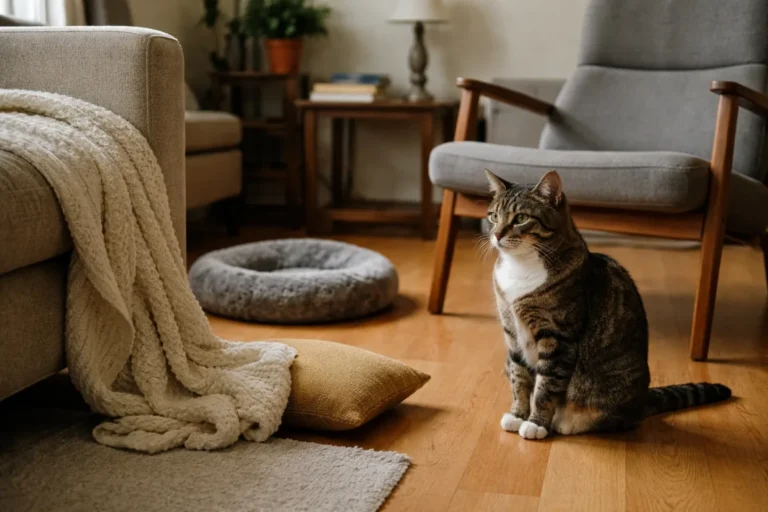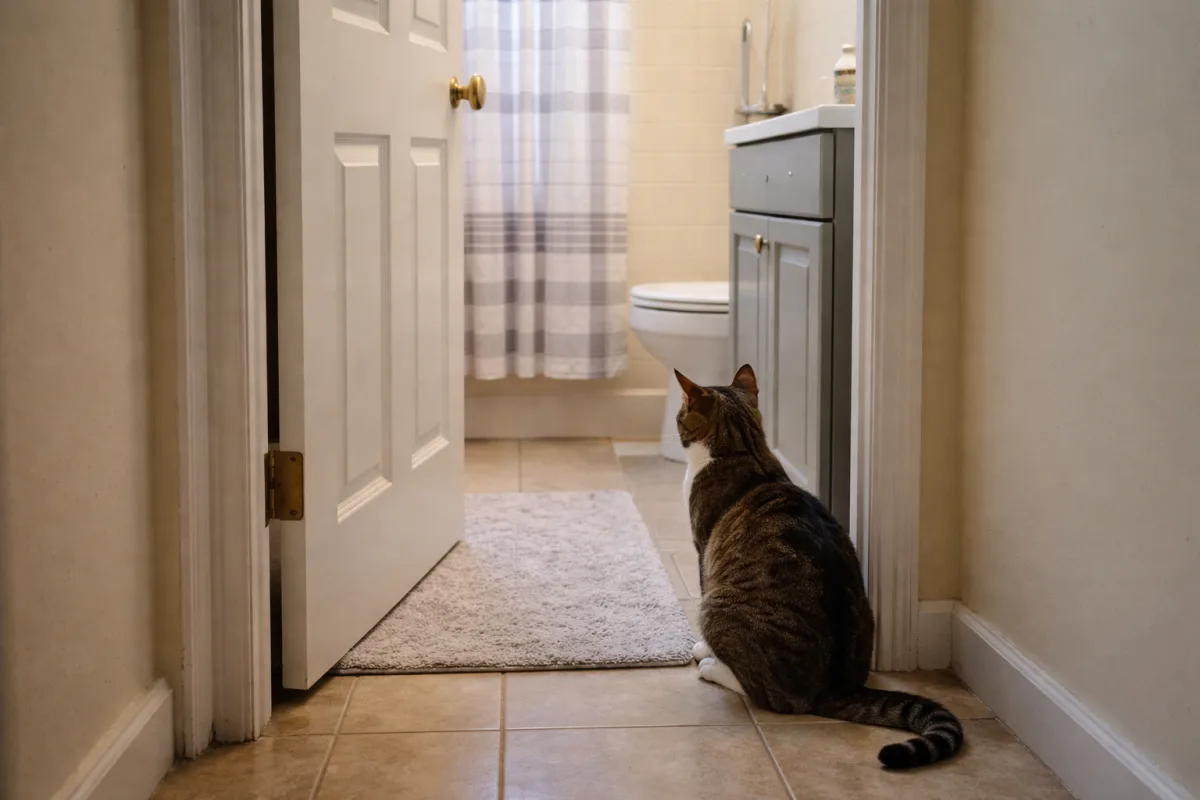
If you have ever closed the bathroom door only to hear soft paws waiting outside, you are not alone. Many cats treat the bathroom like a place they absolutely need to monitor. They may slip inside with you, settle near the tub, stare at the sink, or sit on the bath mat as if they were assigned there.
This behavior can feel funny at first, then slightly confusing, and sometimes a little intrusive. But for most cats, it is not random. The bathroom combines privacy, routine, scent, sound, and attention in a way that can be especially interesting to a cat.
Some cats follow their people everywhere, and the bathroom is simply one more stop. Others seem to care about that room more than any other. Understanding why cats do this often means looking at the whole picture: their instincts, their attachment style, the home environment, and the small details of daily life.
What This Behavior Looks Like in Everyday Life
Bathroom-following can show up in several ways. A cat may pace outside the door and meow until it opens, push inside the moment it cracks open, or wait quietly nearby and then appear the second you sit down. Some cats want direct contact. Others seem satisfied just knowing where you are.
In many homes, this behavior becomes part of a daily routine. Morning bathroom visits, late-night trips, and shower time often bring the cat out of nowhere. The pattern may be mild and consistent, or intense and very specific to certain times of day.
Common versions of the behavior
- Sitting at the door and waiting
- Following you in and then lying on the floor
- Jumping onto the sink, tub edge, or toilet lid
- Meowing, pawing, or nudging the door
- Watching water run or splashing a paw into it
Not every cat wants the same kind of access. Some want to be close to you. Others are drawn to the room itself. The difference matters, because it can point to different motivations behind the same outward behavior.
The bathroom often combines three things cats notice quickly: your presence, strong smells, and predictable routine. That mix can make it unusually attractive.
Why Cats May Follow You There
One of the simplest explanations is attachment. Cats do form strong bonds with their people, and some express that bond through shadowing behavior. If your cat follows you from room to room, the bathroom may just be where that habit becomes most obvious because the door creates a barrier.
Curiosity also plays a big role. Cats are observant by nature, and the bathroom is full of interesting changes. Water moves. Doors open and close. Cabinets hide things. You are also less active there, which may make your cat feel the room is finally worth investigating up close.
Then there is the smell factor. Cats live through scent in a way people often underestimate. Bathrooms usually carry strong and changing odors, from soap and toothpaste to laundry products and running water. To a cat, that is a detailed information center.
Possible internal reasons behind the habit
- Seeking closeness and reassurance
- Following a routine they have learned
- Responding to scent and sound in the room
- Watching for any movement or change
- Wanting to keep access to you under control
Sometimes the behavior is less about neediness and more about observation. Cats like to know what is happening. They often prefer to watch rather than participate, and the bathroom gives them a compact space where they can monitor everything from one spot.
A cat following you to the bathroom is often not “being weird.” It is usually combining instinct, habit, and interest in your movements.
How Cat Traits Shape This Behavior
Cats are often described as independent, but that word can hide how sensitive they really are. Many cats do like closeness. They just express it in quieter, more selective ways than dogs do. Bathroom-following is one of those selective habits. It can reflect trust, curiosity, and a desire to stay connected without constant direct interaction.
At the same time, cats are cautious. A closed door can feel like a boundary they want to understand. If you disappear behind it, they may want to confirm what is happening on the other side. That urge can be especially strong in cats that dislike being separated from their household routine.
The behavior also fits with a cat’s habit of observing from the edges. Bathrooms usually offer small spaces, clear sightlines, and limited exits. Those conditions allow a cat to watch safely without needing to be involved. That is very cat-like.
Typical cat traits connected to bathroom-following
- Attachment without constant physical contact
- Strong interest in routine and predictability
- Comfort with quiet observation
- Curiosity about barriers and closed spaces
- Preference for being near familiar people
In many cases, the cat is not demanding attention in the same way it might during playtime or feeding. It is simply staying close. The distinction matters because proximity itself can be a form of comfort for cats.
What the Bathroom Means to a Cat
The bathroom has a strange status in a cat’s mind. It is private for humans, but full of information for cats. A room with water sounds, smooth surfaces, and closed cabinets is already unusual. Add in a person who repeatedly enters that room every day, and it becomes even more interesting.
Some cats are drawn to the sound of running water. Others watch the shower curtain like it might hide something fascinating. Many simply like the routine of the room. If your presence there always follows the same pattern, the cat may have learned that the bathroom is a reliable point of contact.
For indoor cats especially, the bathroom can be one of the few places where household activity becomes very focused and predictable. You are not walking around. You are not on the phone. You are still. That stillness can make your cat more likely to approach, settle in, or keep watch.
Why the room itself can be interesting
- Running water creates sound and movement
- Closed doors invite investigation
- Cleaning products leave strong scents
- Small spaces support watching from a safe distance
- Your routine there is consistent and easy to track
Some cats even show a preference for specific bathroom moments. One cat may appear only when you brush your teeth. Another may arrive during shower time and leave as soon as the water stops. That timing is often a clue that the behavior is tied to habit, not just general affection.
How Context Changes the Meaning
The same behavior can mean different things depending on the cat and the situation. A relaxed cat waiting outside the door is different from a cat that seems anxious, vocal, or unable to settle. Body language matters. So does the rest of the household.
For example, a cat that follows you only in the morning may be responding to a routine it has learned. A cat that follows you every time you close the door may dislike separation. A cat that appears at the bathroom door only after a loud noise may be seeking reassurance. The context shapes the message.
Household activity matters too. In a busy home, the bathroom may be one of the quietest and most predictable places. In a very quiet home, it may be one of the few spots where the cat can catch your full attention. Those differences change how often the behavior shows up and how intense it becomes.
Context clues that help explain the behavior
- When the cat appears
- Whether the cat seems calm or tense
- How long the behavior lasts
- Whether it happens only with one person
- What else is going on in the home
A cat that follows you in a relaxed way usually looks loose in the body, with a neutral tail and quiet movements. A cat that seems worried may pace, vocalize more, or stay unusually close. Those differences can reveal whether the behavior is mostly social, curious, or stress-related.
Relaxed bathroom-following usually looks calm and repetitive. Stress-related bathroom-following is often more urgent, noisy, or tied to other changes in behavior.
When It Feels Social Rather Than Stressful
Many cats follow their people to the bathroom because they enjoy proximity. That is not the same as panic. A social cat may simply want to be near you while you handle a daily task. It may sit on the mat, rub against your leg, or wait patiently until you leave the room.
These cats often show other signs of easy comfort in the home. They may nap in open areas, greet you when you return, or choose to sit in the same room without needing constant interaction. Bathroom-following becomes one expression of a larger habit of companionship.
The behavior can also be tied to routine affection. Cats learn patterns quickly. If the bathroom is one of the few places where they know you will be in one spot for a few minutes, they may use that window for quiet contact. It is a practical choice, in a cat way.
Signs the behavior is social and relaxed
- The cat appears calm and unhurried
- It leaves easily when it wants to
- It does not show fear or tension
- It may nap nearby or simply watch
- The behavior fits a stable daily routine
In these cases, there is usually no reason to discourage the behavior unless it becomes inconvenient. Even then, the goal is usually to redirect gently rather than block the cat entirely.
When the Behavior May Point to Unease
Sometimes following you to the bathroom is part of a broader pattern that suggests uncertainty. A cat that clings more tightly than usual, cries when separated, or seems unable to relax may be reacting to stress. The bathroom becomes a place where the cat can regain visual contact with you.
Changes in the home can make this more likely. A move, a new pet, a different schedule, loud repairs, or reduced attention can all shift a cat’s sense of stability. When that happens, the cat may shadow you more than usual, including into the bathroom.
That does not mean the behavior is always serious. But it does mean the pattern should be read alongside the cat’s other signals. Appetite, grooming, hiding, vocalization, and litter box habits all help give the behavior its real meaning.
Signs that suggest stress may be involved
- Persistent meowing or calling through the door
- Pacing instead of settling
- Clinginess that is new or increasing
- Hiding less and shadowing more, or the reverse
- Other changes in eating, litter use, or sleep
If a cat seems distressed, the bathroom-following is not the issue itself. It is one visible part of a bigger emotional pattern. In that case, the cat may need more predictability, more quiet, or a check on what has changed recently.
Why Some Cats Care More Than Others
Not all cats follow their people to the bathroom, and not all that do behave the same way. Personality matters. Age matters too. A young, curious cat may investigate every door in the house. An older, settled cat may only appear when routine is disrupted or when a favorite person is nearby.
Breed tendencies can play a role, but home life usually matters more. A cat raised in a busy, interactive household may become accustomed to being part of every activity. A more independent cat may keep its distance unless the bathroom is interesting for some other reason, like running water or a favored perch.
Some cats also learn that the bathroom is a place where attention is easy to get. If following you there has ever led to petting, talking, or a door left open, the habit may strengthen over time. Cats are efficient learners when the reward is clear.
What can make the behavior more noticeable
- Long stretches of time indoors
- A predictable morning and evening routine
- One person being the cat’s favorite human
- Quiet homes with fewer distractions
- Past reinforcement, even accidental
This is why two cats in the same house can behave very differently. One may ignore the bathroom entirely. Another may treat it like a daily meeting room.
How Owners Often Read the Behavior
It is easy to assume a cat is being demanding when it follows you to the bathroom. Sometimes that is true in a mild sense. Cats do like access. But the behavior is often more layered than simple attention-seeking.
People may also misread bathroom-following as clinginess alone. A cat can be attached without being anxious. It can be curious without being needy. It can want to watch without wanting to interact. Those distinctions help explain why the same cat may quietly observe one day and vocally insist the next.
Owners sometimes notice that the behavior becomes stronger during changes at home. That is an important clue. The bathroom may be less about the room itself and more about the cat’s desire to anchor itself to something familiar: you, your routine, and the predictability of your movements.
When a cat follows you to the bathroom, the strongest clue is usually not the room. It is the cat’s overall state and how it behaves everywhere else in the house.
What Happens Over Time
Bathroom-following can stay stable for years, or it can fade and return depending on life stage. Kittens may do it out of curiosity and play. Adult cats may do it because they have learned the routine. Older cats may do it more when they want reassurance or more physical predictability from the people around them.
The behavior may also become quieter with age. A cat that once meowed at the door may later just settle nearby. Another may become more insistent if it develops stronger attachment patterns or if household changes make it more alert to separation.
That flexibility is normal. Cats do not hold one fixed relationship to a habit forever. They adapt, especially when the home environment changes.
Long-term patterns to notice
- Does it happen at the same times every day?
- Has the intensity changed over months?
- Does it appear with stress or change?
- Does the cat calm down once near you?
- Is the behavior part of a larger shadowing pattern?
Watching those details over time can tell you more than a single bathroom visit ever could. The behavior may be a small daily ritual, but the reasons behind it are often woven into the cat’s larger sense of security and habit.
A cat that follows you to the bathroom is usually doing something very ordinary from a feline point of view. It is checking on you, checking the room, and checking the routine. The habit may look quirky from the outside, but inside the cat’s world it often makes perfect sense.
What matters most is the pattern around it. A relaxed cat, a familiar routine, and a quiet interest in your presence usually point to comfort and curiosity. A tense, vocal, or newly clingy cat may be asking for a closer look at what has changed. The same door, the same room, and the same paws on the tile can mean different things depending on the day.