A cat that wants to stay close but refuses to be touched is sending a very specific message. It is not always a sign of rejection, and it is not automatically a sign of affection either. In many homes, this behavior shows up in quiet, ordinary moments: a cat follows you from room to room, sleeps near your feet, sits beside you on the couch, or watches everything you do from the edge of the bed. Then, when you reach out a hand, the cat leans away, steps back, or simply leaves.
That mix can feel confusing. The cat seems interested in your presence, yet guarded about physical contact. For many cats, this is a perfectly normal balance. They want proximity without pressure. They may enjoy being in the same space, but they prefer to control exactly how close the interaction becomes.
Understanding this behavior means looking at more than one moment. The cat’s body language, the timing, the environment, and the relationship history all matter. A cat that wants near-but-not-touch may be calm, affectionate in its own way, sensitive, unsure, overstimulated, or simply particular about personal space.
What this behavior looks like in everyday life
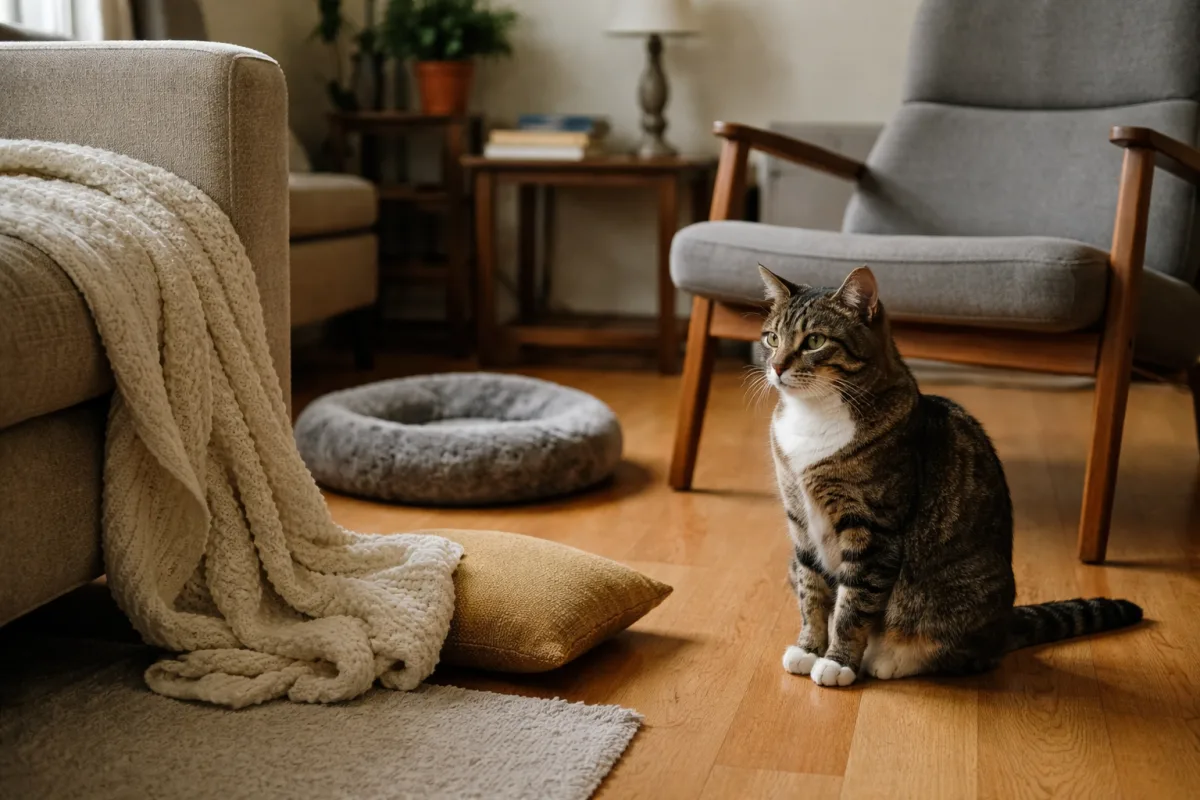
In daily routines, this pattern can appear in a few familiar ways. Your cat may choose the same room you are in, settle nearby, and seem relaxed as long as no one reaches out. It may rub against furniture close to you, stretch across the floor beside your chair, or curl up on the other end of the sofa. The cat is not hiding, and it is not acting fearful in an obvious way. It is staying connected while keeping control of the distance.
Some cats do this consistently. Others only do it at certain times of day or in specific settings. A cat might accept brief petting in the morning but not after dinner. It may come near when the house is quiet, then move away once children return from school or visitors arrive. The pattern can be very stable, or it can change depending on mood and context.
Here are some common examples:
- Sits next to you but moves away when touched
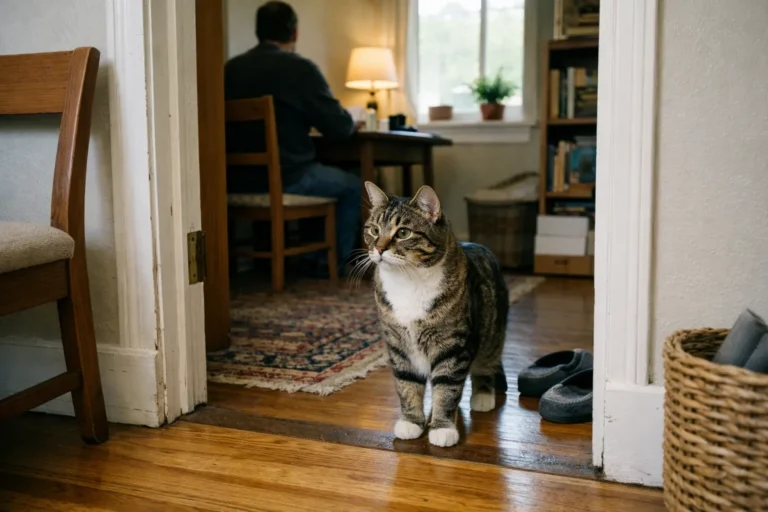
- Follows you from room to room without asking for petting
- Lies at the foot of the bed but dislikes being held
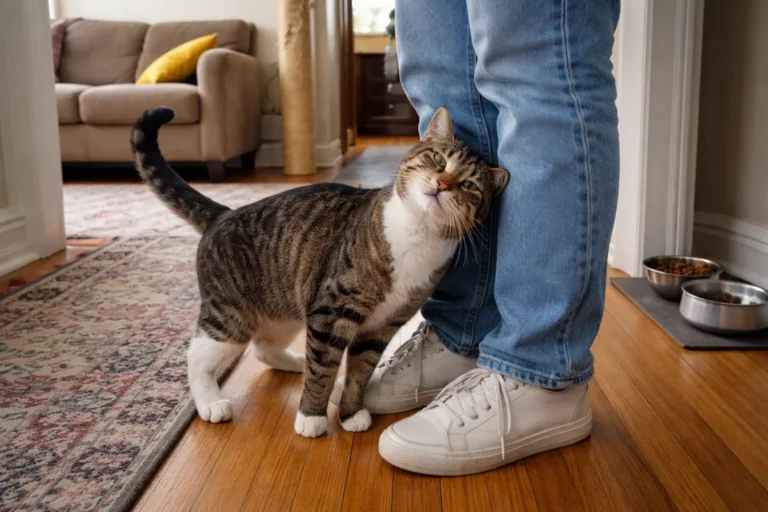
- Rubs against your legs, then declines a hand reaching down
- Waits near you while you work, but leaves when you try to stroke its back
These are not random contradictions. They often reflect a cat that values closeness on its own terms. The cat may like your company more than your hands.
Nearness and touch are not the same thing for a cat. A cat can enjoy your presence while still setting a firm limit on physical contact.
Why cats show this behavior in general
Cats are social in a selective way. Unlike dogs, they often build relationships through shared space, observation, and predictable routines rather than constant physical contact. A cat may feel secure simply by being in the same room as a trusted person. That shared presence can be meaningful even when petting is not welcome.
Some cats have a stronger need to control interactions. They choose when contact starts and when it ends. This is often connected to how they experience the world. Their senses are sharp, their bodies are sensitive, and being touched can feel pleasant one moment and too much the next. What looks like inconsistency is sometimes just a cat trying to stay comfortable.
Breed tendencies, early socialization, and past experiences can also shape this behavior. A cat handled gently and respectfully from kittenhood may still prefer limited touch. A cat with a rough history may be especially willing to stay close without wanting to be restrained. Even a very affectionate cat can have a low tolerance for prolonged petting.
It helps to remember that cats often communicate comfort through presence rather than constant contact. A cat that stays near you is saying something. The message may be simple: I trust you enough to be here, but I still want my space.
Subtle signals that often come with it
The best clues are usually in the body language. A cat that wants to be near but not touched often looks calm at first glance. Its body may be loose, ears neutral, and eyes partially closed. But when a hand moves closer, small changes appear. The cat may shift weight, turn its head away, flick its tail, or step to a safer distance.
Those changes matter. Cats rarely go from comfortable to uncomfortable without warning. The warning can be subtle, especially if the cat is trying to remain polite. A tail that gives a quick twitch, a back that tightens, or a slight lean away from the hand can all mean “close enough.”
Common body language to watch for
- Relaxed sitting or lying posture near you
- Gentle blinking or half-closed eyes
- Tail wrapped around the body or resting still
- Head angled toward you, but not pushing into contact
- Small retreat when your hand gets too close
- Ear position that shifts slightly back during touch attempts
Sometimes the cat will initiate brief contact and then stop it quickly. That does not mean the behavior is fake. It often means the cat likes a short interaction and no more. A chin rub might be welcome. A full-body stroke might not be. A few seconds can be enough.
Timing also tells you a lot. Some cats are more open before meals, after a nap, or in quiet evening hours. Others want closeness only after they have checked the room and confirmed that everything is safe. If the cat chooses the moment, it may be more receptive. If the touch is initiated too soon, the answer may be no.
What the behavior may mean emotionally
This pattern can reflect affection, caution, independence, or simple preference. Often it is a mix. A cat may deeply trust a person and still dislike being petted. That does not cancel the bond. It only means the bond has its own style.
In some cats, the behavior is about emotional balance. They want to stay connected, but too much direct contact feels intense. Being near you allows them to monitor the environment, enjoy your scent and sound, and feel included without losing control. For a sensitive cat, that can be the most comfortable form of closeness.
For other cats, it can signal uncertainty. They may want to be nearby because they are curious or attached, yet they do not fully relax around hands. This is more likely if the cat was not handled gently as a kitten, has had stressful grooming or veterinary experiences, or has learned that touch can lead to restraint. In that case, proximity may be a step toward trust, not the end point.
If a cat stays near you but avoids touch, the relationship may be strong even when the contact is limited. Affection does not always look like petting.
There is also a simple behavioral explanation: the cat may just dislike being touched in certain areas. Many cats tolerate a chin scratch or cheek rub but object to the belly, lower back, or tail base. A cat that seems touch-avoidant may actually have very specific preferences. Those preferences can change over time, too.
How context changes the meaning
The same behavior can mean different things depending on the setting. A cat that stays close but won’t be touched in a busy home may be overstimulated, not distant. A cat that refuses touch after a loud noise may be on alert. A cat that seeks your company in a quiet room may simply be choosing a low-pressure way to relax.
Environmental factors often matter more than people realize. Noise, visitors, strong smells, new furniture, moving boxes, another pet in the house, or changes in routine can all affect how much touch a cat will tolerate. Some cats become more touch-sensitive when the environment feels unpredictable. Others prefer closeness only when the world is calm and routine.
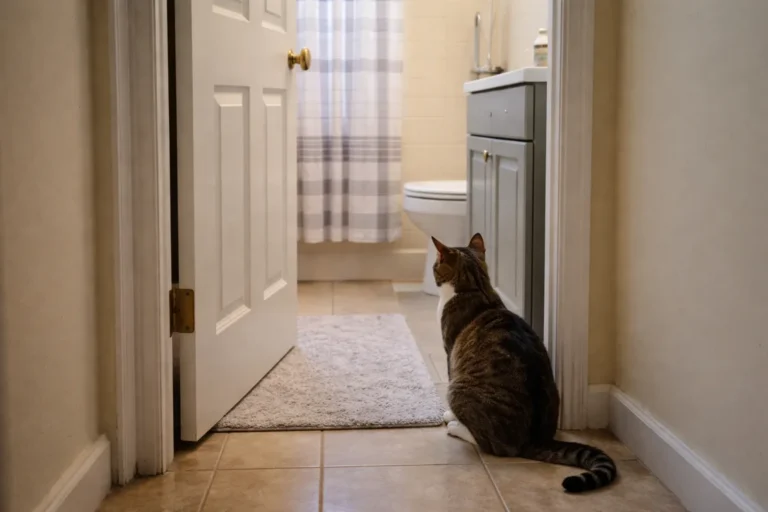
Daily rhythm plays a role as well. A cat may want to sit near you while you read, but not while you are actively moving around. It may follow you to the bathroom, then refuse to be picked up. This is not necessarily a contradiction. To a cat, each situation has a different level of control and safety.
Context clues that change interpretation
- Recent move or change in household routine
- Presence of visitors or unfamiliar animals
- Time of day and activity level in the home
- Whether the cat has just eaten, slept, or played
- Signs of stress such as hiding, reduced grooming, or tension
When the behavior appears suddenly, the context deserves extra attention. A cat that used to enjoy touch but now avoids it may be uncomfortable, sore, or stressed. A gradual preference for more space can be normal. A sudden change deserves a closer look.
Nearness without touch in different life stages
Kittens often move through phases of intense curiosity and quick retreat. A kitten may run toward a person, climb nearby, and then dodge the hand at the last second. This can be playful and exploratory. It is also a learning process. The kitten is testing how close it wants to be and how much contact feels safe.
As cats mature, their preferences often become clearer. Some adult cats grow more social and seek contact often. Others become more selective and develop very specific routines. A young cat that tolerated rough affection may later prefer quiet companionship only. An adult cat that once wanted constant petting may decide that sitting nearby is enough.
Older cats can show this behavior for different reasons. Some become less tolerant of touch because of stiffness, arthritis, or general sensitivity. They may still want to be close to their person, but not handled in ways that strain their body. In these cases, the cat’s preference for nearness with limited touch may be a practical response to discomfort.
That is why age matters. The same pattern can mean playfulness in a kitten, habit in an adult, or physical caution in a senior cat. Looking at the life stage helps narrow the interpretation without forcing one explanation onto every cat.
When the cat is calm, playful, or defensive
Not all near-but-not-touch behavior feels the same. A calm cat may sit beside you with a loose body and only move away when contact is attempted. A playful cat may dart in and out of reach, almost inviting a chase or a quick hand movement. A defensive cat may keep close because it wants to monitor you but remain ready to retreat if approached too directly.
The differences are subtle but important. A playful cat usually looks springy, alert, and interactive. Its ears stay forward, its movements are quick but smooth, and it may return after stepping away. A calm cat is slower and more settled. It may choose a fixed spot near you and stay there for a long time. A defensive cat often looks tighter, more watchful, and less willing to fully relax.
How the signals differ
| Type of behavior | Typical signs | What it often means |
|---|---|---|
| Calm | Loose body, quiet presence, brief retreat from touch | Prefers company without much physical contact |
| Playful | Quick movements, re-approach, teasing behavior | Interested in interaction, but on its own terms |
| Defensive | Tense posture, fast withdrawal, watchful eyes | Wants closeness for safety or monitoring, but feels guarded |
Mixed signals are common. A cat may nuzzle your leg, then refuse petting, then return five minutes later. That does not necessarily mean the cat is confused. It may simply be setting boundaries in real time. Cats often adjust their comfort level moment by moment.
In homes where people are very hands-on, this can be misunderstood as mixed affection. In reality, the cat may be communicating clearly. The message is not “stay away.” It is more often “stay near, but let me decide the terms.”
How owners often interpret it vs. what it may actually mean
People often read this behavior as rejection because touch is the most obvious human form of affection. When a cat declines it, the instinct is to assume something is wrong with the relationship. But cats do not measure closeness the same way people do. For many of them, shared space is enough to show trust.
A cat that follows you around the house is not neutral. A cat that sleeps within sight of you is not detached. A cat that sits near your chair while refusing a hand on its back may be choosing a level of intimacy that feels safe and sustainable. That choice deserves attention.
It is also common to mistake tolerance for enjoyment. A cat may allow petting for a short time, then walk away. That does not mean the cat dislikes you. It may just mean the cat has reached its limit. A lot of conflict can be avoided by noticing the limit before the cat has to defend it more strongly.
When a cat keeps choosing proximity, the connection is often real. The difference is that the cat may want connection without surrendering control over touch.
Some cats will never become lap cats. Some may only enjoy brief contact in very specific situations. That preference is not a problem to solve in every case. It is often a characteristic to understand and respect.
What to pay attention to over time
Patterns matter more than isolated moments. A cat that avoids touch once after a loud appliance noise is not telling the same story as a cat that consistently seeks your company but never your hand. Observing over days and weeks gives a clearer picture.
Watch when the cat comes close, what happens right before it leaves, and whether the behavior is tied to certain rooms or activities. Maybe your cat is comfortable near you on the floor but not on the couch. Maybe it likes being close after meals but not when you are standing up. Maybe the cat accepts petting from one person but not another. These details reveal how the cat experiences safety and choice.
Long-term stability is also informative. Some cats are simply like this for life. Their preference for nearness without touch stays consistent, and they remain healthy and relaxed. Other cats change as their environment, age, or health changes. If a cat’s comfort level shifts noticeably, especially toward more avoidance, it is worth noticing the pattern rather than forcing closeness.
- Track when the cat seeks proximity
- Notice what type of touch it accepts, if any
- Compare behavior in quiet vs. busy settings
- Watch for signs of discomfort, not just movement away
- Pay attention to changes over time, not just one interaction
Consistency can be reassuring. A cat that prefers to be near but not touched is often not sending a warning at all. It is expressing a stable preference. Once that preference is understood, daily life with the cat often becomes easier and more relaxed for everyone.
The cat on the chair beside you, the one at the edge of the bed, the one that shadows you from kitchen to hallway, may be communicating trust in a quiet way. The distance is small. The meaning can be larger than it first appears.