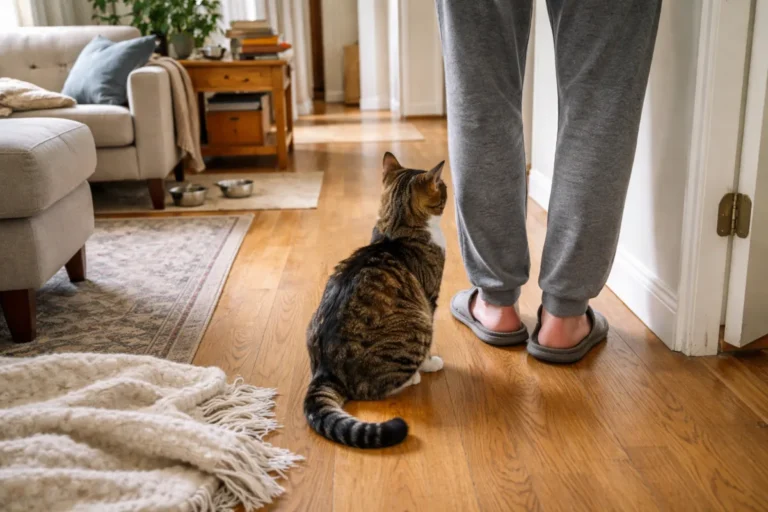
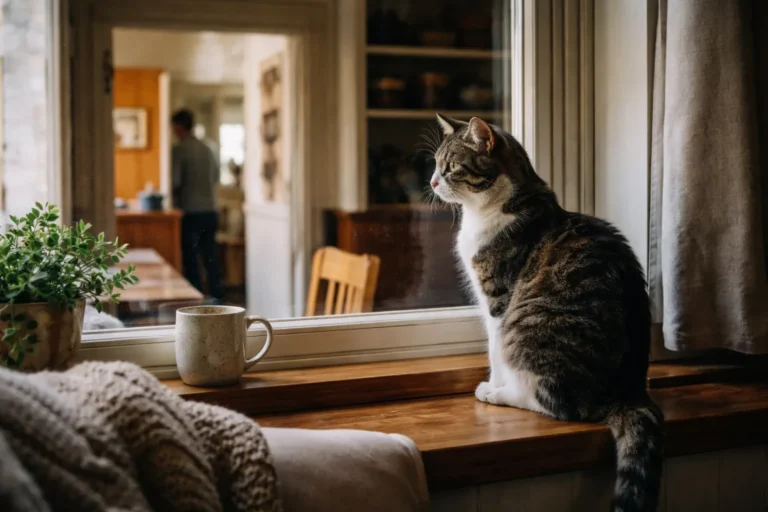
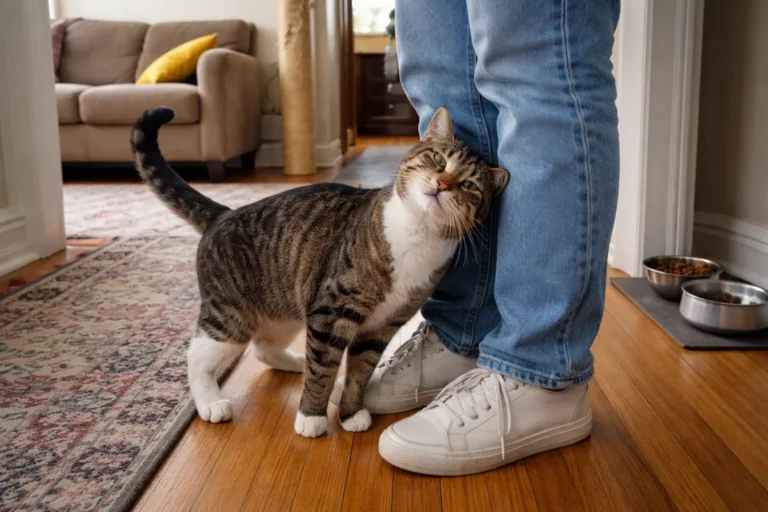
It usually happens right after the chair moves. You sit down to read, answer a message, or finally eat a warm meal, and your cat appears as if they had been waiting for that exact moment. They may hop onto your lap, settle beside your legs, or position themselves directly between you and whatever you were doing. The timing can feel suspiciously perfect.
That habit is not random. Cats notice routine with remarkable accuracy, and sitting down changes the room in ways they care about. Your posture, your attention, your scent, and even the quiet that follows all send signals your cat is quick to read. What looks like a simple cuddle often has several layers underneath it.
Many cat owners notice the same pattern in different homes, with different cats, and at different times of day. The details change, but the basic behavior stays familiar: you sit, and the cat arrives. Sometimes it is gentle and affectionate. Sometimes it is determined. Sometimes it seems almost strategic.
What Cats Are Really Responding To
When a cat comes over after you sit down, they are often responding to a shift in your availability. A person who is walking around, reaching, cooking, or cleaning feels busy and less predictable. A person who sits down becomes slower, quieter, and easier to approach. From a cat’s point of view, that difference matters a lot.
Sitting down also changes the physical space. Your lap becomes a warm resting place, the couch becomes shared territory, and your body becomes a stable surface instead of a moving obstacle. Cats are careful about where they choose to spend their time. They prefer places that feel safe, calm, and easy to leave if needed.
For many cats, a sitting person is a combination of warmth, safety, attention, and routine. That combination is hard to ignore.
There is another layer too: cats are excellent observers. They learn patterns quickly. If you tend to sit in the same chair at the same time each evening, your cat may start treating that moment as part of their own schedule. It is not unusual for them to appear before you are fully settled, almost like they were already expecting the cue.
How This Behavior Looks in Everyday Life
The behavior can show up in very different ways. Some cats leap directly into your lap and curl into a tight ball. Others sit near your feet, lean against your side, or place one paw on your arm as if to remind you they are present. A few cats prefer to sit nearby without touching at all, but they still stay close enough to be part of your space.
You may notice that your cat arrives at specific moments rather than at random. A chair that is empty for most of the day may suddenly become valuable the moment you use it. The bed can be ignored while you are making it, then claimed the second you lie down. The same pattern often applies to the sofa, the floor, or a sunny spot by a window.
Some cats are more obvious than others. One cat may meow and circle your legs. Another may quietly wait until you stop moving. A confident cat may climb on immediately, while a cautious cat may come closer in stages, pausing to watch your face and body language before settling.
Common situations where it appears
- After you sit down to relax in the evening
- When you return home and finally take a seat
- Right before mealtime or feeding routines
- When the house becomes quieter
- When your attention shifts away from a screen or task
- After a burst of activity, when calm returns
In many homes, the behavior becomes part of a daily rhythm. Cats notice that the person who sits in the same place every night often becomes a source of warmth, contact, and routine. Over time, that simple pattern can feel almost ritualistic.
Why Cats May Prefer You When You Sit Down
One reason is comfort. Cats often choose stillness over motion. A sitting human is predictable and less intimidating. The body language is easier to read, and the environment usually feels less tense than when a person is standing, walking, or reaching for things.
Another reason is access. When you sit down, your cat can get closer without having to compete with movement. This is especially true for cats that enjoy physical contact but prefer to initiate it on their own terms. A lap, a cushion next to your thigh, or the space between your ankles becomes more appealing once everything has slowed down.
There is also the matter of scent. When you settle into a chair or sofa, your scent concentrates in one place. Cats rely heavily on smell, and familiar scent can make a spot feel claimed and secure. If your cat rubs against you after you sit down, they may be mixing your scent with theirs and reinforcing that shared space.
In many cases, a cat is not just seeking attention. They are choosing the safest, easiest moment to connect.
Attention matters too. Even when you are not actively petting your cat, sitting down often makes you available in a way that standing does not. Your cat may have learned that this is the time when hands are free, your gaze is softer, and your pace is slower. To a cat, those are all good signs.
How Instinct Shapes the Behavior
Cats have a strong instinct to monitor their surroundings before settling in. A resting cat is vulnerable, so they tend to be selective about where and when they relax. When you sit down, you may create a calm anchor in the room. Your cat notices that change and may decide it is time to join you.
This behavior also connects to their natural preference for observation. Cats do not always want to be in the middle of everything. They like to watch first, then approach once they have collected enough information. Sitting down makes you easier to observe. Your movements slow. Your voice may soften. The room becomes less active.
That same instinct can explain why some cats come closer only after you are fully still. They may be waiting for the last sign that things have settled. A cat that seems clingy in this moment may actually be behaving in a very measured way, choosing the safest point of contact rather than acting impulsively.
Typical instincts involved
- Seeking warmth and physical comfort
- Choosing predictable, low-risk moments
- Watching body language before approaching
- Claiming a familiar shared space
- Responding to routine and timing
These instincts do not disappear in a home setting. They simply show up in softer forms. A living room chair becomes a resting perch. A bed becomes a territory marker. Your lap becomes part shelter, part social space, and part routine.
What It May Say About the Cat’s Mood
Sometimes the behavior means your cat is content and relaxed. A cat that comes over when you sit down may be looking for quiet companionship rather than active play. They may want to rest near you, knead your blanket, or purr while watching the room. In those moments, their behavior is calm and steady.
At other times, it can signal a stronger need for reassurance. A cat that follows you closely and insists on contact as soon as you sit may be seeking comfort after a change, noise, or disruption. New visitors, cleaning activity, loud weather, or a shift in routine can make a cat more attached than usual. Sitting down becomes the first safe moment to reconnect.
It can also reflect anticipation. If your cat has learned that sitting down often leads to petting, feeding, or a quiet session together, they may be showing up because they expect something familiar. That does not make the behavior manipulative or needy in a human sense. It simply means they have made a clear connection between your posture and a positive outcome.
Timing matters. The same cat may look affectionate in one context and uncertain in another, even if the behavior appears identical on the surface.
Pay attention to what happens before and after they arrive. A relaxed cat may have loose body language, a soft tail, and an easy pace. A more tense cat may appear suddenly, hover, or stay very close without fully settling. Those differences help explain whether the behavior is mostly social, comfort-seeking, or tied to stress.
How Body Language Changes the Meaning
The way a cat approaches you says as much as the behavior itself. A cat that walks over with a raised tail, slow blink, and loose posture is probably feeling comfortable and friendly. A cat that flops beside you, exposes their belly, or kneads your clothes is often deeply relaxed. These are signs of trust and ease.
By contrast, a cat that comes over and stays alert may be asking for proximity without complete rest. Their ears may stay forward, but their body remains ready to move. They may sit beside you while keeping an eye on the room. That often means they want comfort, but they are still maintaining awareness of their environment.
Some cats blend signals. They may come for attention, then suddenly leave after a minute. They may climb into your lap and then reposition several times. This does not always mean confusion. Cats can enjoy contact in short bursts. They often regulate closeness based on temperature, noise, and how much stimulation they want at that moment.
Soft signals and stronger signals
| Signal | What it often suggests |
|---|---|
| Slow approach | Comfort, caution, or thoughtful interest |
| Immediate lap jumping | High confidence, warmth, or strong familiarity |
| Tail held high | Friendly mood and social interest |
| Hovering nearby | Interest with some caution |
| Purring and kneading | Contentment and relaxation, often in a safe setting |
These signals help explain why the same behavior can have different meanings from one cat to another. A lap cat and a nearby watcher are both responding to the fact that you sat down. They are simply using different levels of confidence and closeness.
How Home Environment Affects the Pattern
The home itself can shape how often this happens. In a quiet house, a cat may come over every time you sit because the room instantly becomes calm enough for interaction. In a busy household, the behavior may be less immediate. The cat may wait until children settle, appliances stop, or the general movement slows down.
Indoor cats often show the behavior more clearly because the home is their main world. They rely on you not only for food and care but also for cues about the day’s rhythm. If your routines are predictable, your cat can build a strong pattern around them. The more consistent the schedule, the easier it is for the cat to know when it is time to come near.
Outdoor access can change the pattern as well. A cat that spends time outside may be more selective about when they seek human contact indoors. They may come in, inspect the room, and then settle with you only after they have checked their surroundings. Sitting down may be the cue that tells them the indoor part of the day is safe and complete.
Noise, temperature, and furniture layout all matter too. A soft chair near a window can become a favorite resting place. A couch in a quiet corner may attract more visits than a chair near the main traffic path. Cats are not only responding to you. They are also responding to the whole setting around you.
How Routine Makes the Behavior Stronger
Cats remember sequences. If sitting down regularly leads to petting, brushing, treat time, or a shared nap, the cat will notice. The association can become so strong that your cat appears before you even settle fully. In a sense, your own routine teaches the cat when to show up.
This is especially visible in the evening. Many cats become more active or more affectionate when the household slows down after dinner. The end of the day often brings the right conditions: lower noise, repeated seating patterns, and a person who finally has time to respond. For a cat, that combination is easy to learn.
Over weeks and months, the pattern can become stable. Some cats consistently choose the same person, the same chair, or the same time of day. Others remain flexible and shift depending on mood, room temperature, or recent activity. Both versions are normal. What matters is the consistency of the signals your cat has learned from your behavior.
When a cat comes over the moment you sit down, it is often the result of repeated experience, not chance.
That is why changes in your own routine can change the cat’s behavior. A new work schedule, different furniture, a shift in feeding time, or even a habit of sitting in another room can affect when and where your cat appears. They are responding to a pattern they have built with you.
When the Behavior Becomes More Noticeable
You may see it more often during transitions. After a house move, during colder weather, after visitors leave, or when daily schedules change, cats often seek more predictable contact. Sitting down can become a secure signal in the middle of uncertainty. The cat may use that moment to re-center themselves.
It can also become more obvious as cats age. Older cats often appreciate warmth, softness, and routines they can count on. They may still be independent, but they may also spend more time near familiar people once the day settles. A sitting human becomes an easy source of comfort without requiring much effort.
At the same time, younger cats may show the behavior with more energy. They may dart over, climb up quickly, and then decide whether to stay. In those cases, the motion itself is part of the interaction. They are not only seeking closeness. They are testing the moment and reacting to whatever invitation your body gives them.
Different reasons across situations
- After a busy day: the cat may want calm contact
- During cold weather: warmth becomes a stronger draw
- After routine changes: the cat may seek reassurance
- In the evening: the cat may expect attention and rest
- After your arrival home: the cat may want reconnection
These patterns can overlap. A cat may be attracted by warmth, comfort, habit, and companionship all at once. That is part of why the behavior feels so familiar and yet so easy to misread.
What Owners Often Assume, and What May Be Happening Instead
It is easy to think the cat is simply “being affectionate” and leave it there. Affection is often part of it, but not always the whole story. A cat coming to you when you sit down may be expressing comfort, curiosity, habit, or a need for predictable proximity. The action can carry several meanings at the same time.
Some owners assume the cat wants constant petting. In reality, many cats want closeness more than handling. They may be happy to lie on the sofa beside you without being touched much at all. Others enjoy touch in short intervals and then prefer to rest. Watching for how long they stay and how they respond to contact helps you understand the difference.
Another common assumption is that a cat is choosing the person, not the moment. In truth, the moment matters a lot. Your cat may love you and still avoid you while you are active. Once you sit, the relationship becomes easier to express. The behavior is often about timing as much as attachment.
A cat that comes when you sit down is often saying, “Now is the right time,” not only, “I want you.”
That small distinction changes how the behavior feels. It becomes less mysterious and more understandable. The cat is not acting out of nowhere. They are reading your posture, your routine, and the room around them, then choosing the safest and most appealing moment to be near you.
A Quiet Final Thought on the Pattern
When a cat comes over the second you sit down, they are showing how carefully they watch your life. They notice when movement slows, when the room softens, and when your attention becomes available. Sitting down is not just a change for you. It is a signal your cat can read clearly.
That is why the behavior can feel so personal. It often combines habit, comfort, and trust in a single moment. Your cat has learned that your stillness creates a good place to land, and they return to it again and again. The pattern may be simple on the surface, but for a cat, it is full of meaning.