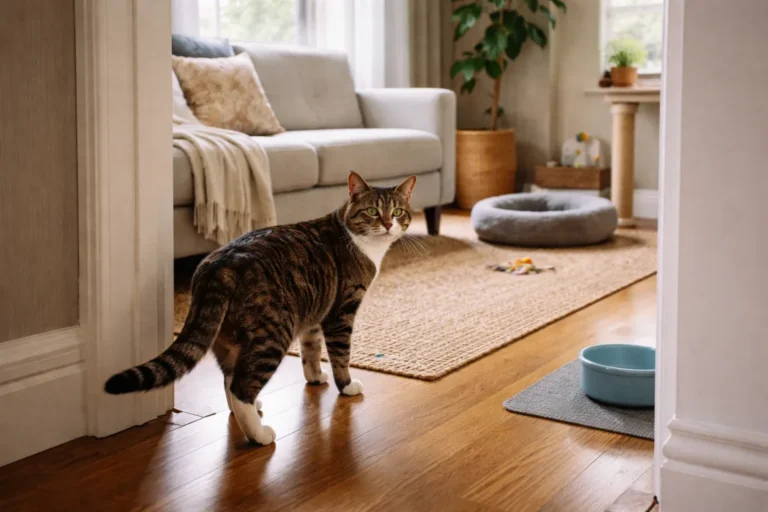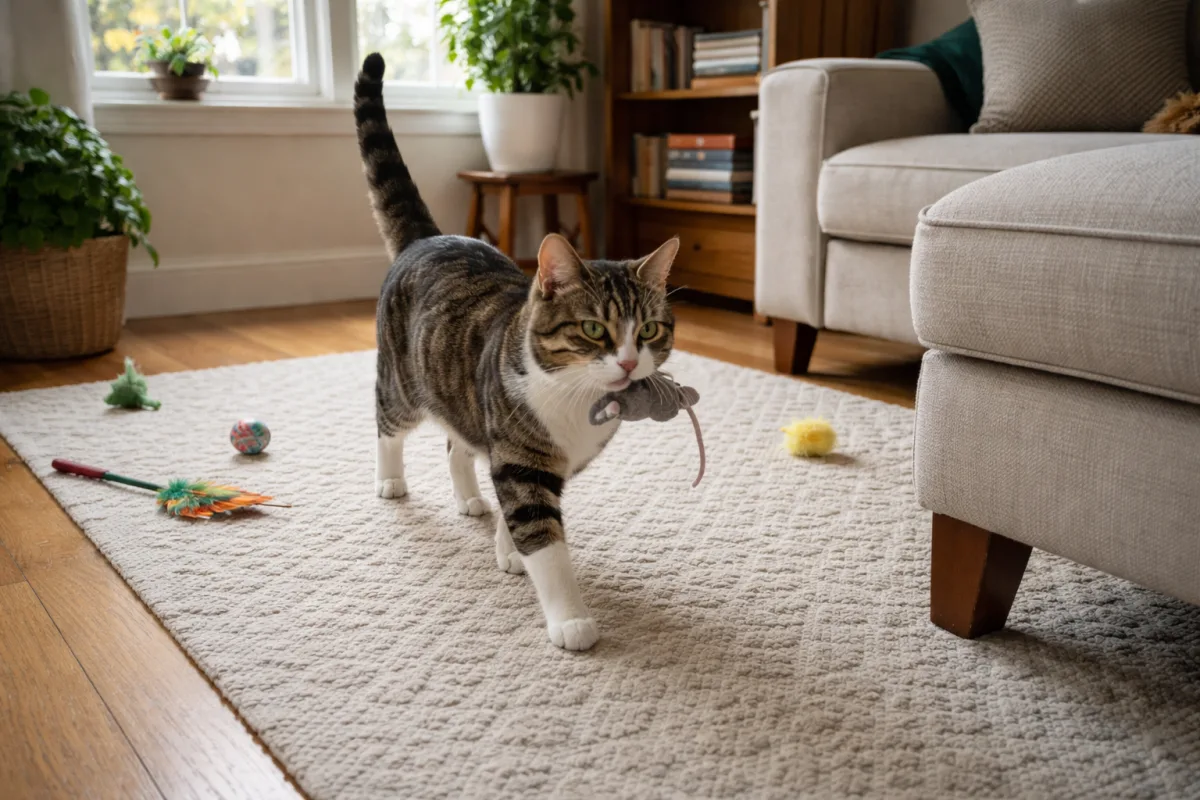
A cat drops a toy at your feet. Sometimes it is a crumpled paper ball. Sometimes it is a toy mouse, a sock, a leaf from outside, or even something that clearly was not meant to be carried anywhere. The moment feels oddly deliberate. Your cat looks at you, waits, and seems to expect something in return.
This behavior can look simple on the surface, but it usually sits at the intersection of instinct, attention, routine, and relationship. Cats do not bring objects for one single reason. A cat that carries something to you may be playing, hunting, sharing, asking for interaction, or repeating a pattern that has become part of daily life.
In many homes, the behavior appears so regularly that it starts to feel like a message. Often it is. The object itself matters less than the context around it: when the cat brought it, what happened before, and how the cat behaves right after. Those details tell a much clearer story than the object alone.
What this behavior looks like in everyday situations
Cats bring objects in different ways, and the meaning can change from one moment to the next. A cat may pick up a toy and carry it to the living room, then drop it near a person’s chair. Another cat may meow while walking toward a bedroom with a favorite plush toy in its mouth. Some cats place the object in a visible spot and leave it there. Others insist on presenting it directly, as if the delivery itself matters.
These moments often happen during predictable parts of the day. Many cats bring objects in the early morning, around playtime, or when they want a response from their person. Some cats do it after a period of quiet activity, almost like they have decided it is time to involve someone else. The behavior may also appear when a cat is excited, slightly restless, or trying to restart a routine that has gone quiet.
In homes with multiple people, a cat may choose one specific person. That choice can make the behavior feel even more intentional. It is not unusual for a cat to carry the same toy to the same spot every day, almost as if that location has become the “delivery point.”
Possible internal reasons behind the behavior
The most common reason is instinct. Cats are natural hunters, and carrying objects is closely related to predatory behavior. Even if the object is not prey, the action itself can satisfy part of the same sequence: spot, grab, carry, deliver. Domestic cats do not need to hunt to survive, but the behavior patterns remain strong.
Another reason is play. Cats often bring things when they want to continue a game or invite a human to join. A cat that carries a toy to you may be saying, in its own way, that the interaction is not finished. This is especially likely if the cat stays nearby, makes eye contact, or returns repeatedly after you do not respond.
Attention also plays a role. Cats learn quickly that carrying an object gets a reaction. A person laughs, talks, picks up the toy, or throws it. The cat notices the result. Over time, that response can turn the behavior into a reliable habit. What begins as instinct can become a learned social routine.
When a cat brings you objects, it is often combining instinct with expectation. The cat may want to hunt, play, or simply get your attention using a behavior that feels natural to it.
There is also a social layer. Cats are often described as independent, but many of them build subtle habits around the people they trust. Delivering an object may function as a form of connection. The cat is not always “giving a gift” in the human sense, but it may still be choosing to share a moment or a resource.
How context and environment influence it
The home environment can make the behavior more or less common. A cat with very little stimulation may bring objects more often because the action gives the day some structure. A cat in a lively home may do it because toys are everywhere and people are easy to engage. In both cases, the surrounding environment shapes how often the behavior appears and what the cat seems to get from it.
Indoor cats often show the behavior more clearly than outdoor cats, simply because toys and household objects are available and carrying them around becomes part of indoor life. An indoor cat may hunt through soft toys, socks, bottle caps, or other lightweight items. A cat with outdoor access may still bring objects, but the behavior can be less obvious or mixed with other outside activities.
Household routine matters too. Cats notice patterns. If a person usually plays after breakfast, the cat may bring a toy near that time. If a cat gets rewarded with attention after carrying something over, the pattern may repeat daily. A change in schedule can make the behavior more noticeable because the cat may be trying to restore the routine it expects.
Noise level, household pace, and available enrichment can also affect the behavior. A quiet cat may use object carrying as one of its main outlets. A very active cat may do it often because it has learned that movement and interaction are available all day. The same behavior can therefore mean different things depending on how a cat lives.
What the behavior may signal about the cat’s state
Body language gives important clues. A cat that brings an object with a relaxed posture, loose tail, and calm ears is often showing comfort and engagement. The cat may be playful or socially interested. If it places the object down and looks at you expectantly, it likely wants a response.
A more intense version can happen when a cat is highly aroused or overstimulated. The cat may carry the item quickly, vocalize, pace, or repeatedly drop and pick up the object. This does not necessarily mean distress. It can simply mean that the cat is very energized and has found a way to express it.
Some cats bring objects when they feel uncertain or understimulated. In those cases, the behavior may seem more repetitive or insistent. The cat might carry the same item from room to room, almost as if it cannot settle. If the behavior appears alongside restlessness, attention-seeking, or changes in routine, it may be worth looking at whether the cat needs more predictable play or enrichment.
Pay attention to the full pattern, not only the object. Timing, posture, vocalization, and repetition tell you far more about the cat’s state than the item itself.
On the other hand, some cats bring objects in a completely calm, almost ceremonial way. They may appear content and composed, with no sign of tension. In those cases, the behavior can simply be a stable habit that has become part of the cat’s normal way of interacting.
Different kinds of objects and what they may suggest
The object itself can offer hints. Soft toys, toy mice, and balls often point to play or mock hunting. These are easy to carry and fit neatly with predatory instincts. They are also common items cats learn to “present” because they are light, movable, and rewarding to manipulate.
Household items tell a slightly different story. A sock, pen, hair tie, or piece of paper may suggest curiosity and opportunistic behavior. Cats often choose objects by texture, smell, size, or how easy they are to move. The object does not need to be special to the person. It only needs to be interesting to the cat.
Some cats bring items that carry strong scent value. Clothing, shoes, or laundry can be especially attractive because they smell like their person. In those cases, the cat may be responding as much to scent as to the object itself. That can make the behavior feel more personal, even if the cat’s motive is practical and sensory rather than emotional.
| Object type | Common possible meaning |
|---|---|
| Toy mouse or ball | Play, hunting behavior, invitation to interact |
| Sock or clothing | Scent attraction, comfort, carrying habit |
| Paper or lightweight household item | Curiosity, boredom, easy transport |
| Outdoor item like a leaf | Exploration, novelty, bringing “found prey” |
Why some cats bring objects to specific people
Many cats do not bring items to everyone. They may choose the person who plays most often, moves predictably, or responds in a way the cat likes. That choice is not random. Cats are skilled observers. They notice who throws the toy, who talks to them, and who seems available at certain times.
Sometimes the chosen person is the one who created the habit without realizing it. If a cat brought a toy once and got immediate attention, the cat may have filed that outcome away. After that, the same person becomes the most likely target because the cat expects a useful response.
Trust can matter too. A cat may carry objects to someone it feels safe around. In a busy home, this may be the quietest person, the most consistent person, or the one who respects the cat’s signals. The behavior can look affectionate, but it is often built on a mix of comfort, predictability, and learned response.
How kittens and young cats differ from adults
Kittens often bring objects in a more obvious play context. They are still developing coordination, so carrying something can feel like an achievement in itself. Their behavior may look clumsy, exaggerated, or highly repetitive. They may also seem more likely to treat anything small and movable as a prize.
Young adult cats usually show more direction. They know which objects are worth carrying and where they want to take them. The behavior can become tied to routine, especially if the cat has learned that people respond at certain times.
Older cats may carry objects less often, but the habit can continue if it has become part of daily life. An older cat may still bring a favorite toy, especially if play remains important. If the behavior changes suddenly in a senior cat, it is worth considering whether mobility, vision, or routine has shifted.
When the behavior becomes more noticeable
The pattern often becomes stronger when a cat is under-stimulated. A cat with too little play, too little novelty, or too much idle time may turn to object carrying as an outlet. It gives the cat something concrete to do and may lead to a response from a person.
It can also become more noticeable during changes in the home. A new schedule, a move, visitors, or less attention than usual can all make familiar behaviors stand out. Cats often respond to uncertainty by increasing behaviors that feel safe and familiar. Carrying objects can be one of those behaviors.
Some cats become especially active with object carrying in the evening. That time of day often matches natural bursts of feline energy. A cat may patrol the home, find a toy, and bring it to where the family is gathered. The behavior then becomes both self-directed and social.
How owners often interpret it vs what it may actually mean
People often read too much or too little into this behavior. Some assume the cat is making a gift in a human-like way. Others dismiss it as random carrying. The truth usually sits between those two views. The cat may not be “gifting” in the human sense, but the behavior is rarely random.
The cat is usually communicating something practical or instinctive. It may want play, stimulation, acknowledgment, or a chance to repeat a satisfying pattern. In some homes, the meaning is very stable because the cat has learned that the same action leads to the same result. That predictability is often the heart of the behavior.
A cat bringing you an object is less about the object and more about the sequence around it. The cat noticed something, carried it, arrived near you, and expected a response. That sequence is the message.
It is easy to over-interpret the behavior as either pure affection or pure hunting instinct. In reality, it may hold both. Cats can act on instinct while also using the behavior to connect with the people around them. Those motives do not cancel each other out.
How to read the pattern without forcing a single meaning
The best clue is consistency. If a cat only brings objects after play sessions, the behavior is probably linked to play and continuation. If it happens when the cat is alone for long periods, boredom or frustration may be part of the picture. If the cat chooses a particular object and location every time, habit is likely playing a major role.
Look at what happens after delivery. Does the cat wait, meow, or run away and return? Does it seem to want you to throw the object? Does it settle down once you acknowledge it? These details help explain the behavior without needing to guess at a single fixed meaning.
It also helps to note whether the behavior is relaxed or frantic. Relaxed carrying usually points to a comfortable routine. Quick, repeated, or intense carrying may reflect high arousal, excitement, or a need for more engagement. The difference matters because the same action can sit in very different emotional states.
Signs the behavior is probably playful
- The cat has loose, comfortable body language
- It drops the object and waits for interaction
- It repeats the action mostly during playtime
- It seems eager, not tense
- It returns to the object when you move it
Signs the behavior may be linked to stress or restlessness
- The cat repeats the carrying over and over
- It seems unable to settle after bringing the object
- The behavior appears after a routine change
- There is pacing, vocalizing, or obvious agitation
- The cat seems more fixated than playful
What this says about cats as companions
Cats often communicate in indirect, small, and highly specific ways. Bringing objects is one of those ways. It may look simple, but it often reflects how a cat organizes its world: through habit, repetition, scent, timing, and selective attention to people. That makes the behavior feel personal even when it is rooted in instinct.
It also shows how adaptable cats are. They take an ancient hunting pattern and turn it into a household ritual. They may use a toy mouse, a hair tie, or a crumpled wrapper, then place it at your feet as if that were the most natural thing in the world. In a home environment, that instinct becomes part of daily life rather than something hidden in the background.
Some cats do it to start a game. Some do it because the action is satisfying. Some do it because they have learned that it works. Many do it for several reasons at once. The behavior stays interesting because it is so flexible.
When a cat keeps bringing objects to you, it is usually repeating something that has already made sense to it. The object may change, but the pattern tends to stay rooted in what the cat finds rewarding, predictable, and worth sharing in that moment.