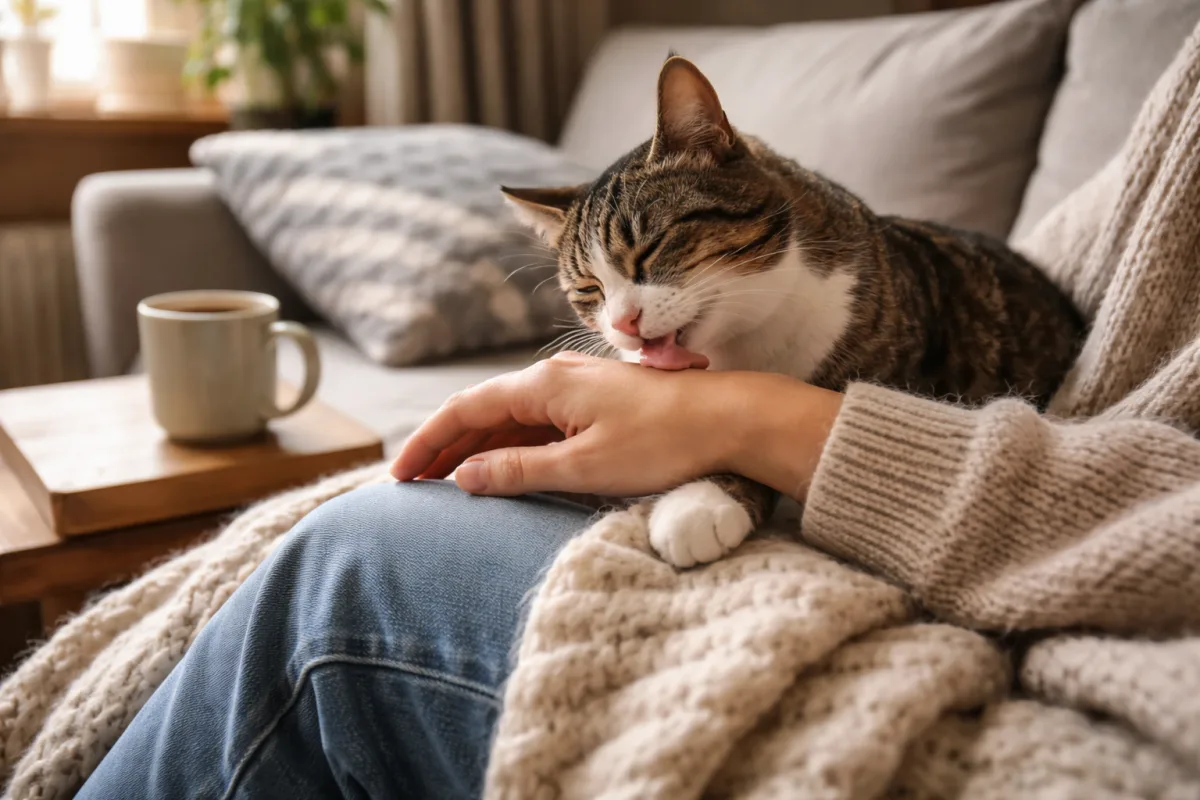
When a cat starts grooming you, it can feel a little surprising at first. A rough tongue on your hand, wrist, hair, or even your ear usually means more than simple curiosity. Cats do not lick people randomly for no reason, and the behavior often carries a social meaning that is easy to miss if you only think of grooming as hygiene.
In a cat’s world, grooming is personal. It helps with cleanliness, but it also helps cats communicate comfort, familiarity, and group belonging. When that behavior is directed toward a human, it often says something about the relationship itself. The cat is treating you as part of its close circle, and that can show up in several different ways depending on the cat’s mood, history, and surroundings.
Sometimes the licking is gentle and rhythmic. Other times it turns into a little nibble, a longer wash session, or a sudden switch from grooming to pawing at your hair. The meaning shifts with the context. A cat grooming you while curled beside you on the couch may be sending a very different message from a cat that licks your hand after a stressful day of visitors and noise.
What Cat Grooming You Usually Means
Cat grooming directed at a person is often a form of social bonding. Cats groom familiar cats in the same social group, especially those they trust. When your cat licks you, it may be extending that same behavior to you as a member of its safe social circle.
That does not always mean the same thing in every situation, though. A cat may groom you because it feels affectionate, because it is relaxing, because it likes the salt on your skin, or because it is trying to calm itself. The behavior can have more than one purpose at once. A cat is rarely being random.
When a cat grooms you, the most common meanings are trust, social bonding, comfort, and sometimes self-soothing.
Why Cats Groom People in the First Place
Grooming is built into feline behavior from an early age. Kittens are licked by their mother for cleaning, warmth, and comfort. That early experience shapes how grooming works later in life. It becomes tied not only to cleanliness, but also to safety and closeness.
Adult cats often use grooming to strengthen social relationships. In multi-cat homes, cats may lick each other around the head, neck, and shoulders. Those are hard-to-reach areas and common places for social grooming. When the behavior extends to a person, the cat may be transferring that social habit across species.
There is also a strong sensory element. Human skin can taste salty, and hair, lotion, or food residue can attract attention. A cat that licks your arm after you exercise may be responding to scent and taste as much as emotion. The same cat may groom your blanket or pillow because your scent is mixed into it.
How Cat Grooming You Looks in Everyday Life
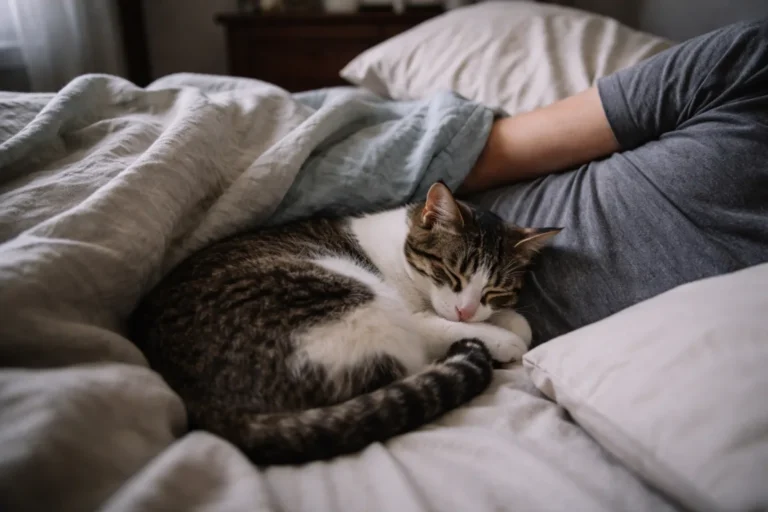
The behavior is not always dramatic. Often it shows up in small, ordinary moments. A cat may start licking your fingers while you are holding it. Another may groom your forearm while you are lying in bed. Some cats focus on hair, especially if it is long and loose enough to resemble fur.
There are also softer variations that people often overlook. A cat may knead first, then lick a sleeve or wrist. It may give a few slow licks, pause, and then resume after settling in. Some cats only groom when the room is quiet and the household feels predictable. Others do it after play, when they are warm and relaxed.
Common places cats choose to groom
- Hands and fingers
- Wrists and forearms
- Hair, especially loose strands
- Neck and shoulders
- Blankets or clothing with a strong personal scent
The location matters because it can hint at what is driving the behavior. Hands often suggest closeness and contact. Hair may suggest exploration, imitation of feline grooming, or attraction to texture. Clothing and blankets may reflect comfort and scent recognition more than direct social interaction.
Affection, Bonding, and Social Familiarity
One of the clearest meanings behind cat grooming is social affection. A cat that grooms you may be treating you the way it would treat a trusted companion. The behavior can be especially meaningful if it happens during quiet, calm contact. It may appear after a nap, while the cat is seated near you, or when you are both settled in the same room.
In many homes, this grooming becomes part of a cat’s routine with one specific person. The cat may lick that person more than others, follow them from room to room, or settle beside them before grooming begins. That pattern usually suggests a stable bond rather than a random habit.
A cat that grooms you during relaxed, voluntary closeness is often expressing comfort and social trust.
Still, affection in cats is rarely loud. It can look understated. A few careful licks, a head press, and then a return to resting can mean a great deal. The absence of dramatic behavior does not make the connection weaker.
When Grooming Is About Comfort or Stress Relief
Not every licking session is mainly about affection. Cats also groom to regulate themselves. Grooming can be soothing, repetitive, and predictable, which makes it useful when a cat feels uncertain, overstimulated, or mildly stressed. In those moments, licking a person may be part of a larger effort to settle down.
This is easier to spot when the behavior appears after a change in the environment. A new pet, guests in the home, loud construction, or a shift in routine can make some cats seek extra comfort. A cat that suddenly grooms more than usual may be trying to create a familiar ritual in a situation that feels less stable.
That does not automatically mean something is wrong. Many cats use grooming as a normal coping tool. The key is pattern and intensity. Gentle grooming during a calm stretch of the day is different from repetitive, urgent licking that seems hard for the cat to stop.
Signs grooming may be linked to stress
- It starts after a household change or disruption
- The licking becomes repetitive or intense
- The cat seems tense, alert, or easily startled
- Other behaviors change at the same time, such as eating or hiding
- The cat redirects grooming to itself, furniture, or fabric as well as you
The Role of Taste, Texture, and Scent
Some cats groom people because they like what they find on the skin or hair. Salt is one of the most common attractions. Sweat, lotion, shampoo, and food smells can all make a hand or face interesting to a cat. What feels like affection to a person may begin as simple sensory interest.
Texture matters too. Hair can resemble fur enough to invite licking, especially if it is soft, damp, or loose. A sweater sleeve may also become a target because it holds scent and offers a familiar texture under the cat’s tongue. Many cats prefer to groom when there is something they can grip with their paws or mouth, like a blanket edge or shirt cuff.
This sensory side of grooming does not make the behavior less meaningful. It just adds another layer. Cats often mix practical preferences with social ones. A cat may enjoy the taste of your skin and still be using grooming as a way to stay close.
Body Language That Helps Explain the Behavior
The tongue alone does not tell the full story. The rest of the body often reveals whether the grooming is relaxed, excited, or uneasy. A cat with soft eyes, loose muscles, and a tucked or settled posture is usually grooming from a calm state. The licks may be slow and measured.
If the cat’s tail is twitching hard, ears are angled back, or the body feels rigid, the grooming may not be purely affectionate. The cat could be overstimulated or conflicted. In some cases, grooming appears right before the cat decides to move away. That can mean the behavior is helping the cat stay calm long enough to remain nearby.
Watch timing as well. Grooming that starts after petting has gone on too long may be part of a “that is enough” message mixed with bonding. Grooming that happens when a cat is already curled against you usually points more strongly toward comfort.
How Owners Often Read It vs. What It May Actually Mean
People often interpret grooming as simple affection, and sometimes that is exactly right. But the meaning is usually broader than that. A cat grooming you may be saying you are familiar, scent-safe, and socially accepted. It may also be responding to the texture of your skin or the smell of your soap.
Owners sometimes assume the behavior always needs to be encouraged. That is not true. If the grooming is gentle and brief, it may be fine to let it happen. If it becomes rough, obsessive, or uncomfortable, the cat may need a small redirection, such as moving to a softer surface, offering a toy, or ending the contact before frustration builds.
Another common misunderstanding is assuming a cat that does not groom people is less attached. Many cats show closeness in other ways, such as sitting nearby, blinking slowly, bringing toys, or following routines. Grooming is just one expression of cat comfort, not the only one.
Different Forms of Cat Grooming You
Not all grooming looks the same, and the difference matters. A calm cat may give a few light licks and stop. A more intense cat may keep going, pair licking with nibbling, or insist on grooming hair and clothing for several minutes. Both can be normal, but they may reflect different levels of arousal.
A playful cat may mix grooming with pouncing, pawing, or rolling over. The action has energy in it. A more defensive or uncertain cat may lick briefly, then pull away, then return again. That stop-start pattern can suggest ambivalence rather than pure relaxation.
| Form | What it often looks like | Possible meaning |
|---|---|---|
| Calm grooming | Slow licks, relaxed body, settled posture | Trust, comfort, bonding |
| Playful grooming | Licks mixed with pawing or movement | Excitement, social play, attention seeking |
| Intense grooming | Repetitive licking or nibbling | Overstimulation, self-soothing, strong interest |
| Brief grooming | A few quick licks, then stopping | Recognition, scent checking, mild affection |
These forms can shift within one session. A cat may start gently and become more intense if it becomes overstimulated. Or it may begin with cautious licking and relax once it feels safe.
How Home Life Shapes the Behavior
Home environment affects grooming more than many people expect. Cats in quiet, predictable homes often groom in more relaxed, consistent ways. Cats in busy homes may do it in shorter bursts or during rare calm moments. The rhythm of the household can change how often the behavior appears and how long it lasts.
Indoor cats sometimes groom people more because the human relationship plays a bigger role in their social world. Outdoor access, other animals, and daily stimulation can change how focused the cat is on household bonding. That does not mean indoor cats are always more affectionate. It means their patterns may be easier to notice because the home is where most social interaction happens.
Routine also matters. Cats often like repeated patterns: feeding times, nap spots, and favorite people at specific times of day. Grooming may show up after dinner, before bedtime, or when a person returns home. If the routine shifts, the behavior may become less frequent or appear in new places.
When Grooming Becomes More Noticeable
Some cats groom people more during life changes. Moving homes, schedule changes, a new pet, or even seasonal shifts can make a cat cling more tightly to familiar contact. Grooming may increase when the cat wants reassurance or wants to hold onto stable parts of its day.
It can also become more noticeable during periods of warmth and rest. After play or during a long couch session, a cat may groom as part of a settling ritual. The behavior often peaks when the cat has energy to spare but is not fully active.
If grooming suddenly changes without an obvious reason, pay attention to the bigger picture. A rise in licking paired with restlessness, appetite changes, or hiding can point to something beyond ordinary bonding. On its own, though, a change in grooming frequency is usually just one clue among several.
What Consistency Over Time Can Tell You
Long-term patterns matter more than one-off moments. A cat that has always gently groomed one person during quiet evenings is showing a stable habit. A cat that begins grooming only after a major household change may be responding to the environment rather than simply expressing a constant personality trait.
Some cats remain consistent for years. Others become more or less affectionate as they age, settle in, or adjust to household dynamics. A cat that used to lick hands but now prefers to sit nearby may not be less bonded. The cat may simply be showing closeness in a different way.
Watching consistency helps separate habit from temporary reaction. If the grooming matches the cat’s usual temperament and the rest of its behavior stays steady, it is often part of normal social life. If it appears alongside other shifts, the broader context deserves attention.
What to Notice Before and After the Grooming
The moments around grooming can be just as revealing as the grooming itself. What happened right before it started? What did the cat do afterward? These small details often explain the behavior better than the licking alone.
- Did the cat come to you on its own?
- Was the room quiet or active?
- Had you just petted the cat for a while?
- Did the cat settle down afterward, or leave quickly?
- Was there a new smell on your skin, clothes, or hair?
A cat that approaches, licks a few times, then curls up beside you is often signaling comfort. A cat that licks and then becomes restless may be working through excitement or mild tension. Context helps decode the difference.
When Cat Grooming You Feels Too Rough
Not every grooming session is pleasant. Some cats use a tongue that feels unexpectedly sharp, and others move from licking to light biting. That can happen when the cat is overly excited, when it has reached the limit of what it enjoys, or when the grooming has become more intense than affectionate.
If the behavior is uncomfortable, it helps to end the interaction calmly and without punishment. Pulling away abruptly can make the cat cling harder. A gentler response is usually more effective: shift position, offer a toy, or place a blanket between you and the cat if it likes to nurse on fabric while settled near you.
Repeated intense grooming can also be a sign that the cat is seeking more stimulation or has learned that licking gets a response. In those cases, small changes in routine and interaction can help keep the behavior from becoming the only way the cat engages.
Gentle, brief grooming is usually a social gesture. Repetitive, intense, or uncomfortable grooming deserves a closer look at the cat’s mood and environment.
A Quiet Sign of Cat–Human Relationship
Cat grooming you is one of those behaviors that can seem small from the outside but feel meaningful in daily life. It often happens in ordinary moments, without fanfare. A cat licks your hand while you read, your hair while you sit on the couch, or your wrist when the room has gone still. Those little actions are part of how cats build and maintain closeness.
The meaning usually sits somewhere between affection and function. The cat may be bonding, tasting, calming itself, or all three at once. That layered quality is what makes the behavior so interesting. It is not a single message, but a blend shaped by trust, habit, and the cat’s immediate state.
When the grooming is gentle and balanced, it often belongs to the ordinary rhythm of a cat’s comfort with its people. When it changes, the same behavior can point to stress, excitement, or a shift in the cat’s needs. Reading those differences takes attention, but the clues are already there in the cat’s body, timing, and choice of when to start and stop.