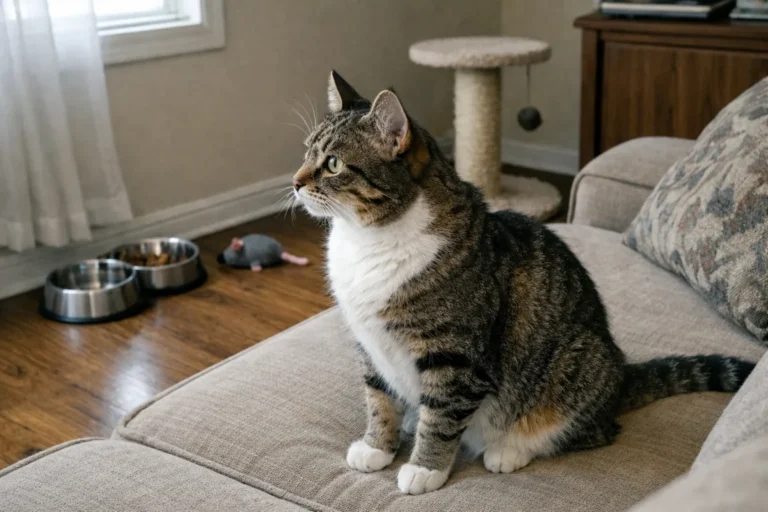
Cat bunting is one of those quiet, familiar cat behaviors that can feel sweet, mysterious, and a little more meaningful than a simple nuzzle. A cat may rub the side of its face against your leg, your hand, a chair leg, the corner of a wall, or even another pet. The motion can look gentle and casual, but it usually carries a clear message in cat language.
For many cats, bunting is part greeting, part scent-marking, and part comfort ritual. It happens in the middle of daily life, often when a cat feels relaxed enough to approach closely and make contact. A cat may bunt when you come home, when it wants attention, when it is moving through a familiar room, or when it is checking in after a change in the home.
Because the behavior is so common, it is easy to overlook. Yet bunting can reveal a lot about a cat’s mood, confidence, and relationship with its surroundings. The details matter: where it happens, how firmly the cat presses, whether the tail is held high, and what comes right before and after the contact.
What Cat Bunting Looks Like in Everyday Life
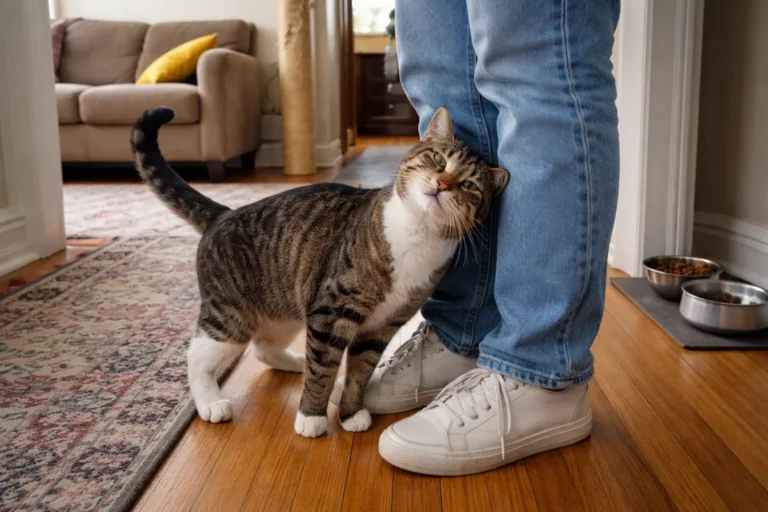
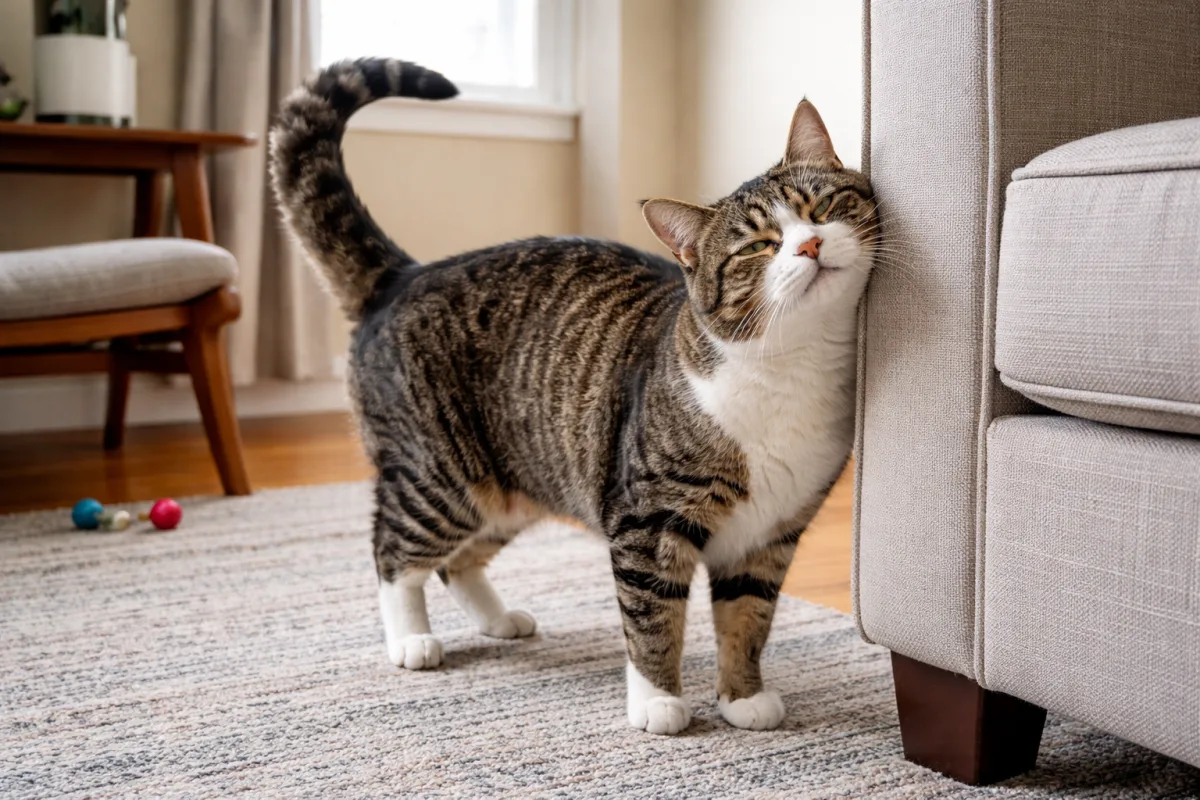
Bunting is usually a head-first motion. A cat will press the side of its face, forehead, or muzzle against a surface and move along it, often in a slow, deliberate way. Sometimes the cat just taps its head once and moves on. Other times it leans in harder and repeats the motion several times in the same spot.
In a home setting, bunting often appears during predictable moments. A cat may meet you at the door and rub against your ankles. It may walk past the sofa and brush its face along the corner. It may hop onto a bed and press its forehead into your arm before settling down nearby.
The behavior can look different depending on the cat’s personality. Some cats bunt with obvious enthusiasm and repeat the motion several times. Others are more restrained and do it quickly, almost as if they are leaving a signature instead of asking for attention.
Common places cats choose for bunting
- Your legs, hands, or arms
- Door frames and wall corners
- Furniture edges and chair legs
- Other cats in the home
- New objects brought into the house
These choices are not random. Cats often bunt places they want to claim, revisit, or make feel familiar. The behavior is as much about communication as it is about touch.
Why Cats Show This Behavior
Cat bunting is usually linked to scent communication. Cats have scent glands around the cheeks, chin, forehead, and lips. When they rub against something, they are leaving behind scent from those glands. To a cat, that scent can help mark an object, a person, or a place as safe and known.
This is one reason bunting often appears in environments the cat trusts. A cat does not usually move through a room and bunt everything if it feels worried or overstimulated. The behavior tends to happen when the cat is comfortable enough to reduce distance and make contact.
There is also a social side to it. Cats living with people often use bunting as a form of friendly interaction. It can be a greeting, a way to start a session of petting, or a quiet request for attention. In multi-cat homes, bunting may help reinforce group familiarity and reduce tension around shared spaces.
When a cat bunts you, it is often combining scent-marking with social contact. It is not only rubbing. It is also saying, in cat terms, “You are part of my familiar world.”
What the Behavior May Signal About the Cat’s State
The context around bunting can tell you a lot about what the cat is feeling. A relaxed cat may bunt slowly, with soft eyes, a loose body, and an upright or gently curved tail. A cat that wants interaction may bunt repeatedly and stay close afterward, waiting for a response.
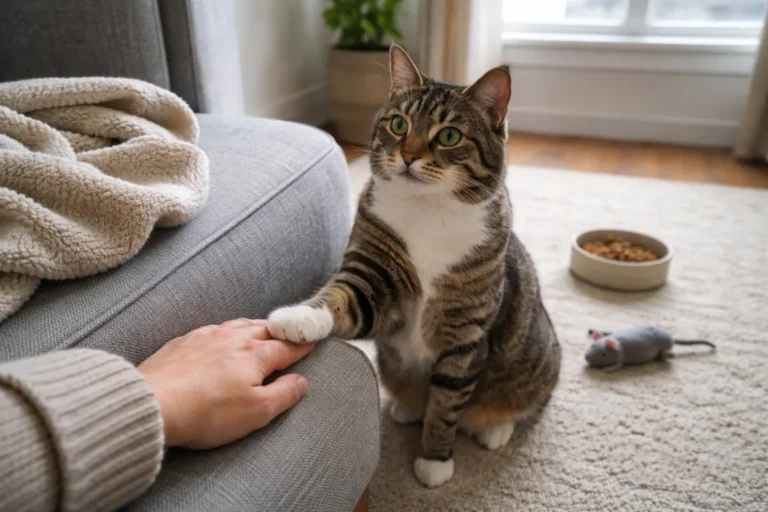
If the behavior is paired with purring, kneading, or a head-raising movement into your hand, it often points to comfort and trust. The cat may be seeking both physical contact and a familiar scent exchange.
Sometimes bunting appears when a cat is trying to settle itself. A cat in a new room, after a household change, or following an unfamiliar noise may rub on nearby objects more often. In those moments, the behavior can function like a way to restore familiarity.
Signals that often appear with friendly bunting
- Tail held up or softly curved
- Slow blinking
- Relaxed whiskers
- Loose, unhurried walking
- Seeking repeat contact
These signs usually suggest that bunting is part of a calm and positive interaction. Still, cats are individuals. One cat may bunt almost constantly when happy, while another may do it only once a day and still mean exactly the same thing.
How Bunting Differs From Similar Behaviors
It is easy to confuse bunting with other forms of rubbing. Cats also rub with their flanks, shoulders, and sides, especially when moving around furniture or another cat. The difference is often in the contact point and the intention behind it.
Head bunting uses the face or forehead and usually looks more deliberate. A cat may angle its head up toward a person or object, press in, and hold that contact for a second before moving away. Side rubbing is often part of walking and may be less focused on direct social exchange.
Another behavior that gets mixed in with bunting is head pressing, which is entirely different. Head pressing is a medical concern and involves a cat pressing its head persistently into a wall or hard object without normal social context. Bunting is active, controlled, and paired with ordinary body movement. Head pressing is not.
| Behavior | What it looks like | Common meaning |
|---|---|---|
| Bunting | Cat rubs face or forehead against a person or object | Scent-marking, social greeting, comfort |
| Side rubbing | Cat brushes body along furniture or legs | Familiar marking, movement, attention-seeking |
| Head pressing | Cat forcefully holds head against a surface | Possible medical issue, needs veterinary attention |
How Context and Environment Influence Bunting
The same cat may bunt more in one setting than another. Indoor cats often use the behavior to organize their world through scent, especially in homes with frequent movement, cleaning, guests, or rearranged furniture. If a couch is moved or a new chair appears, a cat may bunt it repeatedly over the next few days.
Outdoor access can also shape the behavior. Cats that go outside may bunt less in the home for some periods and then resume once they return. The behavior may increase after coming back from a walk, a carrier trip, or a vet visit, when the cat wants to restore a familiar scent environment.
Household rhythm matters too. Cats often bunt at the times when people are most predictable: morning routines, meal prep, arrival from work, or bedtime. In a quiet home, the behavior may be subtle and spread throughout the day. In a busier home, it may become more obvious because the cat uses bunting as a consistent way to reconnect after interruptions.
A sudden increase in bunting after changes in the home can be completely normal. Cats often use scent contact to make new or altered spaces feel more familiar again.
Different Forms of Bunting and What They May Mean
Not every bunt carries the same weight. The strength, speed, and repetition of the movement can add meaning. A soft, single rub may be a simple greeting. A firmer, repeated bunt may show a stronger desire for contact or a more active effort to mark the person or object.
Some cats bunt and then immediately purr or sit nearby. Others bunt, walk away, and later return to do it again. That pattern can suggest a cat that is comfortable but not demanding. It may be checking in rather than asking for sustained handling.
In a few cases, bunting can look intense when a cat is highly stimulated by excitement, routine changes, or anticipation of food. The behavior itself is still normal, but the surrounding body language helps show whether the cat is simply affectionate or somewhat amped up.
Soft vs. stronger signals in bunting
- Soft bunting: brief touch, calm posture, little follow-up
- Medium bunting: repeated rubs, relaxed body, clear social intent
- Stronger bunting: more forceful pressure, repeated passes, clear desire to stay engaged
These differences are subtle. Over time, they become easier to recognize, especially in a cat you see every day.
How Owners Often Interpret It
People usually read bunting as affection, and often they are right. A cat that bunts your hand before settling beside you is likely expressing comfort and a desire to connect. Still, the behavior is not identical to human affection. Cats communicate through scent as much as through touch, so the meaning is broader than a simple hug or nuzzle.
Some owners think bunting always means the cat wants petting. That is not always true. A cat may bunt and then move away, or bunt and remain nearby without asking for more physical contact. In that case, the cat may be acknowledging you, marking you, or simply reinforcing the bond in a way that feels good to it.
Others assume bunting only happens when a cat is especially attached to one person. In reality, many cats bunt multiple people, furniture, and housemates. The behavior can be social without being exclusive.
Internal Reasons Behind the Behavior
Bunting comes from a mix of instinct and learned association. Cats are naturally inclined to mark familiar things with scent, and domestic life gives them many opportunities to do so. The behavior becomes part of the cat’s routine because it works. It helps the cat feel oriented in its space.
There is also a calming quality to it. A cat that bunts may be regulating its own comfort by refreshing scent on a favorite object or person. This can be especially noticeable after stress, such as a noisy event, a visitor, or a trip outside the home.
Some cats seem to bunt more when they are emotionally balanced. They move through the house with confidence, greet people, and use bunting as one of several normal social behaviors. In these cats, bunting is less a response to a problem and more a regular part of daily communication.
When Bunting Becomes More Noticeable
There are periods when bunting stands out more clearly. A new pet in the house can trigger more scent-marking. So can new furniture, a guest room that has been opened, or a room that has been cleaned with a stronger-smelling product.
Seasonal routines can matter too. A cat may bunt more when family members are home more often, when schedules shift, or when the house is quieter and the cat notices changes more easily. Cats are sensitive to routine, and bunting often rises when they are adjusting to the daily pattern around them.
Some cats also bunt more as they age, not necessarily because of a major change in behavior, but because they become very attached to predictable spaces and people. If the behavior is steady and paired with normal appetite, grooming, and mobility, it is usually just part of the cat’s familiar way of moving through life.
Body Language That Helps You Read the Moment
Bunting is best understood with the rest of the cat’s body. A cat that approaches with a lifted tail, relaxed ears, and smooth movement is usually confident and calm. A cat that bunts while scanning the room, twitching the tail, or flattening the ears may be feeling mixed emotions.
The timing also matters. A bunt before mealtime may be linked to anticipation. A bunt after waking up may be part of reorienting to the space. A bunt after a tense event may be a way of reestablishing familiarity.
Watch what the cat does immediately after. If it stays close, rolls slightly, or begins slow blinking, the contact is likely part of a friendly exchange. If it bolts away or seems startled afterward, the bunting may have been brief contact during a more sensitive moment.
Body language gives bunting its real meaning. The same rub can be affectionate, practical, or self-soothing depending on posture, timing, and what comes next.
How Bunting Works in Multi-Cat Homes
In homes with more than one cat, bunting may help maintain social balance. Cats often rub on each other in areas around the face and neck, which helps exchange scent and keep group odor more unified. This can reduce tension and make shared spaces feel more familiar.
Not every pair of cats uses bunting the same way. Some cats greet each other with repeated face rubs. Others keep bunting focused on humans or favorite objects. A cat may also bunt a new cat in the household as part of the adjustment period, especially if introductions are going well and the body language remains soft.
If bunting becomes forceful, one cat may be trying to assert comfort or claim access to a shared resource. Even then, the behavior is not automatically a problem. The surrounding interactions matter far more than the rub itself.
What Bunting Says About the Cat-Human Relationship
When a cat bunts a person, it is often including that person in its scent map. That can feel subtle, but for cats it is meaningful. The person becomes part of the familiar environment, not just a source of food or petting.
This helps explain why some cats bunt the same person more often than others. The cat may have formed a routine around that individual’s presence, smell, and predictable behavior. A person who sits quietly, uses a consistent voice, and respects the cat’s space often becomes an easy target for bunting.
Sometimes the behavior even shifts by time of day. A cat may bunt one person in the morning and another in the evening, depending on who is around during key routines. The pattern is less about ranking affection and more about incorporating the people who shape the cat’s day.
Knowing When It Is Ordinary and When It Is Not
Ordinary bunting is brief, controlled, and tied to normal daily activity. The cat remains coordinated, uses the behavior in social situations, and returns to regular movement afterward. That is the pattern most owners will see.
It becomes more concerning if the head-rubbing behavior looks compulsive, is paired with disorientation, or appears as persistent head pressing against walls and furniture. A cat that seems unsteady, withdrawn, or unable to respond normally should be checked by a veterinarian. The difference between social bunting and abnormal head contact is important.
In everyday life, though, bunting is usually exactly what it looks like: a cat’s way of greeting, marking, and settling into a shared space. It appears in ordinary moments because cats live through scent, routine, and contact more than people often realize.
The Quiet Logic Behind the Behavior
Cat bunting makes sense once you look at the world from the cat’s point of view. Scent is information. Touch is communication. Familiarity is comfort. A bunt can combine all three in just a second.
That is why the behavior stays so common across different cats, homes, and routines. A cat does not need to be dramatic to make its point. A small rub against a leg or a chair leg can be enough to update the room, the relationship, and the cat’s sense of place.
In the middle of a normal day, that tiny gesture often says more than it seems to. It is part greeting, part map-making, and part quiet confidence in the space the cat already knows.