Cats often make their own choices about where to rest, and those choices are not always the softest or the most obvious. A bed with plenty of room may be ignored in favor of a laundry basket, a paper bag, the space under a chair, or a box that looks too small at first glance. To people, that can seem random. To a cat, it usually makes perfect sense.
Tight or enclosed areas give cats something they value deeply: a sense of control. They can see what is happening without being fully exposed, and they can relax with fewer directions to watch. That feeling matters even in a quiet home where nothing seems threatening to human eyes.
These spaces can also satisfy a cat’s body as much as its mind. A snug spot supports the way many cats like to curl, lean, and hold warmth. It is not unusual for a cat to choose a small space even when larger, softer options are available nearby.
What Tight Spaces Mean in Everyday Cat Life
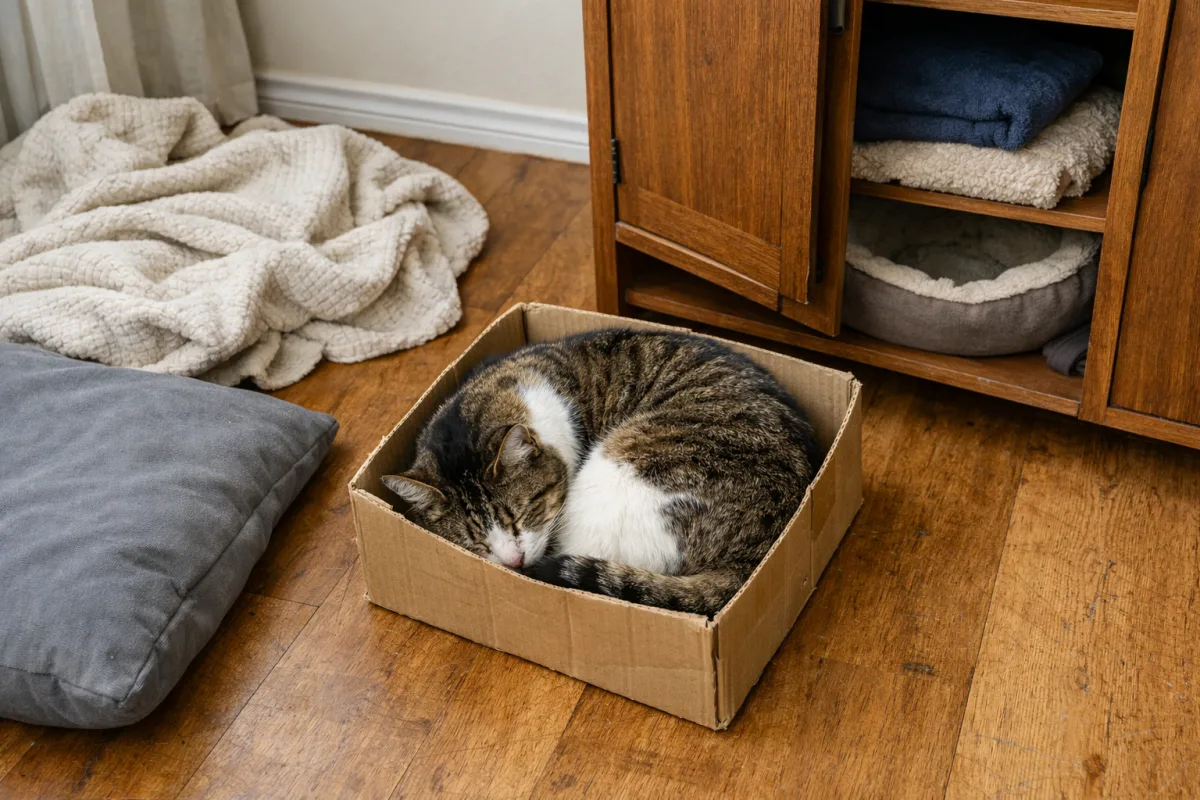
In daily life, this behavior shows up in familiar ways. A cat may slip into a cardboard box the moment it is left on the floor. It may nestle behind a sofa cushion, wedge itself into a shelf opening, or spend part of the day in a covered cat bed rather than out in the open.
Sometimes the choice is very deliberate. A cat may walk past several open resting spots and go straight to the narrowest one. Other times the pattern changes by time of day. A cat might seek an enclosed place in the afternoon but choose a windowsill or couch arm when it wants to watch the room.
Enclosed spaces are often used for resting, but not only for sleeping. Cats may also retreat there after a busy household moment, during visitors, after play, or simply because they want a quiet corner. The space itself becomes a small buffer between the cat and the rest of the environment.
Common places cats choose
- Cardboard boxes
- Soft covered beds
- Under beds or sofas
- Closets and cabinet openings
- Carrier-style hiding spots left open at home
- Spaces behind furniture or beside appliances
Not every enclosed place has the same meaning. A box in the middle of a busy room may be chosen for quick observation. A spot under a bed may suggest a stronger need for retreat. The location, timing, and body language around the choice all matter.
Why Cats Are Drawn to Tight or Enclosed Areas
There are several practical reasons cats like these spaces, and most of them are rooted in ordinary feline behavior. Cats are both hunters and prey animals by nature. Even in safe homes, those instincts remain active. A small enclosed area lets a cat watch without feeling too visible.
The sides of a box or the edge of a cabinet can feel like a boundary. That boundary helps reduce the amount of space a cat has to monitor. Instead of scanning a whole room, it can focus on one opening and settle more easily. For a species that prefers awareness, that is a real advantage.
Warmth is another factor. Tight spaces trap body heat more effectively than open floor space. Many cats are drawn to warmth, and enclosed areas often hold it well. A snug corner can feel especially appealing on a cool morning or after a period of activity.
For many cats, a small enclosed space combines three comforts at once: safety, warmth, and a better view of what is happening around them.
Instinct plays a large part
Wild ancestors of domestic cats benefited from places that concealed them. A hidden den could protect them during rest and help them avoid danger. That background still influences the way house cats behave now. Even a very social cat may still want a place that feels partially sheltered.
This is one reason boxes are so popular. They are simple, enclosed, and easy to understand. A cat can sit low, tuck its body in, and stay aware of movement outside the box. That combination lines up well with feline instincts.
Comfort is physical, not just emotional
Cats often like pressure around their bodies. A tight space can feel reassuring because it gives them contact on multiple sides. This is similar to how some cats press into cushions, curl in corners, or tuck their paws under their chest. The body relaxes when it does not need to keep balancing itself in a wide open area.
Even sleeping position can influence the preference. Some cats like to stretch out, but many prefer a curled shape. A small space supports that shape naturally. It can also reduce drafts and help the cat keep a steady temperature.
How the Home Environment Changes the Behavior
The same cat may behave differently in different homes or even in different rooms. A busy apartment with children, frequent movement, and noise can make enclosed spots more appealing. A quiet home may still produce the same behavior, but for a different reason. The cat may simply prefer the feeling of a contained, private resting place.
The layout of the home matters too. Open floor plans can leave a cat feeling more exposed, while furniture, shelves, and corners create natural hiding options. Cats often choose spaces that let them see the room while staying partly out of view. This is especially common in rooms with many people passing through.
Change can also influence the behavior. New visitors, furniture rearrangement, cleaning activity, loud appliances, or a new pet can all make enclosed spaces more attractive. The cat is not necessarily frightened. It may just be responding to a temporary shift in the environment.
When the behavior becomes more noticeable
- During house guests or gatherings
- After moving to a new home
- When loud cleaning equipment is used
- In homes with active children or multiple pets
- During storms or other unusual noise
- When a cat is adjusting to a new routine
Some cats make this choice more often during transition periods and then return to more open resting spots once they feel settled. Others keep the habit for years because it simply suits them. Stable preference is common and does not automatically signal a problem.
What the Behavior May Say About a Cat’s State of Mind
Context gives the behavior its meaning. A cat lying in a box while it is relaxed, loose, and willing to come out for food or play is showing something very different from a cat hiding hard under a bed and refusing contact. The space may look similar from the outside, but the emotional state behind it may not be the same.
When the choice is calm, the cat often appears settled. Its body is tucked but not tense, its ears are neutral, and it may close its eyes or nap deeply. It may leave the space willingly when something interesting happens, then return to it later. That pattern usually suggests comfort rather than concern.
When the choice seems defensive, the body language changes. A cat may stay pressed low, keep its eyes wide, or react strongly when approached. It may spend more time in the enclosed area than usual and avoid normal routines. In that case, the space may be functioning as a refuge rather than just a favorite bed.
A cat’s favorite hiding place is not automatically a warning sign. The difference is usually in the body language, willingness to interact, and whether the behavior fits the cat’s normal pattern.
Soft signals versus stronger signals
| Behavior | Likely meaning |
|---|---|
| Cat rests in a box but comes out for meals and petting | Normal comfort-seeking |
| Cat uses enclosed spots mostly during busy household moments | Temporary need for privacy |
| Cat hides constantly and avoids contact | Possible stress or illness |
| Cat switches between open and enclosed spaces easily | Balanced, flexible behavior |
A cat can move between these states from one day to the next. A single hiding episode is not usually significant. Repeated withdrawal, especially if it comes with changes in appetite, grooming, or social behavior, deserves more attention.
How Cats Use Enclosed Spaces in Different Ways
Not every enclosed area serves the same purpose. Some are for resting. Some are for observing. Others are chosen for security during moments that feel uncertain. The same cat can use each type depending on what it needs at the time.
Playful use
Some cats treat boxes and tunnels as part of play. They jump in and out, swat at moving objects, or crouch inside and wait for a toy to pass by. In these moments, the space becomes a stage for hunting behavior. The enclosure helps the cat feel hidden enough to pounce.
This kind of use tends to look loose and energetic. The cat may peek out, dart back in, and reappear quickly. It often chooses the spot because it is fun, not because it is worried.
Neutral use
Neutral use is the most common. The cat enters a tight or enclosed area, settles comfortably, and does not seem especially excited or upset. It may simply be selecting the best available resting place. The behavior is ordinary and easy to overlook once it becomes part of the cat’s routine.
Many owners notice this when a cat consistently returns to the same box, corner, or covered bed even when there are many other options. The location may become one of the cat’s preferred sleep spots because it offers predictable comfort.
Defensive use
Sometimes the same behavior becomes more intense. The cat may rush into the space, flatten its body, or stay extremely still. It may only leave when the house is quiet again. In this version of the behavior, the space serves as protection from something the cat does not want to face.
That could be noise, another animal, unfamiliar people, pain, or general unease. The spot itself is not the problem. It is the cat’s way of making the environment feel manageable.
Why Some Cats Prefer Very Tight Spaces More Than Others
Individual personality matters. Some cats are bold and curious, but they still appreciate a hidden nook from time to time. Others are naturally cautious and choose enclosed places more often. Breed tendencies, early experiences, and home life can all influence the pattern, but no single factor explains every cat.
Kittens often learn quickly that small spaces feel secure. If a kitten spent time nestled with littermates, tucked into bedding, or resting in sheltered spots, it may carry that comfort into adulthood. A cat that grew up in a very active home may also become especially fond of enclosed spaces because they gave it a predictable place to settle.
Adult cats may keep the habit for years with little change. Some become more selective as they age, choosing closer-fitting spaces because they feel easier to enter and more comfortable to hold heat. Others become less interested if they prefer elevated resting spots or if mobility changes over time.
Life stage can shape the preference
- Kittens often use boxes and hideaways for security and play
- Young adults may use enclosed spaces for both rest and hunting games
- Middle-aged cats may settle into favorite private spots with clear routines
- Senior cats may prefer spaces that are warm, easy to access, and physically supportive
None of these patterns is unusual on its own. What matters most is whether the cat seems comfortable and whether the choice fits its usual habits.
What Owners Often Misread
One common mistake is assuming a cat is being unfriendly because it chooses a hidden space. Many cats are affectionate in their own way and still need periods of solitude. Wanting privacy does not cancel out trust. It simply shows how the cat balances closeness and independence.
Another misunderstanding is assuming all hiding means fear. A cat may use a covered bed every afternoon because it likes the feel of it, not because something is wrong. If the cat comes out normally, eats well, grooms itself, and interacts as usual, the behavior is often just part of its routine.
On the other hand, some owners dismiss hiding too quickly. If a cat suddenly starts spending far more time in enclosed areas, especially with other changes in behavior, that shift should not be ignored. A cat that is in pain or stressed may seek the same safety-seeking behavior that a comfortable cat uses for rest, but the full picture will look different.
It is the pattern around the hiding that matters: appetite, movement, grooming, posture, and how easily the cat returns to normal activity.
How to Read the Setting Around the Behavior
Timing offers useful clues. A cat that enters a small space after a noisy vacuum runs is probably responding to sound. A cat that does it every afternoon in a sunless room may simply like the warmth and privacy. A cat that only hides after being handled by visitors may want a break from stimulation.
Even small details can matter. Is the cat lying in the enclosure with relaxed limbs, or are the paws tucked tightly under the body? Is the tail loose, or wrapped stiffly around the feet? Does the cat blink slowly and remain calm, or does it stay alert to every movement outside the space?
Owners often learn to notice these details over time. The same box can mean different things on different days. One day it is a cozy nap spot. Another day it is a retreat from too much activity. The setting around the cat gives the clearest clue.
Questions worth observing
- Does the cat come out on its own?
- Is eating, drinking, and litter box use normal?
- Does the cat tolerate touch or avoid it?
- Has the household routine changed recently?
- Does the cat still play or explore at other times?
If the enclosed-space habit is paired with normal daily behavior, it usually reflects preference. If it comes with a visible decline in routine, it may be telling a different story.
Why This Habit Can Remain Stable for Years
Many cats do not outgrow the preference for enclosed spaces because the reason behind it remains useful throughout life. The world keeps offering movement, noise, unfamiliar smells, and unpredictable moments. A snug spot is a simple solution that continues to work.
This stability is one reason cat owners see the behavior as part of personality. Some cats are open and social in many settings but still want a closed bed or small box nearby. Others keep one favorite hiding spot for years and return to it whenever they need to reset. The habit can be steady without being unhealthy.
That said, long-term patterns can shift if the cat’s body changes or if the environment changes. A senior cat may prefer an enclosed area with easier entry. A cat living with a new pet may seek more shelter than before. A move to a quieter home may reduce the need for hiding, while a busier home may increase it.
The preference is flexible enough to respond to daily life, but stable enough to remain a recognizable part of the cat’s behavior. That balance is one reason it is so common.
Natural Comfort in a Small Space
When a cat chooses a tight or enclosed area, it is often making a practical decision. The spot may be warm, secure, familiar, and easy to monitor. It can support rest, play, or recovery from stimulation. Sometimes it simply feels right.
The key is not the size of the space alone, but how the cat uses it. A calm cat in a small box is expressing comfort. A cat that withdraws into a hidden place and acts unlike itself may be asking for more space, quieter surroundings, or closer observation. The same behavior can hold different meanings, and the surrounding details tell the difference.
That is what makes this habit so consistent in everyday cat life. Tight and enclosed areas give cats a simple way to feel settled while staying aware, and that combination suits them well in homes of almost every kind.