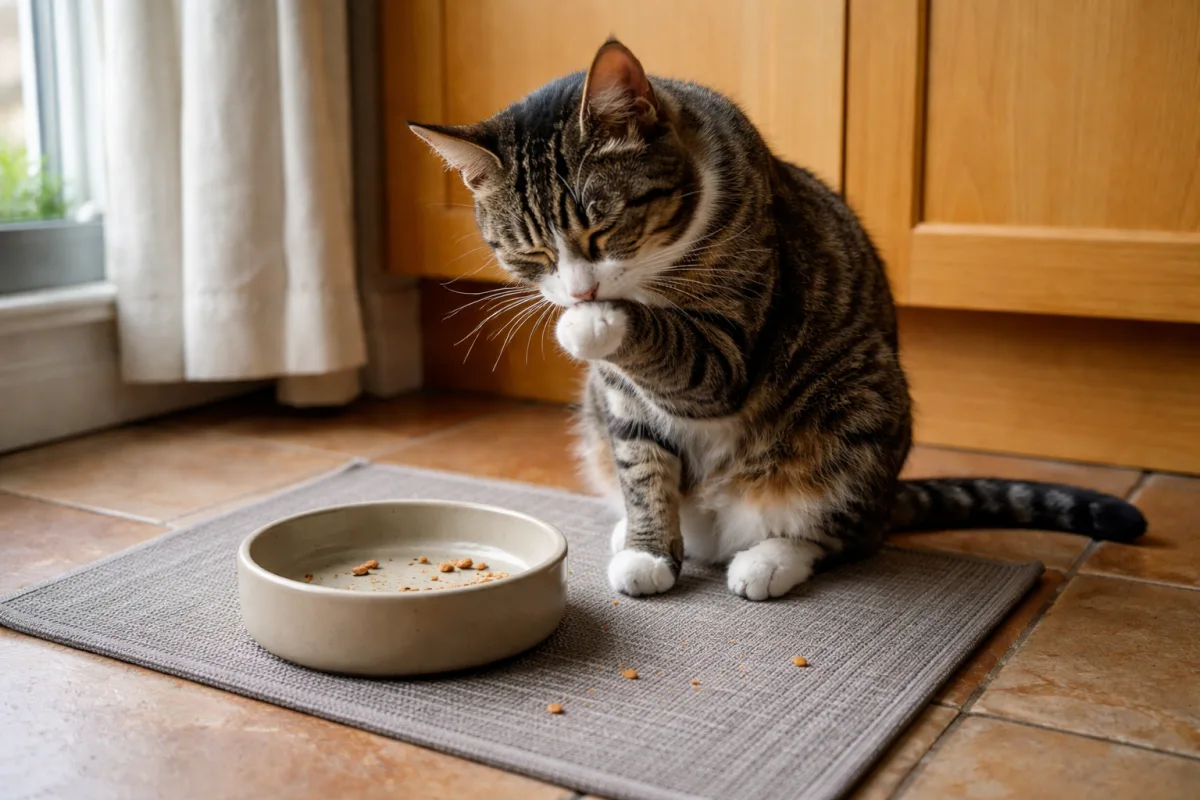
Many cats take a few minutes to groom after eating. They lick their paws, rub their face, and carefully clean around the mouth as if nothing else in the world matters. For cat owners, this can look like a tiny ritual, especially when it happens every time the food bowl empties.
The behavior is usually normal. In fact, it often says more about a cat’s natural habits than about the meal itself. Grooming after eating can be about cleaning away food, settling the body, calming the mind, or simply following a deeply ingrained routine.
Sometimes the timing is almost exact. A cat eats, lifts its head, pauses for a second, and begins washing one paw after another. Other cats wait a little longer or groom only the face and whiskers. The pattern can vary, but the reason often stays close to the same: cats like to feel clean, secure, and in control of their own space.
Why Cats Groom After Eating
After a meal, a cat’s mouth, chin, and whiskers may carry traces of food, scent, or moisture. Grooming helps remove those traces quickly. Cats are very sensitive to texture and smell, and a bit of food stuck near the lips can be enough to trigger a cleaning session.
There is also a social and instinctive side to it. In the wild, cats keep themselves clean to reduce odor and maintain a polished coat. Domestic cats still carry that habit, even though they do not need to hunt or hide from predators in the same way. Grooming after eating can therefore reflect a behavior that is both practical and instinctive.
For many cats, post-meal grooming is a normal reset: clean the face, smooth the coat, and settle back into comfort.
Some cats groom more intensely after wet food than after dry food. Wet food can leave more residue around the mouth and paws, so the licking becomes more noticeable. Cats that eat quickly may also groom right away simply because food has collected on the fur around their face.
What This Behavior Looks Like in Everyday Life
In a home setting, this behavior often appears in small, repeatable moments. A cat may finish a bowl of food, step back, and spend a minute or two cleaning the muzzle. Another cat may lick one front paw and sweep it over the whiskers in a neat, deliberate pattern.
Sometimes the grooming stays focused on the face. Other times it extends to the chest, front legs, and even the shoulder area. This depends on how much food was eaten, how messy the meal was, and how particular the cat is about cleanliness.
Common post-eating grooming patterns include:
- licking the lips and nose
- wiping the face with a damp paw
- cleaning whiskers one side at a time
- licking crumbs or residue off the front paws
- continuing into a full-body grooming session
Some cats are brief and efficient. Others turn the habit into a longer routine. A cat that spends five minutes grooming after every meal is not necessarily being dramatic. It may simply be more fastidious, or more aware of tiny changes in scent and texture.
Possible Internal Reasons Behind the Behavior
Cleaning away food scent
Food smell can cling to fur, especially around the mouth and paws. Cats often seem to want that scent gone as soon as the meal ends. This is partly about comfort, but it may also be tied to instinct. A cleaner face and coat can feel more normal to a cat than one with lingering food residue.
Shifting from eating mode to resting mode
Eating is an active event. Grooming afterward can act like a transition. The cat moves from focusing on food to returning to a calmer, more settled state. Many cats seem to use grooming this way, as if cleaning their face helps them close the chapter on the meal.
Regaining a sense of control
Cats often like predictable sequences. Eat, clean, rest. That order may help them feel organized in a busy or noisy household. When a cat grooms after eating, it may be reinforcing a familiar routine that feels safe and satisfying.
Comfort and self-soothing
Grooming is not only about hygiene. It can also be soothing. The repetitive motion of licking can have a calming effect, especially in cats that are sensitive or easily overstimulated. A cat that eats in a busy kitchen and then immediately cleans itself may be using the ritual to settle down.
If grooming after meals becomes very intense, frantic, or paired with discomfort, the meaning can shift. The context matters more than the habit itself.
How It Connects to Typical Cat Traits
This behavior fits neatly with several things cats are known for. They are independent, observant, and often selective about their environment. Grooming after eating reflects that mix. The cat is not waiting for help. It is handling the situation in its own way.
Cats also pay close attention to small changes. A tiny crumb, a bit of sticky wet food, or a damp patch on the chin may be enough to prompt grooming. What looks minor to a person can feel very noticeable to a cat.
There is a strong sense of self-maintenance in the behavior. Cats do not usually like appearing disheveled, even if no one else is around. That makes post-meal grooming part of a larger pattern of personal care that extends throughout the day.
What the Behavior May Signal About the Cat’s State
In many cases, grooming after eating signals that the cat is comfortable. A cat that feels safe enough to clean itself right after a meal is often relaxed in the environment. The behavior may look almost sleepy or content, especially if the cat then stretches out and rests nearby.
It can also show that the meal was satisfying. Some cats groom more after a hearty feeding session than after a few bites. The combination of eating and cleaning may reflect a sense of completion. The cat has had enough, and now it is tidying up before moving on.
Still, the meaning is not always the same. The way the cat grooms matters. Gentle, slow cleaning is usually very different from repeated, uneasy licking.
| Grooming pattern | What it often looks like | Possible meaning |
|---|---|---|
| Brief face cleaning | A few licks around the mouth and nose | Normal cleanup after a meal |
| Paw wiping | Using the front paw to clean the muzzle | Removing residue, settling down |
| Full-body grooming | Face cleaning followed by coat care | Comfort, routine, or transition to rest |
| Repeated licking | Constant focus on one spot | Possible irritation or stress |
When grooming is calm and predictable, it usually belongs in the normal range. When it becomes fixed, repetitive, or concentrated on one area, it may be worth paying closer attention.
How Context Changes the Meaning
The same behavior can mean different things depending on the situation. A cat eating in a quiet room and then grooming slowly is different from a cat who finishes a meal, licks its lips rapidly, and keeps scanning the room. In the first case, the grooming may be purely comfortable. In the second, the cat may be alert or distracted.
Household activity matters too. In a noisy home, after-meal grooming may help a cat calm itself after a burst of stimulation. In a peaceful home, it may simply be a habit that follows meals with little variation.
Feeding style also plays a part. Cats that eat from shallow dishes, whisker-friendly bowls, or flat plates may groom differently from cats that press their faces into deep bowls. A bowl that leaves food on the chin can make the habit much more noticeable.
Temperature and coat type can influence it as well. Long-haired cats often collect more food around the mouth or chest, while short-haired cats may show the habit more because the grooming is quick and easy to see. Cats with very fine whiskers or sensitive mouths may also react more strongly to tiny messes.
Different Forms of the Behavior
Calm grooming
This is the most typical version. The cat eats, pauses, and then cleans itself in an orderly way. The movements are slow and steady. The cat usually seems settled and unconcerned.
Energetic grooming
Some cats groom with more urgency. They may lick several times in a row, wipe their face briskly, or move from one area to another without much pause. This is not always a problem, but it can suggest the cat is bothered by leftover food, a strange texture, or a mild irritation.
Playful grooming
Occasionally grooming appears almost lighthearted. A cat may bat at its face, pause, and then continue with a few casual licks. This can happen in young cats or in adults that remain very relaxed after meals.
Defensive or uneasy grooming
When a cat seems tense, grooming may look less like cleanup and more like a coping behavior. The ears may be angled back, the body may stay stiff, or the cat may keep licking in the same spot. In those moments, the grooming is not the main story. It is a sign that the cat’s comfort may be off.
Body language gives important clues. A relaxed cat grooms smoothly. A tense cat often grooms with a stiff posture, wide eyes, or frequent pauses.
Signals Owners Often Misread
One common misunderstanding is assuming that all grooming after eating means the cat enjoyed the meal equally every time. That is not always true. Some cats groom because the food was messy, not because it was especially satisfying.
Another mistake is treating frequent grooming as automatically suspicious. A cat that grooms after most meals may simply have a strong cleanliness habit. That pattern alone does not mean there is a problem.
At the same time, owners sometimes overlook changes. If a cat suddenly stops grooming after eating when it used to do so, or begins grooming much more than usual, that shift may deserve attention. Changes in food texture, oral comfort, stress level, or general health can all affect the pattern.
It is also easy to confuse grooming with scratching or face rubbing. A cat may seem to “wash” after eating, but closer observation may reveal that it is trying to soothe an itchy spot, remove a stuck particle, or respond to a sore mouth. The exact motion matters.
When Grooming After Eating Becomes More Noticeable
Some cats only groom after certain meals. Wet food, fish-based recipes, or rich broths can leave stronger odors and more residue. Sticky or saucy textures often lead to more face cleaning than dry kibble.
The habit may also become more visible in cats that eat quickly. A fast eater may finish with food still around the mouth and then spend extra time cleaning up. In slower eaters, grooming may be shorter because less food ends up on the face in the first place.
Stressful periods can change the behavior too. A move to a new home, a change in feeding schedule, or the presence of other pets can make a cat more reactive. Post-meal grooming may increase because it gives the cat a familiar, repeatable action in an otherwise changed routine.
Indoor cats may show the behavior more clearly than outdoor cats simply because their routines are easier to observe. But the habit itself is not limited to home life. It is part of normal cat behavior across many environments.
Long-Term Patterns and Stability
Many cats keep the same grooming pattern for years. The behavior can be remarkably stable. A cat that has always cleaned its face carefully after meals may continue doing so well into adulthood and senior age.
That stability often means the habit is simply part of the cat’s personal routine. Some cats are especially tidy. Others are less interested in grooming right after food and may wait until later. Neither pattern is unusual on its own.
What matters more is whether the rhythm changes. A cat that suddenly begins grooming with more intensity, avoids eating because of mouth discomfort, or seems irritated after meals may be showing that something in the routine has shifted.
Long-term observation works best when it stays casual and consistent. Not every lick has a hidden message. But the repeated pattern across days and weeks can tell a useful story about comfort, habits, and small changes in condition.
What a Cat Owner Can Notice Without Overreading It
It helps to watch the full picture instead of one single moment. Notice how long the grooming lasts, what part of the body is involved, and how the cat looks while doing it. A calm cat with relaxed ears and a loose body is different from a cat that keeps pausing to scan the room.
You can also pay attention to the meal itself. Messy food, bowl shape, and eating speed all affect what happens afterward. If a cat only grooms heavily after wet food, the explanation may be simple. If the behavior seems unrelated to food and happens even after tiny snacks, it may be more about habit or comfort.
In daily life, the behavior often becomes part of the cat’s rhythm. Eat, clean, rest, move on. That sequence may look small, but for a cat it can be one of the most ordinary and reassuring parts of the day.
A cat that groomed after lunch yesterday and does the same today is probably showing a familiar routine. A cat that changes the pattern suddenly is the one to watch more closely. The difference is usually in the shift, not the habit itself.
Post-meal grooming is one of those cat behaviors that seems simple until you observe it closely. Then it becomes a useful window into how cats handle comfort, cleanliness, and the small transitions built into their day.