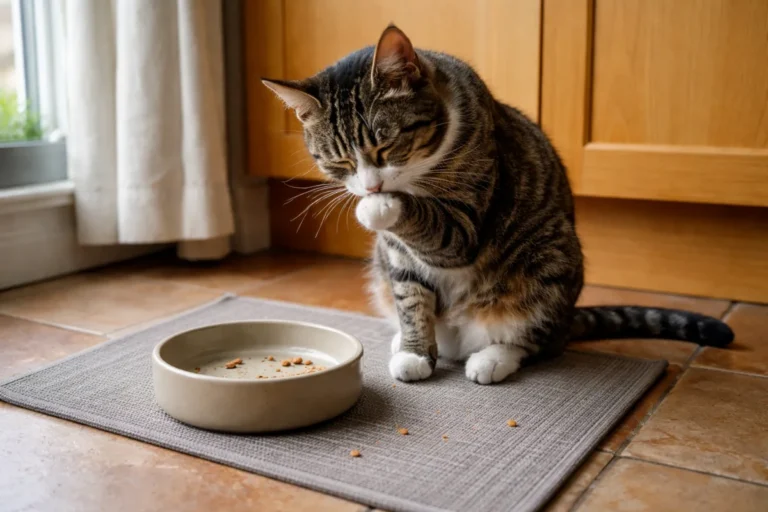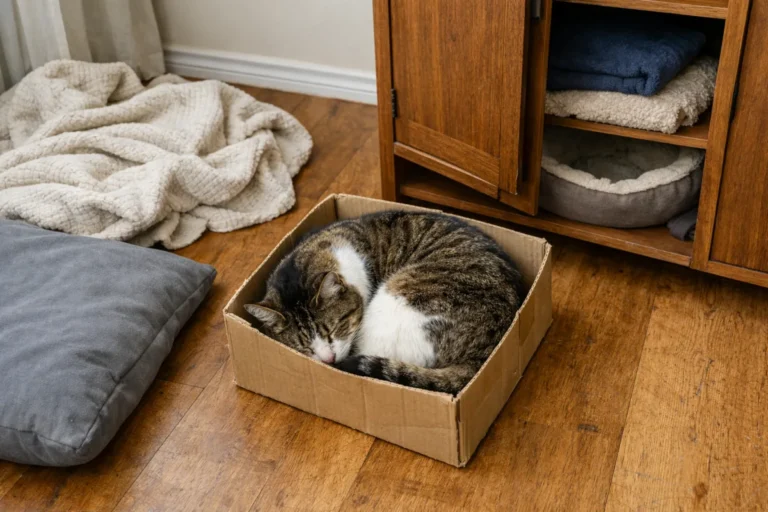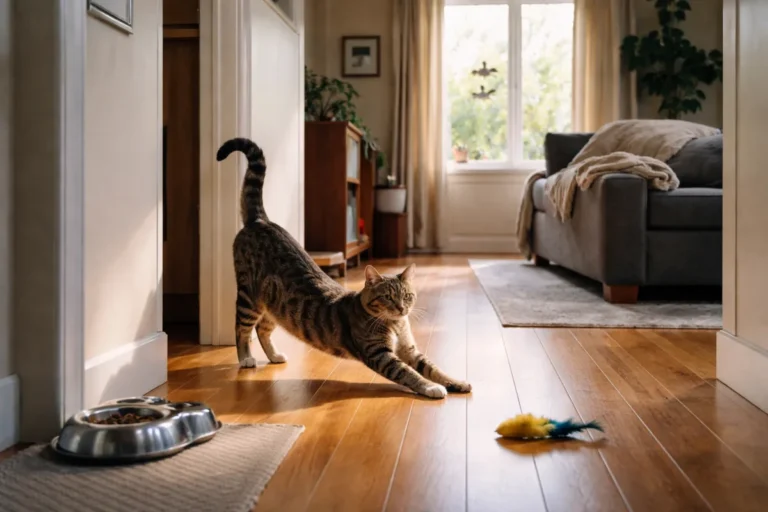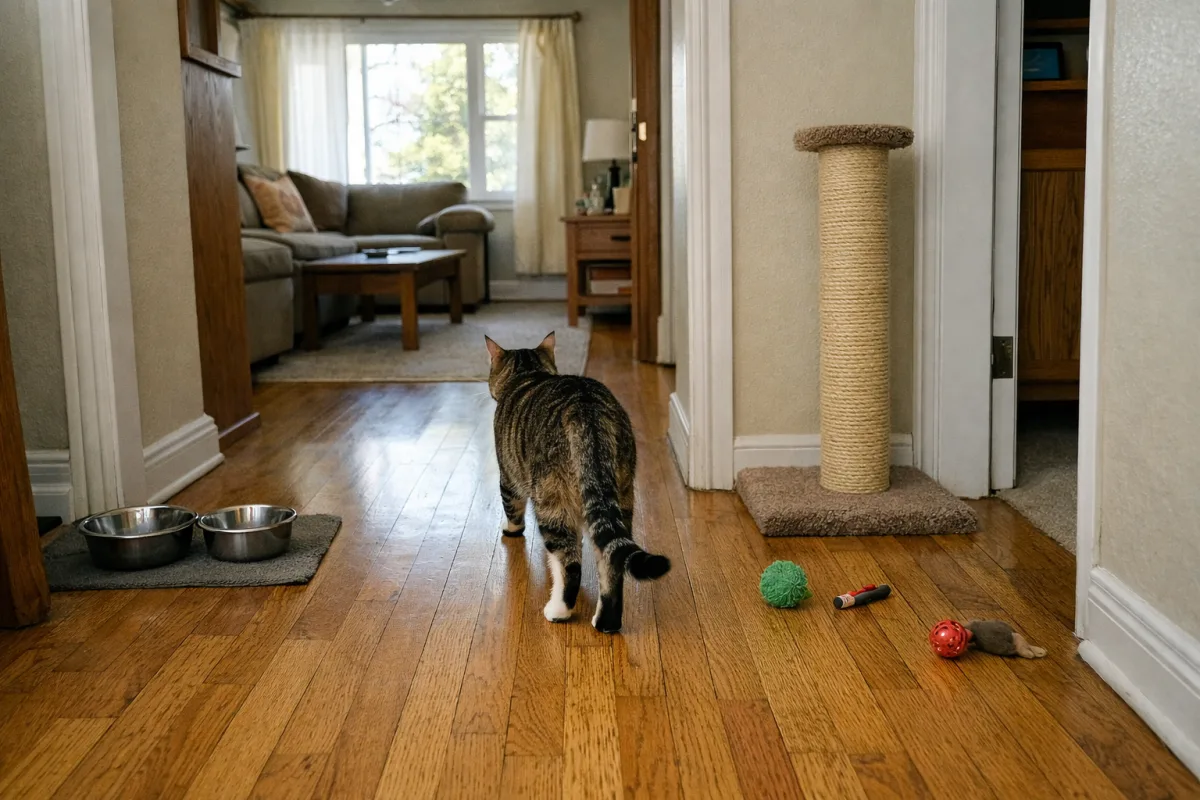
A cat that walks through the house again and again is not always being random. The same hallway, the same doorway, the same kitchen corner can become part of a familiar circuit. To a cat, repeated exploration often serves more than one purpose at once: checking scent changes, confirming that nothing has shifted, and staying aware of what is happening in the home.
This behavior can look calm or restless. One cat moves with loose shoulders and pauses to sniff a rug, then continues on a slow loop. Another may return to the same rooms quickly, almost as if completing a task it has not finished yet. The pattern can happen at any time of day, but it often becomes more noticeable when the home is quiet, after feeding, or when the cat has heard a new sound.
Repeated wandering is part of how many cats interact with their space. They do not experience the house as a single fixed environment. It is a shifting map of smells, sounds, routines, hidden paths, and safe resting spots. Walking through it again helps them update that map.
What Repeated House Exploration Looks Like
The behavior can take several forms. Some cats patrol the home slowly and methodically, checking one room after another. Others circle the same area, leave for a moment, and then return. A cat may also revisit places that seem unimportant to people, such as the base of a chair, the edge of a bathtub, or the corner near a heating vent.
In daily life, this may appear as a cat who:
- makes repeated laps through hallways and doorways
- sniffs familiar objects every time it passes
- moves from room to room without settling
- returns to windows, closets, or under-furniture spaces
- checks the same area after a household change
Sometimes the repetition is brief and harmless. A cat explores for a few minutes, then lies down in a favorite spot. At other times, the movement continues longer and seems tied to tension, alertness, or strong curiosity. The difference is usually visible in body language.
Calm Exploration vs Restless Repetition
When the exploration is calm, the cat’s posture is loose. The tail may be neutral or gently upright, the whiskers relaxed, and the pace unhurried. The cat may stop to rub against furniture, then continue on its way.
Restless repetition often looks different. The cat may move faster, pause abruptly, or seem unable to choose a place to stay. It may keep checking the same window, the same hallway, or the same closed door. In these cases, the pattern can reflect curiosity mixed with uncertainty.
Repeated walking is often less about “looking for trouble” and more about updating information. Cats rely on small environmental changes that people barely notice.
Why Cats Revisit the Same Areas Again and Again
Cats are highly attentive to place. Their sense of security is closely tied to what is familiar, and familiar does not mean static. They want to know what has changed since the last time they passed through. A new scent trail, a sound from another room, or a piece of moved furniture can be enough to make them check the area twice.
One major reason is scent monitoring. Cats use smell to gather information about other animals, people, and changes in routine. A repeat visit allows them to compare what they smelled before with what they smell now. That comparison can tell them whether the environment still feels safe or whether something requires closer attention.
Another reason is territory tracking. Indoor cats still maintain a sense of territory, even when they share a home peacefully with humans or other pets. Repeated exploration helps them reinforce that the space belongs to them too. They are not always claiming a room in an aggressive way. Sometimes they are simply confirming their role within the household map.
Curiosity also plays a part. Cats notice patterns, and they remember where things happen. If a bag was set down in the entryway yesterday, the cat may check that spot today. If a drawer was open or a new box appeared, the cat may return to inspect it repeatedly until the novelty fades.
Information Gathering Through Routine
Daily repetition is not boring to a cat the way it can be to a person. Routine gives them reference points. A morning walk through the home may help a cat understand whether breakfast is coming, whether a window is open, or whether another pet has already crossed a preferred route.
This is why some cats seem to “patrol” at the same times every day. They are not following a human schedule on purpose, but they do notice it. If activity in the house changes at predictable times, the cat may revisit the same places to confirm those changes. The behavior can become part of an internal timetable.
When a cat repeatedly explores, it is often collecting evidence: smells, sounds, movement, and routine cues. The house is being read like a living record.
How Personality Shapes the Habit
Not every cat repeats exploration for the same reason. Personality matters. A bold, social cat may move through the house often simply because it wants to stay connected to everything that is happening. A more cautious cat may do the same thing because it needs frequent reassurance that the environment is still predictable.
Some cats are naturally investigative. They like checking doors, cabinets, beds, and thresholds. They may be the first to walk into a new room and the first to return to it later. These cats often repeat exploration after any small change because it is part of their normal style.
Other cats are more sensitive to change. They may patrol the home after guests leave, after a vacuum is used, or after an unfamiliar smell appears. Their repeated movement is a way of rebalancing. They are trying to decide whether the space feels normal again.
There are also cats that repeat exploration when they are under-stimulated. If the day has been quiet and predictable, a cat may roam more simply because it has energy to spend and no other outlet. In that case, the behavior can look like idle wandering, but it still has a purpose.
Age and Life Stage Matter
Kittens often explore repeatedly because everything is new. They do not just inspect a room once and move on. They return to it, test it, and revisit it from another angle. For young cats, repetition is part of learning how the home works.
Adult cats tend to be more deliberate. They already know the layout, so repeated exploration usually points to a need for confirmation, novelty, or regulation. Seniors may revisit spaces more slowly. If the pattern becomes more frequent in an older cat, it may reflect changes in comfort, hearing, vision, or overall sensitivity to the home environment.
What the Behavior May Signal About a Cat’s State
Repeated exploration does not always mean the same thing emotionally. A cat can be curious, relaxed, alert, unsettled, or mildly bored and still perform the same basic action. The context determines the meaning.
When the cat seems peaceful, the behavior may signal comfort. A cat that feels secure enough to patrol its territory is showing trust in the environment. It knows the space well enough to revisit it without hesitation.
When the cat seems sharper or more focused, the behavior may signal vigilance. This is common after a noise, a visitor, a new object in the house, or an encounter with another pet. The cat is checking for follow-up information.
When the cat moves around without settling and keeps returning to the same spots, it may be feeling uncertain. That does not automatically mean distress, but it does suggest the cat is working through something in its surroundings. The repeated motion becomes a way to manage that uncertainty.
Body Language That Adds Meaning
It helps to look at the whole picture, not just the walking pattern. A cat that explores repeatedly with relaxed ears and a soft tail is different from a cat that scans corners, freezes often, or keeps its body low. Small details matter.
- Loose, easy movement: often suggests comfort or mild curiosity
- Frequent pauses with sniffing: usually means the cat is gathering information
- Tail puffed or stiff: may point to tension or surprise
- Repeated checking of exits or windows: can reflect alertness to outside activity
- Inability to settle after pacing: may suggest overstimulation or unease
Some cats also vocalize while exploring. Soft chirps or brief meows can accompany a social or curious mood. Repeated meowing with pacing may indicate the cat wants attention, food, access to another room, or help coping with a change.
How the Home Environment Influences the Pattern
The house itself can encourage repeated exploration. Indoor cats have limited control over where they go outside, so the home becomes the entire world they manage. Changes inside that world matter a great deal. A moved couch, a new litter box location, a fresh cleaning scent, or a closed bedroom door can alter how the cat uses the space.
Noise level plays a role too. In a lively home, a cat may keep moving to avoid interruptions or to keep track of people. In a quieter home, the same cat may patrol more visibly because it has fewer distractions. Both settings can lead to repeated exploration, but the reason behind it may be different.
Household routines also shape the habit. Cats often revisit spaces around feeding time, cleaning time, or when family members begin moving around. They notice timing. They also notice when a routine changes. If dinner arrives later than usual, the cat may walk the house more than normal, checking the kitchen, the feeding area, and the people involved.
Indoor-Only Cats and the Need to Recheck Space
Indoor-only cats often depend more heavily on repeated exploration because they do not have outdoor territory to expand into. The home becomes both shelter and hunting ground, resting place and observation post. Walking through it again can help satisfy the need for environmental control.
Window access can intensify this. A cat that watches birds, neighbors, or passing animals may repeatedly revisit the same window or hallway. The cat is following activity outside and comparing it with what is happening inside.
Multi-pet homes can add another layer. Cats may repeat exploration to check where other animals are resting, eating, or traveling through shared spaces. Even peaceful coexistence can involve a lot of monitoring.
A cat that rechecks the home after every change is not necessarily anxious. It may simply be keeping its mental map current in a world that rarely stays the same for long.
Common Triggers That Make the Behavior More Noticeable
Certain moments tend to bring the behavior out more clearly. A household shift often becomes the starting point. A guest arrives. Furniture is moved. A bag is brought in from outside. The cat walks the house again, sometimes more than once, to account for the change.
Feeding time is another common trigger. Some cats patrol before meals, partly out of anticipation and partly out of habit. Others walk the house after eating, especially if they are waiting for the next social cue or checking whether the environment feels settled again.
Weather changes can also matter. Storms, wind, and sudden pressure changes may make a cat more alert. The cat may revisit windows, doors, and quiet corners as if trying to understand the source of the shift.
Even small things matter. A different laundry scent, a new bag on the floor, or a recently cleaned area can prompt a cat to explore repeatedly. Cats often respond to details people overlook.
When Repetition Becomes a Daily Pattern
If the behavior happens every day, it may be part of the cat’s normal routine. Many cats have a preferred route through the home. They follow it after waking, after meals, or during periods of low activity. That pattern can last for years.
What matters is whether the pattern looks stable or whether it has changed. A cat that has always enjoyed walking the house is different from one that suddenly starts pacing every evening. New repetition can carry different meaning than long-standing habit.
It helps to notice timing, not just frequency. A cat that repeats exploration only after the vacuum is used is responding to a trigger. A cat that does it at the same hour every day may be following a routine it has built for itself.
How Owners Often Misread the Behavior
People sometimes assume repeated house exploration means a cat is bored, needy, or being difficult. Those ideas can miss what is actually happening. The cat may be checking safety, following scent changes, or creating a sense of order after something has shifted.
Another common mistake is to treat all pacing as the same. A cat walking through the home calmly is not necessarily in the same state as a cat that rushes from room to room with little pause. The speed, the posture, and the timing all change the meaning.
Some cats are also misunderstood when they explore near closed doors or specific corners. That behavior may look like fixation, but often it is about access, smell, or sound. A cat may return to a location because it has information there, not because it is trying to make a point.
Small Clues That Help Separate Normal From Concerning
There is no single line where normal exploration suddenly becomes a problem. Instead, look for changes in pattern. If the cat still eats, sleeps, uses the litter box, and relaxes normally, repeated exploration may simply be part of its personality or daily rhythm.
If the behavior appears alongside other shifts, it deserves more attention. Examples include sleeping less, hiding more, vocalizing differently, or becoming unusually reactive to routine events. Repetition alone is one thing. Repetition with clear tension is another.
Some cats also become more exploratory when they are adjusting to a new home, a new pet, or a rearranged living space. In that stage, the repeated walking is often temporary. The cat is building a new map and testing where it feels safe.
Long-Term Patterns and Stability
Over time, repeated house exploration often settles into a recognizable rhythm. Some cats maintain the habit for life. Others shift as the household changes. A kitten may explore constantly, then become more settled as it matures. An older cat may revisit spaces more often if comfort, hearing, or vision changes make the environment feel different.
The behavior can also become more pronounced during transitions. Moving to a new home, adding another pet, or changing household routines can restart the cat’s need to check everything again. That does not always fade immediately. Some cats keep exploring for days or weeks while they adapt.
Consistency is useful to notice here. A cat that repeats exploration in a predictable way is often expressing a stable trait. A cat whose exploration suddenly becomes intense, frantic, or paired with other behavior changes may be responding to a new physical or emotional issue.
What looks like “the same behavior” can mean very different things depending on whether it has been steady for years or appeared out of nowhere.
House Exploration as Part of Cat Communication
Cats do not explore the home only for themselves. They are also leaving information for other cats, and for the humans in the house. When they rub against corners, pause at doorways, or revisit a room after someone enters it, they are participating in shared space management.
That is one reason repeated exploration can look social. The cat may not be asking for attention in a direct way, but it is still communicating presence. It is saying, in its own language, that this area matters and is worth checking again.
In homes where cats are closely bonded with people, repeated exploration can become part of a daily pattern of interaction. The cat may travel room to room, stopping briefly near where a person is sitting, then continuing on. The movement is not always a request. Sometimes it is just a way of staying connected to the household rhythm.
Once a cat has chosen a route through the house, that route can become meaningful. It marks safe passage, known smells, familiar sounds, and regular checkpoints. Repeating the route is how the cat keeps that sense of order intact.
When the Pattern Makes the Most Sense
The behavior becomes easier to understand when it is seen as a mix of instinct, memory, and environment. A cat repeats house exploration because the home is never fully static from its point of view. Something is always different: a scent has faded, a sound has changed, a person has moved, a room has been closed, or another pet has crossed the floor.
That does not make the cat confused. It makes the cat attentive. Repeated checking is one of the ways cats remain oriented in a space that matters deeply to them.
In a settled home, the pattern may stay quiet and familiar. In a changing home, it may become more visible. Either way, it is part of how a cat reads its world, one room at a time.