A cat that spends part of every day wandering from room to room, checking corners, pausing at windows, and revisiting the same spots is doing something deeply natural. This daily exploration is not random pacing. It is a mix of curiosity, routine, scent checking, territory review, and quiet information gathering.
To people, the behavior can look small or even repetitive. To a cat, it can be a full daily survey of the home. A doorway smells different after someone walks through it. A chair holds yesterday’s scent. A closed laundry basket, a moved box, or an open closet can change the meaning of a room. Cats notice those changes quickly and often revisit them more than once.
Daily exploration also helps cats feel oriented. The home is not just a place to sleep and eat. It is a map of safe routes, familiar objects, and monitored spaces. When a cat moves through that map each day, it is confirming what is where, what has changed, and whether anything needs attention.
What Daily Exploration Looks Like in Everyday Life
In a typical home, exploration can appear in small, consistent patterns. A cat may begin the morning by walking the hallway, stopping near the kitchen, then circling the sofa before settling in a sunny spot. Later, the same cat may inspect the litter area, sniff the baseboards, and jump onto a chair that was empty earlier in the day.
Some cats prefer broad patrols. They move through every room, often touching the same points in the same order. Others do shorter checks, focusing on one or two important zones such as food, sleeping areas, and windows. The route often matters less than the habit itself.
Daily exploration often includes these behaviors:
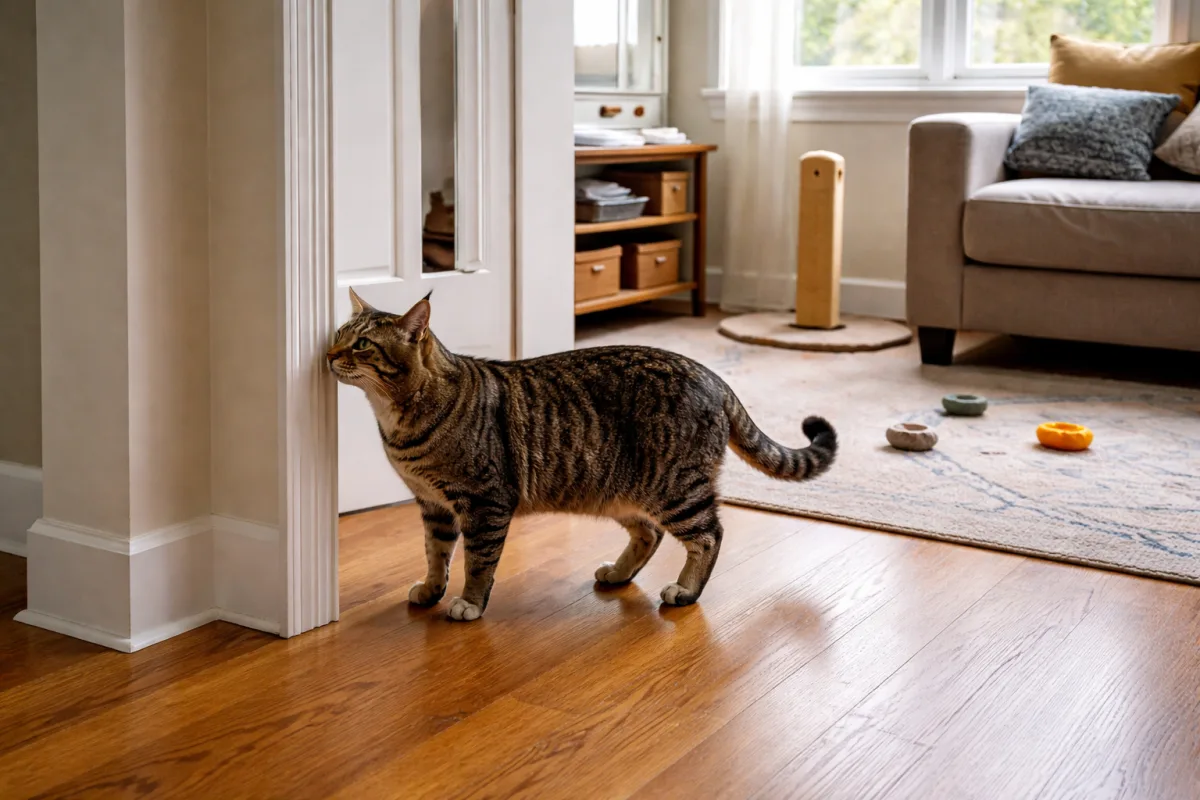
- Sniffing around doors, vents, and corners
- Walking the same path more than once
- Checking windows, shelves, or high surfaces
- Pausing to listen before entering a room
- Returning to recently visited places
Sometimes the behavior is quiet and unremarkable. Other times it becomes more visible after a change in routine, a visitor, a new object in the house, or even a shift in weather. Cats often explore more when something in the environment feels newly relevant.
Daily exploration is often a cat’s way of collecting information, not just moving around. The cat is checking safety, scent, and routine all at once.
Why Cats Explore Every Day
Cats are built to notice details. Even in a calm home, they remain alert to movement, sound, and scent. Daily exploration gives them a way to process all of that without needing constant interaction. It is one of the main ways cats keep track of their world.
Territory plays a major role. A cat does not usually think about territory in the human sense of ownership, but it does care about control, familiarity, and access. Exploration helps the cat confirm that its resting places, feeding spots, and pathways are still usable and predictable.
Scent is another major reason. Cats read the environment through smell in a way people do not. A room can feel “different” to a cat after a guest arrives, a window is opened, or another animal passes nearby outside. Even small scent changes can prompt another round of investigation.
There is also a mental benefit. Exploration gives a cat a job. It breaks up the day, offers structure, and allows the cat to make choices. For many indoor cats, that daily inspection is one of the few opportunities to actively direct their own routine.
Internal Reasons Behind the Behavior
Curiosity and information gathering
Curiosity is the most obvious piece, but it is not the whole story. Cats are not exploring just because they are interested in novelty. They are also confirming what has stayed the same. Familiarity matters as much as change. A cat may inspect the same chair every day because that chair is part of the home’s reliable pattern.
Comfort through routine
Many cats feel more settled when they can predict their surroundings. A daily route through the home can function like a ritual. It is not always obvious to the owner, but the cat may use this route to begin the day, shift between activities, or wind down in the evening.
Alertness and sensitivity
Some cats explore because they are naturally more sensitive to environmental changes. They notice footsteps in the hallway, a new bag on the floor, or the sound of a nearby dog barking outside. This sensitivity is not necessarily anxiety. Often it is simply part of how the cat stays informed.
Play drive and energy release
When cats are younger or more active, exploration can blend with play. A cat may leap onto furniture, race through a room, then stop to inspect something small. In those moments, movement and discovery are tightly connected. The cat is not only looking; it is testing the environment with the body.
Exploration can come from curiosity, comfort, alertness, or play. The same behavior may have different meanings depending on the cat’s state and timing.
How Home Environment Shapes Exploration
The same cat can behave very differently in two homes. A quiet, stable apartment may lead to steady but mild exploration. A busy household with children, guests, and changing objects often creates more frequent checking behavior. The cat is responding to the amount of movement and unpredictability around it.
Indoor-only cats often show stronger daily exploration than outdoor cats because the home is their full territory. Every room matters. Every corner matters. Outdoor cats may still patrol indoors, but they sometimes divide their attention between inside and outside spaces, so the daily pattern can look shorter or more selective.
Vertical space also affects the behavior. Cats who have shelves, cat trees, window perches, and high furniture often explore in layers. They may move from floor level to elevated spots, checking the room from different angles. In homes with limited climbing options, exploration may become more horizontal and repetitive.
Noise matters too. A quiet home may encourage slow, thorough inspection. A louder home may produce shorter checks interrupted by pauses. A cat may choose to explore when the house is calm and retreat when activity increases. That timing is often part of the cat’s sense of control.
What Daily Exploration May Signal About the Cat’s State
Relaxed and confident
A relaxed cat often explores with loose body movement, steady pauses, and little urgency. The cat may sniff, look around, and continue on without tension. This kind of exploration usually suggests a comfortable relationship with the home environment.
Restless or under-stimulated
If exploration becomes frequent, prolonged, and paired with signs like pacing, vocalizing, or trouble settling, the cat may be looking for more activity. That does not always mean distress. Sometimes the cat simply needs more enrichment, more social interaction, or more opportunities to climb, hunt, or chase.
Uncertain or cautious
A cat may explore slowly after a change such as moving furniture, hearing unfamiliar sounds, or noticing a new pet in the home. In this case, the behavior may include stopping often, keeping the body low, or retreating after a quick check. The cat is gathering information before deciding how safe the area feels.
Possible stress-related exploration
Exploration can become a coping pattern when a cat feels uneasy. The cat may keep moving without settling, repeatedly inspect doors, or return to the same route again and again. In that case, the behavior is less about interest and more about self-regulation.
| Pattern | Common signs | Possible meaning |
|---|---|---|
| Calm exploration | Loose body, quiet sniffing, normal pauses | Comfort and routine checking |
| Playful exploration | Quick turns, hops, sudden bursts of movement | Energy release and curiosity |
| Cautious exploration | Slow pace, low posture, frequent listening | Assessment after a change |
| Restless exploration | Pacing, repeated loops, difficulty settling | Under-stimulation or stress |
Body Language That Goes With It
Daily exploration becomes easier to read when you pay attention to posture and timing. The body often says more than the route itself. A cat walking with a relaxed tail, normal breathing, and soft ears is usually just moving through a familiar check-in pattern.
When the ears rotate constantly, the tail flicks sharply, or the cat freezes at small sounds, the exploration may be more cautious. A cat that sniffs with intense focus and then bolts to another room may be responding to a specific smell or noise rather than exploring for fun.
Time of day can also change how the behavior looks. Morning exploration may be tied to waking up and reorienting. Evening exploration may happen after the house gets quieter. Some cats become more active at dawn and dusk, when their natural rhythms make them more alert and movement-friendly.
How Owners Often Misread the Behavior
People sometimes assume a cat is “just wandering” when the cat is actually engaged in a meaningful daily habit. They may also mistake repeated checking for boredom alone. While boredom can be part of it, the behavior is usually more layered than that.
Another common misunderstanding is thinking that a cat exploring a lot is necessarily unhappy. That is not always true. Many content cats are highly observant and spend a fair amount of time inspecting their environment. Exploration by itself is not a problem. The rest of the cat’s behavior gives the better context.
On the other hand, some owners dismiss exploring as normal even when it is clearly tied to stress. The difference is usually in intensity, repetition, and whether the cat can settle afterward. A calm cat explores, then rests. A distressed cat may keep scanning without ever seeming fully done.
Look at the whole pattern: how the cat moves, how often it repeats the behavior, and whether it can relax afterward.
How Daily Routines Affect Exploration
Cats are excellent pattern readers. If breakfast usually happens at a certain time, exploration often increases shortly before that. If the household gets busy in the afternoon, the cat may do its quiet checking earlier in the day. If the litter box is cleaned, furniture is moved, or bags come in from outside, the route may shift immediately.
Routine also influences confidence. Cats in predictable homes often explore with less urgency. Cats in homes with constant change may spend more time rechecking spaces. That does not always mean the cat is “anxious”; sometimes it simply means the environment is harder to map.
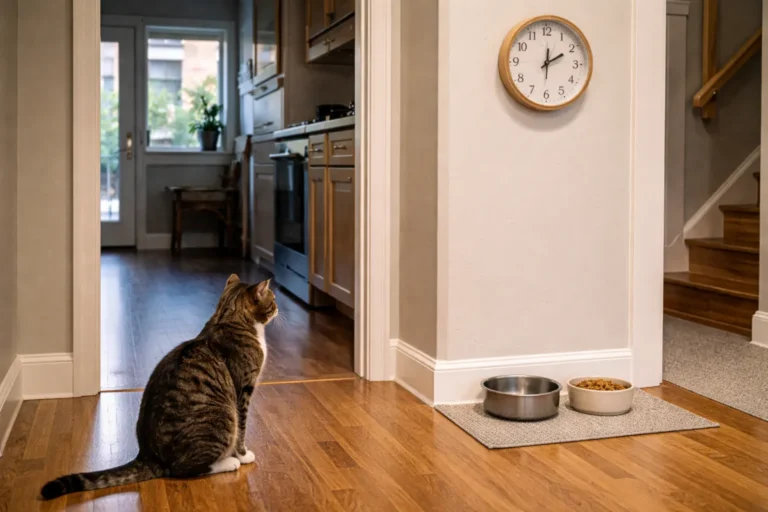
Feeding schedule matters too. Many cats do a short exploratory round before meals, especially in the kitchen or near the feeding area. This can be a mix of anticipation and environmental checking. The cat is not only waiting. It is also reading cues that food time is close.
When Daily Exploration Becomes More Noticeable
Certain moments bring the behavior into sharper view. After a move, a renovation, a visitor’s stay, or the arrival of another pet, many cats increase exploration. The same happens after furniture is rearranged or a new object appears in a room. The cat needs to rebuild its mental map.
Exploration may also become more obvious during changes in the cat’s own life stage. Kittens tend to inspect everything and move quickly from one discovery to the next. Adult cats usually become more selective. Senior cats may still explore daily, but with slower movement and more reliance on familiar routes.
Health can play a role as well. A cat that suddenly explores more, less, or in a more restless way may be responding to discomfort, vision changes, reduced hearing, or a shift in energy. The behavior itself is not a diagnosis, but a sudden change in pattern deserves attention.
Long-Term Patterns and Stability
For many cats, daily exploration is stable over time. The exact route may change with seasons, furniture placement, or household routine, but the habit remains. That stability is part of what makes the behavior useful. It is a dependable window into how the cat is experiencing the home.
Some cats keep the same favorite inspection points for years. A windowsill, a hallway threshold, the top of a bookshelf, or the area near a bedroom door may remain important long after other parts of the house are ignored. Those spots often combine scent, height, visibility, and access.
What matters most is whether the exploration still looks balanced. A cat that checks the home and then rests, eats, grooms, plays, or seeks contact is usually showing a healthy rhythm. A cat that cannot seem to settle, or that loses interest in places it once used daily, may be signaling a shift in comfort or well-being.
Reading the Behavior in Real Life
The best way to understand daily exploration is to watch how it fits into the rest of the cat’s day. A cat that investigates a room, then naps, then eats, then returns to the same route later is probably following a normal internal rhythm. A cat that keeps moving without interruption may be using exploration to cope with something else.
It also helps to notice what the cat chooses to inspect. Frequent checks near windows often point to outside activity. Repeated attention to a hallway may reflect sound, traffic, or household movement. Focus on the litter area can be simple hygiene monitoring, but a sudden increase there may also mean the cat is reacting to changes in smell or routine.
Not every investigation needs a response from the owner. Sometimes the cat is only doing its own quiet round of the house. A little observation can reveal whether the behavior is steady, playful, cautious, or restless, and that difference matters more than the number of steps the cat takes.
A cat’s daily exploration is usually a small ritual with real purpose: checking space, checking scent, and checking safety.
Natural Instincts Behind a Modern Home Habit
Even though most house cats live far from the environments their ancestors moved through, the instinct to survey space remains strong. Modern homes replace bushes, trees, and open ground with door frames, carpets, couches, and shelves, but the cat’s need to assess the environment is still there.
This is why the behavior can look so ordinary and still matter so much. A cat may be doing what natural hunters and territorial animals do best: collect information, stay oriented, and keep a sense of control. The difference is simply that the terrain is now a living room instead of a field.
That instinct shows up in small everyday choices. A cat may walk the edge of a room instead of crossing the center. It may favor high places for watching. It may revisit the same path after a disturbance. These are all practical, familiar strategies for a species that relies on awareness.
Quiet Signs That the Exploration Is Meaningful
Some of the most telling signs are subtle. A cat that pauses at a doorway before entering, doubles back after hearing a sound, or checks the same corner at the same time each day is not behaving at random. The repetition suggests the space has a function in the cat’s internal map.
Other small details matter too. A cat that explores more after cleaning may be reacting to altered scent. A cat that inspects guests’ belongings may be evaluating unfamiliar smells. A cat that checks a bed or sofa before lying down is often making sure the resting place still feels acceptable.
These actions are normal when they remain brief and balanced. They become more important when they change sharply or start interfering with rest. In everyday life, though, they often mean the cat is simply doing what cats do best: staying aware without making a fuss.
What Makes the Behavior Look Different From Cat to Cat
Personality has a real effect. Some cats are bold and fast-moving, so their daily exploration looks lively and obvious. Others are careful and measured, so the same behavior looks like quiet sniffing and slow walking. Both can be completely normal.
Age matters too. A young cat may explore with repeated leaps and sudden detours. A mature cat may prefer a calm daily circuit. A senior cat may continue to inspect favorite places but spend less time covering the whole home. The habit changes shape, not necessarily meaning.
Past experience can also leave a mark. Cats that have lived in several homes, experienced noisy environments, or shared space with other animals may be more thorough in their checks. Their exploration may reflect a need to keep track of safety and access.
Closing Perspective
Daily exploration is one of the clearest ways cats stay connected to their world. It can look like a small routine, but it carries a lot of information: comfort, vigilance, curiosity, and adaptation to change. A cat that moves through the home each day is not just passing time. It is reading the environment and placing itself within it.
When the behavior remains calm and consistent, it usually fits naturally into a healthy daily rhythm. When it shifts in intensity or tone, the change often tells its own story. Watching that pattern over time gives a more accurate picture than any single walk through the house ever could.