A cat that moves through the same routes every day can look almost ritualistic. One moment it slips from the bedroom to the hallway, then takes the same turn around the sofa, pauses near the window, and continues toward the kitchen as if following a private map. To people, the pattern may seem repetitive. To the cat, it often feels efficient, familiar, and fully intentional.
Daily route-tracing is one of those quiet behaviors that becomes easier to notice once you start paying attention. Some cats walk the same path before meals. Others circle the apartment at certain hours, visit the same corners in the same order, or patrol familiar spaces after waking up. The pattern can be gentle and relaxed, or fast and purposeful. In either case, it usually says something about comfort, habit, territory, or the way the cat organizes its environment.
What matters is not only that the cat repeats the route, but how it does it. The pace, posture, timing, and consistency all help explain whether this is simple routine, a form of exploration, a check-in with the home, or a sign that the cat is responding to something in its surroundings. A repeated path is often a small window into a cat’s sense of order.
What Repeated Daily Routes Look Like in Ordinary Life
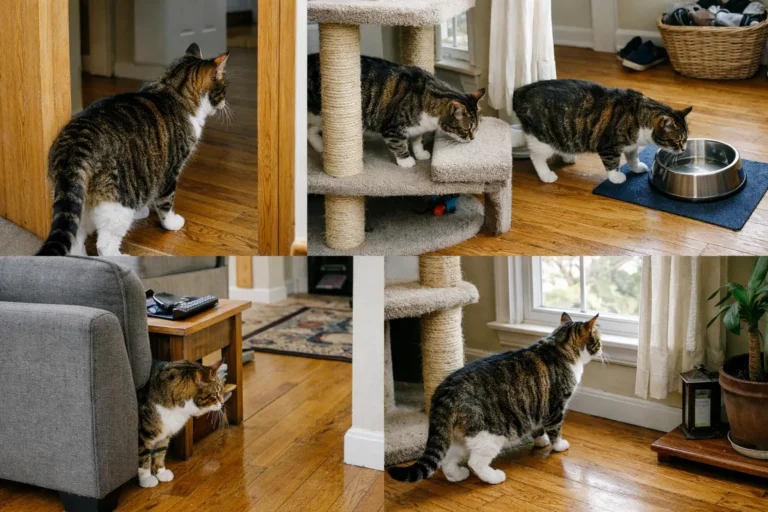
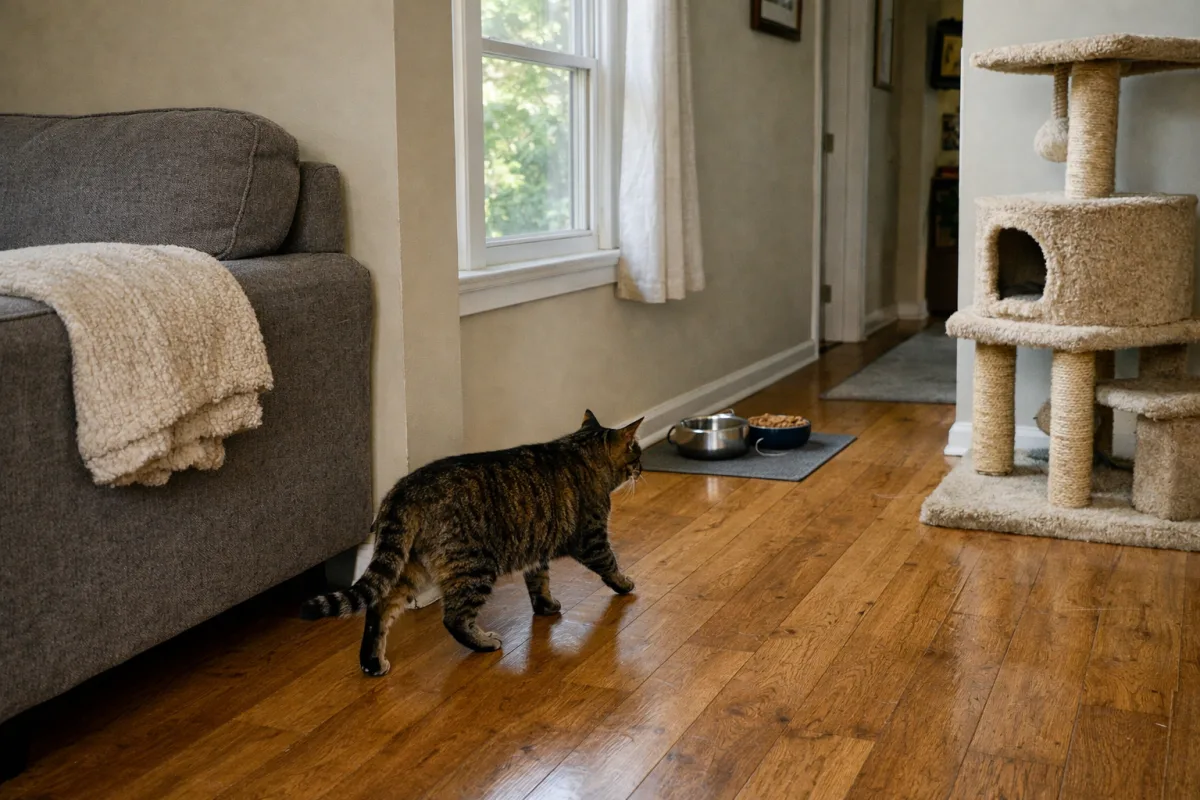
Many cats develop predictable movement patterns that appear nearly the same from day to day. The route might begin at the same sleeping spot, pass through the hallway, continue beside the couch, and end at a food bowl or a favorite perch. Some cats do not just walk through space; they seem to use it in a sequence.
This behavior often becomes most visible in homes with defined rooms and narrow walkways. A cat may choose the same edge of the rug, the same stretch of sunlight, or the same path around furniture legs. If the home has multiple levels, the cat may take the same staircase route or visit the same landing before heading elsewhere.
Common examples include:
- walking from one window to another at the same time each day
- making a loop through the home before meals
- checking specific rooms after the household wakes up
- repeating a route after using the litter box
- patrolling the same path in the evening when the house becomes quiet
These movements may look casual, but they often reflect a cat’s preference for predictability. A familiar route saves effort. It also lets the cat keep track of what has changed, what has not, and where important resources are located.
Why Cats Repeat the Same Routes
Cats are creatures of habit, but their habits are rarely meaningless. Repeated movement through the same spaces often comes from a combination of instinct, comfort, and learned experience. Cats tend to favor efficient paths that feel safe and that connect important places in the home.
One reason is territorial awareness. A cat often thinks in terms of locations: resting spots, feeding areas, litter access, high vantage points, and quiet corners. Moving through the same route can be a way of checking that those locations remain available and unchanged. In a stable home, the pattern can become almost automatic.
Another reason is sensory familiarity. Cats rely heavily on scent, memory, and spatial cues. A route that smells familiar and contains few surprises can feel reassuring. If the cat has already learned that a certain path avoids sudden noises, other pets, or awkward obstacles, it will probably choose that path again.
Repeated routes are often less about stubbornness and more about efficiency. A cat usually returns to a known path because it works well for its needs.
Habit also plays a role. Cats are quick learners when a movement pattern leads to something pleasant, such as food, attention, warmth, or a good lookout. Once a route becomes associated with a positive outcome, it can stay in use for a long time.
The Internal Reasons Behind the Pattern
Not every repeated route means the same thing. Sometimes it is a simple comfort behavior. Sometimes it helps the cat manage arousal, alertness, or uncertainty. The same movement can have different meanings depending on the rest of the cat’s body language.
Comfort and predictability
A cat that feels relaxed often sticks to familiar paths because they require little decision-making. This is especially common in cats that live in stable homes with consistent routines. The cat learns where the household usually is, when food appears, and which rooms stay quiet at certain times.
Territorial checking
Some cats move the same route as part of a regular territory survey. They are not necessarily anxious. They are simply monitoring the space. This may happen more often in multi-cat homes, near entrances, or in homes where windows reveal outdoor activity.
Anticipation of routine events
Many cats can predict daily events very accurately. If breakfast, playtime, or a human’s arrival happens around the same hour, the cat may start the same route before the event occurs. The movement becomes part of the cat’s internal schedule.
Self-regulation
A cat may also walk a repeated route when it wants to settle itself. Gentle pacing through known areas can help the cat shift from alert to calm. This does not always signal distress. Sometimes it is simply a way to organize energy.
How Home Layout Shapes the Behavior
Environment matters a great deal. Cats rarely move randomly through a home if there is a better option available. They choose paths based on access, visibility, and comfort.
In a quiet home, route repetition may be subtle. The cat might only circle the bedroom, cat tree, and kitchen at the same times every day. In a busier home, the route may become more defined because the cat is working around people, children, dogs, or household noise. It will learn which corridor stays open and which route avoids disturbance.
Furniture placement also influences the pattern. A cat often uses edges, walls, and familiar passageways because those lines help it move confidently. If a new chair blocks an old path, the cat may pause, reroute, or begin using a slightly altered loop. The new path may then become the replacement routine.
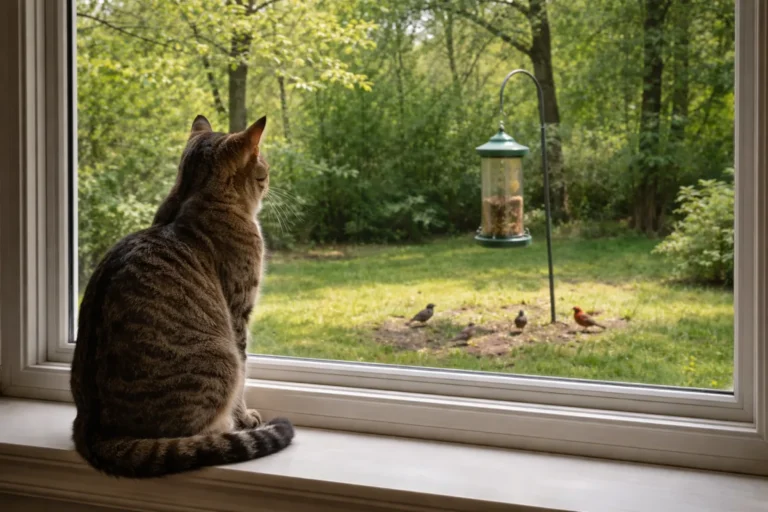
Outdoors and window access matter too. Indoor cats often build routes around places where they can observe outside activity. They may move from a sunny bed to a window ledge, then toward a hallway overlook or a back door. The route becomes a sequence of observation points.
Small changes in the home can change a cat’s route quickly. New furniture, loud appliances, unfamiliar smells, or rearranged rooms can shift a familiar pattern within days.
What the Route Can Suggest About the Cat’s State
The same repeated movement can mean different things depending on how it is performed. A relaxed cat and a stressed cat may both walk the same route, but the details usually differ.
| Behavior detail | More relaxed pattern | More tense pattern |
|---|---|---|
| Speed | steady, unhurried | fast, abrupt, or restless |
| Body posture | loose, normal tail position | low body, tight muscles, crouched movement |
| Stops | brief pauses to look or sniff | frequent checking, sudden freezing |
| Timing | predictable, linked to routine | repetitive without a clear trigger |
| Other signals | kneading, grooming, resting after | vocalizing, hiding, reduced appetite, vigilance |
A calm route often appears like an ordinary part of the day. The cat may walk, inspect, and then settle down. A more tense route tends to look less fluid. The cat may repeat the path over and over with little variation, as if trying to resolve a concern or monitor something unseen.
It helps to watch for context. If the behavior appears before meals or after household activity, it may simply be part of the cat’s schedule. If it suddenly becomes frequent, intense, or paired with other changes, it may deserve closer attention.
How the Behavior Changes in Different Daily Situations
Cats often use the same route for different reasons at different times of day. Morning movement may look very different from evening movement. The route itself may stay the same, but the meaning shifts with the moment.
Before food
Many cats develop a food-related route. They may visit the kitchen, circle the feeding area, or cross the same path to signal expectation. In these cases, the route becomes a learned part of the feeding routine. Some cats even start it before the person opens the can or walks toward the bowl.
After waking up
After a long nap, a cat may take a familiar route as a way to reorient itself. This is often gentle and slow. The cat stretches, walks a loop, and checks key spots before choosing another activity.
During quiet hours
In the evening or late at night, route repetition can become more noticeable. The cat may patrol the home more actively when the environment is still. This does not always indicate a problem. It can simply reflect increased alertness at a time when the house is calm.
When something changes
If a guest arrives, a package is brought in, or a room is rearranged, the cat may revisit the same route more often. It may be reassessing the space. Cats are careful observers, and repeated movement through a familiar path gives them a way to notice differences without venturing too far from what they know.
The Difference Between Habit and Concern
It is easy to assume that repetition means worry, but that is not always true. A cat can be perfectly content and still move through the same routes every day. Habit is part of how cats manage their world. The key is whether the behavior looks balanced or driven.
A balanced habit usually has a clear rhythm. The cat moves through the route, checks what it wants, and then shifts to another activity such as eating, grooming, sleeping, or watching the room. It still seems engaged with the environment, not trapped by it.
A more concerning pattern may be harder to interrupt. The cat might pace the same path often, especially without resting, and seem less interested in normal activities. That does not automatically point to a medical or emotional issue, but it does suggest that something in the environment or routine may be affecting the cat’s comfort.
What matters most is the overall pattern. Repetition alone is not a warning sign. Repetition plus restlessness, hiding, vocal changes, or appetite shifts is more meaningful.
How Cats Learn Routes Over Time
Cats do not usually invent a route fully formed. They build it. A good path becomes a repeated choice after several small successes. The cat finds that the hallway is clear, the carpet is quiet, the door stays open, or the window offers a rewarding view. After enough repetition, the route becomes part of the cat’s daily map.
Over time, the route may become more precise. The cat learns where the floor creaks, which areas are warmer, and which corners let it observe the most activity with the least effort. It may also adapt the route when its needs change. A younger cat may use a route for exploration and movement, while an older cat may use it for comfort and access.
Some cats maintain the same route for years. Others change it when their environment changes. Age, confidence, household activity, and even the presence of another pet can reshape the pattern. The behavior is stable enough to become familiar, but flexible enough to respond to life at home.
What Owners Often Miss
People sometimes notice the route only when it becomes annoying or obvious. A cat that crosses the same path repeatedly at bedtime may seem restless, but that movement may be tied to social timing, hunger, or simply the cat’s preferred way of checking the house. It is easy to miss the details that make the pattern make sense.
Another common mistake is assuming the cat is being deliberate in a human way. The cat is not necessarily making a statement. It is following a successful pattern. The route may feel meaningful because it is consistent, but the cat is usually responding to comfort, habit, and environment rather than trying to communicate a complex message.
Owners may also overlook the role of routine. If feeding, play, and quiet time happen predictably, the route often reflects that structure. When the schedule changes, the route may change too. The behavior is rarely isolated from the rest of the day.
When Daily Routes Become More Noticeable
Some cats barely seem to have a route until something shifts in the home. Then the pattern stands out. That often happens during transitions: a move, a new pet, a temporary visitor, a renovation, or even a change in the cat’s own routine. Familiar movement can become more visible when a cat is trying to regain its bearings.
Older cats may also show clearer route preferences. They often choose paths that are shorter, safer, or easier on their bodies. If a cat has arthritis or reduced mobility, it may select the same route because it avoids jumping, slipping, or unnecessary turns. In that case, the pattern is not only behavioral. It is practical.
At times, the route becomes a signpost for the household. The cat uses it to reach a warm spot, a quiet room, or a place where it can observe people without being disturbed. The repetition is built into the cat’s everyday comfort system.
Reading the Pattern in a Real Home
To understand a cat that moves through the same routes every day, it helps to observe the whole scene. Notice the time of day, the speed of the walk, the tail position, the ears, and what happens right before and after. One route may be tied to food. Another may be tied to window watching. Another may simply be part of morning wake-up behavior.
It also helps to look for consistency. If the pattern is predictable and the cat seems otherwise content, the route is likely just part of normal living. If it appears out of nowhere and begins taking up a larger part of the day, the cat may be responding to a change in the environment or in its own state.
Daily routes are not random wandering. They are often a practical, quiet expression of how cats organize the spaces they trust. The path a cat chooses again and again can be as revealing as a favorite sleeping spot or a preferred window seat, because it shows how the cat moves through the home it knows best.
In that sense, a repeated route is less of a mystery than it first appears. It is a familiar line drawn through the day, one step at a time, across the same floor, past the same corners, toward the places that matter most to the cat.