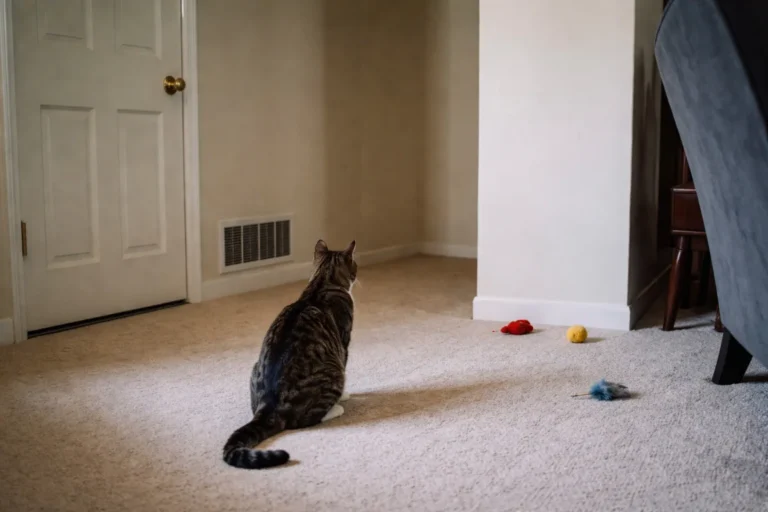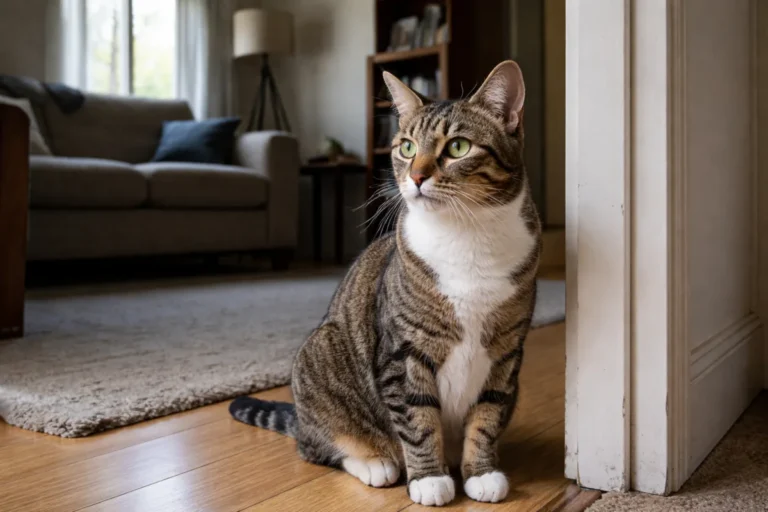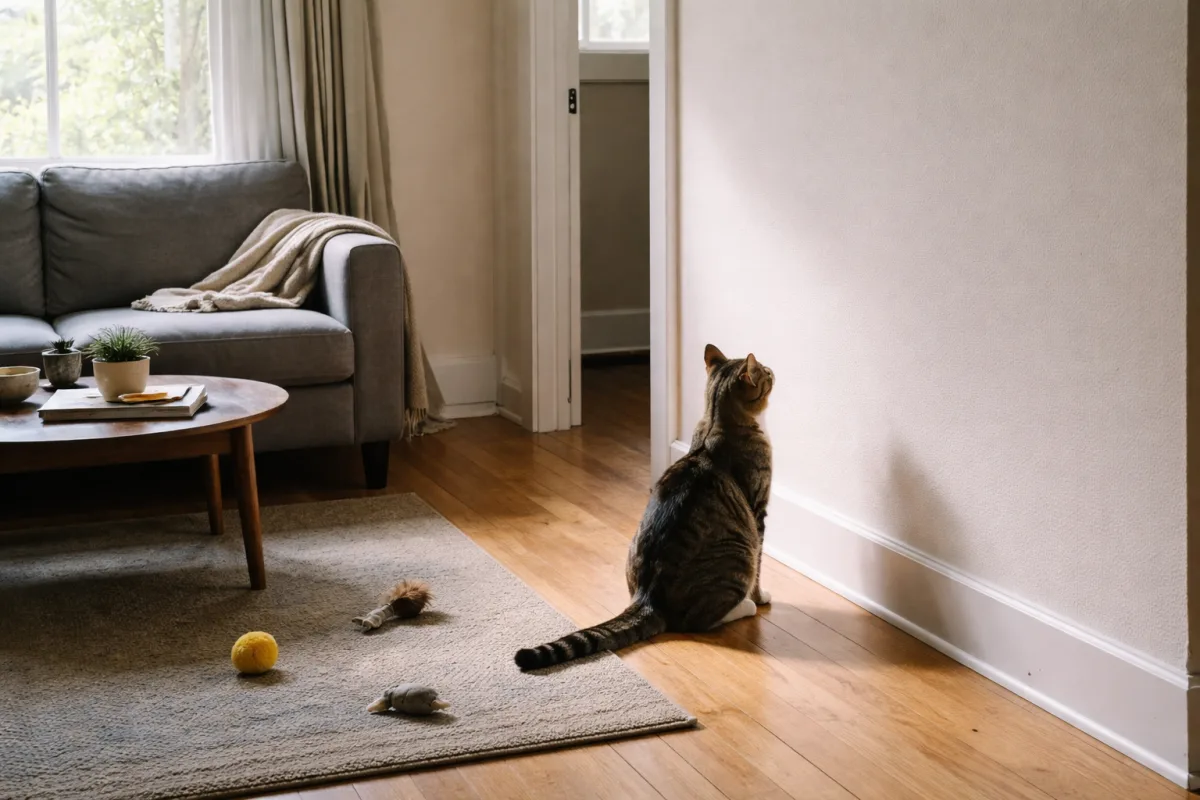
At some point, almost every cat owner has seen it: the sudden pause, the fixed gaze, and a cat staring at what looks like empty air. No toy. No bird. No obvious movement. Just a quiet, concentrated look into a corner, a wall, or the space above your shoulder.
It can feel strange because cats often seem so alert and self-contained. When they lock onto nothing you can see, the moment invites questions. Are they hearing something tiny? Sensing movement we missed? Daydreaming in their own way? In many cases, the answer is less mysterious than it appears.
Cats stare into space for a mix of ordinary reasons: they notice small sounds, track faint motion, process smells, rest their minds, or simply remain ready for anything. The behavior is usually normal, but the meaning changes with context. A relaxed cat in a sunny room is not sending the same signal as a cat that seems confused, rigid, or unresponsive.
Understanding this habit starts with watching the whole picture, not just the eyes. Body posture, tail movement, ear position, and timing all help explain what the cat may be experiencing in that moment.
What staring into space often looks like in everyday life
The behavior is easy to recognize once you have seen it a few times. Your cat may sit in the middle of the room and stare at a blank wall for half a minute. Or they may stand still near the hallway, head slightly raised, eyes open wide, as if listening to something far away. Sometimes the stare comes with a small head turn, a twitch of the ears, or a slow shift in body weight.
In many homes, this happens during quiet moments. The house is still, the TV is off, and the cat suddenly becomes intensely focused on a point no one else notices. To a human, the scene can look unusual. To a cat, it may be a normal reaction to a sound, scent, or movement that is simply too subtle for us to register.
Common situations where cats stare into space
- Watching a wall, ceiling, or doorway for several seconds
- Pausing after hearing a distant sound
- Looking upward at a light reflection, insect, or dust movement
- Staring during rest periods between naps
- Freezing briefly before jumping, pouncing, or walking away
Sometimes the stare appears to have no clear trigger. Even then, it often fits into normal feline behavior. Cats are observant by nature, and they process their surroundings in quick, silent bursts rather than in the constant, broad attention that people use.
Why cats show this behavior in general
Cats are built to notice small changes. Their survival instincts reward stillness, patience, and sharp attention. A cat that freezes and watches is doing something deeply natural. In the wild, this kind of behavior helps cats track prey, avoid threats, and assess whether something is worth engaging with.
That instinct does not disappear in a living room. Even a well-fed indoor cat still carries the same sensory habits. A quiet pause can mean they are listening for a mouse in the wall, watching a tiny insect cross the room, or monitoring a new odor from the kitchen or open window.
Cats do not stare into space because nothing is happening. Often, they are reacting to details people cannot easily detect.
The important point is that “space” is usually a human description, not the cat’s experience. To your cat, that same area may contain a moving shadow, a faint sound, or a smell trace from another animal. Their attention may be focused, not blank.
Possible internal reasons behind the behavior
- Sound detection: Cats hear frequencies and distances people miss.
- Visual tracking: Tiny movements, reflections, and shifting light can catch their eye.
- Olfactory interest: A smell may hold their attention even when nothing is visible.
- Alert rest state: Cats often rest while staying partly aware of the environment.
- Mild mental processing: They may simply be taking a quiet pause between activities.
Because cats move so quickly from stillness to action, staring can be part of a larger pattern rather than a separate event. It may happen just before grooming, eating, playing, or changing rooms. The pause itself is often the bridge between one behavior and the next.
How the home environment influences the behavior
Indoor environments can make staring more noticeable. Walls, corners, windows, screens, and reflective surfaces create a mix of visual and auditory details that can hold a cat’s attention. A cat may stare at a window because they sense movement outside, or at a vent because air flow carries a smell or sound. Even a quiet house has plenty of tiny triggers.
Routine matters too. Cats often stare more when the home is still, when people are asleep, or during predictable low-activity periods. Early morning and late evening are common times. These are natural alert windows for many cats, especially if they are watching for feeding, play, or outdoor activity.
In busier homes, the behavior may look different. A cat may stare less at a single point and more at movement around them. In a quieter home, they may have more time to sit and focus. Either way, the environment shapes where the cat directs attention and how long they hold it.
Indoor and outdoor influences
| Environment | What may trigger staring | Typical pattern |
|---|---|---|
| Indoor home | Reflections, vents, sounds in walls, insects, routine changes | Longer stillness, fixed gaze, brief bursts of attention |
| Outdoor access | Birds, leaves, movement at a distance, scents, neighbors’ animals | Shorter, sharper focus with quick shifts in direction |
Light also plays a role. Cats often notice a moving patch of sunlight on the floor or a shadow changing shape near the curtain. What seems like empty space may be a field of movement from the cat’s point of view.
What the behavior may signal about the cat’s state
Staring can mean different things depending on the cat’s body language. A relaxed cat may stare with soft eyes, loose shoulders, and a still tail. That usually suggests curiosity or simple alertness. The cat is engaged, but not troubled.
A more intense stare can look different. The eyes may be wide, the body tight, and the ears angled forward or slightly back. In that case, the cat may be focused on something meaningful, or they may be feeling uneasy. The key is not the stare itself, but the combination of signals around it.
Body language tells you more than the stare alone. A calm cat and a tense cat can both look “fixed” from across the room.
There are also moments when staring reflects fatigue or mental overload. A cat that has been active, startled, or highly stimulated may stop and gaze into space as a way of resetting. This is especially common after bursts of play or after a stressful event like loud noise, visitors, or a change in routine.
Soft signals vs stronger signals
- Soft signals: relaxed posture, slow blinking, ears neutral, tail still or gently moving
- Stronger signals: stiff body, unblinking eyes, lowered head, flattened ears, abrupt freezing
- Mixed signals: relaxed body with sharply focused eyes, or tense body with only brief staring
Mixed signals are common. A cat may look calm but still be paying close attention to a sound behind a wall. Another cat may appear tense for a moment and then settle as soon as they realize there is no threat. This is why single behaviors should always be read in context.
How cats combine curiosity, independence, and sensitivity
Cats are often described as independent, but independence does not mean disinterest. Many cats spend a lot of time quietly observing before they act. Staring into space fits that style perfectly. It lets them monitor their surroundings without committing to movement.
The behavior also reflects sensitivity. Cats notice subtle changes in smell, sound, and motion, and they may react to them long before people do. That sensitivity can make them seem mysterious, but in daily life it is usually practical. They are gathering information.
At the same time, cats can be selective about when they reveal their attention. A cat may sit in a room that appears empty and remain still for minutes, then suddenly follow one small sound with a precise head turn. The stillness is not disengagement. It is a form of watchfulness.
What owners often misread
People sometimes assume that staring into space means a cat is “seeing ghosts” or acting in some unusual, supernatural way. While the behavior can look eerie, the more likely explanation is ordinary feline perception. Cats notice things humans miss all the time, especially tiny movements and faint sounds.
Another common misunderstanding is that staring always means stress. That is not true. A cat lying in a peaceful room may stare because they are resting while staying aware. The difference is whether the cat seems comfortable or guarded. Relaxed muscles, normal breathing, and an easy posture usually point to a benign moment.
Some owners also worry when a cat stares at nothing for a long time and does not respond right away. A brief delay can be normal, especially if the cat is absorbed in a sound or visual detail. But if the cat seems unable to orient, appears disoriented, or starts doing this much more than usual, the behavior deserves closer attention.
When the pattern may be worth noticing more closely
- The stare lasts much longer than the cat’s usual behavior
- The cat seems confused or unable to focus afterward
- There are signs of lethargy, wobbling, or unusual silence
- The cat stops responding to familiar cues in a normal setting
- The staring is paired with hiding, appetite changes, or agitation
Those signs do not automatically mean something is wrong, but they change the meaning of the stare. A new pattern is always more important than an isolated moment.
How emotional state and timing affect interpretation
Timing can tell you a lot. A cat who stares into space right after a meal may simply be settling. A cat who does it after a loud noise may be checking for safety. A cat who stares during play may be in hunting mode, watching an imaginary target or tracking a toy that disappeared under furniture.
Emotional state matters just as much. Curiosity, contentment, caution, and mild stress can all produce a similar-looking stare. The surrounding behavior is what separates them. A cat that stares, blinks slowly, and returns to grooming is likely in a peaceful state. A cat that stares, freezes, and avoids movement may be more guarded.
Even boredom can play a role. Cats without enough stimulation may spend longer periods watching walls, corners, or windows because they are under-occupied. That does not mean the cat is unhappy every time it happens. It simply means the stare may be one small part of a day that lacks enough variety.
How cat–human interaction shapes the moment
Cats often stare into space when humans are nearby because the room itself is changing around them. A person walking by, opening a cabinet, turning on a faucet, or shifting on the couch can create a chain of tiny cues. The cat may pause to evaluate all of it at once.
Sometimes the stare appears directed at the owner, but the cat is actually watching the space just beyond them. That can happen near doorways, on sofas, or at the edge of a bed. Cats are good at using human movement as part of their environmental map.
One reason this behavior feels so noticeable is that people usually expect direct, intentional communication from a pet. Cats often communicate through observation first. Staring can be part of that quiet system. They look, compare, and decide whether to approach, ignore, rest, or play.
When a cat stares in your direction, it may not be asking anything. It may be assessing the room, your movement, or a sound you never noticed.
How long-term patterns help make sense of it
For most cats, staring into space is a stable behavior that comes and goes with normal life. It may increase during seasonal changes, when window activity changes, or when the household routine shifts. It may be more common in younger cats who react to every new sound, or in older cats who spend more time resting quietly.
Over time, owners usually learn their cat’s version of the habit. One cat stares before mealtime. Another does it near the front door every evening. Another sits and watches the hallway after everyone has gone to bed. These patterns are often useful because they show when the cat is most alert, most relaxed, or most easily distracted.
If the behavior is consistent and the cat otherwise seems healthy, it is often just part of their personality. Some cats are simply more observant than others. They prefer watching to moving, especially when the world around them is active enough on its own.
Reading the behavior in context
The best way to understand a cat staring into space is to ask what else is happening at the same time. Is the home quiet or noisy? Is the cat resting or keyed up? Did something change recently, like a new pet, a different feeding schedule, or a rearranged room? Small details often explain the moment better than the stare itself.
A cat that looks fixed on empty air is usually doing one of several ordinary things: listening, tracking, resting, or thinking in the practical cat sense of the word. The behavior becomes meaningful when paired with the rest of the cat’s body and the rhythm of the day.
In a calm household, a brief stare often passes without incident. The cat blinks, shifts position, and moves on. In a more active setting, the same stare may be the first sign that the cat has noticed something important. The behavior stays the same on the surface, but its meaning changes with the moment around it.
That is what makes cats so interesting to watch. They rarely waste attention. Even when they seem to be staring at nothing, they are usually engaged with something that matters to them, whether it is a sound in the wall, a flash of movement by the window, or simply a quiet pause between the next thing and the one after that.