One moment a cat is curled tightly into a small ball. A few minutes later, the same cat stretches out on its side, then turns over, then hops to a different spot entirely. This constant shifting can look random, but it usually means the cat is responding to something real in its body or environment.
Cats are not still by nature. They adjust often, sometimes for comfort and sometimes because they are alert to tiny changes that people barely notice. A slight draft, a warmer patch of sunlight, a changing sound in the next room, or even a mood shift can be enough to make them move again.
Changing positions is usually normal. In many cases, it is simply a cat fine-tuning its comfort. Other times, it can reveal restlessness, tension, or a need for reassurance. The clue is not just that the cat moved, but how often, how quickly, and in what context.
What position changes look like in everyday life
Cats rarely settle in one pose for long unless they are deeply relaxed or asleep. More often, they rotate between several familiar positions during the day. They may start with a loaf, switch to a side stretch, then tuck the paws under again, all within the same hour.
These changes can happen on the couch, in a bed, on a windowsill, or right beside a person. Some cats adjust every few minutes. Others stay put longer but still make small shifts: a tail flick, a head turn, a slow roll, or a careful repositioning of the hind legs.
Not every shift means the cat is uncomfortable. Cats are observant animals, and they often change positions because they are tracking their surroundings. A sound from outside, a person walking by, or another pet moving nearby can prompt a new posture without the cat ever seeming fully alarmed.
Common everyday patterns
- Sleeping curled up, then stretching out as the body warms up
- Moving from a sunny place to a cooler floor
- Turning to face a doorway or a person entering the room
- Shifting after grooming to settle into a more relaxed position
- Repositioning after hearing a noise or sensing movement
These small changes are part of normal cat behavior. A cat does not need to stay in one position to be comfortable. In fact, frequent adjustments often show that the cat is checking in with its body and surroundings at the same time.
Frequent position changes are not automatically a sign of a problem. The meaning depends on the cat’s age, health, setting, and overall behavior.
Comfort is one of the biggest reasons
The simplest explanation is often the right one: cats move because they want to feel better. Their bodies are flexible, and they like to keep adjusting pressure, temperature, and support until the position feels right. A pose that was pleasant a minute ago may stop being pleasant after the muscles relax or the surface shifts.
Cats are especially sensitive to small details in comfort. A hard surface may feel fine for a short while, then become too firm. A soft cushion may start to trap too much heat. Even a tiny change in limb placement can make the difference between rest and irritation.
This is why a cat may seem unable to “make up its mind.” What looks like indecision is often precision. The cat is exploring the best balance between support, warmth, and security.
Temperature changes matter more than many people realize
Cats often move to regulate body temperature. They may stretch out when they feel warm or curl up tightly when they want to conserve heat. In a house with changing sunlight, air conditioning, or heating vents, a cat may keep shifting throughout the day as conditions change.
A cat that keeps moving from one surface to another may simply be searching for the right temperature. Tile, carpet, blankets, and windowsills all feel different. Cats notice those differences quickly.
A cat changing positions near a window, heater, or air vent is often responding to temperature, not restlessness alone.
Instinct plays a quiet role
Cats do not lie down the way dogs often do. They keep a part of their attention on the world around them. This comes from instinct. In the wild, staying too fixed in one vulnerable position could be risky, so a cat’s body is built to remain ready.
That same instinct still shows up indoors. Even when a cat is safe, it may prefer to keep options open. A cat may shift so it can see the room better, hear movement more clearly, or position itself for a quick stand-up if needed.
This is one reason cats often change positions during light sleep. They are not fully detached from their surroundings. They are resting, but in a way that keeps them aware.
How instinct appears in common postures
- Facing the room instead of turning its back to open space
- Keeping the paws tucked under for a quick rise
- Rolling slightly but not fully exposing the belly
- Changing spots after a sudden noise
- Choosing a perch with a clear view of the room
These habits do not mean a cat is scared. They reflect an animal that likes to monitor its environment while still resting. The position keeps changing because the cat is balancing comfort with awareness.
Body language often gives the reason away
Position changes make more sense when paired with the rest of the cat’s body language. A cat that is relaxed while shifting is different from one that seems tense, guarded, or unable to settle. The ears, tail, eyes, and muscles all help tell the story.
A slow repositioning followed by loose limbs and half-closed eyes usually suggests normal comfort. A cat that keeps moving but looks tense may be telling a different story. The movement may be driven by nervousness, itchiness, pain, or environmental stress.
Signs that the movement is calm
- Slow, deliberate repositioning
- Soft face and relaxed whiskers
- Loose tail or gentle tail curls
- Normal breathing
- Brief shifts followed by settling
Signs that the movement may reflect discomfort
- Repeated standing up and lying down
- Inability to get comfortable for long
- Hunched posture or stiff limbs
- Flattened ears or wide eyes
- Overgrooming, licking, or scratching along with shifting
The same behavior can mean different things depending on the rest of the picture. A cat rolling from side to side in sunshine is not the same as a cat pacing between beds and never fully settling.
Daily routine can shape how often a cat shifts
Some cats change positions more often because their day is more active. A busy household brings noise, footsteps, doors opening, food prep, visitors, and movement from other pets. In that kind of environment, a cat may reposition often simply to keep track of everything happening around it.
Indoor cats in quiet homes may also shift often, but for different reasons. Without outdoor stimulation, their attention may move from one room detail to another. They may relocate from one resting area to the next as light, sound, and temperature change during the day.
Routine matters as well. Cats often develop habits around meals, playtime, and family schedules. If a cat shifts position repeatedly around certain times, it may be reacting to expected events, not just physical comfort.
How the home environment influences movement
- Busy homes can make cats reposition to monitor activity
- Quiet homes may lead to more attention to subtle changes in light or temperature
- Multiple pets can create social tension that affects resting spots
- Limited perch choices can make a cat keep searching for a better place
- Soft bedding, window access, and elevated spots can reduce unnecessary shifting
If a cat keeps leaving one resting spot for another, the environment may be too noisy, too warm, too exposed, or simply not comfortable enough.
Sometimes the cat is seeking control
Changing positions can also be a way for a cat to manage its own sense of control. Cats like choice. When they can switch spots, adjust angle, or move closer and farther from people, they often seem more settled overall.
This is especially noticeable in cats that are social but selective. They may curl near a person for a while, then shift slightly away, then return later. That movement does not always mean rejection. It can be a way of balancing closeness with personal space.
A cat may also move because it wants to keep a door in view, maintain a route to escape, or stay near a source of comfort without fully committing to it. The position itself becomes part of how the cat feels in control of the room.
Stress can look like constant repositioning
Not all shifting is casual. A cat that never seems comfortable may be under stress. Stress does not always show up as hiding or vocalizing. Sometimes it appears as repeated changing of position, as though the cat cannot fully relax anywhere.
This is more likely when the cat is also showing other tension signals. The cat may keep getting up, circling around, choosing one place and then another, or lying down only briefly before changing again. The body never quite drops into a deep resting state.
Stress-related shifting often happens after changes in the home. A new pet, a different schedule, construction noise, unfamiliar visitors, or a move to a new space can all make a cat more restless. Even small disruptions can matter when a cat is sensitive.
Patterns that deserve attention
- Frequent switching without sleeping deeply
- Restlessness that increases after a home change
- Movement paired with hiding, appetite changes, or vocalizing
- Repeated repositioning followed by sudden departure
- Difficulty settling in places that were once familiar
In these cases, the movement may be less about comfort and more about uncertainty. The cat is trying to find a place that feels safe enough to stop.
Health can influence how a cat lies down and gets back up
Physical discomfort often changes how a cat uses its body. Pain in the joints, abdomen, skin, or mouth can make certain positions hard to hold. A cat may keep adjusting because no position feels fully right.
Older cats may change positions more often as stiffness sets in. They may lie down, then shift after a short time because their joints feel tight. Younger cats can also do this if they are itchy, sore, or dealing with internal discomfort.
What matters most is whether the behavior is new or noticeably different. A cat that used to settle easily but now keeps repositioning may be trying to avoid pain. The changes may be subtle at first.
Signs that position changes may have a medical cause
- Reluctance to jump, climb, or stretch
- Guarded movement or stiffness
- Frequent posture changes during rest
- Sensitivity when touched in one area
- Changes in litter box habits, appetite, or grooming
When movement and discomfort appear together, it is worth paying close attention. Cats often hide pain well, so changes in how they rest can be one of the earliest clues.
Different positions serve different purposes
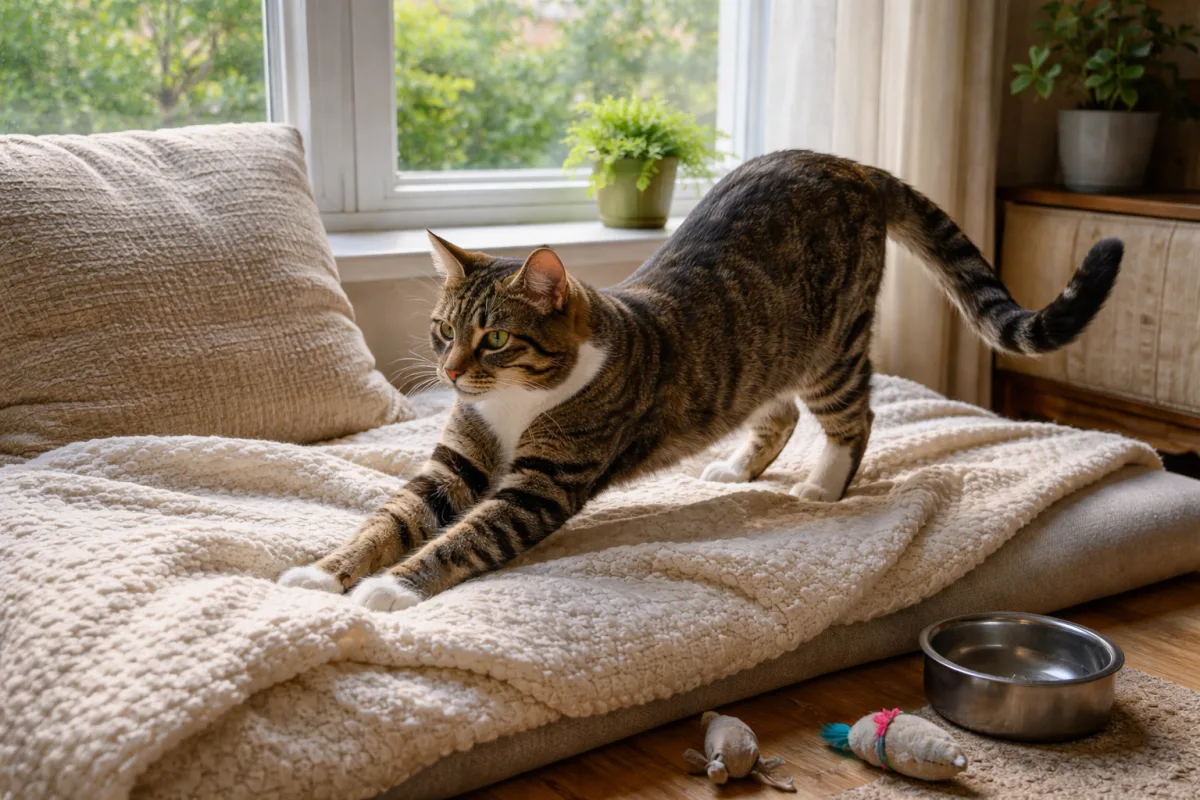
Cats do not shift without reason. Each position can serve a different purpose, even if the changes look casual from the outside. A curled pose conserves warmth. A side stretch relaxes the body. A loaf keeps the cat ready to move. A full belly-up sprawl usually happens when the cat feels safe and very comfortable.
Some cats rotate through these positions as the day changes. They may start guarded, relax more after a meal, then spread out in a warmer spot later. That sequence is often a sign that the cat is adapting to what it needs moment by moment.
| Position | Common meaning |
|---|---|
| Curled tight | Warmth, security, or deep rest |
| Loaf | Relaxed but alert |
| Side stretch | Comfort, trust, body release |
| Belly exposed | High comfort or social ease |
| Frequent rising and lying back down | Possible discomfort, stress, or uncertainty |
These are not rigid rules. A cat’s meaning can change with context. Still, the pattern of movement often becomes clearer once the position itself is considered.
Social behavior can influence how a cat settles
Some cats change positions more when people are nearby. They may move closer when they want attention, then shift away once they have had enough. This does not always mean the cat is indecisive. It can be a normal part of social interaction.
Cats often balance connection and independence. They may want to be in the same room, near enough to observe, but not necessarily in direct contact. If a cat keeps changing positions around a person, it may be adjusting the distance that feels right in that moment.
That same behavior can happen with other pets. A cat may move to monitor a dog, avoid a pushy housemate, or claim a spot that offers a better social buffer. Position changes become part of communication.
A cat that moves away after brief closeness is not always rejecting contact; it may simply be setting a comfortable boundary.
What repeated shifting usually means over time
When position changes happen occasionally, they are usually nothing to worry about. When they happen all the time, the reason is often consistent. A cat may always be looking for a cooler spot, avoiding a noisy area, or settling only when the room is quiet.
Patterns matter. If the cat keeps changing positions in the evening but rests more easily during the morning, the environment may be louder later in the day. If the cat seems restless only after meals, after grooming, or when certain people are present, those details provide useful context.
Over time, many cats show stable preferences. Some like high places. Some prefer a soft bed. Some avoid being fully exposed. Watching where a cat chooses to stop, and where it refuses to stay, often reveals more than the movement itself.
When the behavior is simply part of being a cat
Sometimes the answer is plain: cats keep changing positions because they can, and because it helps them stay comfortable. Their bodies are built for quick adjustments. Their senses are tuned to subtle changes. Their resting habits reflect both traits.
A cat that shifts, stretches, curls, and resettles is often doing exactly what it should be doing. It is checking the room, checking its body, and finding the best available moment to rest. That can look restless from a human point of view, but in cat terms it is often normal and practical.
The clearest clue is consistency. A healthy cat with a comfortable environment usually changes positions in a loose, unhurried way. The movement looks smooth, not frantic. It has rhythm. And after a few adjustments, the cat settles again.
When the movement is abrupt, constant, or paired with other changes in behavior, it deserves more attention. But in ordinary life, position changes are just one of the ways cats stay tuned to their world while remaining ready for whatever comes next.