A cat can go from still as a statue to fully engaged the moment a moving shadow slides across the floor. A shaft of sunlight on the wall, a hand passing over a lamp, or a flicker from a TV screen can pull their attention in seconds. To people, it may look random. To a cat, it often feels like a small event worth noticing.
Light and shadow are not just visual details in a cat’s world. They change, move, and disappear quickly, which makes them especially interesting. Some cats stare at them with intense focus. Others pounce, bat, or follow them from room to room. A few only glance up, then settle back down, as if they have already decided the movement is harmless but worth a check.
This reaction comes from more than simple curiosity. It reflects how cats are built to notice motion, how they read their surroundings, and how they decide whether something deserves attention. In a home, those same instincts show up around curtains, reflections, ceiling fans, smartphone screens, and even the shifting pattern of daylight on furniture.
What Cats Actually Do When They Notice Light and Shadows
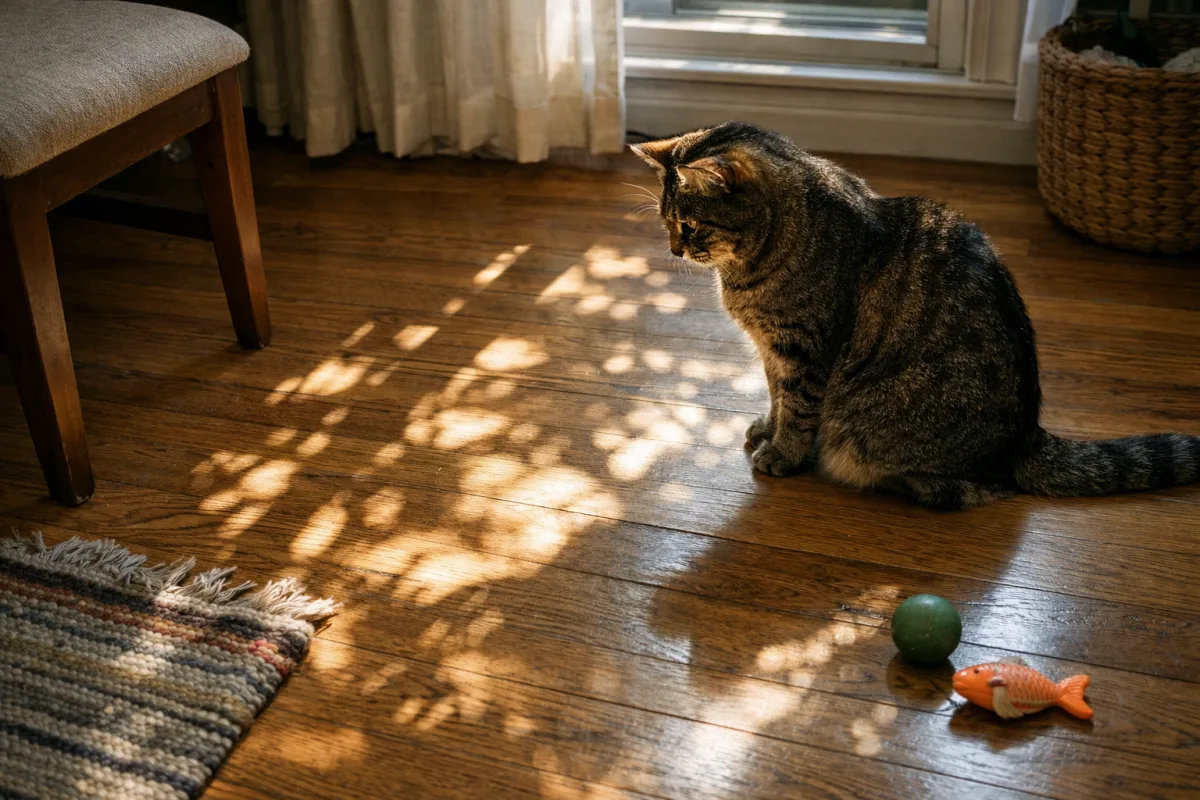
The reaction can look playful, alert, or oddly serious. One cat may crouch low and track a shadow with slow, deliberate head movements. Another may dart after a sunbeam as if it were a bug. A third may freeze and stare at a moving reflection on the wall, ears turning forward, body tense, tail twitching at the tip.
These behaviors often appear in very ordinary moments. Morning sunlight moving across a kitchen floor. A flashlight beam from a child’s toy. Headlights sweeping past a window at night. The cat does not need a clear object to react. In many cases, the movement itself is enough.
For cats, changing light can behave like a moving signal: brief, uncertain, and worth investigating.
That does not always mean the cat is “chasing” something in the human sense. Sometimes they are tracking the edge of the shadow. Sometimes they are watching for a source. And sometimes they are simply responding to a visual change that stands out from the stillness around it.
Why Light and Shadow Catch a Cat’s Attention
Cats are built to notice motion more than detail. Their vision is adapted for spotting changes in the environment, especially small movements that could indicate prey. Light and shadow create exactly that kind of change. They move, split, blur, and disappear in ways that are easy for a cat to notice and hard to ignore.
There is also a strong instinctive element. A flickering patch of brightness on the wall can resemble the movement of an insect. A shadow crossing the floor can trigger the same attention that a mouse-like shape might trigger outdoors. The cat’s brain does not need the object to be real prey for the response to begin.
Another reason is that shadows are uncertain. They can shift with no clear explanation from the cat’s point of view. That uncertainty makes them interesting. Animals often pay close attention to things that are small, changing, and not immediately predictable.
Key reasons cats react
- They are highly sensitive to movement.
- Changing light creates visual contrast.
- Shadows can resemble prey-like motion.
- Unpredictable changes draw their attention.
- Some cats simply enjoy the stimulation.
Not every reaction has the same meaning. A cat may be playful one minute and cautious the next. The difference usually comes from the context, the cat’s mood, and how sudden the light change is.
How the Behavior Looks in Everyday Life
In a quiet home, a cat may spend a long time watching a bright rectangle shift across the floor as the sun moves. The cat might sit in the path of the light, then slowly step away as the shape changes. This is not always about play. Sometimes it is just careful observation.
In busier homes, the behavior often looks more active. A cat may leap at a flashlight spot, chase the reflection from a watch face, or paw at a beam from outside. Some cats become especially interested when a light source creates fast-moving patches on walls or ceilings.
At night, the behavior can be even more noticeable. Cars passing outside may send brief flashes through curtains. Screens, charging lights, and electronic displays all create tiny visual changes. Cats often check these signals repeatedly, even when the humans in the room stop noticing them.
Common situations that trigger the response
- Sunlight moving through windows or blinds
- Reflections from mirrors, glass, or metal
- Flashlights and laser toys
- TV screens and phone light
- Headlights or streetlights outside
- Shadows from people walking past
Some cats will return to the same spot every day if the light pattern repeats. Others react only when something changes quickly. That difference often says more about the individual cat than about the light itself.
What the Reaction May Say About the Cat’s State of Mind
The same shadow can produce very different behavior depending on the cat’s mood. A relaxed cat may watch with soft eyes, a loose body, and slow blinking. A more aroused cat may have a tighter posture, quick tail movements, and fixed attention. When the reaction turns intense, the cat may be less interested in the light itself and more driven by nervous energy or high stimulation.
Playfulness is one common explanation. Cats often enjoy visual motion because it gives them a target for hunting-style behavior without requiring a real hunt. Bats, pounces, and short chases can be part of normal play, especially in younger cats or cats that have not had much active enrichment during the day.
But some reactions are more about alertness than fun. A cat that suddenly locks onto a shifting shadow after hearing a noise outside may be responding to a broader sense of the environment. Light becomes one more cue in a scene the cat is already evaluating.
A calm reaction usually looks loose and brief. A stressed or overstimulated reaction often looks sharper, narrower, and harder to interrupt.
Body language to watch
- Forward ears often suggest interest
- Slow tail movements can show focus
- Tense shoulders may mean rising arousal
- Flattened ears or crouching can signal discomfort
- Repeated jumping or darting may mean overexcitement
If a cat seems unable to settle after the light disappears, the reaction may be carrying more emotional weight than simple curiosity. In that case, the shadow is not the whole story. The cat’s overall state matters just as much.
Why Some Cats React More Strongly Than Others
Not all cats respond to light in the same way. Breed tendencies, age, energy level, and personality can all shape the reaction. Some cats are naturally more observant and reactive to environmental changes. Others are more laid back and appear interested only when a visual cue is especially dramatic.
Indoor cats often notice these effects more because they spend more time in spaces with windows, screens, lamps, and reflective surfaces. Cats who live with predictable routines may also become very tuned in to everyday light changes because those changes stand out against a familiar background.
Outdoor access can change the pattern as well. A cat that spends time outside may be exposed to more visual variety and may treat indoor shadows with less urgency. Or the opposite may happen: after observing real movement outdoors, a cat may become even more sensitive to shifting shapes indoors.
Factors that influence intensity
- Age and activity level
- Indoor or outdoor lifestyle
- How much mental stimulation the cat gets
- How sudden the light movement is
- Previous experiences with toys or chasing behavior
- The cat’s general comfort in the environment
A confident cat may treat light like a puzzle. A cautious cat may stare first and move later. A highly energetic cat may react with a quick burst of motion and then lose interest just as fast. Each version can be normal.
The Role of Instinct in a Modern Home
Modern homes are full of visual surprises that cats were never meant to ignore. Shimmering TV images, glass doors, polished floors, and moving sunlight all create shifting patterns. To a cat, these are not meaningless decorations. They are part of the sensory landscape.
That is one reason cats will often investigate the same light source repeatedly. A shadow that changes shape over the course of the day gives the cat new information each time. Even when nothing is “happening,” the environment keeps offering small updates.
Some cats focus on light because they enjoy the challenge of tracking something intangible. The behavior may look like hunting, but it can also be a form of practice. Cats rehearse quick attention shifts, body coordination, and timing in these moments.
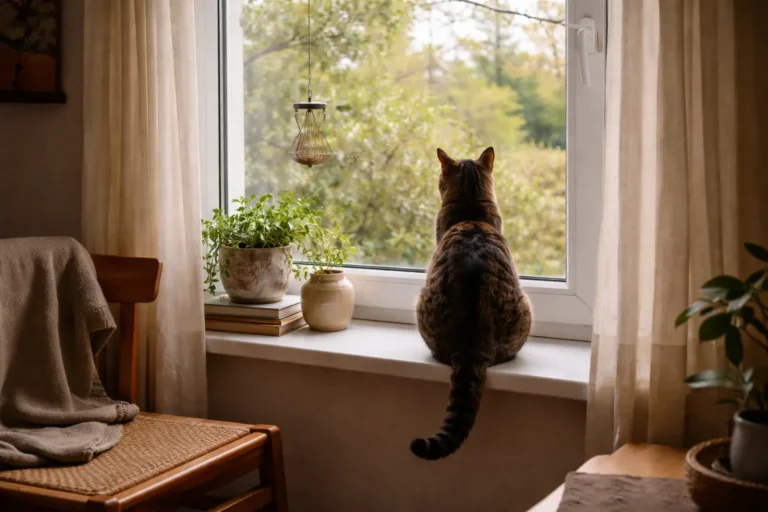
Homes with lots of glass, bright surfaces, or active window traffic may make this more obvious. A cat near a sunny window may keep turning its head as clouds pass. Another may sit beside a curtain and watch the pattern on the fabric change with every breeze.
When the Reaction Is Playful, Calm, or Defensive
The same shadow can produce three different responses, and the difference matters. A playful cat usually shows curiosity with flexible body movement. The cat may stalk, bounce, or tap the moving light without appearing tense. When the light disappears, the cat may quickly disengage or look around for the next cue.
A calm cat often watches without acting. The ears may remain neutral, the body relaxed, and the interest brief. This is common when the light is familiar or the cat is already comfortable and resting.
A defensive response is less common but worth noticing. If a cat startles hard, retreats, or seems ready to swat aggressively at the source, the light may be part of a larger stress reaction. That can happen if the change is sudden, the environment is noisy, or the cat already feels uneasy.
Different types of reactions
| Reaction type | What it may look like | Possible meaning |
|---|---|---|
| Playful | Pouncing, chasing, quick returns | Engagement and energy |
| Calm | Watching, slow blinking, loose posture | Quiet awareness |
| Defensive | Startling, hiding, tense body | Discomfort or unease |
| Overstimulated | Repeated lunging, difficulty settling | Too much arousal |
These categories are not rigid. Cats move between them. A cat may begin in a calm watching mode and become playful if the light keeps moving. The reverse can happen too, especially if the movement becomes too abrupt or too long-lasting.
How to Read the Full Situation, Not Just the Shadow
The meaning of the reaction depends on timing, surroundings, and the cat’s usual habits. A cat that chases a beam for a few seconds and then relaxes is usually displaying ordinary interest. A cat that keeps scanning the room after the light is gone may be responding to something broader, like outdoor movement or general tension.
It also helps to notice what happens before the reaction. Did the cat just wake up? Is there a bird outside? Has the house been unusually loud? Is the cat already playful from another game? Context changes everything.
Light and shadow can be the trigger, but not always the root cause. The cat may already have energy to burn, curiosity to satisfy, or anxiety to release. The visual cue simply gives those feelings a direction.
When a cat reacts strongly to light, the most useful question is not only “What did it see?” but “What else was happening at that moment?”
What Cats May Be Communicating Through This Behavior
In many cases, the reaction is just part of normal feline behavior. But it can still communicate something useful about the cat’s environment and comfort level. A cat that reacts only during daylight shifts may be telling you the environment is visually stimulating in a pleasant way. A cat that reacts most intensely during noisy, busy periods may be showing that its attention is already elevated.
This behavior can also reflect boredom. Cats with too little stimulation sometimes latch onto moving light because it is one of the few active events available. In that case, the shadow is not a problem by itself. It is simply one of the few things that feels worth following.
At other times, the reaction can reveal sensitivity. Some cats are especially aware of changes in brightness, motion, and reflection. Those cats may need a calmer environment, more predictable routines, or more appropriate outlets for chasing behavior.
What Happens Over Time
For many cats, the reaction remains fairly stable throughout life, though its intensity may change. Kittens often react with more obvious enthusiasm. They are still learning how moving objects work, and their play drive is strong. A kitten may leap at a shadow with very little caution.
Adult cats often become more selective. They may watch first, then decide whether the movement is worth the effort. Older cats may still notice light changes, but they may respond more slowly or with less physical pursuit. That does not mean the behavior disappears. It often becomes subtler.
Long-term patterns matter more than isolated moments. If a cat has always enjoyed sun patches and shadow play, the behavior is probably part of its normal temperament. If the behavior changes suddenly, becomes more obsessive, or starts alongside other changes in appetite, sleep, or mood, that shift deserves attention.
Stable patterns to notice
- Whether the behavior happens at the same times each day
- Whether the cat stays relaxed before and after
- Whether the reaction is brief or repetitive
- Whether the cat can redirect easily
- Whether the behavior has changed over weeks or months
Over time, the most meaningful difference is often not whether the cat reacts to light, but how it reacts. A soft curiosity and a tight, repeated fixation are not the same thing.
Living with a Cat That Loves Light and Shadows
Many cats enjoy this kind of stimulation without any problem at all. They watch, pounce, and move on. The key is understanding whether the behavior fits into the cat’s normal pattern or seems to take over too much attention.
If the reaction seems playful and short-lived, it is usually just part of the cat’s daily rhythm. If the cat becomes frustrated by unreachable light sources, or keeps hunting reflections long after the source is gone, the behavior may be feeding excess energy rather than satisfying it.
A cat that reacts to light and shadow is not being strange. It is responding to a world built on movement, contrast, and surprise. In a home full of changing shapes and shifting brightness, those small signals can be as interesting as any toy on the floor.
What looks like a simple shadow from across the room can, for a cat, be a moving event with texture, timing, and meaning. That is why a patch of sunlight can hold a cat’s attention so completely, while the rest of the room fades into the background.