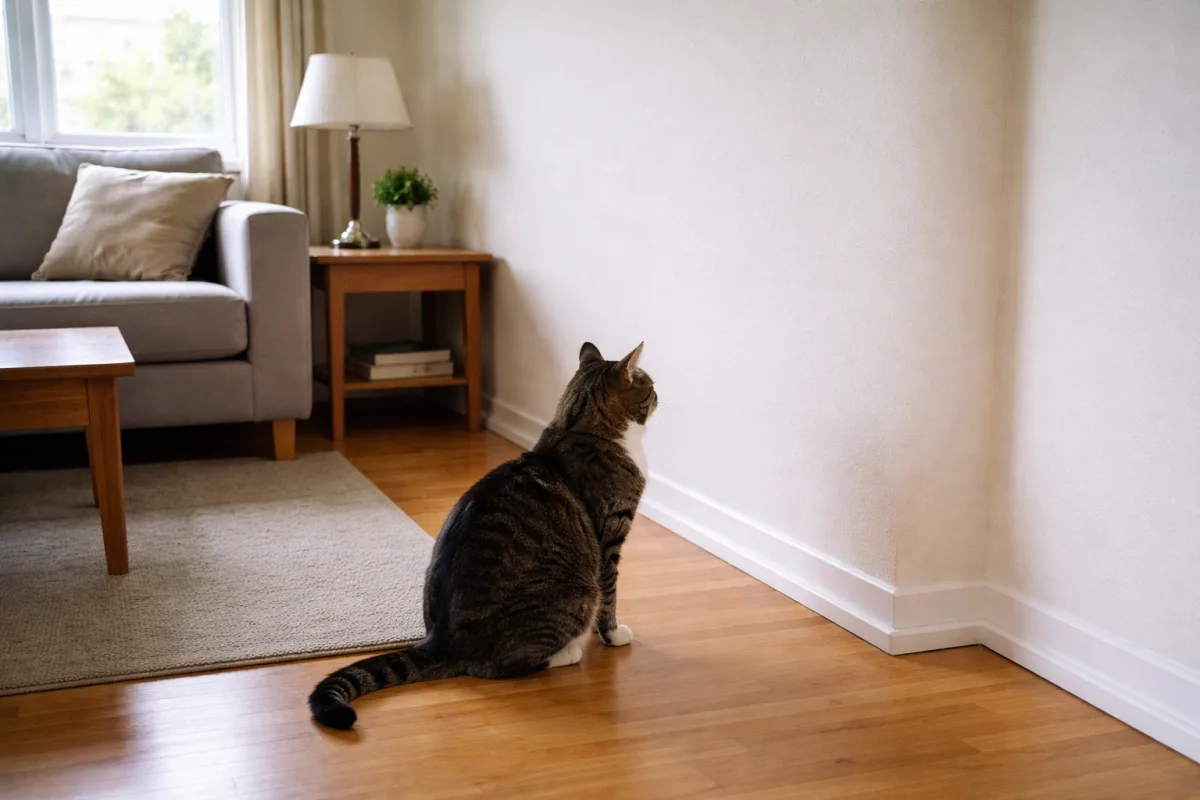
A cat staring into an empty corner can look eerie, almost comical, or deeply confusing depending on the moment. One second your cat is relaxed on the couch, and the next it is fixed on a spot where nothing seems to be happening at all. For people who live with cats, this kind of behavior is common enough to notice, but unusual enough to raise questions.
Sometimes the explanation is simple. A cat may have heard a tiny sound, caught a faint movement, or noticed a scent that never reached human attention. Other times the behavior seems to last longer, repeat more often, or appear in a specific room, which makes it feel more meaningful. The truth is that cats are constantly gathering information from their environment, and empty corners can hold more interest for them than they do for us.
What looks like blank staring is often a mix of instinct, attention, and sensitivity. A cat may be tracking air movement near a vent, watching shadows shift on the wall, or listening for insects behind baseboards. In some cases, the behavior is simply part of a cat’s normal habit of scanning a space. In others, it may reflect stress, sensory changes, or a shift in how the cat experiences its home.
What the behavior looks like in everyday situations
Cats do not usually stare at empty corners in exactly the same way every time. The posture, duration, and timing often give the best clues. A cat might sit still with ears pointed forward, gaze fixed toward a doorway corner, and remain there for a minute or two. Another cat may look into a corner while its tail flicks slowly, then walk away after a brief pause.
In many homes, this happens during quiet hours. Early morning and late evening are especially common because the house is still, household noise drops, and small sounds become easier for cats to detect. A corner near a heater, air vent, appliance, or cabinet can become a favorite place to inspect because it carries noise, warmth, or scent changes.
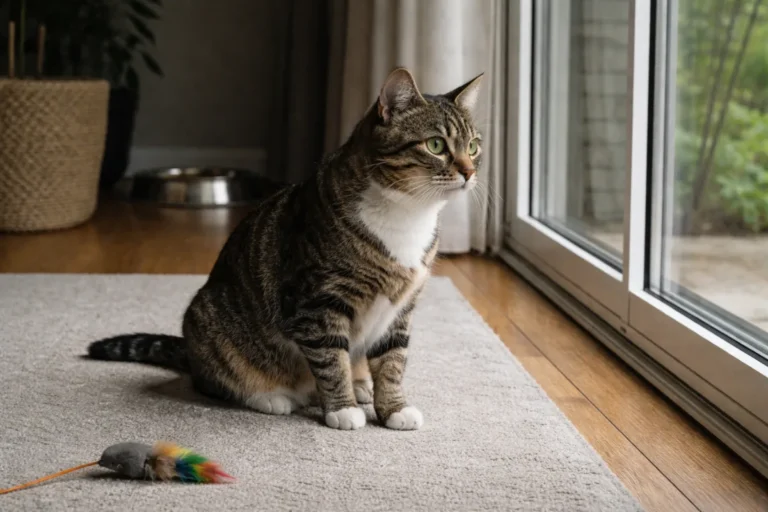
The behavior can also appear during play. A cat may suddenly stop chasing a toy and lock onto a far corner, as if something else has taken priority. That does not necessarily mean anything is wrong. It may simply mean the cat’s attention shifted from one possible stimulus to another.
Common patterns owners notice
- Staring at the same corner repeatedly over several days
- Watching a corner after hearing a small noise
- Fixating on a corner near windows, vents, or furniture
- Looking into a corner and then sniffing the air
- Pausing in place with an alert body posture
These patterns matter because they show that the behavior is often tied to something in the environment, even when the human eye cannot detect it. Cats are not usually reacting to “nothing.” They are reacting to something subtle, temporary, or easy to miss.
Why cats show this behavior in general
Cats are built to notice small changes. Their survival instincts depend on it. A rustle, vibration, faint odor, or shadow can all matter to a cat in a way that feels invisible to people. An empty corner may be interesting because it collects information from the room: air currents, dust movement, hidden insects, or sound reflections.
Another reason is simple curiosity. Cats often investigate places that seem unimportant to us because those places are quiet, enclosed, or slightly different from the rest of the room. Corners can also feel like boundaries. They frame the room in a way that makes movement and shapes easier to monitor.
Some cats are more observant than others. A cautious cat may spend a lot of time watching before approaching. A confident cat may stare briefly and move on. Both can be normal. The difference is usually not whether the cat looks at a corner, but how intensely and how often it does so.
When a cat stares at an empty corner, the first question is usually not “Why is it doing that?” but “What changed in this space that the cat noticed and I did not?”
Possible internal reasons behind the behavior
Not every instance is about something external. A cat’s internal state can shape how it behaves in still moments. A cat that is under mild stress may become more watchful and reactive to small details. It may linger in corners, hallways, or thresholds because those places offer a sense of control and clear sightlines.
A cat that feels secure may also stare at corners simply because it is relaxed enough to observe its surroundings. Stillness is not always a warning sign. Sometimes it is just a cat being a cat: quiet, attentive, and mentally occupied.
There are also sensory reasons. Older cats may have changing vision or hearing, which can affect how they interpret space. They might watch an area longer because they are relying on a different sense than before. A cat with reduced hearing, for example, may visually scan spaces more often. A cat with mild vision changes may stare toward familiar edges where contrast is easier to process.
Internal factors that can matter
- Heightened alertness after a stressor
- Boredom and under-stimulation
- Age-related sensory changes
- Sleepiness or a half-alert resting state
- General temperament, especially in cautious cats
These internal factors do not all mean the same thing. A cat who is bored may look into corners because the environment is too predictable. A cat that is stressed may do it because it is scanning for safety. A senior cat may do it because its senses are changing. Context is what separates those possibilities.
How context and environment influence it
The room itself often explains more than people expect. Corners near heating vents may carry movement in the air. Corners near windows may pick up shifting light from outside. Corners next to appliances can hold low vibrations or repeated sounds. Even a quiet refrigerator or pipe can create a subtle pattern that draws a cat’s attention.
Household layout matters too. Some corners act like traffic points. A cat may stare there because family members pass by often, or because another pet uses the area. In a multi-cat home, corners can become observation posts where one cat watches another without directly engaging.
Seasonal changes can also affect the behavior. In summer, insects may be more active around windows and walls. In winter, heating systems may create warm currents or small noises. A cat may appear to choose the same empty corner again and again, when in fact the corner is changing with the environment.
Environmental triggers to consider
- Air vents and floor registers
- Window reflections and moving shadows
- Hidden insects or small rodents in walls
- Appliances, pipes, and wall vibrations
- Other pets moving through nearby spaces
One useful habit is to look at the same corner at different times of day. A corner that seems blank at noon may look very different at dusk. Light, sound, and temperature can all shift what a cat detects there.
How owners often interpret it vs what it may actually mean
People often jump to dramatic explanations because the behavior feels so specific. A cat staring at a corner can seem like it is seeing something supernatural or responding to something impossible. In most cases, the explanation is far more ordinary. Cats are not trying to communicate mystery; they are often reacting to tiny physical cues.
That said, repeating behavior deserves attention. If a cat constantly stares at the same corner and also seems restless, withdrawn, or unusually jumpy, the behavior may be part of a broader change. It could reflect anxiety, environmental discomfort, or a shift in health. The staring alone does not tell the whole story.
Owners sometimes misread quiet focus as blankness. In reality, a cat may be deeply engaged. The difference between calm observation and concerning fixation often comes down to body language and frequency. A relaxed cat will usually change position, blink, groom, or move on. A cat that is fixated may appear tense, frozen, or difficult to redirect.
Look at the whole picture: posture, ears, tail, time of day, and whether the behavior comes with other changes in appetite, sleep, or social behavior.
Subtle signals that accompany the stare
The corner itself is only one part of the story. Cats often send small clues before, during, and after the behavior. Ears may rotate toward the corner. Whiskers may point forward. The body may lower slightly as if preparing to investigate. Some cats stop blinking for a few seconds, then slowly blink again once they decide the area is safe.
Tail movement is especially useful to watch. A relaxed, slow tail flick can mean mild interest. A rapidly twitching tail can signal agitation or overstimulation. If the cat’s fur stands up, it may be reacting to a sudden noise or perceived threat.
Timing matters too. A brief stare after a sound is normal. A prolonged stare that happens many times a day may point to a recurring trigger. If the cat always looks into the same corner after naps, it could simply be reorienting itself as it wakes up. If it happens during intense house activity, the cat may be processing noise and movement from the room around it.
Body language that helps interpret the moment
- Forward ears: alert curiosity
- Flattened ears: discomfort or uncertainty
- Slow blinking: relaxed attention
- Frozen posture: strong focus or caution
- Tail twitching: tension or stimulation
When playful attention and defensive attention can look similar
Playful cats and defensive cats can both stare into corners, but the energy behind the behavior is different. A playful cat may crouch, wiggle, and then suddenly dart forward, often after spotting dust, a bug, or a shifting shadow. The body is loose, and the sequence usually includes movement afterward.
A defensive cat looks more rigid. It may stare without blinking, keep its body low, and hesitate to approach. The cat might also retreat if another person enters the room or if a sudden sound breaks its concentration. That kind of behavior suggests caution rather than curiosity.
The tricky part is that one cat may show both forms at different times. A cat can be playful in one moment and uneasy in another. That is why the setting matters so much. The same corner can be part of a game one day and a stress point the next.
| Type of behavior | Typical body language | Likely meaning |
|---|---|---|
| Playful | Loose body, quick pounce, active movement | Interest in a tiny moving target or shadow |
| Neutral | Quiet stare, relaxed posture, brief pause | Observation, routine scanning, mild curiosity |
| Defensive | Rigid body, fixed stare, tense tail, retreating | Alertness, stress, or perceived threat |
How mixed signals can appear
Some cats send mixed signals because their feelings are mixed. A cat may approach a corner, sniff it, pause, and then back away. It may stare with a loose body but keep the ears turned sharply toward the hallway. That does not always mean uncertainty in a negative sense. It can be part of normal assessment.
Mixed signals are common in homes with changing routines. Guests, construction noise, a new pet, or even a rearranged room can make familiar spaces feel slightly different. A cat may want to investigate while also staying cautious. This split response is very typical for cats that prefer to gather information before acting.
In some households, the behavior becomes more noticeable after a stress event. A loud repair, a move, or a conflict with another pet can make a cat more watchful for days. The cat may return to the same corner because it has become a place where it feels able to monitor the room.
How lifestyle changes the pattern
Indoor cats often show this behavior more clearly because their environment is stable enough to make small changes stand out. Outdoor cats may also do it, but they are usually exposed to more varied stimuli, so the attention may shift faster. A very quiet home can make the behavior more visible simply because there is less competing activity.
Daily routines also matter. Cats that live with predictable schedules often develop predictable observation habits. The same corner may become part of the morning routine, the evening wind-down, or the quiet hour after dinner. A cat that has learned when the house is calm may choose those moments to scan its territory.
In busier homes, the behavior can happen when everything finally settles. The cat may wait until the children leave, the TV turns off, or the kitchen activity stops before turning its attention to a corner. In this way, the empty corner is often not the main event. It is the quiet space left behind after everything else moves on.
Long-term patterns that can be useful to notice
- Does the cat stare in one room or many rooms?
- Does it happen at the same time each day?
- Has the behavior increased after a home change?
- Does the cat stay relaxed while doing it?
- Does the cat also avoid the area or use it normally?
If the behavior is stable and the cat otherwise seems well, it is often just part of that cat’s normal style. Some cats are observers by nature. They like to sit at the edges of activity and study what happens next.
When the behavior becomes more noticeable
There are times when a cat’s corner-staring stands out more than usual. After illness, aging, schedule changes, or a major household disruption, the cat may seem more absorbed in still spaces. Some cats also do it more during periods of reduced enrichment, when they have fewer toys, less interaction, or a less stimulating environment.
A sudden increase is worth watching closely. If a cat that used to ignore corners now stares for long periods, especially if it seems confused or difficult to comfort, there may be an underlying reason worth checking. Pain, sensory changes, anxiety, or changes in cognition can all alter how a cat behaves in quiet spaces.
Still, not every change means something serious. Cats evolve with age, and their habits change with the home. A cat that once sprinted through every room may later spend more time sitting and watching. The behavior is not automatically a problem just because it becomes more obvious.
A new pattern is more meaningful than an old habit. Frequency, intensity, and the presence of other changes matter more than the stare itself.
Long-term meaning and consistency
Over time, a cat’s corner behavior often reveals a personal pattern. Some cats always watch door corners because they like to track movement. Others focus on vents, radiators, or hallways. The details can be remarkably consistent. Those preferences give a useful sense of what the cat notices most in its home.
Consistency is usually reassuring. If the cat has behaved this way for months or years and seems otherwise content, the behavior is likely part of its ordinary routine. If the pattern changes suddenly, becomes more intense, or comes with other signs of discomfort, the meaning shifts.
The best way to interpret it is to think like a cat for a moment. A room is never just a room. It is sound, scent, movement, temperature, and memory. Empty corners are often full of information from a cat’s point of view, even when they seem blank to everyone else.
A calm read on the behavior
When a cat looks at an empty corner, it is usually responding to something subtle rather than something strange. The trigger may be a faint sound, a shift in air, a tiny insect, or a change in how the cat feels inside the room. The behavior can be playful, cautious, routine, or simply observant.
What matters most is the pattern around it. A brief stare in a relaxed cat is usually just another part of daily life. Repeated fixed staring, especially when paired with tension or other behavior changes, deserves a closer look at the environment and the cat’s overall state. Corners may be empty to people, but to a cat they can be places of quiet information, small movement, and constant checking.