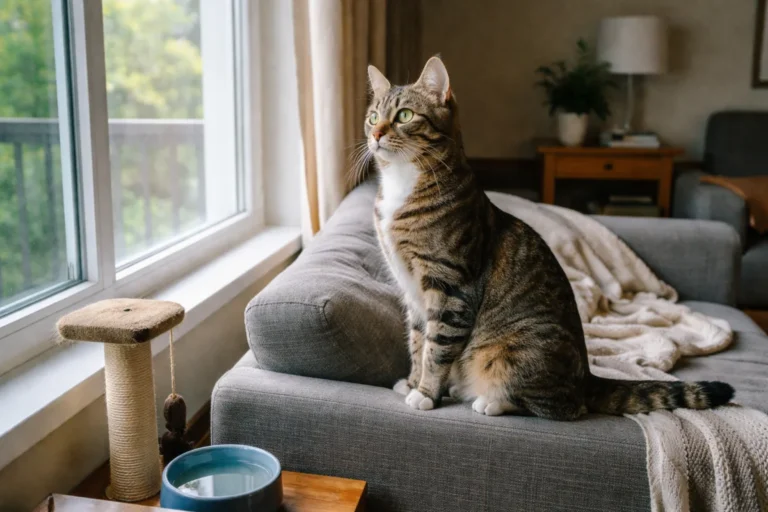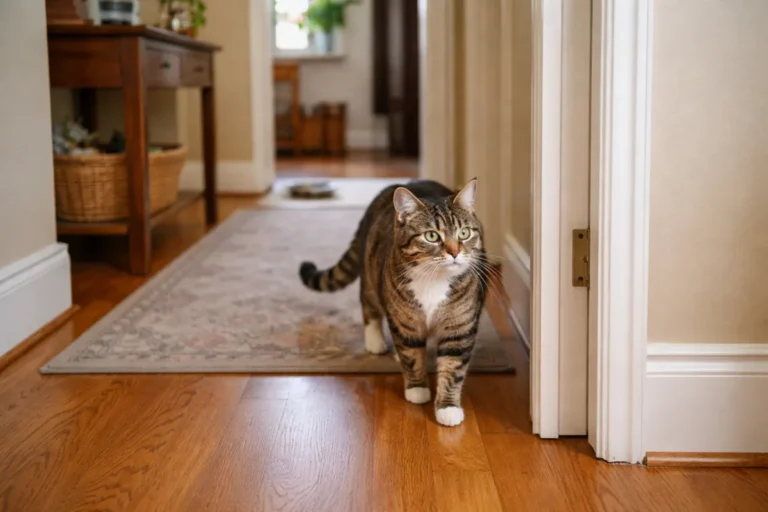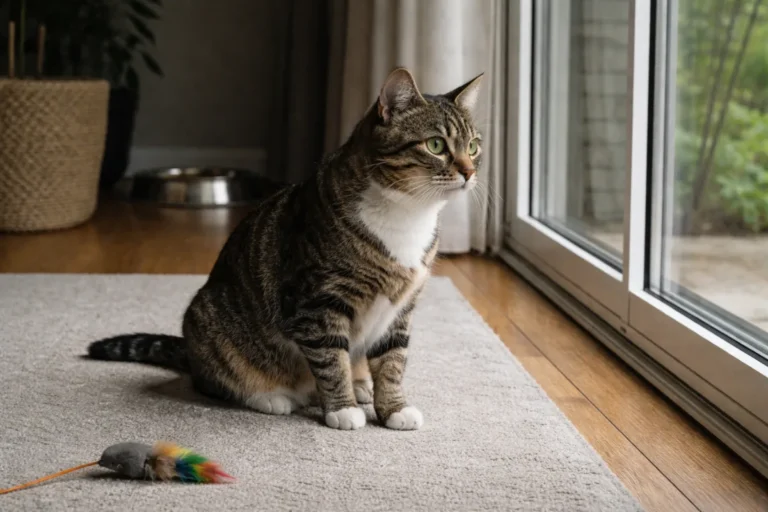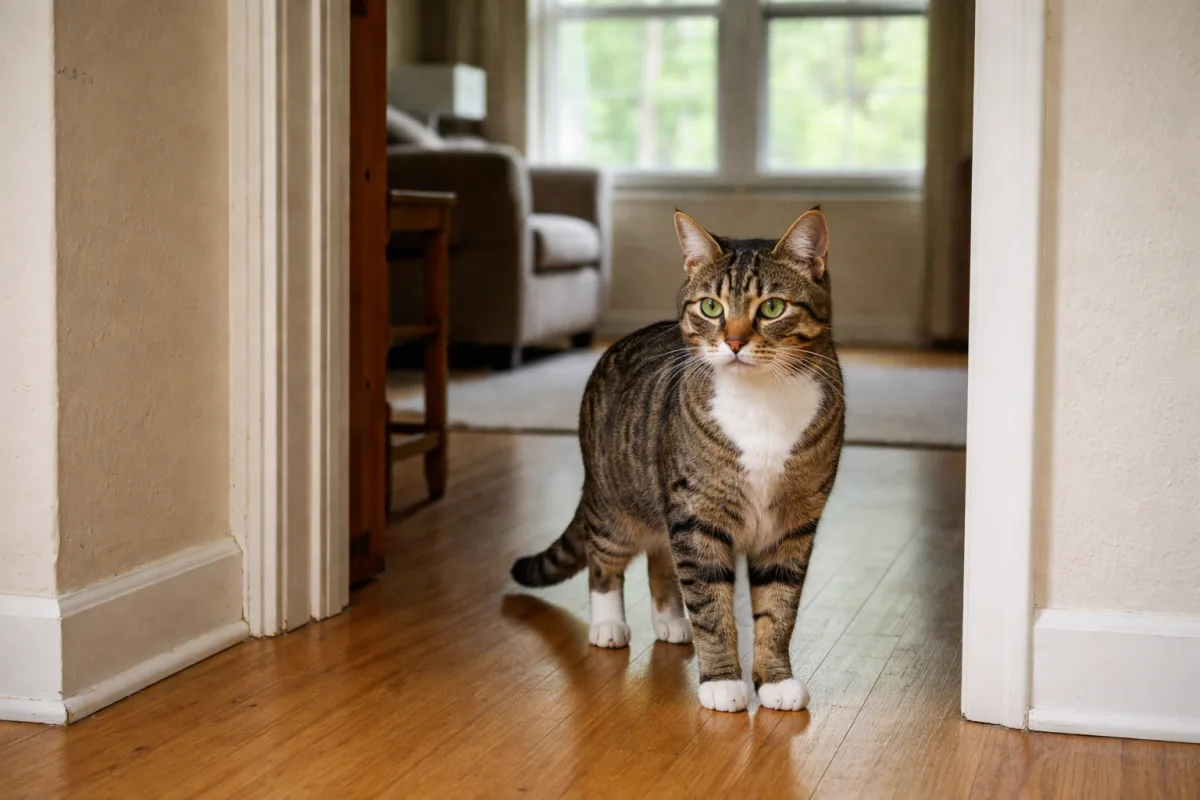
A cat that stops moving suddenly can look almost frozen in place. One moment they are walking across the room, and the next they are still, alert, and focused on something you may not even notice.
This kind of pause is often normal. Cats use stillness as part of how they observe, assess, and react to the world around them. But when the change feels abrupt, it can leave owners wondering whether the cat is simply listening, preparing to pounce, feeling uneasy, or dealing with something physical.
The meaning depends on the full picture: body posture, eyes, tail, breathing, timing, and what happened just before the cat stopped. A sudden stop can be harmless, but it can also be a useful clue that something in the environment or in the cat’s body has changed.
What sudden stillness looks like in everyday life
In daily life, a cat may stop moving in a very ordinary way. They might be walking toward the kitchen and freeze when they hear a sound near the window. They may be mid-play and pause with one paw lifted. Some cats stop at the top of a stair, stare into a hallway, and seem to listen to something no one else can hear.
These moments often happen quickly and without warning. The cat may not look tense at all. In fact, many cats look perfectly relaxed while they are motionless. Their ears may rotate slightly, their whiskers may point forward, and their eyes may narrow as they concentrate.
Sometimes the stillness is brief and ends just as suddenly as it began. Other times the cat remains fixed in place for a while before resuming normal movement. The difference matters, because the length and quality of the pause can hint at what is driving it.
Common everyday examples
- Stopping in the middle of walking to listen to a noise
- Freezing during play before chasing or pouncing
- Pausing near a doorway when something unfamiliar is happening nearby
- Becoming still after noticing another pet, a person, or movement outside
- Holding a crouched position while tracking a sound or smell
When the stop is tied to curiosity or hunting behavior, the body is usually controlled rather than stiff. The cat looks focused, not distressed. That distinction is useful, because not every sudden pause means the same thing.
Why cats stop moving in general
Stillness is part of normal cat behavior. Cats are both predators and prey, so pausing to evaluate a situation is built into how they move through the world. In the wild, being motionless can help them avoid detection, judge distance, or decide whether to approach or retreat.
At home, those instincts do not disappear. A cat may stop moving because they heard a faint sound, caught a scent, noticed a shadow, or simply want a better read on the room. Their senses are tuned to small changes, and motionlessness can help them process information.
That is why a sudden stop is not automatically a problem. The cat may be doing exactly what cats do: gathering information before making the next move. Stillness is often a sign that the cat is paying close attention, not necessarily that something is wrong.
Brief freezing is often a normal feline response to sound, movement, or uncertainty. The surrounding body language tells you far more than the pause alone.
Possible internal reasons behind the behavior
Some reasons for sudden stillness come from inside the cat rather than from the room around them. Attention, emotion, discomfort, and physical sensation can all affect whether a cat keeps moving or stops in place.
Focused attention
A cat may freeze because their attention has narrowed. Cats can lock onto a sound, scent, or visual detail so completely that the rest of their movement stops. This is especially common during play, around prey-like motion, or when something changes in the environment.
In these cases, the pause is usually short. The cat is not stuck; they are gathering information. A small ear turn, a head tilt, or a slight shift in the tail often shows that the mind is active even if the body is still.
Uncertainty or caution
When a cat is unsure about something, stopping can be a cautious choice. They may have noticed another animal outside, a new smell in the hallway, or a strange sound from an appliance. Instead of moving forward right away, they pause to evaluate whether it is safe.
This kind of stillness can look delicate. The cat may keep their body low, avoid blinking too much, or watch from a distance before deciding what to do next. The behavior is not always dramatic. Sometimes it is subtle and easy to miss unless you know the cat well.
Fear or stress
A sudden stop can also happen when a cat feels stressed. A loud noise, an unfamiliar visitor, a change in routine, or a conflict with another pet may cause the cat to go motionless. Freezing is one of the classic responses to perceived threat.
In a stressed cat, the stillness is often accompanied by other signs: tight muscles, flattened ears, a tucked tail, wide eyes, or a body angled for escape. The cat may not move because moving feels risky. That is different from a relaxed pause.
Pain or physical discomfort
Sometimes the reason is not emotional at all. A cat may stop moving suddenly because movement causes discomfort. Joint pain, abdominal pain, back pain, or an injury can make a cat hesitate or hold still in a way that stands out from their usual behavior.
Physical discomfort may be more obvious when the cat also seems stiff, reluctant to jump, less willing to turn, or unusually quiet. Some cats avoid motion without vocalizing much. Others may seem restless but stop moving whenever they try to shift position.
If sudden stillness comes with limping, hiding, a hunched posture, repeated licking of one area, or reduced appetite, the behavior deserves closer attention.
How context changes the meaning
The same still pose can mean very different things depending on what is happening around the cat. A pause during play is not the same as a pause after a fall. Freezing at a window is not the same as freezing after being picked up.
Context helps separate normal alertness from concern. A cat that stops to stare at a bird is usually engaged. A cat that suddenly halts in the litter box, on the other hand, may be reacting to discomfort or difficulty urinating. The location and timing matter as much as the stillness itself.
Household sounds and movement
Modern homes are full of quick sensory changes. A vacuum, a dropped spoon, a running faucet, a door closing, or footsteps overhead can all make a cat stop instantly. Many cats pause because they are trying to identify a sound before deciding whether it matters.
Other times, the environment changes in ways people barely notice but cats do. A new smell from cleaning products, a package brought home from outside, or a visiting animal’s scent on clothing can trigger a moment of stillness. The cat may not flee or hide. They may simply stop and process the information.
Other pets and social tension
If another cat or dog is present, sudden stillness can reflect social caution. A cat may freeze when another animal approaches, turns their head, or blocks a path. The pause gives them time to judge distance and intent.
This is especially common in homes where relationships are still developing. A cat may move normally when alone but stop abruptly when another pet enters the same room. That pause can reveal tension even when there is no hissing or chase.
Changes in routine
Cats notice routine. Feeding time, play time, litter box habits, and household patterns all shape their behavior. If something changes, a cat may stop moving more often while they reorient themselves.
For example, if furniture is rearranged or a familiar path is blocked, the cat may stand still at the edge of the new setup. They are not always confused in a dramatic way. Sometimes they simply need a moment to reassess the space.
| Situation | Common meaning | What to notice next |
|---|---|---|
| Stops while watching a window | Interest or hunting focus | Ears forward, tail steady, body engaged |
| Stops after a loud noise | Startle or caution | Wide eyes, crouch, quick scanning |
| Stops and seems stiff | Possible discomfort | Reluctance to jump, slow movement, hiding |
| Stops around another pet | Social tension or caution | Path blocking, tail position, distance changes |
Body language that helps explain the pause
A cat’s body often answers the question before their behavior does. A sudden stop with relaxed muscles means something different from a stop with a rigid spine and tense legs. Small details tell the story.
Signs of a calm, engaged pause
- Tail held loosely or gently swaying
- Ears turning toward the sound or movement
- Eyes focused but not wide
- Weight balanced rather than frozen backward
- Normal breathing
This version of stillness is often part of observation. The cat is interested and in control. They may resume walking, approach the object of attention, or launch into play.
Signs of a tense or worried pause
- Body held low or stiff
- Ears flattened or pulled back
- Tail tucked or held very still
- Eyes wide and fixed
- Breathing faster than usual
When these signs appear together, the cat may feel unsure or threatened. They are not simply stopping; they are bracing. That difference can matter a great deal, especially if the trigger is nearby and likely to continue.
Signs that may suggest discomfort
- Sudden reluctance to move after getting up
- Stiff steps or uneven posture
- Hesitation before jumping
- Stopping in unusual places and staying there
- Reduced grooming or changes in appetite along with the stillness
A cat with pain may freeze because motion is uncomfortable, not because they are paying close attention. This can be easy to miss when the cat is quiet and otherwise appears normal.
How owners often interpret it versus what it may actually mean
People often assume a cat that stops moving suddenly is being dramatic, stubborn, or spooky in some way. In reality, the behavior usually has a practical reason. Cats do not freeze just to make a point. They are reacting to information, emotion, or sensation.
Sometimes owners worry too quickly when the cat is simply alert. A cat staring at a corner may only be tracking movement or sound. A cat who stands still by the door may be listening for a familiar person or waiting for a chance to pass another pet.
On the other hand, people sometimes dismiss repeated freezing because the cat still eats and purrs. That can be a mistake if the behavior is new or paired with subtle signs of pain. Cats are good at hiding discomfort, and stillness can be one of the earliest clues that something has shifted.
The key question is not “Why did the cat stop?” alone, but “What does the whole body look like while the cat is stopped?”
When the behavior becomes more noticeable
Some cats stop moving suddenly more often at certain times of day. Evening is common, especially if the cat is active during low-light hours. Small movements, shadows, and household sounds can become more noticeable then.
After meals, before play, or when the home is unusually quiet, stillness may stand out more. A cat may be comfortable but highly aware. In a busy home, the pause can seem more dramatic because it interrupts visible activity.
The behavior may also appear more often during life changes. A move, a new pet, a repair project, or even a different work schedule can make the cat more watchful. They may stop more often because they are recalibrating to a changed routine.
What to pay attention to over time
One isolated pause rarely tells the whole story. Patterns matter more. If your cat occasionally stops to listen or watch, that is part of normal feline behavior. If the pauses become frequent, longer, or more rigid, the meaning may be changing.
Watching the same cat over days or weeks can reveal whether the stillness is linked to specific triggers. Maybe it happens near the front door, after certain sounds, when another pet enters the room, or when the cat tries to jump onto the couch. Patterns like these are useful because they connect the behavior to a setting or a sensation.
Questions that help clarify the pattern
- Did the cat stop in response to a sound, smell, movement, or touch?
- Was the body loose, crouched, stiff, or tucked?
- Did the cat resume normal movement right away?
- Has the cat been eating, grooming, and using the litter box normally?
- Is this new, or has it always been part of the cat’s habits?
These questions help separate ordinary alertness from something more concerning. They do not replace observation, but they make the cat’s behavior easier to read. A pattern is often more revealing than a single moment.
When a sudden stop deserves closer attention
A cat who freezes once in a while is usually just being a cat. A cat who suddenly stops moving and also seems unwell may need more attention. The larger behavior picture matters here.
Pay closer attention if the stillness comes with hiding, loss of appetite, litter box changes, vocal discomfort, repeated crouching, shaking, or a clear reluctance to move. Sudden immobility after a jump, fall, or impact also deserves caution. Even if the cat later walks away, the initial pause may point to pain.
It is also worth noting when the stillness is paired with odd breathing, open-mouth panting, or a cat who seems unable to settle. Those signs are not typical of a simple alert pause. They suggest the cat may be struggling physically or emotionally.
How cats use stillness as part of normal communication
Stillness is not only a reaction. It can also be a communication tool. A cat that stops moving may be signaling that they are watchful, unsure, or unwilling to proceed until the situation changes. Other animals often read this correctly, even when people do not.
Between cats, a sudden pause can help prevent conflict. One cat may stop and stare before choosing a path around another cat. In a multi-pet home, these quiet moments can keep distance and reduce friction.
With people, stillness can mean the cat is waiting. Some cats stop when they want attention, a meal, or a response. Others stop because they are deciding whether to approach. The pause is part of the exchange, even if it looks simple from the outside.
Natural instincts in modern home life
Today’s home is not a forest or a barn, but a cat still brings the same instincts into it. Shelves, curtains, hallways, appliances, and windows all become part of an environment full of signals. A sudden stop often reflects the cat’s instinct to interpret those signals before acting.
That is why the behavior can seem so common and so mysterious at the same time. Cats are built to notice tiny changes. A shift in air movement, a sound behind a wall, or an unfamiliar object on the floor can be enough to interrupt motion.
In a quiet house, these moments are easier to see. In a busy one, they may blend into the background until they repeat. Either way, the pause is often less about confusion and more about attention.
When a cat stops moving suddenly, the most important detail is usually not the freeze itself, but what comes before and after it.
Calm reading of the behavior
A cat that stops moving suddenly is often responding exactly as a cat should. The pause may be instinct, caution, curiosity, or discomfort. The answer is usually found in the details that surround it.
Watch for posture, timing, and repetition. A quiet pause near a window is one thing. A rigid stop after a leap or a new reluctance to walk is another. The difference is in the surrounding clues, not the stillness alone.
Once those clues are noticed, the behavior becomes easier to understand. Sometimes the cat is listening. Sometimes they are deciding. Sometimes they are telling you, in the quietest way possible, that moving feels different than it did before.