A cat that walks in a small circle before settling down can look thoughtful, almost ceremonial. One moment the cat is standing still, and the next it is shifting paws, turning, checking the surface, and circling once or twice before finally sitting or lying down. It is one of those ordinary feline habits that people notice often but rarely stop to decode.
This behavior usually seems simple from the outside, yet it can come from several different instincts at once. A cat may be checking the area, arranging a comfortable resting spot, or following a deeply rooted pattern passed down from wild ancestors. Sometimes the circling is brief and casual. Other times it is deliberate, repeated, and tied to the cat’s mood or the environment around it.
Not every cat does it in the same way, and not every circle means the same thing. A cat on a soft couch may circle for comfort. A cat near a window may circle because it is alert and deciding where to land. A cat that circles repeatedly on the floor may be reacting to temperature, scent, stress, or even a small physical discomfort. The movement is small, but the reasons behind it can be surprisingly layered.
What the circling behavior looks like in everyday life
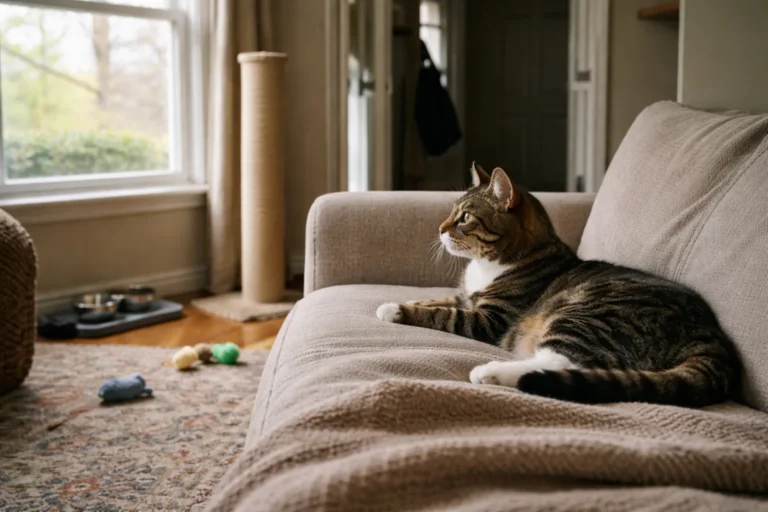
In a normal home, this behavior often appears during quiet moments. The cat approaches a favorite bed, pauses, then takes one step to the side, rotates, and lowers itself only after testing the space. Many cats also do it on blankets, laps, rugs, or the edge of a couch. The movement may seem almost automatic.
Some cats make a neat little loop and settle immediately. Others keep adjusting their position several times, turning their body, kneading the surface, and starting over if something feels off. The more uncertain the cat feels, the more likely the circling becomes noticeable.
Common everyday examples
- Circling before lying down on a bed or cushion
- Turning once or twice before sitting beside a person
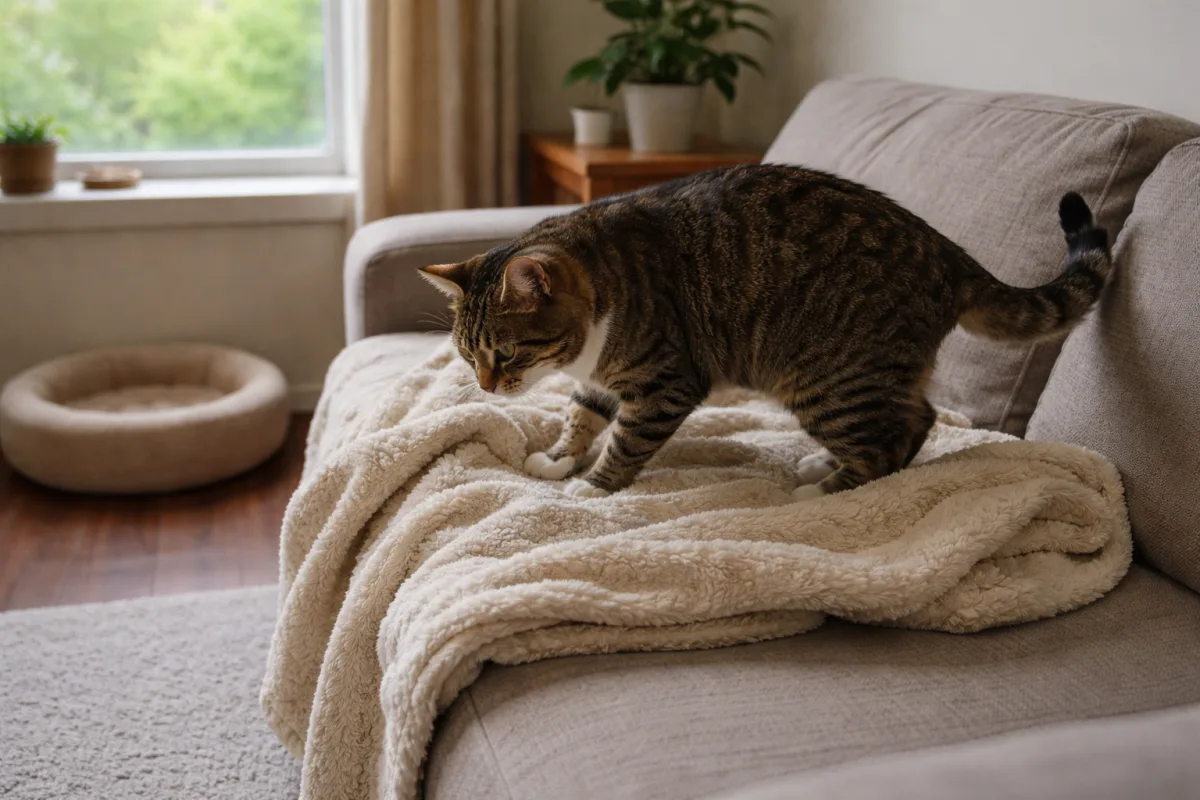
- Walking a small loop on a blanket before kneading and resting
- Adjusting position several times on a warm or unfamiliar surface
- Circling near a doorway, window, or high perch before settling
In many homes, this is a completely normal habit. Cats are not always trying to create drama. They are often checking whether the place feels safe, stable, soft enough, and free of disturbances. Their bodies move with purpose, even when the purpose is not obvious to us.
When a cat circles before sitting down, it is usually preparing, not hesitating. The behavior often reflects comfort checks, awareness of surroundings, or an instinctive routine.
Why cats show this behavior in general
Circling before sitting down can come from instinct, comfort-seeking, or both. Cats are naturally careful about where they place their bodies. Even in a relaxed home, they may behave as if the environment deserves a quick inspection. That tendency makes sense when you think about how cats are built. They are sensitive to surface texture, temperature, scent, and nearby movement.
One likely reason is ancestral behavior. Wild cats often needed to evaluate ground conditions before resting. A small clearing could contain uneven dirt, hidden insects, dampness, or signs of another animal. Circling helped them assess the spot and, in some cases, flatten grass or create a more comfortable nest-like area. Domestic cats still carry traces of that pattern.
Another reason is body comfort. Cats are compact, flexible animals, but they still care a great deal about support. A few steps in a circle can help them decide how much pressure to place on their hind legs, whether the surface is too hard, or whether they want to turn toward warmth, a wall, or a view of the room. The ritual may look minor, but for the cat it can be a practical adjustment.
Possible internal reasons behind the movement
- Checking whether the resting spot is safe and stable
- Testing softness, temperature, or texture
- Following an inherited nesting or settling routine
- Orienting the body toward a preferred direction
- Reducing uncertainty before relaxing
There is also a psychological side. Cats like control over their own resting choices. Circling can be part of that sense of control. Rather than dropping into a spot instantly, the cat takes a moment to decide. That pause may feel small, but to the cat it is part of setting the terms for rest.
How environment and context influence the habit
The same cat may circle more in one room than another. Environment matters a great deal. A cat that settles quickly on a familiar bed may circle more on a slick floor, a noisy room, or a new piece of furniture. Even the smell of a space can change how long the cat takes before sitting down.
Temperature is another factor. Cats often circle longer on a surface that is too cool, too warm, or unexpectedly different from the rest of the room. A sunlit patch may invite a quick turn or two. A drafty corner may lead to several hesitant steps before the cat commits.
Household activity can shape the behavior as well. A calm cat may circle once and lie down. A cat in a busier home may circle repeatedly because it is tracking movement, listening to sounds, or staying aware of people and other pets nearby. The behavior is not only about the spot itself. It is also about everything happening around the spot.
A cat often circles more when the environment feels unfamiliar, active, or slightly imperfect. The behavior can increase whenever the cat needs to evaluate its surroundings before relaxing.
Situations that often make circling more noticeable
- After furniture has been moved
- When the cat is using a new bed or blanket
- In a room with several noises or quick movements
- Near another pet’s resting area
- On a surface with an unusual smell or texture
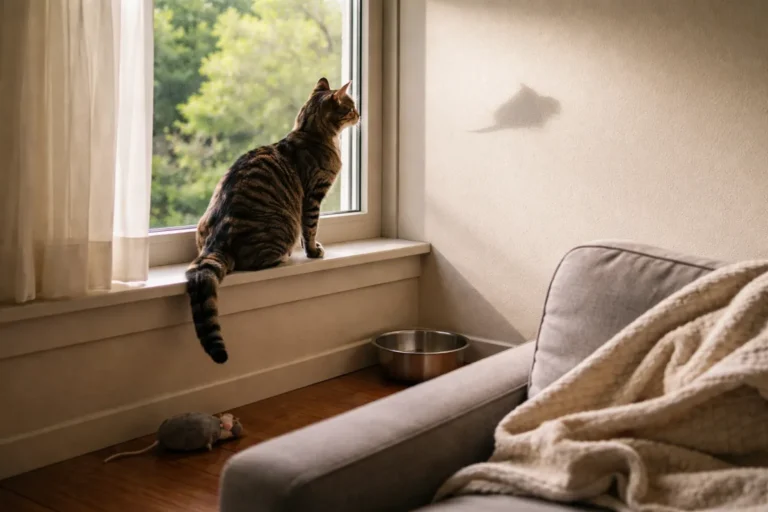
Sometimes the environment is not stressful, just interesting. A cat may circle near a window because it has noticed birds outside and wants to settle while staying alert. In that case, the circling is part preparation, part observation. The cat is choosing a position with intention.
What the behavior may signal about the cat’s state
Circling can reflect a calm state, but it can also show mild alertness. The difference often lies in the speed, repetition, and body language that go with it. A relaxed cat usually moves in an unhurried way, then settles without much fuss. A more tense cat may pace the same small area several times, pause often, or keep repositioning after sitting down.
If the circling is paired with soft eyes, a loose tail, and slow movement, it usually points to ordinary comfort-seeking. The cat may simply be choosing the best angle for rest. If the cat looks uneasy, keeps scanning the room, or seems unable to settle, the behavior may reflect alertness rather than comfort.
Soft signals that often accompany calm circling
- Loose body posture
- Slow, deliberate steps
- Relaxed ears facing naturally forward or slightly outward
- Tail held neutrally or gently curved
- Easy transition into sitting or lying down
Stronger signals that may suggest tension
- Repeated pacing in the same small area
- Frequent pauses before committing to a spot
- Stiff body or lowered posture
- Tail flicking or tight tail position
- Difficulty settling even after several turns
The behavior can also reflect habit. Some cats are simply more methodical than others. They circle whether they feel deeply relaxed or only moderately comfortable. That is why it helps to read the whole picture, not just the circular movement itself.
How owners often interpret it versus what it may actually mean
People sometimes assume circling is odd, stubborn, or cute without much purpose. In reality, it is usually practical. A cat is not performing for attention. It is deciding how to rest in a way that feels right to its body and instincts.
Some owners interpret repeated circling as a sign of nervousness, and sometimes that is true. But the behavior can appear even in very content cats. A cat that circles once and settles in a favorite spot may be doing exactly what it has always done. The habit becomes more meaningful when it changes in pattern, intensity, or frequency.
Another common misunderstanding is to think the cat is always “making a bed.” That can be part of it, especially on blankets or soft surfaces, but not every surface needs grooming or flattening. Sometimes the cat is simply orienting itself, checking for comfort, and choosing a position with a clear view of the room or a wall for back support.
Circling is often a decision-making behavior. It may be linked to comfort, caution, habit, or orientation rather than a single emotional state.
Different forms of the behavior
Not all circling looks alike. The pace and purpose can shift depending on the cat’s personality and the situation. Some cats make a quick little turn before dropping down. Others do a slow, careful loop. A few combine circling with kneading, sniffing, or looking around before settling.
These patterns can be useful to observe because they reveal how the cat is approaching rest. A playful cat may circle a favorite bed once, then flop down with energy. A cautious cat may circle several times and stop to look around between turns. A cat that feels defensive may circle near an exit or high point, keeping escape routes in mind.
Quick comparison of common forms
| Form | What it often looks like | Possible meaning |
|---|---|---|
| Calm circle | One or two slow turns, then settling | Comfort, routine, simple preparation |
| Playful circle | Light movement, quick repositioning | High energy, interest, relaxed alertness |
| Defensive circle | Repeated turning, scanning, stiffness | Caution, uncertainty, need for control |
| Comfort-seeking circle | Sniffing, kneading, then lying down | Searching for the best resting setup |
The same cat may switch between these forms depending on the day. A behavior that seems minor in the morning might look different at night, after visitors arrive, or when another animal has been in the room. That flexibility is part of what makes the habit so interesting.
How long-term patterns can change with age and routine
Kittens often circle with less precision. Their movements may be clumsy, energetic, or mixed with play. They are still learning how to judge surfaces and how to settle themselves efficiently. As they mature, the circling usually becomes cleaner and more predictable. Adult cats often develop a strong preference for certain resting spots and repeat the same small routine every time.
Older cats may circle more slowly. That does not automatically mean something is wrong. It can reflect stiff joints, reduced flexibility, or a more careful approach to sitting down. When a senior cat makes several turns before lying down, the behavior may deserve a closer look if it is new or noticeably more frequent than before.
Long-term observation matters because the habit itself is less important than change. A cat that has always circled before resting is simply being a cat. A cat that suddenly starts circling repeatedly, seems restless, or struggles to get comfortable may be communicating something different.
Changes worth noticing over time
- More circling than usual before resting
- Visible stiffness while turning
- Reluctance to lie down after several attempts
- Shifting to new preferred resting surfaces
- Restlessness that appears in multiple rooms
Routine also shapes the habit. A cat with a predictable daily schedule may circle at the same times each day, especially before naps, evening rest, or quiet family hours. The pattern can become part of the household rhythm. It may look like a small ceremony, but it is really a familiar part of how the cat organizes its comfort.
Body language that helps interpret the circle
Circling alone gives only part of the story. The rest is in the body language. Ears, tail, speed, and eye movement all matter. A cat that circles while remaining loose and unhurried is sending a very different message from a cat that circles with a tight body and watchful eyes.
Pay attention to what happens before and after the turn. Does the cat sniff the spot, paw at it, or glance around the room? Does it lower itself smoothly, or does it change its mind and stand again? Does it knead once it arrives, or immediately stretch out? These details help explain whether the behavior is mostly about comfort, caution, or routine.
Helpful body-language clues
- Slow movement usually suggests ease
- Frequent head turns suggest alertness
- Tail flicking can point to irritation or uncertainty
- Lowered posture may mean caution
- Soft blinking and relaxed whiskers often accompany calm settling
Some cats circle in silence, while others add small vocal sounds. A soft meow or trill may signal recognition, anticipation, or a wish to settle near a person. That is not the same as distress. The context matters more than the sound itself.
When the habit is part of ordinary comfort
For many cats, circling before sitting down is simply part of how they prepare to rest. It can be as ordinary as stretching after waking or grooming after a meal. The movement helps the cat choose a position, test the surface, and transition from activity to stillness.
This is especially common in cats with strong preferences for certain textures or resting heights. A cat may circle more before lying on a fuzzy blanket than on a flat chair. Another may circle on the floor because it likes to line itself up with a wall or a sunbeam. The behavior can be subtle, but it often reflects a very clear preference inside the cat’s mind.
Most circling before sitting down is a normal settling habit. The key question is not whether the cat circles, but how the circling changes with comfort, age, and surroundings.
When context changes the meaning
The same motion can mean different things in different moments. A cat circling before napping in a quiet bedroom is not sending the same message as a cat circling repeatedly in a room full of noise. Context shapes interpretation. That is why owners often benefit from noticing what else is happening at the time.
New pets, visitors, unfamiliar scents, rearranged furniture, or changes in household routine can all influence how often a cat circles. Cats are sensitive to shifts in their environment, and resting behavior often reveals that sensitivity before anything else does. A cat may not hide or vocalize, but it may take longer to choose a place to sit.
Physical comfort can matter just as much. If a cat seems to circle more because it cannot easily find a comfortable position, that may point to soreness, stiffness, or another physical issue. A behavior that appears simple on the surface can sometimes be the earliest visible sign that something feels different.
Calm understanding of the behavior
Circling before sitting down is one of those cat habits that sits at the intersection of instinct, comfort, and personal preference. It can be brief and routine, or it can reveal a cat that is checking its surroundings more carefully than usual. In everyday life, the movement often means the cat is preparing to rest in the way that feels most secure and satisfying to it.
When the pattern stays familiar, it usually belongs to the normal rhythm of the cat’s day. When it becomes more intense or more frequent, the surrounding details give the clearest clues. The turn itself may be small, but it says a lot about how a cat chooses to meet the ground, the room, and the moment before it finally settles.