Cats move with intention, and that makes repeated motions easy to notice. A tail that flicks over and over, a paw that kneads the same blanket, or a cat that paces between two rooms can seem ordinary one moment and puzzling the next. Repetition is often part of how cats organize their feelings, energy, and surroundings.
Many of these movements are harmless. Some are tied to comfort. Others appear when a cat is excited, alert, frustrated, or trying to calm itself. The same action can mean different things depending on when it happens, how often it repeats, and what the rest of the body is doing.
What matters most is the pattern around the pattern. A repeated movement with relaxed ears and soft eyes usually tells a different story than the same motion paired with a stiff body or tense focus. Once you start reading those details, repetitive behavior becomes easier to understand in everyday life.
What repeated movements usually look like at home
Repetitive movement is not one single behavior. It can show up as kneading, tail swishing, head rubbing, pacing, paw tapping, licking a specific spot, or circling before settling down. Some cats repeat movements in a slow, steady way. Others do it quickly and with very clear purpose.
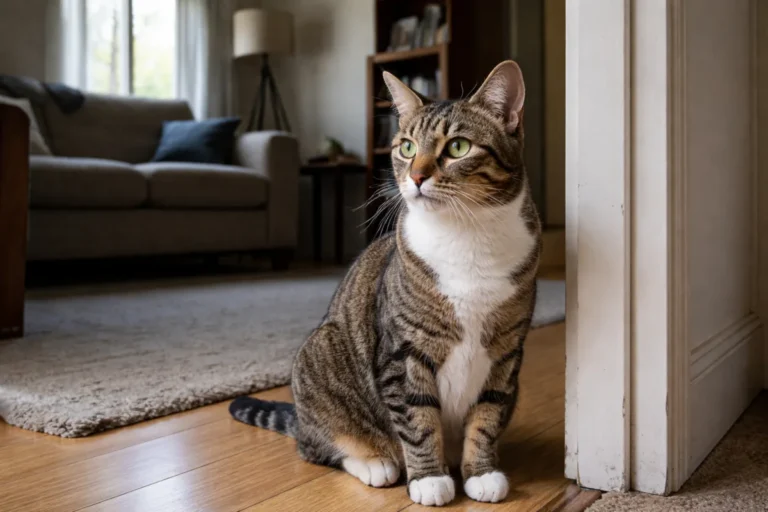
In a home setting, these actions often appear during transitions. A cat may pace while waiting for food, knead before sleep, or tap a paw at a closed door. The repetition can be soothing, but it can also reflect expectation. Cats are highly aware of routines, and the body often responds before the brain seems to “settle.”
Common everyday examples
-
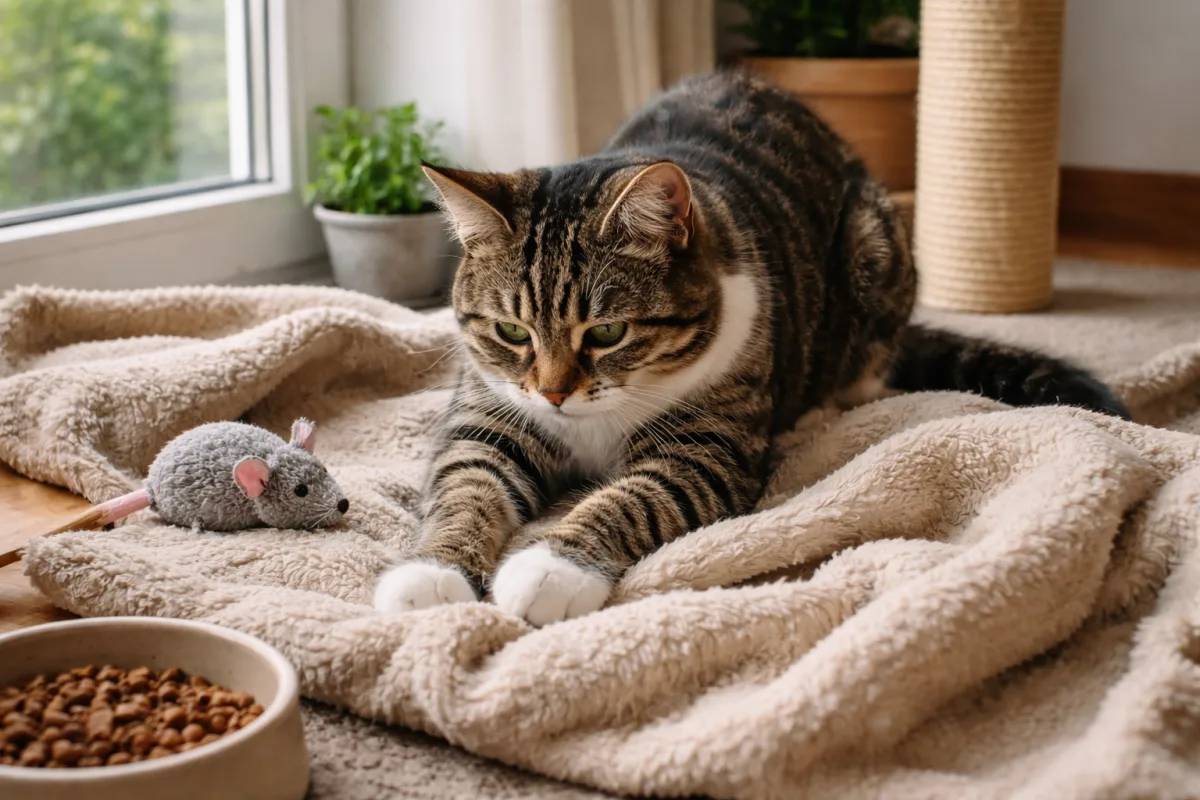
Kneading a blanket before napping
-
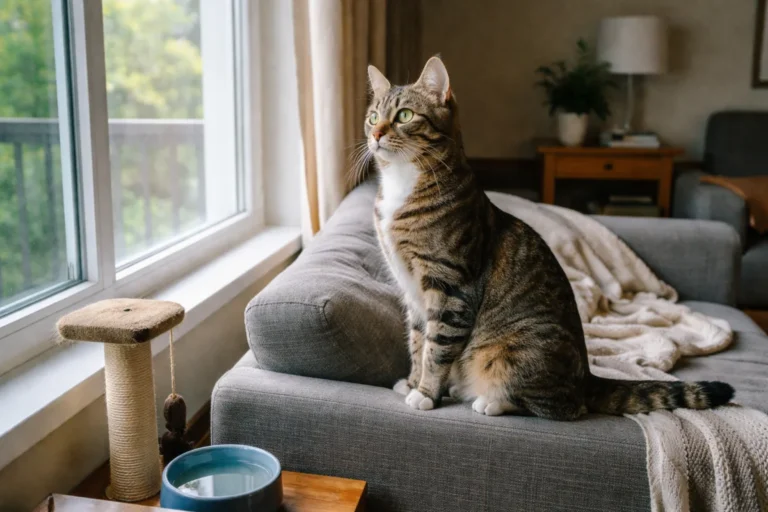
Tail flicking while watching birds from a window
-
Pacing near the kitchen at feeding time
-
Repeated meowing combined with walking from room to room
-
Licking one area more than the rest of the body
-
Making short, repeated jumps onto the same surface
Not every repeated motion means a problem. Cats repeat useful actions because repetition works for them. It can help release energy, sharpen focus, or signal a need clearly. The challenge is telling the difference between a normal habit and behavior that has become too intense or too frequent.
Repeated movement matters less by itself than by pattern, timing, and intensity. A calm, occasional habit is very different from a motion that seems compulsive, restless, or hard for the cat to stop.
Why cats repeat motions in the first place
Cats are creatures of habit, and their bodies often reflect that. Repetition is a natural part of feline behavior because it supports survival, comfort, and communication. A cat may repeat a movement to prepare for rest, focus on prey-like activity, or make a point without using words.
Some repeated motions come from instincts that are deeply built in. Kneading can connect to kittenhood and nursing comfort. Pacing can reflect anticipation or the urge to patrol territory. Repeated sniffing or circling may help a cat gather information before making a choice. These actions are not random. They are usually efficient, even when they look odd to us.
Internal reasons behind repetitive movement
-
Comfort-seeking: The cat is trying to relax or create a familiar feeling.
-
Anticipation: Food, play, attention, or access to a space is expected soon.
-
Energy release: The body has extra energy and needs an outlet.
-
Self-soothing: The motion helps the cat regulate stress or uncertainty.
-
Attention and communication: Repeated behavior may be used to get a response from a person.
When a cat repeats the same motion in the same context, that context usually matters. A cat that kneads the couch every evening may simply be settling down. A cat that paces only when the carrier appears may be reacting to a learned association. The behavior itself may look similar, but the reason behind it can be very different.
What the body language around it can reveal
One repeated motion rarely tells the whole story. Cats communicate through posture, facial expression, ear position, and the way their movements begin and end. A tail that flicks once in a relaxed room does not mean the same thing as a tail that lashes while the cat stares at another animal.
Pay attention to whether the movement is fluid or jerky, relaxed or tense. A cat kneading with half-closed eyes and loose paws is often content. A cat kneading while also vocalizing, shifting weight, or scanning the room may be less settled. The behavior is still repetitive, but the emotional tone has changed.
Signals that often travel with repeated movement
-
Relaxed ears and slow blinking: Usually point toward comfort.
-
Stiff shoulders or crouched posture: Can suggest tension or readiness.
-
Tail held low or twitching rapidly: May indicate irritation or concentration.
-
Soft vocalizing: Can accompany anticipation or mild frustration.
-
Wide eyes and fixed attention: Often appear during intense focus.
A cat’s movement is only part of the message. A repeated action combined with relaxation usually means something very different from the same action paired with tension. That is why context always matters more than the motion alone.
How environment shapes repetitive behavior
Home life changes the way repetitive motions appear. Cats living in quiet, predictable homes may show repetition mostly around routines such as waking, feeding, and bedtime. In a busier home, the same cat may pace more often, especially if doors open and close a lot or the household schedule changes from day to day.
Indoor cats often repeat movements that help them manage limited territory. They may patrol hallways, circle favorite resting spots, or revisit windows repeatedly. Outdoor cats can show the same patterns, but the triggers may be broader because they interact with more smells, sounds, and changing spaces. Environment does not create every repeated motion, but it strongly shapes when it appears.
Things that can make repetition more noticeable
-
Feeding routines that are very predictable
-
Window access with frequent outdoor stimulation
-
Long periods of boredom or inactivity
-
Loud household changes or visitors
-
Limited hiding places or resting areas
-
Competition with other pets
Some cats also repeat movements more when their environment feels unfinished from their perspective. A room without enough vertical space, scratching options, or visual access to the outside may leave them restless. The body looks for a job to do. Repetition becomes the outlet.
When a cat’s repeated movement increases after a change in the home, the timing can be more revealing than the action itself. New schedules, new animals, or new noise patterns often shift behavior first.
Playful repetition, neutral repetition, and stress-related repetition
Not all repeated movement has the same emotional weight. Some forms are clearly playful. Others are neutral habits that help a cat settle into daily life. A third group can signal distress or discomfort, especially when the motion feels hard to interrupt.
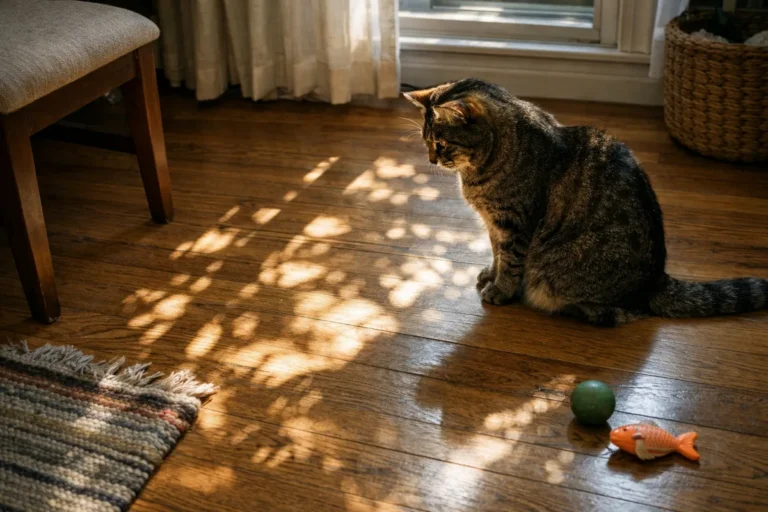
Playful repetition usually appears in short bursts. A cat may chase a toy in the same loop, leap repeatedly at a dangling string, or dart back and forth with loose, springy steps. The body looks ready and engaged. The movement has rhythm, but it does not look trapped.
Neutral repetition often comes out in routines. A cat may circle the bed twice before lying down or knead the same spot for a minute before sleeping. These actions are familiar and self-contained. They do not usually escalate, and the cat can move on afterward.
Stress-related repetition tends to be more urgent or harder to interrupt. A cat may pace for long periods, lick one area constantly, or repeat a motion even after the source of stress is gone. The body may look tight, and the cat may seem unable to fully settle.
| Type of repetition | Typical signs | What it often means |
|---|---|---|
| Playful | Loose body, quick bursts, obvious engagement | Energy, interest, hunting-style play |
| Neutral | Predictable, brief, routine-based | Comfort, habit, transition between activities |
| Stress-related | Persistent, tense, difficult to stop | Frustration, anxiety, overstimulation, or discomfort |
The same motion can fit different categories. Tail movement is a good example. A slow sweep can be thoughtful. A fast lash can signal irritation. Repetition gains meaning from pace, pressure, and accompanying body language.
When repetitive movement may reflect emotion rather than habit
Cats do not separate body and feeling in the way people often do. Emotional state can show up through repeated motion before anything else becomes obvious. A cat that suddenly kneads more often, circles a room repeatedly, or paces at night may be showing a change in emotional load rather than a change in preference.
Attention-seeking behavior is one common emotional layer. Some cats repeat actions because they have learned that repetition gets noticed. They may tap a paw on a person’s arm, rub against the same leg over and over, or walk back and forth until someone responds. This is communication, but it may also reflect unmet expectations.
Other times, repetition serves as a way to reduce uncertainty. Cats often feel better when they can turn a vague situation into a familiar routine. Repeated motion gives the body something structured to do while the cat evaluates the environment.
Repeated movement and emotional state
-
Excitement: Fast pacing, brisk tail movement, repeated jumps near food or play.
-
Comfort: Slow kneading, gentle circling, relaxed settling motions.
-
Frustration: Repeated meowing, door pacing, pawing at an obstacle.
-
Uncertainty: Short patrol-like loops, stop-and-start movement, scanning the room.
These emotional layers can overlap. A cat may feel both excited and frustrated before dinner. Another may look calm on the outside while repeating a movement that helps manage internal stress. That is why observing timing matters. The more consistently the behavior appears in a certain emotional context, the more informative it becomes.
How owners often misread repeated movements
People sometimes assume repetition means obsession, misbehavior, or boredom alone. In reality, it is usually more specific than that. A cat kneading is not always asking for attention. A pacing cat is not always anxious. A flicking tail is not always angry. Simplifying the behavior too much can lead to the wrong response.
Another common mistake is reacting only to the visible action and not to the surrounding pattern. For example, a cat that repeatedly scratches at a door may not be “being difficult.” The cat may be trying to reach another area, follow a routine, or relieve restlessness. The repeated motion is the message, not the problem.
Owners may also overlook frequency. A behavior that happens occasionally can be normal. The same behavior becoming more frequent, more intense, or harder to redirect may deserve closer attention. Change over time often matters more than a single moment.
If a repeated motion is new, persistent, or paired with changes in appetite, litter box use, grooming, or sleep, it deserves attention beyond simple interpretation.
What long-term patterns can tell you
Some repetitive movements stay stable for years. A cat may knead every time it settles into a certain blanket. Another may circle twice before sleeping and do so for its whole life. Long-term consistency often points to a harmless habit or a deeply rooted comfort behavior.
Other patterns shift with age or circumstances. A young cat may pace more because of high energy, while an older cat may repeat motions more slowly or with more stiffness. A change in household routine, another pet, or a medical issue can also change how and when repetition appears.
One helpful way to think about it is stability versus change. Stable repetition usually follows a familiar script. Changing repetition often has a reason behind it. The motion might be the same, but the story around it has altered.
Questions that help make sense of the pattern
-
When does the behavior usually appear?
-
Has it increased, decreased, or stayed the same?
-
Does it happen in one place or many places?
-
Does the cat seem relaxed or tense during it?
-
What changed in the home before the behavior started?
Answering those questions often reveals more than watching the motion alone. A repeated behavior tied to a familiar routine may simply be part of the cat’s daily rhythm. A repeated behavior that suddenly becomes intense or constant deserves a closer look because it may be linked to discomfort, stress, or unmet needs.
How repeated movements fit into cat communication
Cats rarely communicate in one clean signal. They layer messages. A repeated movement can be part of a larger conversation involving posture, sound, and timing. It may tell you the cat is preparing, waiting, calming down, or asking for something in the clearest way available to it.
That is why repetitive movement should be read in context rather than judged by appearance. A cat that kneads and purrs on your lap is likely expressing comfort. A cat that paces near the window, then stops to stare outside, may be processing stimulation or frustration. A cat that repeats a small motion while looking toward the food area may be signaling expectation with great consistency.
These are not random habits. They are practical behaviors shaped by instinct, routine, and experience. Once you notice the details around them, they become easier to understand and less mysterious in everyday life.
Repeated movement is often the cat’s way of keeping balance. Sometimes that balance is about comfort. Sometimes it is about excitement or control. And sometimes it is simply the most efficient way for a cat to meet the moment it is in.