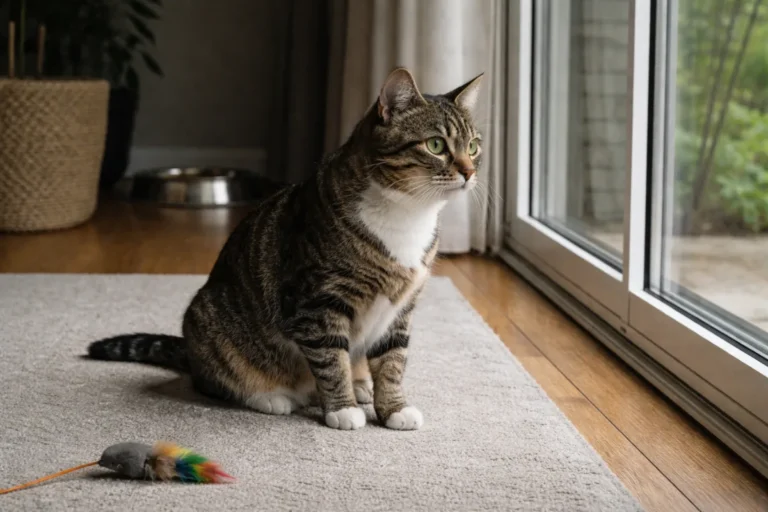
A cat sitting still and watching without reacting can look almost unreadable at first. The ears may be forward, the body loose, the tail quiet. Nothing obvious happens, yet the cat is clearly paying attention.
This kind of behavior is easy to misread because it sits between calmness and alertness. A cat may be studying a moving object, a sound in another room, another pet, or even a person’s mood. The lack of action does not mean the cat is bored, unfriendly, or disconnected. Often it means the opposite: the cat is gathering information before deciding what to do next.
In daily life, this can appear during a household routine, a visit from guests, a noise outside the window, or a moment when another animal enters the space. The cat watches. It does not approach. It does not retreat. That pause can reveal a lot about comfort, confidence, caution, and instinct.
Why cats watch first and react later
Cats are built to notice details before they commit to movement. In the wild, reacting too quickly can waste energy or expose them to danger. That basic pattern still shows up in home life. A cat often prefers to observe an event a few times before deciding whether it matters.
This makes the quiet stare very natural. It is not always indecision. Sometimes it is assessment. The cat is checking distance, sound, speed, and body language. If something seems harmless, the cat may stay put and keep watching. If it seems important, it may shift position, blink, flick an ear, or leave the area entirely.
Cats often use stillness as part of their decision-making. Watching without reacting can be a sign of careful evaluation, not passivity.
That is why a cat can seem surprisingly patient around changing situations. A dropped bag, a new object on the floor, or a humming appliance may be watched for a while before the cat decides whether to approach. The reaction may come later, or not at all.
What this looks like in everyday situations
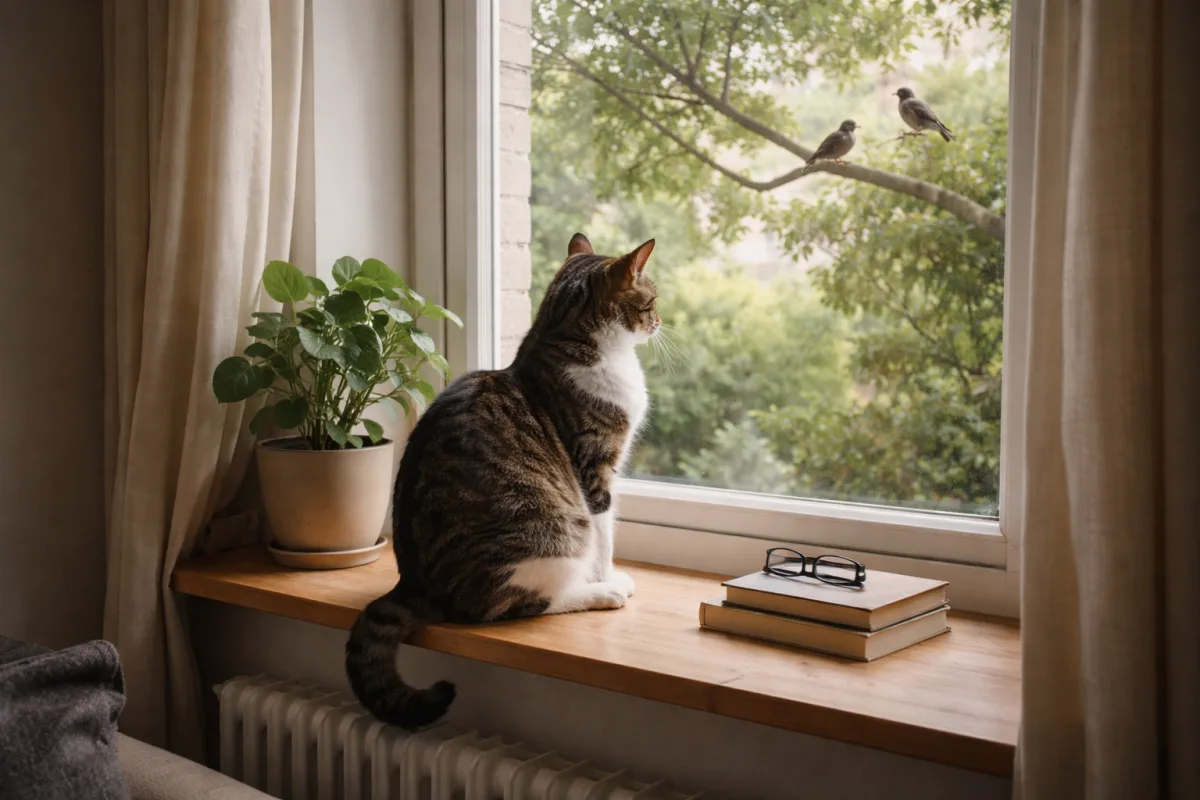
One common example is the window cat. Birds move across the yard, leaves shift, a dog passes by, and the cat simply sits there, focused but unmoving. The eyes track the scene, yet the body stays composed. This can last for several minutes, especially if the cat feels secure in the spot.
Another common scene happens at home with people. A cat may observe a guest from across the room rather than hiding immediately. It may watch a child playing on the floor or a family member unpack groceries. The cat is present, interested, and cautious all at once.
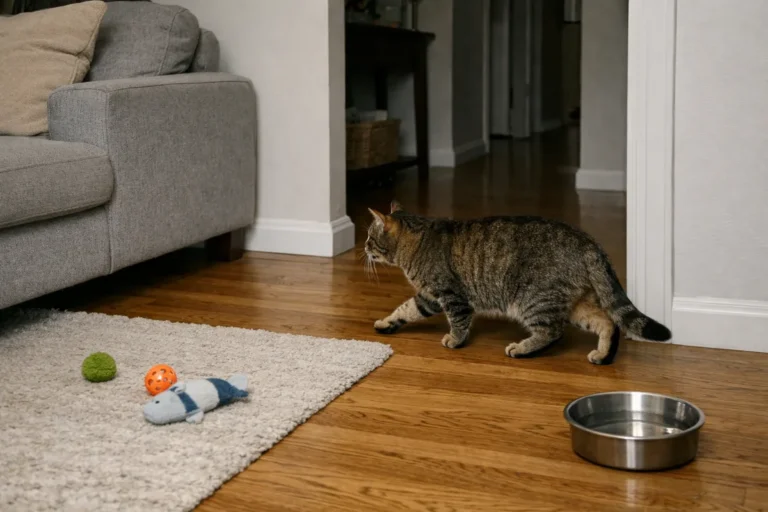
Some cats do this during feeding time too. They watch the bowl being prepared, the movement of other pets, or the person serving the food. Instead of rushing, they wait and assess the order of events. A still, watchful cat may simply be processing the environment before stepping in.
Typical everyday examples
- Staring at birds, insects, or passing cars from a perch
- Watching another pet enter a room without moving toward it
- Observing a person open a door, bag, or cabinet
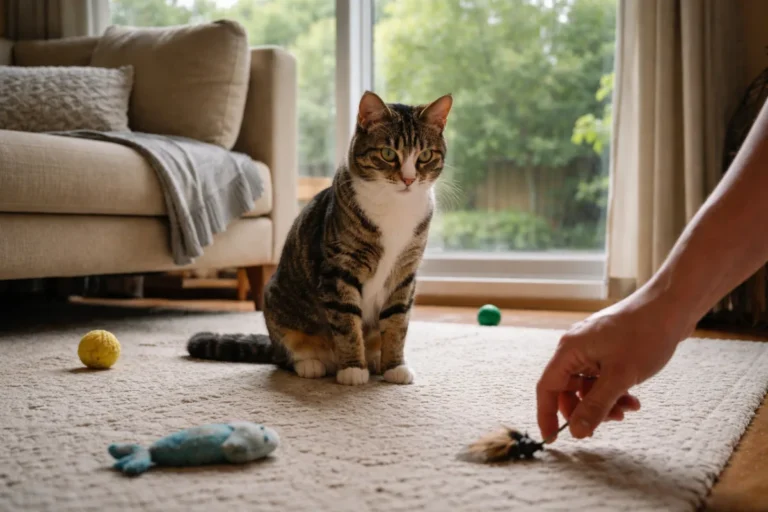
- Following hand movements with the eyes while keeping the body still
- Sitting near a new object and checking it out for several minutes
In many homes, this behavior becomes part of the cat’s routine. The cat has favorite observation points and repeated patterns. The same chair, shelf, sill, or hallway may serve as a lookout post day after day.
Possible internal reasons behind the behavior
There is usually more than one reason a cat watches without reacting. Curiosity is one. Caution is another. A cat may also be relaxed enough to stay still but interested enough to track what is happening.
Sometimes the behavior reflects a cat’s personality. Some cats are naturally bold and approach quickly. Others prefer to collect information first. Neither style is wrong. A cat that watches quietly may simply be more deliberate than dramatic.
Energy level matters too. A sleepy cat may follow movement with its eyes but not feel like engaging. A content cat might prefer to rest and observe rather than interrupt its own comfort. In those cases, the cat is not ignoring the world. It is choosing not to spend energy on it.
A quiet stare can mean curiosity, caution, rest, or all three at once. The same behavior can have different meanings depending on the moment.
Stress can also play a role, but it does not always show up in obvious ways. A cat under mild stress may freeze and watch instead of acting. The key is to look at the full picture: posture, tail movement, ears, pupil size, and whether the cat is able to shift away or relax after a few moments.
How body language changes the meaning
The meaning of a watchful cat depends heavily on the rest of the body. A loose body with soft eyes is very different from a stiff body with wide pupils. Both cats are observing, but they are not necessarily in the same emotional state.
If the cat’s tail is resting or moving gently, and the whiskers look relaxed, the behavior often points to calm attention. If the ears are forward and the cat blinks slowly, the moment may be one of safe curiosity. The cat is interested without feeling threatened.
When the body tightens, the meaning shifts. A frozen posture, flattened ears, tail tucked close, or sudden holding of breath can suggest uncertainty or discomfort. The cat is still watching, but now the stillness may be part of a guarded response.
Signals to notice alongside the watchful stare
- Ear position: forward, sideways, or pinned back
- Tail movement: still, slow, twitching, or tucked
- Eyes: relaxed, narrowed, wide, or fixed
- Body tension: loose, crouched, or rigid
- Movement after watching: approach, retreat, or continued stillness
These details matter because cats rarely explain themselves through one signal alone. A cat watching from a windowsill with a soft body is showing something different from a cat watching from under a table with a tense back and no blinking. The behavior is the same on the surface, but the context changes everything.
How environment shapes the behavior
A quiet home can make this habit more noticeable. When the household is predictable, a cat has more space to observe. There is less need to rush. The cat may spend more time watching because the environment feels safe enough to do so.
In a busier home, the same behavior may appear in short bursts. The cat watches from the edge of activity, then leaves when the scene becomes too intense. In a home with children, multiple pets, or frequent visitors, observation can become a way of staying involved without getting overwhelmed.
Outdoor access changes things too. An indoor cat may stare for long periods at window activity because that is where the most interesting movement happens. An outdoor cat may watch from hidden or elevated spots before deciding whether to approach another animal, a person, or a new sound.
Environment can stretch or shorten this behavior. Calm, predictable spaces often invite longer observation, while busy spaces may produce briefer, more guarded watching.
New changes at home often bring the behavior into focus. A new couch, a moving box, a repairperson, or a different feeding schedule can all prompt a cat to sit back and study the situation. Cats often prefer to let unfamiliar things prove themselves harmless over time.
What owners often think it means
It is easy to assume that a cat watching without reacting is disinterested. People sometimes expect a cat to either play, approach, or leave. When none of those things happen, the behavior can seem blank. But cats do not always show interest in direct, obvious ways.
Some owners also read stillness as rejection. If a cat stares from across the room and does not come when called, it can feel distant. Yet the cat may be engaged in its own kind of social monitoring. It may be comfortable enough to remain near, but not ready to interact.
Another common mistake is treating all stillness as the same. A cat may sit quietly while relaxed and attentive, or it may freeze because something feels off. The difference is in the whole pattern, not the stare alone.
How to tell calm watching from uneasy watching
- Calm watching usually includes loose muscles and easy blinking
- Uneasy watching often includes stiffness and limited movement
- Calm watching may end with a stretch, nap, or casual walk-away
- Uneasy watching may end with hiding, backing up, or a sudden startle
- Calm watching fits a normal routine; uneasy watching may appear around new stressors
These differences help explain why the same behavior can mean different things on different days. A cat watching the family cook dinner is not necessarily in the same state as a cat silently staring at a new dog through a cracked door.
How this behavior connects to trust
Watching without reacting can be a sign that a cat feels safe enough to stay present. That does not always mean the cat wants contact. It means the cat is comfortable enough not to escape the scene. In many cases, that is a quiet form of trust.
Cats often choose proximity on their own terms. A cat may sit nearby, observe, and remain physically uninvolved. This can happen with favorite people too. The cat may seem detached, but it is still participating in the room in its own way.
At the same time, trust does not erase caution. A cat may trust the home but still be careful around sudden movement, loud sounds, or unfamiliar visitors. Observation lets the cat maintain a sense of control. It is a middle ground between full engagement and withdrawal.
When a cat chooses to stay and watch, it often signals a mix of confidence and self-protection. That balance is part of normal feline behavior.
Age and life stage can change the pattern
Kittens often watch intensely because nearly everything is new. They may freeze, stare, pounce, then freeze again. Their reactions can be fast and uneven. Observation is part of how they learn what is safe, what is fun, and what deserves more attention.
Adult cats tend to become more selective. They may still observe plenty, but they often react with less noise and less wasted motion. A mature cat can spend a long time studying something without deciding to act. That does not mean the cat has lost interest. It may simply be more efficient now.
Older cats may watch without reacting for different reasons. They might be less energetic, less playful, or more careful with movement. A senior cat may still track familiar household events, but with less urgency. The behavior may look quieter because the cat’s overall pace has slowed.
When the behavior is nothing to worry about
In many cases, a cat watching without reacting is perfectly normal. The cat may be resting, thinking, listening, or waiting for a better moment. If the body looks relaxed and the cat returns to ordinary activities afterward, the behavior usually fits within everyday feline life.
This is especially true when the cat has a stable appetite, normal grooming habits, regular litter box use, and an even routine. A watchful cat can be healthy, social, and content. Some cats are simply more observant than outwardly active.
The behavior also makes sense in homes where there is constant movement. A cat may spend a lot of time monitoring the room because the room keeps changing. That watching can be a normal response to a lively environment.
When the behavior deserves closer attention
There are moments when still watching may be tied to discomfort rather than simple observation. If a cat seems unable to relax, startles easily, or stays rigid for long stretches, the behavior may be part of a larger stress pattern. That is more important than the stare itself.
Changes matter. If a cat who usually moves around suddenly spends most of the day frozen in place, or if the watching is paired with hiding, loss of appetite, or reduced grooming, something may be affecting the cat’s sense of security or health. The shift in routine is the clue.
The same is true if the cat watches one specific person, pet, or room with clear tension every day. Consistent guarded behavior around a certain trigger can reveal ongoing discomfort. In that case, the cat is not just observing. It is bracing.
Concern rises when stillness is paired with tension, repeated avoidance, or changes in normal habits. The behavior itself is not the issue; the pattern around it is.
How to read the moment without overthinking it
A useful way to understand a cat watching without reacting is to ask three simple questions. Does the body look loose or tight? Is the cat choosing to stay nearby, or is it trapped in place? Does the behavior end naturally, or does it seem to linger in a strained way?
Those questions keep the focus on context. A cat at the window, calm and unmoving, is likely just observing the world. A cat crouched low, staring at the hallway with wide eyes, may be feeling very different. The posture tells the story.
Many cats use observation as a daily habit, and that habit can say a lot about how they relate to their surroundings. Some are watchers by nature. They prefer to measure a situation before joining it. Others observe only when something catches their attention. Both patterns are normal parts of living with cats.
When the cat finally moves, it often reveals the answer. It may step away, pounce, stretch, groom, or settle down as if nothing unusual happened. That quiet shift is often the clearest sign that the watching served its purpose. The cat looked, decided, and moved on in its own time.