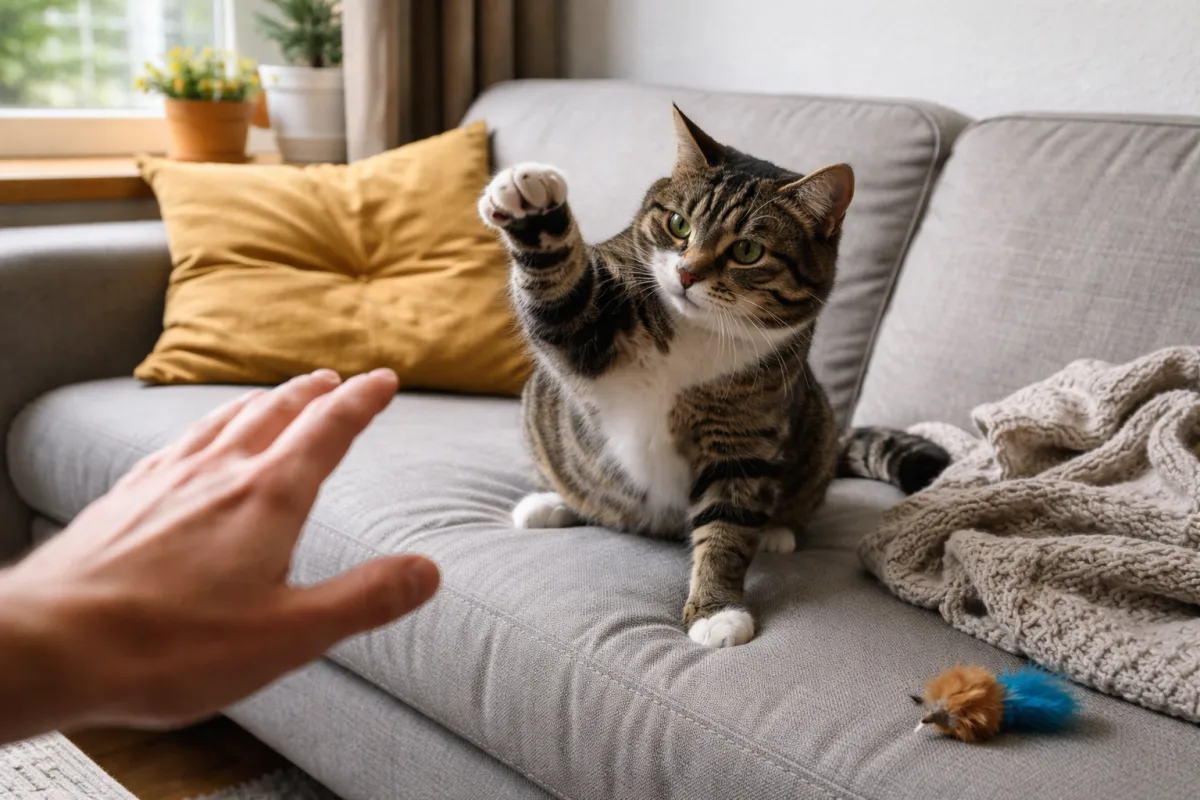
A cat can be purring beside you one second and swatting at your hand the next. The movement is quick, sharp, and often confusing because it seems to appear out of nowhere. For many cat owners, the hardest part is not the swat itself but the lack of obvious warning before it happens.
What looks sudden is often the end of a process that began much earlier. A cat may have been getting uncomfortable, overstimulated, nervous, or simply done with the interaction long before the paw moved. Cats rarely announce their limits in the same way people do, and that difference is where a lot of misunderstanding begins.
Swatting without warning is usually not random aggression. In many cases, it is a fast communication tool. The cat is saying something clearly, but the message can be easy to miss if the signs leading up to it are subtle.
What Cats Are Really Doing When They Swat
A swat is not always a full attack. It may be a light tap, a quick bat with claws retracted, or a stronger strike that ends the interaction immediately. The meaning changes depending on the cat’s body language, the setting, and what happened just before the movement.
Some cats swat to create space. Others do it to stop petting, block a hand, redirect attention, or react to a sudden change in the environment. The motion is fast because it works. A cat does not need to explain itself in words when one paw can make the point.
Swatting is often a boundary-setting behavior. It can mean “back up,” “stop that,” “I am unsure,” or “I am overstimulated.”
That boundary can be soft or firm. A soft swat may be a warning, while a harder one suggests the cat has already been pushed past comfort. The difference matters because it helps explain whether the cat is trying to guide the interaction or escape it.
Why It Seems to Happen Without Warning
To people, warning signs usually mean a clear change: a growl, a hiss, or a dramatic posture. Cats are often more subtle. Their early signals can be small enough to miss if you are focused on petting, playing, or reaching for them.
Before a swat, a cat may freeze for a moment. The tail might twitch. The ears may angle slightly to the side. The skin on the back may ripple, or the cat may turn its head to watch your hand closely. These signals are easy to overlook because they do not always look dramatic.
Sometimes the warning is hidden in the timing. A cat that was fine a minute ago may have simply reached a limit. Cats can tolerate attention for a short period and then shift very quickly from relaxed to irritated. That shift can feel sudden if you do not notice the buildup.
Common Situations That Lead to Swatting
Swatting often appears in predictable moments, even if the cat seems unpredictable at first glance. The setting usually matters a great deal. A cat may behave one way on the sofa, another near a doorway, and another when startled during sleep.
During petting
Many cats enjoy touch, but only in certain areas and for a limited amount of time. Petting can build physical overstimulation. A cat may like a few strokes on the cheeks and then decide it has had enough. If the hand keeps moving, the cat may swat to end the contact.
When a cat is startled
A cat that is resting, grooming, or focusing on something else may swat if approached too quickly. The behavior is often defensive rather than hostile. In that moment, the paw acts as a quick barrier between the cat and whatever suddenly entered its space.
During play
Play swatting is common, especially in younger cats. It can look intense, but it often has a different feel from defensive swatting. The body may stay loose, the ears may remain neutral, and the cat may continue to engage after the tap. Even so, play can tip into frustration if the cat gets too worked up.
When a cat is cornered
Some cats swat when they feel they have no easy exit. A blocked path, a looming hand, or being held when they do not want to be can trigger a quick strike. The paw is often a last effort to open space.
What the Behavior May Signal About the Cat’s State
Swatting is usually a sign that the cat’s internal state has changed. That change may be mild or strong. It can reflect discomfort, anxiety, excitement, annoyance, uncertainty, or a need for control over the interaction.
One common reason is overstimulation. Cats can enjoy touch and then suddenly become sensitive to more touch. This does not mean the cat dislikes affection. It means the threshold was reached. The swat becomes the message that the threshold is gone.
Another possibility is fear. A frightened cat may not hiss or run first. If the situation feels too close or too fast, the cat may strike as a first defense. This is especially true in cats that are naturally cautious or have had stressful experiences.
Frustration can also play a role. A cat may want interaction on its own terms. If a person keeps petting, picking up, or trying to engage after the cat has clearly moved on, the swat may reflect irritation rather than alarm.
Context matters more than the paw movement itself. The same swat can mean play, discomfort, fear, or a request for distance.
Body Language That Often Comes Before the Swat
Cat communication is layered. The swat is usually the final step, not the first. Watching the body as a whole gives much better clues than focusing only on the paw.
-
Tail movement: a slow tail flick can be an early sign of irritation or rising energy.
-
Ear position: ears turning sideways or flattening slightly may show discomfort.
-
Eye changes: wide eyes, fixed staring, or quick blinking can signal tension.
-
Body stiffness: a cat that suddenly becomes still may be preparing to react.
-
Head turning toward the hand: this can mean the cat is tracking a touch it no longer wants.
Not every cat uses the same signals in the same order. Some are very expressive. Others are quiet until the moment they are not. A cat that seems to swat “out of nowhere” may simply be a cat whose warning language is easy for humans to miss.
How Playful Swatting Differs From Defensive Swatting
Two cats can swat in ways that look similar but mean very different things. The tone of the interaction changes the meaning. So does the rest of the body.
| Type of swat | Common signs | Likely meaning |
|---|---|---|
| Playful | Loose body, bouncy movements, ears mostly neutral, may return for more play | Engagement, excitement, mock hunting |
| Defensive | Stiff posture, ears back or sideways, staring, quick retreat after swat | Discomfort, fear, a need for distance |
| Frustrated | Tail flicking, impatient movement, repeated attempts to escape attention | Interaction has gone on too long or feels intrusive |
Playful swats usually happen in a broader pattern of active interaction. The cat may bounce, stalk, pounce, and then pause. Defensive swats are more likely to be sharp, efficient, and followed by retreat or more warning signs.
It helps to think less about the paw and more about the full sequence. A cat that bats a toy and then runs back for another round is communicating something very different from a cat that swats and immediately hides.
Why Some Cats Swat More Than Others
Individual personality plays a major role. Some cats are naturally tolerant and give many chances before reacting. Others are sensitive and prefer very specific kinds of contact. Both types are normal.
Early life experiences also matter. Cats that grew up around gentle handling and consistent boundaries may be more predictable about their limits. Cats with rough handling, inconsistent contact, or little positive human interaction may react more quickly when they feel pressure.
Breed is sometimes mentioned, but personality and history usually matter more than a label. Even within the same household, one cat may be patient with touch while another swats at a hand that moves too fast.
Age can shape the pattern too. Kittens often swat during play because they are learning how to use their bodies. Adult cats may swat more when they are overstimulated, stressed, or trying to control access to themselves. Older cats may react if they are sore, hearing less well, or startled more easily.
How the Home Environment Influences the Behavior
A calm cat in a peaceful home may still swat, but the behavior often becomes more noticeable in busy or unpredictable settings. Noise, crowding, lack of hiding places, and frequent interruptions can all make a cat more reactive.
Indoor cats in active households may swat when they cannot fully control who comes near them. A hallway encounter, a child reaching suddenly, or repeated attempts to pet a cat that is already in a resting spot can all create tension. The cat may feel like it has to defend its personal space more often.
Even small changes can matter. Moving furniture, visitors, loud appliances, or the arrival of another pet can alter how safe a cat feels. When the environment feels less stable, swatting can become one of the quickest ways for a cat to respond.
A cat that swats more often in a certain room, at a certain time, or around a certain person is often reacting to the situation, not acting “mean.”
How Owners Often Misread the Signal
People often assume a swat means the cat was unpredictable or angry for no reason. In reality, the cat may have been communicating for several seconds or even several minutes before the swat happened. The missed signals are usually the problem, not the cat’s behavior itself.
Another common misunderstanding is treating every swat as a behavioral problem that needs correction. Sometimes the better answer is to change the interaction. Slow down. Give the cat space. Stop petting before the cat reaches its limit. Let the cat choose the distance.
It is also easy to confuse a swat with rejection. A cat may enjoy being near people and still dislike a specific kind of touch, a sudden approach, or being picked up. That does not mean the cat does not want connection. It means the connection works best on certain terms.
Practical Ways to Read the Moment Better
Understanding swatting starts with noticing patterns. Cats are consistent more often than people realize, but the pattern may be narrow. They may tolerate chin scratches and dislike belly touch. They may enjoy one minute of petting and then want a pause. They may greet quietly but swat if approached from behind.
-
Watch for tail twitching during petting.
-
Pause when the cat turns its head toward your hand.
-
Respect a cat that moves away, even if only by a few steps.
-
Offer a hand and wait instead of reaching in quickly.
-
Keep play sessions short enough that the cat stays engaged but not frantic.
These habits do not require special training. They simply make the interaction easier for the cat to manage. When a cat feels less pressured, there is often less need to use a paw as a warning.
When Swatting Becomes More Noticeable
Some cats swat more during certain phases of life or under particular conditions. A newly adopted cat may be uncertain and defensive until the home becomes familiar. A cat recovering from illness or pain may react more strongly to touch. A cat in a home with new pets or more visitors may become less patient.
There are also times when swatting may rise because the cat’s tolerance has changed. A cat that once loved long petting sessions may now prefer brief contact. A cat that used to enjoy rougher play may no longer want it. These changes are worth noticing because they often reflect a shift in comfort rather than a sudden personality change.
Some cats are simply more responsive during the evening, after a nap, or when their hunting energy is high. Others become less tolerant when they are tired. The timing can be part of the clue.
What the Behavior Says About the Cat–Human Relationship
Swatting often shows that the relationship is active enough for the cat to express limits. That is not a failure. It is information. Cats that feel they must use their paws are still communicating with the people around them, even if the message is blunt.
The better the relationship, the easier it becomes to spot patterns and respect them. A cat that swats less once its boundaries are honored is not being “fixed” in a dramatic sense. The cat is simply getting what it asked for: more control, more space, or a gentler pace.
That is why one cat may swat a hand in the morning and sit peacefully on the same person’s lap later in the day. The behavior is not always about the person. It is often about timing, touch, and the cat’s current comfort level.
Natural Instincts Behind the Quick Paw
Cats are built to respond fast. Their paws are used for hunting, climbing, testing, blocking, and defending. A swat draws on those instincts. It is efficient, immediate, and effective in a way that fits a cat’s natural style.
This is one reason swatting can seem sudden even when it is not. The cat does not need a long buildup or a dramatic display. A quick paw is enough to create distance or redirect attention. In the cat world, that economy of motion makes sense.
Understanding that instinct does not excuse every swat, but it does make the behavior easier to read. Cats are not behaving like small humans. They are using a species-specific tool in a moment that feels important to them.
When the Swat Has No Obvious Trigger
Sometimes a cat seems to swat for no clear reason. In those cases, the trigger may still exist, but it may be small. A scent, a sound, a movement in the corner of the room, or a hand entering too quickly can be enough. Cats notice details that people often ignore.
If the behavior appears repeatedly without any clear pattern, physical discomfort should also be considered. Pain, skin sensitivity, arthritis, or another health issue can make a cat less tolerant of touch. A cat that seems unusually reactive is worth observing carefully, especially if the pattern is new.
What looks like unpredictability may actually be a cat that is trying to avoid something uncomfortable before anyone else notices it. The swat arrives quickly because the cat wants the situation to end just as quickly.
Quiet Signals That Often Matter More Than the Swat
The most useful information often comes before the paw moves. A cat that is done with interaction usually gives several small hints. Once those hints become familiar, the swat is less surprising and easier to prevent.
-
The cat stops leaning into the petting.
-
The body tightens instead of staying soft.
-
The tail begins to flick or thump.
-
The cat watches the hand rather than relaxing into the touch.
-
The cat shifts weight as if preparing to leave.
These cues are easy to miss when the cat has been calm for a long stretch. But once you start noticing them, the behavior makes more sense. The swat is usually not the first sign. It is the last one.
A cat that swats without warning is often a cat whose warning system is subtle, not absent. The behavior becomes clearer when you look at the whole scene: the timing, the posture, the setting, and the kind of contact involved. That fuller picture is usually enough to explain why the paw came out when it did.