A cat that suddenly seems frightened by ordinary things can leave an owner feeling puzzled. One day the same cat is relaxed on the couch, and the next day a crinkling bag, a new guest, or a sound from the hallway sends it racing away. This kind of reaction is often more than simple nervousness. It can reflect a cat’s history, personality, health, and the way its environment feels to it.
Overly fearful behavior does not always come from one clear cause. In many cats, it develops slowly. A change in routine, a painful experience, a lack of early social exposure, or an environment that feels unpredictable can all shape how strongly a cat reacts. Fear may show up as hiding, freezing, dilated pupils, hissing, sudden startle responses, or refusing to approach familiar people.
Some cats are naturally more cautious than others. Still, when fear becomes intense or frequent, it is worth paying close attention to the pattern. The important question is not just what the cat is afraid of, but why that reaction has become so strong in the first place.
Why Cats Become Overly Fearful
Fear is a normal part of cat behavior. In the wild, caution helps cats stay alive. Domestic cats still carry that instinct, even when they live safely indoors. A cat that reacts quickly is not being dramatic. It is responding to something it sees as a possible threat.
Problems begin when the response becomes too intense for the situation. A normal caution response might mean pausing at a strange sound. An overly fearful response might mean bolting under the bed every time the dishwasher starts. The difference is in degree, duration, and frequency.
Several things can push a cat toward this state:
- poor early socialization
- pain or illness
- trauma or frightening past experiences
- constant noise or disruption at home
- changes in territory, smells, or routine
- stress from other animals
Fearful behavior can also become a habit. If a cat repeatedly gets startled and never gets a chance to feel safe, the nervous system stays on alert. Over time, the cat may begin reacting before anything actually happens.
A fearful cat is not trying to be difficult. The behavior usually reflects a nervous system that expects danger, even in ordinary situations.
What Overly Fearful Behavior Looks Like in Everyday Life
At home, fear can appear in ways that are easy to miss at first. Some cats simply seem “shy,” but their behavior has a sharper edge than shyness alone. They may monitor every movement in the room, avoid eye contact, or leave as soon as they hear footsteps.
Common signs include:
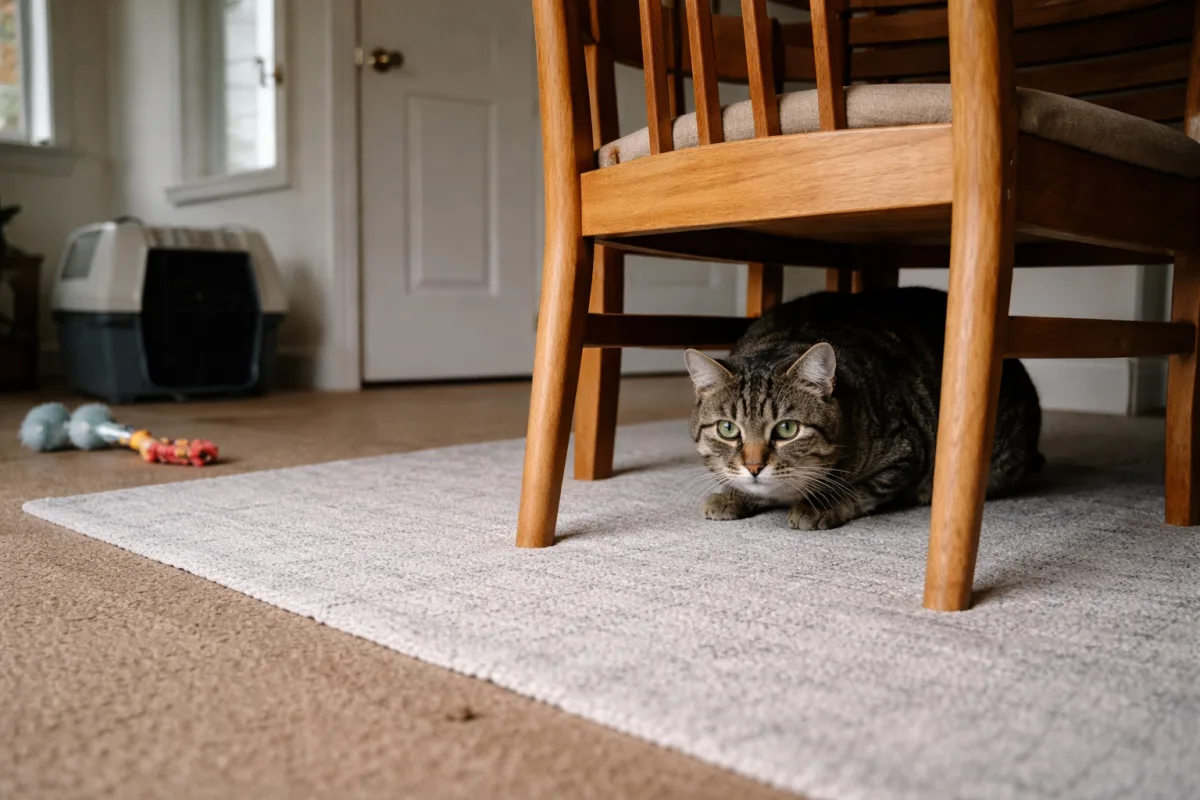
- hiding for long periods
- running away from normal household activity
- flattened ears and a low body posture
- tail tucked close to the body
- refusing treats when stressed
- startling at small noises
- hesitating before entering a room
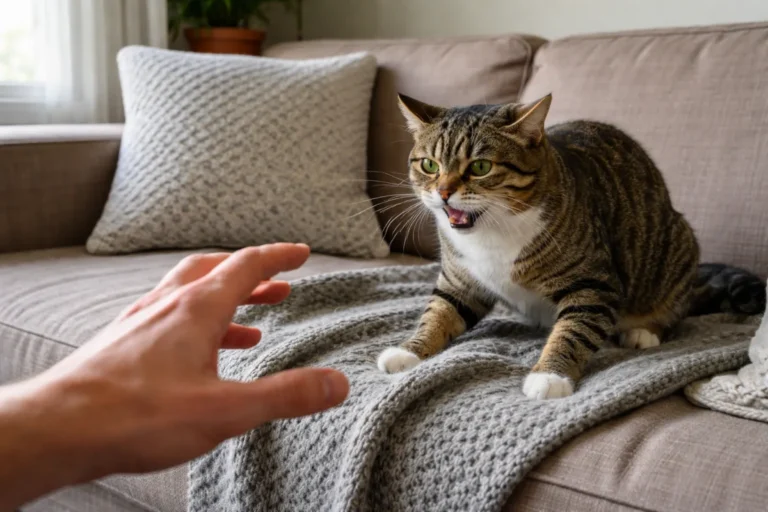
- hissing, swatting, or defensive biting when cornered
Some fearful cats are quiet and withdrawn. Others look restless, pacing from room to room, unable to settle. A cat may also seem fine for much of the day, then suddenly panic when a specific trigger appears. That unpredictability can make the behavior feel confusing, but it usually follows a pattern once you look closely enough.
Timing matters too. A cat that only hides during vacuuming is different from a cat that seems tense all day. The first cat may be reacting to a clear trigger. The second may be living in a constant state of unease.
Internal Reasons Behind Strong Fear Responses
Early experience shapes sensitivity
Kittens go through a key learning period early in life. During that time, they become familiar with sounds, people, handling, other animals, and normal household activity. A kitten that misses important exposure may grow into an adult cat that finds everyday events overwhelming.
This does not mean every shy kitten becomes fearful forever. Cats can improve over time. Still, early experience often leaves a lasting mark on how quickly a cat feels safe.
Personality is part of the picture
Some cats are naturally more observant and cautious. They tend to take in details before acting. That trait can be useful, but in a busy environment it may look like fear. A cat with a sensitive temperament may react more strongly to change, even when nothing harmful is happening.
There is a difference between a cat that prefers quiet observation and a cat that seems unable to relax. The first may simply be reserved. The second may be stuck in a fear response.
Pain often hides behind fear
Discomfort can make a cat react as if the world is unsafe. A cat with joint pain may avoid being approached because movement hurts. A cat with dental pain may become defensive when touched around the face. Even mild chronic pain can lower tolerance and make ordinary interaction feel threatening.
This is one reason sudden fear in an adult cat should never be dismissed as a personality quirk. If a calm cat becomes jumpy, less social, or unusually reactive, physical discomfort needs to be considered.
Memory can strengthen fear
Cats remember threatening experiences well. One scary trip in a carrier, one rough handling experience, or one attack from another pet can create a strong association. Later, the cat may react not only to the original event, but to anything that resembles it.
That is why some cats fear shoes, boxes, carriers, or certain rooms. The object itself is not the real issue. It is what the object has come to mean.
How Context and Environment Influence Fear
A cat’s home environment has a major effect on how safe it feels. Cats rely on territory, routine, and predictability. When those things change too often, fear can grow stronger.
Busy households can be especially hard on sensitive cats. Loud televisions, children running through the room, visitors, construction noise, and frequent rearranging can create a sense that the environment never settles. Even if nothing is directly aimed at the cat, the overall atmosphere can still feel unpredictable.
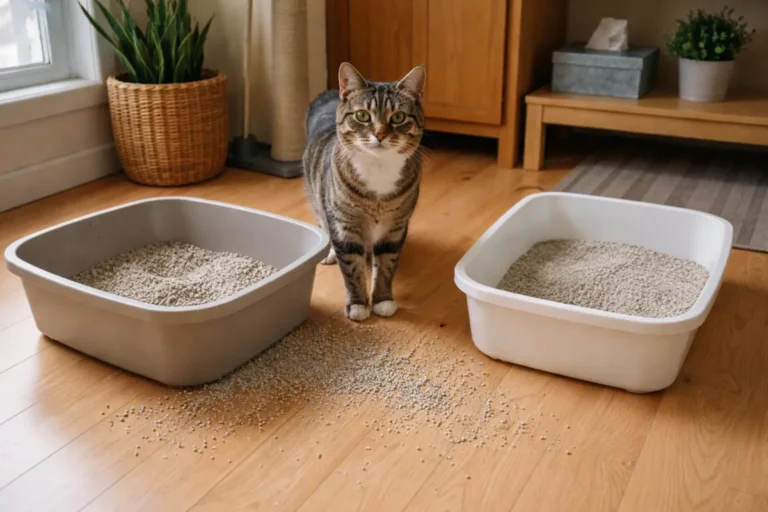
Multi-cat homes can also create tension. A cat that is being stared at, blocked from resources, or ambushed near a doorway may start living defensively. The fear may seem “mysterious” if the conflict is subtle, but many cats communicate pressure quietly. They may avoid the litter box, wait to eat until others leave, or choose hidden routes through the house.
Some environment-related triggers are easy to overlook:
- strong cleaning product smells
- new furniture or moving boxes
- loud appliances
- open windows with outside cat sounds
- unpredictable feeding times
- too few safe resting places
Fear often increases when a cat cannot escape or observe from a distance. Cats usually feel better when they can watch new things before deciding whether to approach. If every change happens too quickly, their sense of control disappears.
For many cats, fear grows when life feels unpredictable. Predictable routines and safe retreat spaces often matter more than owners realize.
Different Forms of Fear: Quiet, Defensive, and High-Alert
Not all fearful cats act the same way. Some withdraw quietly. Others react with obvious tension. A cat’s fear can also shift from one form to another depending on the situation.
| Fear style | Common signs | What it may suggest |
|---|---|---|
| Quiet fear | Hiding, low movement, avoiding contact | The cat is trying to stay unnoticed and safe |
| Defensive fear | Hissing, growling, swatting, biting | The cat feels cornered or pressured |
| High-alert fear | Scanning the room, sudden startles, inability to relax | The cat expects something to happen at any moment |
A cat may move between these modes in the same day. A quiet cat that usually hides may become defensive if approached too closely. A defensive cat may calm down once it has space. A high-alert cat may look restless in every room because its nervous system never fully settles.
These differences matter because the response should match the cat’s version of fear. A hiding cat usually needs distance. A defensive cat needs more space and fewer direct interactions. A high-alert cat often needs a calmer overall environment, not just one changed routine.
What Fear May Signal About the Cat’s State
Fear is often a signal, not the whole problem. It can point to emotional stress, physical discomfort, environmental pressure, or a combination of all three. Owners sometimes focus on the trigger they can see, while missing the larger pattern underneath it.
A cat that hides after guests arrive may be reacting to social stress. A cat that flinches when picked up may be uncomfortable or in pain. A cat that suddenly becomes fearful at night may be hearing or sensing something that is hard for people to notice, or it may feel less secure when the house becomes quiet and unfamiliar sounds stand out.
Fear can also indicate that the cat has reached its limit. Some cats tolerate stress for a long time before showing obvious signs. Then the behavior changes quickly. That shift can be the first clear sign that something has become too much.
Look for patterns around:
- time of day
- specific rooms
- specific people or animals
- handling, grooming, or vet visits
- noise, movement, or scent changes
Patterns tell a more useful story than one bad moment. A single frightened reaction is one thing. A repeated pattern is something else entirely.
How Owners Often Misread Fearful Cats
Fear can be mistaken for stubbornness, antisocial behavior, or even grumpiness. A cat that avoids touch is sometimes labeled aloof. A cat that hides is called antisocial. A cat that lashes out is treated as mean. Those labels miss the actual experience the cat is having.
Another common misunderstanding is assuming a cat is “fine now” because it came out of hiding. Many fearful cats do not relax right away. They may emerge only because they are hungry, curious, or trying to track the environment. Being visible is not the same as feeling safe.
Owners also tend to read confidence into movement. A cat walking through a room slowly and carefully may look composed, but the body language may show tension. Likewise, a cat that stops eating during stress is not being picky. It may be too unsettled to focus on food.
Subtle signals are easy to miss:
- freezing in place instead of moving normally
- watching doorways constantly
- keeping the body low even while walking
- delayed response to sounds
- licking the lips when nothing is being eaten
- avoiding open spaces in the home
These signs often appear before the more dramatic ones. By the time a cat hisses or bolts, the fear has usually already been building.
Cat–Human Interaction and Fear
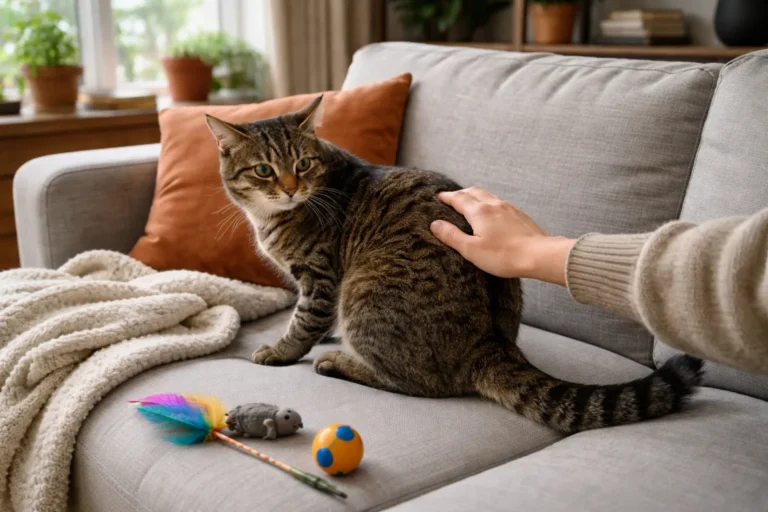
The way people approach a cat can either reduce fear or strengthen it. Cats generally do better when contact feels optional. Forced interaction often makes fear worse, even when the intention is affectionate.
Fast hand movements, direct staring, reaching over the head, or picking up a nervous cat without warning can feel threatening. Some cats need time to observe from a distance before they are ready for touch. Others may always prefer limited handling. That preference is not a problem by itself. It becomes one only when the cat seems distressed by normal interaction.
Predictable routines help build trust. Feeding at steady times, speaking calmly, and letting the cat choose when to come closer can make a real difference. So can offering safe resting spots that are not disturbed by traffic or noise.
Trust grows in small steps. A fearful cat does not usually change because someone tries harder. It changes when the environment and interactions become easier to interpret.
When a cat fears normal contact, the goal is not to push through the fear. It is to make interaction feel less demanding and more predictable.
How Fear Can Shift Over Time
Fear is not always stable. It can increase during a move, after a veterinary procedure, when a new pet arrives, or when household routines change. It can also improve if the cat begins to experience more predictable days and fewer surprises.
Some cats stay cautious throughout life. Others become more secure as they age and learn the pattern of their home. A few cats become more fearful later in life because of hearing loss, vision changes, pain, or cognitive changes that make familiar surroundings feel less certain.
This is why long-term observation matters. A cat’s fearful behavior should be viewed as a moving pattern, not a fixed identity. The same cat may be confident in one setting and frightened in another. It may feel safer with one person than another, or in one room but not the rest of the home.
Consistency can be reassuring, but flexibility helps too. If a cat avoids the living room after evening activity begins, that may tell you the room is too busy for its comfort. If the cat comes out more when the house is quiet, the environment itself is part of the answer.
When Fear Becomes a Daily Pattern
Occasional fear is normal. Persistent fear is different. A cat that seems on edge most days may be living with ongoing stress that never resolves. This can affect eating, grooming, litter box use, sleep, and willingness to explore.
Long-term fear often creates a narrower life. The cat may stop using certain areas of the home, avoid social contact, or remain hidden for most of the day. In some cases, the fear becomes so ingrained that the cat reacts before the trigger is fully present. A sound from another room, a visitor’s footsteps, or even the owner’s routine movements can be enough to start the response.
That kind of pattern often means the cat has learned to expect stress, not just react to it. The difference is important. A cat that expects stress needs time, predictability, and often a calmer environment before it can feel secure again.
Closing Perspective
Overly fearful cats are usually responding to something real in their world, even if the trigger is not obvious to people. Sometimes the cause is early experience. Sometimes it is pain. Sometimes it is a noisy home, another pet, or a history of frightening events. Often, it is several of these things working together.
When fear is seen as information instead of misbehavior, the cat’s actions become easier to understand. Hiding, freezing, hissing, and startle responses all have meaning. They point to discomfort, uncertainty, or a lack of safety. The cat is not choosing fear for no reason. It is trying to cope.
Noticing the pattern, rather than just the moment, gives the clearest picture. Where the cat feels tense, what changes before the reaction, and which situations repeat the response all matter. Over time, those details reveal why fear has become so large in the cat’s daily life.