Cat spray indoors is one of those behaviors that can feel confusing fast. A cat may seem relaxed one moment, then suddenly back up to a wall, sofa, curtain, or doorway and leave a strong-smelling mark behind. It is different from normal urination, and it usually carries a message.
Many owners first notice it in places that matter most: near windows, around a front door, on laundry, along baseboards, or on furniture that sits in shared areas. The behavior can appear in a home that feels calm to people, which is part of why it catches attention so sharply. A cat does not spray at random in the same way a litter box accident happens. There is usually context behind it.
Spraying is not simply “bad behavior.” It is a form of communication tied to instinct, territory, stress, social tension, and sometimes medical discomfort. The details matter. Where it happens, how often it happens, and what else the cat is doing at the time can point to very different reasons.
What cat spraying actually looks like
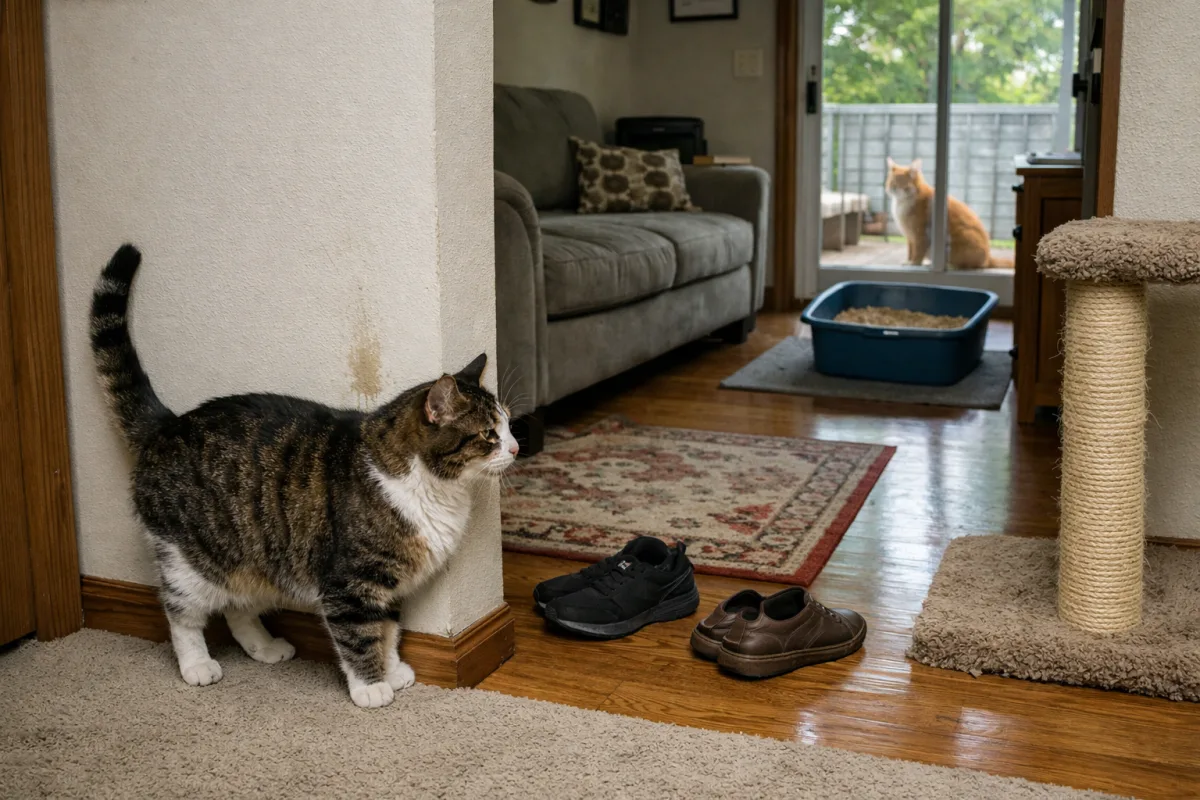
Spraying has a signature pattern. The cat usually stands with the tail held up, sometimes quivering, then releases a small amount of urine against a vertical surface. The amount is often much less than a full accident on the floor. The posture is the clue that separates it from ordinary peeing.
It tends to happen in locations that feel like boundaries. Doors, windows, screens, furniture edges, and hallway corners are common spots. These are places where the cat can mark a shared space or signal awareness of something outside the home.
Not every owner spots the moment itself. Sometimes the first sign is the smell, a damp mark at cat height, or repeated visits to the same place. The smell is strong for a reason: the message is meant to stay noticeable.
Why cats spray indoors in general
Spraying is usually connected to communication. Cats rely heavily on scent, and urine marking is one way they leave information for other animals. Even indoor cats still carry this instinct, which does not disappear just because the home is safe and quiet.
In a home environment, spraying can be triggered by a cat’s need to define space. That need may increase when another cat is present, when outdoor cats are visible, or when the home feels socially crowded. Some cats are simply more sensitive to these changes than others.
It can also happen when a cat feels unsettled. A move, a new pet, rearranged furniture, unfamiliar guests, loud construction noise, or changes in routine can make a cat feel less secure. Spraying can become a way to restore a sense of control.
Spraying is often less about spite and more about communication, stress, or territorial awareness.
Everyday situations where spraying appears
Owners often notice spraying after a shift in the home. A new cat may arrive, even if the two animals are not directly fighting. The resident cat may respond by marking doorways, hallways, or objects that smell strongly of the newcomer.
It can also appear when outdoor cats are around. A cat that sits at a window and watches another cat on the porch may spray nearby walls or furniture. The outside cat does not need to enter the house for the indoor cat to react. Seeing, hearing, or smelling another cat can be enough.
Some cats spray during periods of low predictability. Feedings that happen at different times, litter boxes that are cleaned less often, family schedules that shift, or a sudden change in attention can all add stress. The behavior may show up in the same place repeatedly because the spot has become emotionally important to the cat.
There are also quieter situations. A cat that feels blocked from a favorite resting area, startled by a dog, or displaced by household traffic may spray even when the home seems peaceful overall. The behavior often reflects the cat’s personal experience, not the owner’s impression of the house.
Internal reasons behind the behavior
Territorial marking
One of the most common reasons for indoor spraying is territorial marking. Cats are highly aware of space, and they use scent to keep track of what feels familiar. When a cat sprays, it may be reinforcing a boundary or leaving information in a location that feels important.
This is especially common in homes with more than one cat. Even if the cats do not fight openly, they can still feel tension around access to food, windows, sleeping spots, litter boxes, and human attention. Spraying may be one quiet way that tension shows itself.
Stress and insecurity
Stress can make a cat more likely to spray, especially if the cat is sensitive by nature. Some cats notice small changes that people barely register. A new smell from a neighbor’s pet, a suitcase near the door, or a change in the owner’s work schedule can be enough to affect them.
The behavior is not always dramatic. A cat under stress may still eat, sleep, and use the litter box normally. Spraying can be the only obvious change. That makes it easy to miss the broader picture unless the pattern is tracked over time.
Conflict with other animals
Household conflict is another strong factor. A cat may spray when another cat blocks access to a favored area or when a dog invades its personal space. The conflict does not have to look obvious to the human eye. Cats often communicate through subtle pressure, avoidance, and scent before there is ever a visible fight.
In multi-cat homes, spraying may appear near shared resources. This can include litter boxes, feeding stations, water bowls, scratching posts, and doorways. Those places carry social meaning. A cat may be saying, in its own way, “this matters to me.”
Medical discomfort and physical changes
Not every marking behavior is purely behavioral. Pain or illness can influence how and where a cat urinates. Urinary tract issues, inflammation, constipation, and other medical problems can create confusion around elimination. A cat in discomfort may begin associating certain places with relief or may mark more frequently because the body is sending mixed signals.
Age can also matter. Older cats may experience changes in mobility, bladder control, or sensation. A cat that once sprayed only in a few spots may begin having more frequent incidents if its physical condition changes. When the pattern shifts quickly, a medical check becomes especially important.
Any sudden change in urination habits deserves attention, especially if the cat strains, cries, urinates frequently, or seems uncomfortable.
How context and environment influence spraying
The same cat may spray in one home and never do it in another. That difference can come down to environment. Cats respond strongly to what is happening around them, including noise, visual access to the outdoors, and the number of safe resting places available.
A home with many high-traffic areas can make some cats feel exposed. If the cat cannot easily retreat or observe from a distance, it may become more vigilant. Spraying can then cluster around thresholds, corners, and rooms that feel socially important.
Window access is another major factor. Cats watch the outside world carefully. If there are frequent cat visitors, birds, or neighborhood animals passing by, the cat may spray on nearby surfaces. Those marks are not random; they often follow what the cat sees and hears.
Household scent changes can matter too. New cleaning products, fresh paint, moving boxes, guest luggage, or a recently used animal carrier can all alter how a space feels. Cats depend on scent for orientation, so changes that seem minor to people can feel major to them.
Subtle signals that often come before spraying
Spraying often does not happen in a vacuum. The cat may show small signs first. These signs are easy to overlook because they can look like normal cat behavior at a glance.
- Repeated sniffing of the same area
- Hovering near doors or windows
- Watching other animals closely
- Tail twitching or held stiffly upward
- Increased pacing or restlessness
- Using high-traffic spots more often
Sometimes a cat will pause, lift the tail, and posture before spraying. Other times the act seems brief and almost automatic. The more familiar an owner becomes with the cat’s rhythm, the easier it is to notice the warning signs.
These signals can be helpful because they show the behavior is not always sudden. A cat may be building up to the moment for hours or days, responding to an environment that keeps feeling unsettled.
What owners often misunderstand about spraying
One common mistake is assuming the cat is being defiant. Cats do not spray to “get back” at people in the human sense. The behavior is usually tied to instinct, discomfort, or social pressure. That distinction matters because it changes how the situation should be read.
Another misunderstanding is confusing spraying with a litter box problem. The two can overlap, but they are not the same. A cat that sprays a wall is not necessarily refusing the litter box. The cat may still use the box normally and still mark elsewhere under specific conditions.
People also sometimes assume spraying means a cat is unhappy all the time. That is not always true. Many cats spray only in certain situations or during specific life stages. A cat may seem calm, affectionate, and playful for most of the day and still mark near windows at night when outside cats are active.
There is also the assumption that neutering or spaying always ends the behavior immediately. Sterilization often helps, especially in younger cats, but it does not erase every cause. Stress, habit, territorial pressure, and environmental triggers can still matter after surgery.
How the behavior can change with life stage
Young cats may spray as they become socially aware of their territory. This can happen around maturity, especially when they begin reacting more strongly to other animals or outdoor activity. The behavior may start suddenly, which makes it feel surprising to owners who were used to a calmer kitten stage.
Adult cats may spray in response to household competition or change. In a stable home, the behavior may stay quiet for long periods and then flare up after a move, a new pet, or a shift in family routine. Some adults spray only seasonally if outdoor cat activity changes with the weather.
Older cats may spray for a different mix of reasons. They may be reacting to discomfort, reduced confidence, or changes in body function. A senior cat that starts spraying after years of calm behavior should not be assumed to be “just getting old.” The reason may be manageable, but it should be taken seriously.
Different intensity levels and what they may suggest
Spraying is not always equally intense. A small, occasional mark by a window suggests something different from repeated spraying across several rooms. Frequency, location, and the cat’s body language all help shape the interpretation.
| Pattern | Possible meaning | Common context |
|---|---|---|
| Occasional single spot | Boundary marking or environmental trigger | Outdoor cats, new smells, brief stress |
| Repeated same location | High-value territory or ongoing tension | Doorways, windows, shared spaces |
| Multiple spots in one day | Heightened stress or social conflict | New pet, household disruption, loud activity |
| Change from usual habits | Possible medical issue or emotional shift | Sudden onset, discomfort, avoidance |
Intensity matters because it helps show whether the cat is reacting to a temporary trigger or living under a more persistent pressure. A pattern that escalates over time deserves closer observation than one that appears once after a major change and then fades.
How people and cats can influence each other
Cats are careful observers of human routines. They notice when people leave, return, argue, clean, move furniture, or bring in unfamiliar scents. They also learn where the household tends to feel crowded and where they can move without interruption. Spraying can emerge in the places where those human patterns and feline instincts collide.
Sometimes the cat is reacting to the social atmosphere of the home rather than one single event. A house with frequent visitors, noisy evenings, or inconsistent attention can feel hard to predict. A cat that sprays in that setting may be trying to stabilize the space in the only way it knows.
At the same time, the cat’s marking can affect the household in return. Once a spot has been sprayed, the smell may draw the cat back again. That makes the location feel even more established. The behavior can become self-reinforcing, especially if the underlying reason is never addressed.
What the location of spraying can reveal
Where a cat sprays matters as much as how often it happens. A mark near the front door can suggest outside influence, while a mark near the litter area may point to tension around elimination space. A sofa, bed, or laundry pile can carry a strong emotional or scent-based meaning for the cat.
Vertical surfaces often indicate classic marking behavior. Horizontal surfaces can suggest something closer to a urination issue, though there are exceptions. The angle, the amount of urine, and the cat’s posture together tell the fuller story.
Repeated marking on one object can mean the cat is especially focused on that item’s scent. It may be a favorite resting place, a site where another animal has left odor, or a piece of furniture that sits in a highly visible part of the home. Cats rarely choose these spots without reason.
Why the behavior can feel unpredictable
Spraying can seem inconsistent because cats are sensitive to changes humans miss. One day the home feels the same as always, but the cat may notice that a neighborhood cat passed by the window, a room cleaner was changed, or a family member came home with a different animal scent on clothing. Tiny shifts can matter.
The timing can also be confusing. Some cats spray when the house is quiet, not chaotic. Others spray after a busy day is over. That can make the cause seem hidden, but the pattern often becomes clearer when viewed over several days rather than one isolated event.
It helps to think of spraying as part of a larger communication system. The cat is not choosing randomly. It is responding to what feels important in the moment, whether that is territory, safety, or social pressure.
How stress and routine often connect
Routine gives many cats a sense of security. Predictable feeding times, familiar resting spots, consistent litter box care, and stable social patterns can all reduce the urge to mark. When routine breaks down, even a little, the cat may start looking for ways to reestablish a sense of order.
That does not mean every change will cause spraying. Some cats adapt easily. Others are more delicate about shifts in environment. The difference often comes down to temperament, past experiences, and how much competition the cat feels in the space.
A cat that sprays only during specific transitions may be telling you that the environment is a little too active or unpredictable for comfort. A cat that sprays with no clear trigger may need a closer look at both health and home dynamics.
Living with the pattern over time
Spraying patterns can stay stable for years, or they can change with life circumstances. A cat that used to spray only near the front door may begin marking a bedroom after a guest cat’s scent enters the home. Another cat may stop completely after one household change and never return to the habit.
Long-term observation helps reveal the shape of the behavior. Notes about time of day, location, recent changes, and the presence of other animals can make the pattern easier to understand. The value is not in collecting data for its own sake. It is in seeing what the cat seems to respond to again and again.
When the behavior remains steady, it often points to a stable trigger. When it shifts, something in the cat’s world has likely shifted too. Both versions matter.
Repeated spraying in a familiar spot often means the cat associates that area with something important, not that the cat is forgetting where to go.
A calm closer look at the behavior
Indoor spraying is a layered behavior. It can involve territory, stress, social tension, outside animals, medical discomfort, and habit all at once. That is why simple explanations rarely fit every cat.
The clearest clues usually come from the details: posture, location, timing, and what changed before the spraying began. Those details turn the behavior from a mystery into a pattern that can be read more carefully.
When a cat sprays indoors, it is usually responding to something in its world that feels meaningful. The mark itself may be small, but the message behind it is often very specific.