Sometimes a cat looks perfectly fine and still makes those soft crying sounds that seem to come out of nowhere. The ears are relaxed, the coat looks normal, the food bowl is full, and yet the cat keeps meowing in a way that sounds worried or sad. That mismatch is exactly what makes the behavior hard to read.
Cat crying without an obvious reason is rarely random. More often, it is a sign that something small is happening beneath the surface. The cause may be physical, emotional, or environmental, and it is not always dramatic enough to stand out right away.
What sounds like “crying” is usually vocal communication. Cats use different tones for different needs, and some of the most important messages are the quiet, persistent ones. A cat does not need to be in visible distress to be trying to tell you something.
What cat crying can look like in everyday life
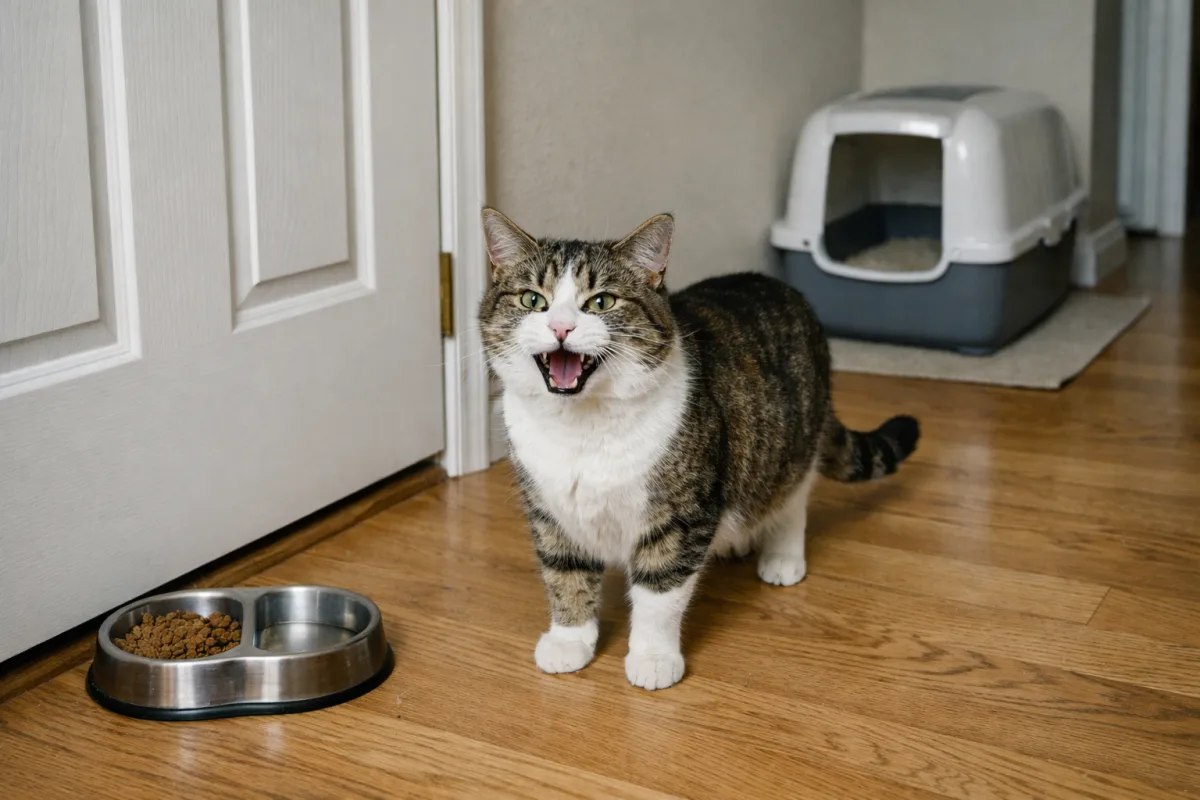
People often describe the sound as a cry, but in daily life it may show up as repeated meowing, yowling, trilling, or a drawn-out call. The sound might happen near the bedroom door at night, by the kitchen in the morning, or in the hallway when the house is quiet. Some cats are talkative by nature, while others only become vocal when something changes.
The pattern matters as much as the sound itself. A single meow while walking past you is very different from ten minutes of pacing and calling. If the crying appears at the same time every day, in the same spot, or after a specific event, that usually points to a trigger rather than a mood with no cause.
Common everyday situations
- Waiting for food at predictable meal times
- Calling from another room after a routine changes
- Meowing at windows when outdoor activity catches attention
- Vocalizing in the litter box area, near doors, or around sleeping spots
- Talking more when the home is quiet or the cat feels alone
Some cats also become more vocal after small disruptions that people barely notice. A late dinner, a new scent, a different sleeping place, or a change in household noise can be enough to bring out crying behavior. Cats are sensitive to routine, and even minor shifts can feel meaningful to them.
When a cat starts crying more than usual, the question is not only “Why is it happening now?” but also “What changed, even slightly?”
Physical reasons can hide behind the sound
One of the most common reasons a cat cries without an obvious reason is discomfort that is not easy to see. Cats are skilled at masking pain, so a cat may still eat, walk, and even play while feeling unwell. The vocalization may be the only clear clue that something is off.
Urinary discomfort is a good example. A cat may cry near the litter box, in the hallway, or while trying to go. Digestive upset can also lead to more vocal behavior, especially if the cat feels restless or sensitive. Older cats may cry because of stiffness, arthritis, or a general feeling of not being fully comfortable.
Health issues that can increase vocalizing
- Urinary tract discomfort
- Constipation or digestive pain
- Dental pain or mouth sensitivity
- Arthritis or joint stiffness
- Vision or hearing decline
- Hyperthyroidism or other age-related conditions
- General nausea, fever, or low energy
These conditions do not always create obvious limping or dramatic behavior changes. Instead, they can show up as restlessness, nighttime crying, or a cat suddenly wanting more attention. If the vocalizing is new, stronger, or paired with changes in appetite, litter box habits, or movement, it deserves attention.
If crying comes with straining, hiding, reduced appetite, or a litter box change, the behavior is no longer just “vocal.” It may be a health signal.
Emotional reasons are often quieter than people expect
Cats do not cry for attention in the same simple way people sometimes imagine, but they do respond strongly to emotional discomfort. A cat may cry when feeling lonely, overstimulated, insecure, or unsettled by a change in the household. The reason may be subtle, but the response can be very real.
Separation can matter more than many owners expect. Some cats are deeply attached to their routines and the people in them. If someone leaves earlier than usual, works longer hours, or stops doing a familiar evening ritual, the cat may call out more often. The crying may sound like complaint, but it often reflects uncertainty.
Other cats become vocal when they want interaction but do not know how to settle themselves. They may pace between rooms, call out, and then stop when someone speaks to them. This does not always mean the cat is spoiled or demanding. It can also mean the cat has learned that vocalizing is the clearest way to ask for social contact.
Emotional states that can show up as crying
- Loneliness after changes in household presence
- Stress from visitors, loud appliances, or new animals
- Need for reassurance in unfamiliar surroundings
- Frustration when a routine is interrupted
- Overstimulation after too much activity or petting
The difference between emotional crying and other forms often lies in body language. A worried cat may hold its tail low, move in short bursts, or keep scanning the environment. A social cat may look directly at you, approach, and call again if you do not respond.
Body language gives the sound more meaning
The cry itself tells only part of the story. The rest is in the posture, timing, and overall energy. A cat lying comfortably on a window perch and giving occasional chirps is not communicating the same thing as a cat that walks from room to room with a tense body and a fixed stare.
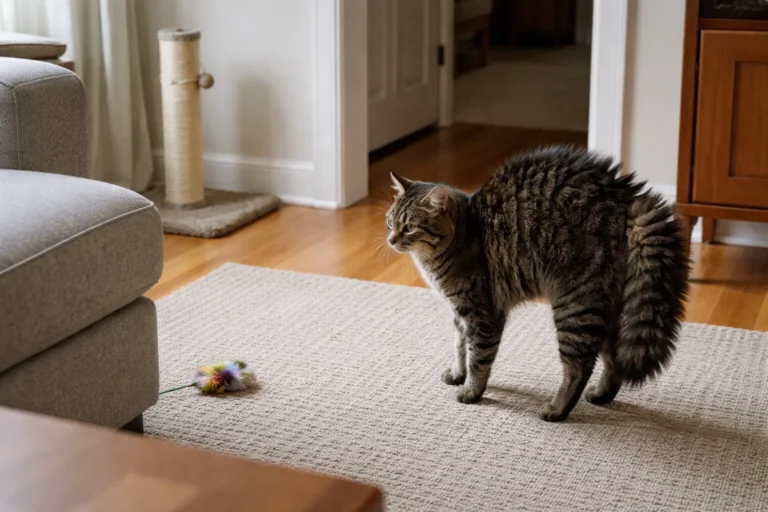
Watch the ears, tail, and movement speed. Ears turned sideways or back, a puffed tail, and abrupt pacing often point to agitation. A relaxed tail, soft eyes, and a cat that settles after a brief call may be asking for attention or checking in. One sound can mean very different things depending on what the body is doing at the same time.
Signals that change the meaning of crying
- Pacing or restlessness
- Staring at one place, object, or door
- Tail twitching or swishing quickly
- Hiding after crying
- Approaching and retreating repeatedly
- Changes in grooming, appetite, or sleep
Timing also matters. Crying at night often feels more intense because the house is quieter and the cat has fewer distractions. Crying before meals may be simple anticipation, while crying after a stressful event may be a sign that the cat has not fully calmed down yet.
Age can shape how the behavior appears
Kittens, adult cats, and older cats may all cry for different reasons. A kitten usually vocalizes because of need, uncertainty, or a strong desire for contact. The cry may be frequent, high-pitched, and tied closely to proximity. Kittens are still learning how to manage their environment, so their sounds are often more direct.
Adult cats tend to become more selective. If an adult cat suddenly starts crying more often, the change can matter more than the sound itself. It may point to boredom, routine disruption, pain, or a new stressor in the home. Adult cats usually have patterns, so a shift in those patterns is worth noticing.
Older cats can become louder for reasons that are easy to miss. Confusion, reduced sensory ability, nighttime disorientation, and age-related pain all play a role. A senior cat may cry simply because it feels less certain about where it is or what comes next.
Life stage patterns
| Life stage | Common pattern | What to watch |
|---|---|---|
| Kittens | Frequent calling, especially when separated | Need for warmth, safety, and contact |
| Adults | More specific vocalizing tied to routines | Changes in habit, stress, or discomfort |
| Older cats | Night crying, confusion, louder calls | Pain, sensory decline, or cognitive changes |
Home environment can make the crying more noticeable
A cat may seem to cry “for no reason” when the real cause is the environment around it. Indoor cats especially depend on predictable spaces. If the home is busy, noisy, or constantly changing, the cat may become more vocal without any one dramatic trigger standing out.
Open windows, shifting schedules, visitors, construction sounds, new furniture, and even a changed litter box location can affect how a cat behaves. Some cats cry near doorways because they want access. Others cry when they can hear outside cats, neighborhood animals, or unfamiliar sounds but cannot investigate them.
Indoor cats with limited stimulation may also vocalize more because they are under-engaged. A cat that spends most of the day waiting for something interesting may begin calling simply because the environment offers too little to do. That does not mean every vocal cat is bored, but the context is worth considering.
Environmental triggers that are easy to overlook
- Moved food, water, or litter boxes
- New pets or frequent visitors
- Stronger household noise than usual
- Visible outdoor animals through windows
- Reduced playtime or interaction
- Altered sleeping places or blocked access to favorite spots
Some cats react strongly to change and others hardly seem to notice. The difference is not just personality. It can also reflect how tightly the cat depends on routine to feel secure.
Why owners misread the crying
It is easy to assume a crying cat is being dramatic, but that interpretation often misses the point. The sound may be a request, a protest, a check-in, or a sign of unease. When the same cry gets labeled the same way every time, subtle patterns can be missed.
Owners often pay attention to the loudness and overlook the sequence. A cat that cries before eating, after waking, or when the house gets quiet may be showing a reliable pattern. Another cat may cry only when interacting with a specific person, which can reveal attachment, anticipation, or even stress tied to a routine.
The most common mistake is treating all vocalizing as one behavior. It is not. A short greeting meow, a nighttime yowl, and a repeated cry at the litter box can all sound similar but mean very different things.
Repeated crying is easier to understand when it is paired with three questions: when does it happen, where does it happen, and what else is the cat doing at the same time?
How to think through the possible cause
Start with the simplest practical observations. Notice when the crying begins, how long it lasts, and whether it follows a specific event. Check whether food, water, litter, play, and sleep routines have changed. Even a small shift can be enough to create noise in a cat’s day.
Then look at the cat itself. Is it moving normally? Eating as usual? Using the litter box in the same way? Grooming, sleeping, and jumping normally? A cat that still looks generally comfortable may be reacting to a routine issue or social need, while a cat that seems off in several areas may need a health check.
Useful questions to ask
- Did the crying start suddenly or build over time?
- Does it happen at a specific time of day?
- Is the cat looking at something, asking for access, or seeking attention?
- Has the home changed in any small way?
- Are there other signs like hiding, restlessness, or litter box changes?
If the behavior is new and persistent, or if it is paired with physical changes, it is sensible to seek veterinary advice. When the cry is tied more to routine or environment, the answer may be in adjusting daily life rather than assuming the cat is simply being vocal.
The deeper connection between cats and human routines
Cats live close to human schedules even when they seem independent. They learn meal times, sleep patterns, and the sound of familiar footsteps. When those rhythms shift, cats often respond with sound before anything else. Crying can be their way of marking that the world has moved out of sequence.
This is why a cat may cry “without reason” to a person but not to the cat. The reason may be a missed routine, a sound from outside, a feeling in the body, or a social need that was not obvious. Cats communicate in layers, and vocalizing is only one layer of that system.
A cat that cries persistently is not necessarily being difficult. It may be trying to restore predictability, ask for help, or reduce a feeling of discomfort it cannot express any other way. The sound matters because it is often the first visible sign that something in the cat’s world deserves attention.
When the crying appears again, the most useful response is calm observation. Look at the setting, the timing, and the cat’s body. That combination usually tells a clearer story than the sound alone.