A cat that suddenly starts biting too hard, kicking with both back feet, or grabbing skin during play can leave an owner confused. One moment the interaction seems fun, and the next it feels sharp, intense, or even a little personal. That change is common, but it usually has a reason.
Rough play is often a mix of instinct, excitement, timing, and how a cat reads the situation. Some cats are naturally more physical. Others get overstimulated fast, especially when hands are used as toys or the play session goes on too long. A cat may not be trying to be aggressive in the way people imagine; it may simply be reacting the only way it knows how.
When a cat gets too rough while playing, the details matter. The same bite can mean very different things depending on body language, energy level, and what happened right before it. The more closely you look at those patterns, the easier it becomes to understand what your cat is actually telling you.
What rough play usually looks like in everyday life
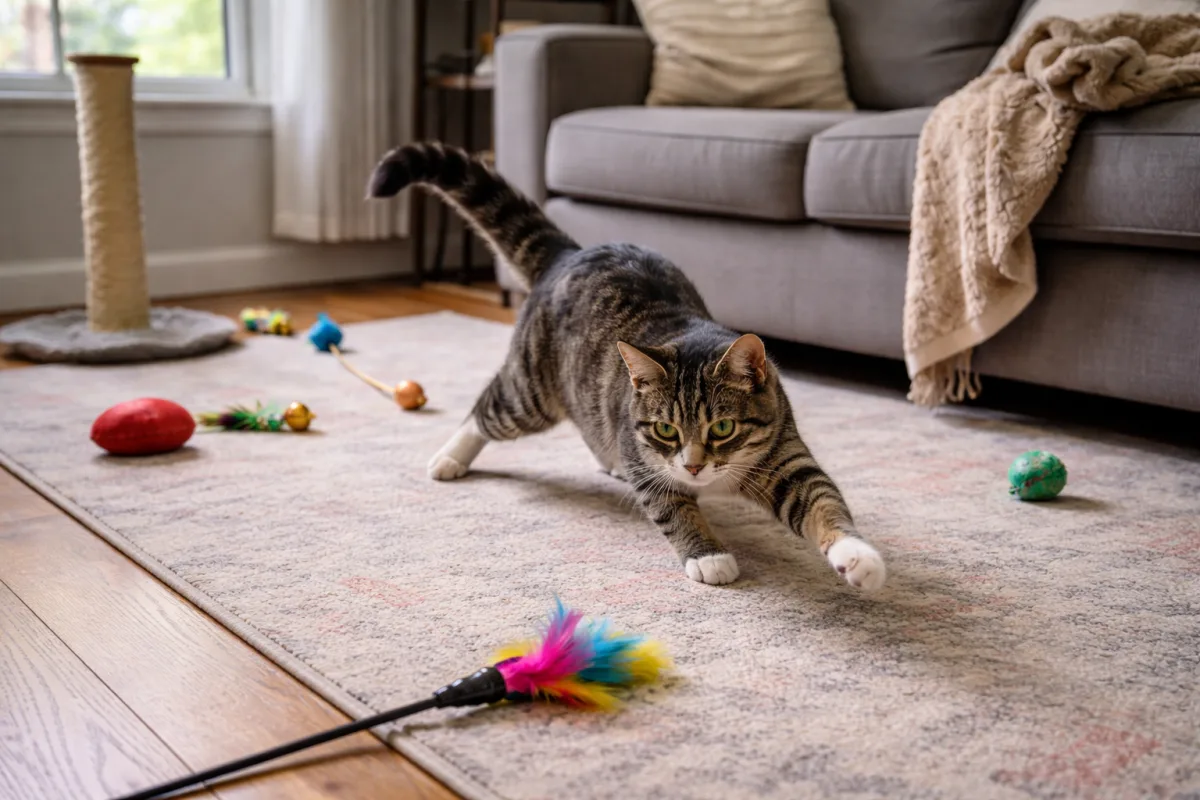
Rough play does not always start with a dramatic moment. It often builds gradually. A cat may begin with gentle paw taps, then move to lunging, grabbing, biting, and bunny-kicking as the excitement rises. What started as a harmless game can turn into a frantic burst of energy in only a few seconds.
In many homes, the pattern is easy to miss because the cat seems playful at first. It may roll onto its side, stretch toward a hand, or chase fingers under a blanket. Then the teeth come out harder than expected. The cat may clamp down, hold on, or keep attacking even after the person tries to pull away.
Common signs of play that is becoming too rough include:
- Ears turning back or flattening slightly
- Tail swishing harder or faster
- Sudden changes from loose movement to stiff movement
- Repeated biting without pausing
- Back legs kicking with strong force
- Ignoring normal redirection or toy movement
Some cats give very little warning. Others send small signals first, but those signals are easy to overlook when the game is moving quickly. A brief pause, a stare, or a tail flick may be the last calm moment before the cat goes over threshold.
Why cats become rough during play
One of the biggest reasons is instinct. Cats are hunters by nature, and play often activates the same chase-and-capture behaviors used in real hunting. Pouncing, grabbing, biting, and kicking are all normal feline actions. The problem is not the behavior itself. The problem is when the intensity is too high for safe interaction with a human.
Excitement is another major factor. Cats can move from relaxed to overaroused very quickly. Once the body is flooded with energy, self-control drops. A cat that was handling gentle play well may suddenly bite harder because the emotional level changed before the cat could settle.
Some cats also roughhouse because they learned that hands are acceptable play objects. If a kitten spent a lot of time wrestling fingers, chasing toes, or attacking moving hands, that habit can carry into adulthood. What once felt cute can become painful later, when the cat is bigger and stronger.
There is also a difference between a cat that is playful and one that is frustrated. A playful cat may be intense but still somewhat responsive. A frustrated cat may bite more sharply, hold on longer, or seem less interested in the toy itself and more focused on the person. That shift can happen when the cat wants more movement, more space, or a different type of interaction.
Rough play is often less about “bad behavior” and more about a cat reaching a point where instinct and excitement take over faster than self-control.
How body language changes before the bite gets harder
The body usually gives clues before play becomes painful. The challenge is that those clues can be subtle, especially in fast-moving interactions. A cat may stop blinking softly, hold its body more tightly, or begin staring with intense focus. These are small shifts, but they matter.
Watch for the difference between loose and tight movement. A relaxed cat often moves in smooth, bendable ways. A cat that is becoming overstimulated may look more rigid, with quick darting motions and less pause between actions. The energy changes from curious to urgent.
Tail position can be helpful, but it should be read with the whole body. A twitching tail tip may simply mean concentration. A lashing tail, especially when paired with flattened ears or a tense back, suggests the cat is nearing its limit. If the cat starts biting harder right after those signs appear, the warning was already there.
Eyes also tell part of the story. A cat in easy play often looks alert but not fixed. A cat that is getting too rough may lock on with a hard stare and stop tracking the broader environment. That narrow focus can make the interaction escalate quickly.
Why some cats get rough faster than others
Not every cat has the same threshold. Some are naturally more tolerant, while others are easily overstimulated. Breed, personality, early socialization, past experiences, and daily routine all play a role. Even two littermates can grow up with very different play styles.
Kittens often bite too hard simply because they are still learning control. They are practicing hunting moves, testing pressure, and figuring out how strong their teeth and claws are. Without steady redirection, they may learn that human skin is an acceptable target.
Adult cats can be rough for different reasons. A young adult cat with lots of energy may need more structured play sessions. An older cat may become rough when startled or when a favorite routine changes. A cat with limited outlets for climbing, chasing, and stalking may put more of that energy into people.
Stress can also lower a cat’s tolerance. A cat that feels uneasy, bored, or crowded may not be looking for a full play session. It may invite contact briefly, then snap when the interaction continues longer than it wanted. That response is not the same as open aggression, but it does mean the cat’s comfort level has shifted.
The role of timing in rough play
Timing changes everything. A cat may be perfectly fine with a short chase game in the morning and then become rough at night when it is already tired or wired. It may enjoy feather wand play for five minutes, then overreact if the game keeps going after its energy starts peaking.
Some cats become rough because the person keeps the toy too close to their body. Hands, feet under blankets, and fingers moving quickly can confuse the cat about what is part of the game and what is not. Once the boundary gets blurry, the cat may bite harder without fully distinguishing toy from skin.
Play that ends too abruptly can also matter. If a cat is in the middle of a hunting sequence and the target disappears, the cat may redirect that energy onto the nearest moving object, which is often a hand or ankle. A smoother ending gives the cat time to disengage.
Common timing patterns that lead to harder play
- Play sessions that go on after the cat has already become overstimulated
- Using hands instead of toys
- Starting rough play when the cat is already energetic and restless
- Interrupting a chase too suddenly
- Playing when the cat is hungry, bored, or under-stimulated
What rough play may be saying emotionally
Not all rough play carries the same emotional tone. Sometimes the cat is genuinely having fun and simply does not yet understand pressure. Other times the roughness is a sign of frustration, tension, or a need for more control over the interaction. The same bite can come from very different feelings.
Play can become a way for a cat to release energy, but it can also become a way to manage stress. A cat that pounces too aggressively after a noisy day, a visitor, or a change in household routine may be using play to reset itself. The play looks physical, but the reason behind it can be emotional.
That is why the context matters so much. If the cat is usually gentle and only gets rough after a long session, the issue may be overstimulation. If the cat frequently attacks hands when asked to interact, it may have learned a pattern that needs changing. If roughness appears mostly during stressful days, the behavior may be linked to tension rather than pure play.
When a cat’s play turns sharp, the goal is not just to stop the bite. It is to understand what changed in the cat’s state right before that moment.
How home environment influences rough play
The environment can make rough play more likely or less likely. A cat living in a busy, noisy, cramped space may have fewer chances to burn off energy in healthy ways. If there are not enough climbing spots, hiding places, or solo toys, the cat may turn to people as the easiest source of stimulation.
Indoor cats often need more intentional play because their world is smaller and more predictable. Without enough variety, the same toys can become dull, and the cat may push interactions harder just to keep them interesting. That does not mean indoor life causes roughness by itself, but it can raise the chance of it when routines are limited.
A quieter home can create the opposite problem. A cat with little change in the day may build up energy and then release it all at once. The first moving hand, dangling sleeve, or foot under a blanket becomes the target. In that setting, the roughness is often the result of pent-up play drive rather than hostility.
Household rhythm matters too. Cats often become more intense when people are inconsistent about when and how they play. A cat that sometimes gets hand wrestling and sometimes gets toy play may not understand the rules clearly. Clear habits make it easier for the cat to predict what is allowed.
How owners often misread the behavior
Many people think a cat is being mean when it is really overstimulated. Others assume a cat is fine because it is still coming back for more. Both interpretations can miss the real issue. A cat can want the game to continue and still be past its comfort point.
Another common misunderstanding is thinking that all bites during play are equal. A soft exploratory nip is very different from a hard clamp that draws blood. So is a bite that happens once versus a pattern of repeated grabbing and kicking. Intensity matters.
Some owners also assume that pulling away quickly will solve the problem. In reality, sudden movement can make the chase response stronger. Calm stillness, followed by redirecting to a toy, often works better than a dramatic reaction. The cat is not trying to “win” a game in a human sense; it is following instinctive movement cues.
It can help to separate playful behavior from boundary-setting behavior. A cat that is still loose in the body but excited may simply need a toy. A cat that has gone stiff, narrowed its eyes, and is biting harder may need the interaction to stop completely for a while.
How to tell playful roughness from a warning sign
Playful roughness usually has a light, bouncy quality at the beginning. The cat may retreat and re-engage, switch targets, or pause between attacks. Even when it gets intense, there is often a sense that the cat is following a game pattern rather than reacting to discomfort.
Warning-sign roughness feels different. The cat may stop responding to the toy, stare intensely, or go directly for skin with less hesitation. Its body may seem tighter, and the energy may feel less like chasing and more like grabbing. That shift is important because it suggests the cat is no longer simply playing.
| Behavior | Often suggests |
|---|---|
| Loose body, brief bites, pauses between moves | Playful excitement |
| Tail lashing, ears back, stiff body | Overstimulation or irritation |
| Repeated hard bites, strong kicking, no pause | Escalated play or stress |
| Sudden attack after ending the game | Redirected energy or frustration |
What repeated rough play can mean over time
If rough play happens often, it usually reflects a stable pattern rather than a random event. Some cats simply have a high prey drive and need more structured outlets. Others have learned that hands are part of the fun and will keep using that habit until the pattern changes. Repetition often tells more than the single incident itself.
Consistency matters. A cat that becomes rough only when overexcited may do well with shorter, more controlled play sessions. A cat that gets rough because it lacks stimulation may improve when the day includes more climbing, chasing, and independent activity. A cat that uses roughness as a response to stress may need the environment adjusted first.
Over time, the pattern can also tell you what kind of play your cat prefers. Some cats want fast-moving prey-like toys. Others do better with slower stalking games and longer pauses. Matching the game to the cat’s style often reduces the push toward hard biting.
Why some play gets worse at certain life stages
Kittens often bite too hard because they are still learning limits. They explore with their mouths and paws, and they do not yet understand that human skin is sensitive. This stage is noisy, active, and full of trial and error.
Young adult cats can be the most intense. Their bodies are strong, their reflexes are sharp, and their energy is high. If they have not learned controlled play, they may turn every interaction into a wrestling match. That age group often needs the most guidance, not because the cat is difficult, but because the behavior is still flexible.
Older cats may roughhouse less often, but they can still do it. Some become sharper if they are surprised, if pain is involved, or if they are no longer comfortable with certain kinds of touch. In those cases, roughness is often tied to a clear change in comfort rather than a desire to play harder.
When rough play is more likely to appear
Some moments make rough play almost predictable. A cat may become intense right before mealtime, after being indoors for a long stretch, or when a favorite person returns home and gives immediate attention. These are times when energy and expectation are both high.
Other triggers are less obvious. A cat may react more strongly when there has been loud activity in the house, when sleep has been interrupted, or when the play area feels too small. Even the texture of the toy can matter. If the toy does not move in a convincing way, the cat may turn to hands out of frustration.
A few practical patterns are worth noticing:
- Rough play after long periods of inactivity
- Harder biting when the cat is highly excited
- More intense behavior when hands are used directly
- Escalation during noisy or busy household periods
- Increased roughness when play has no clear ending
What the behavior means in everyday cat-human interaction
Rough play is often part of the relationship, not separate from it. Cats use play to explore boundaries, test reactions, and practice hunting skills. When the interaction turns too sharp, it usually means the communication broke down somewhere along the way.
That breakdown can happen because the cat was overstimulated, because the toy was confusing, or because the person missed a warning signal. It can also happen when a cat wants more control than the moment allows. In many homes, the solution is not to avoid play altogether but to make the interaction more readable and less ambiguous.
Clear patterns help. Toys should be the target, not fingers. Sessions should have a beginning and an end. Pauses give the cat a chance to reset. And when the cat starts to get too intense, stopping before the bite gets harder teaches that the game has limits without creating a fight.
A cat that gets too rough while playing is often showing a mix of instinct and overload, not a simple desire to be difficult.
Once the roughness is viewed in that light, the behavior becomes easier to read. A cat may not need punishment, and it rarely needs a dramatic reaction. It usually needs a clearer game, better timing, and a way to use that strong hunting energy without turning human skin into the target.