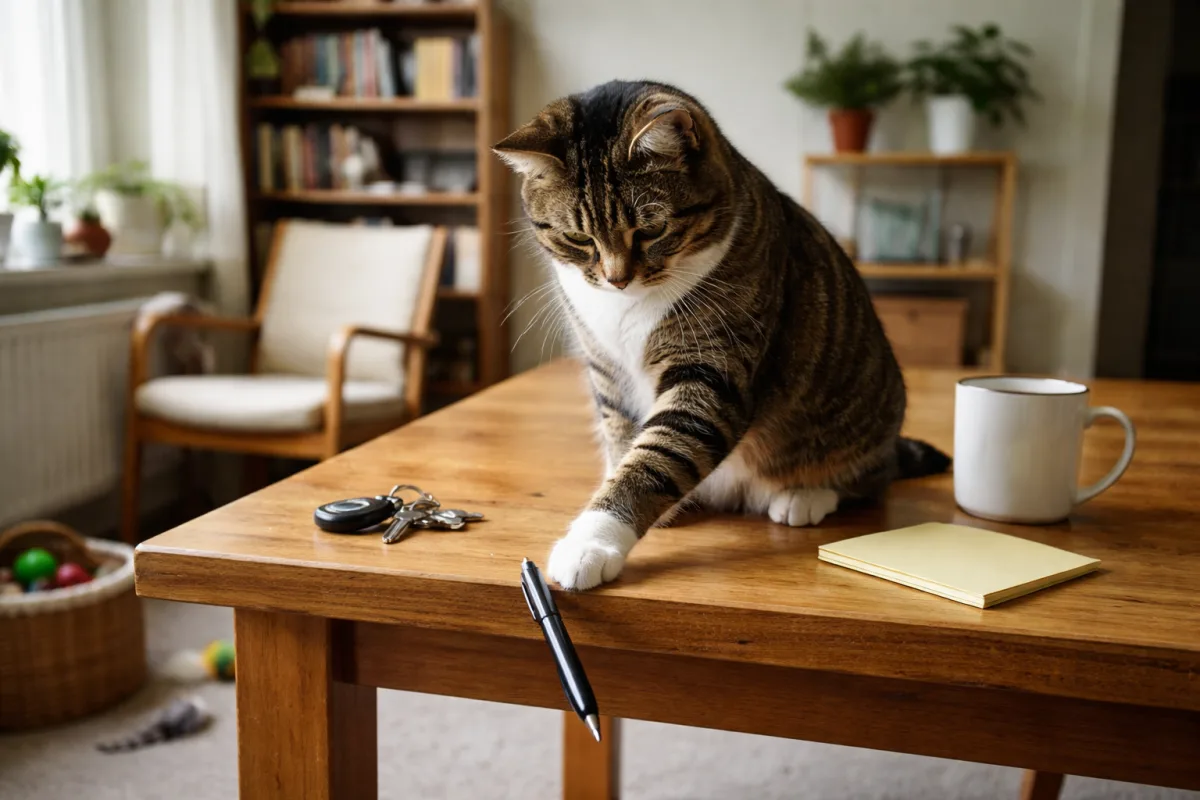
A cat steps onto a table, studies a pen, a spoon, or a small plant, and with one neat paw sends it over the edge. The motion can look deliberate, almost smug. It often happens when the room is quiet, when you are busy, or right after you have put something back in place for the third time.
That habit is not random in the way it feels to people. Cats usually have a reason, even if the reason is simple and repetitive. Sometimes they are testing how an object moves. Sometimes they want attention. Sometimes the table has become the easiest place to explore a small urge they cannot express any other way.
For many households, the behavior shows up as a daily puzzle. One cat carefully nudges a remote control to the floor. Another only targets cups left near the edge. Another seems to knock down items that are not even interesting once they land. The pattern can tell you a lot about how a cat thinks, what kind of environment they live in, and how they interact with the people around them.
What the behavior looks like in everyday life
Knocking things off tables usually starts with observation. A cat approaches a surface, watches an object, and places a paw near it. Then comes the push, tap, or swipe. Sometimes the action is quick and playful. Other times it is slow and careful, as if the cat is measuring the result.
This behavior is most obvious with small or unstable objects. Eyeglasses, pens, keys, jewelry, chargers, and paper items are common targets. Cats may also push items farther across the table before letting them fall, especially if the object makes an interesting sound or moves in a way that catches their attention.
It may happen more often on certain surfaces. A dining table, coffee table, nightstand, or desk often becomes a regular stage because these places collect human objects and smells. To a cat, that combination can be irresistible. The area is elevated, central, and full of things that do not belong to the cat but are still within reach.
Why cats show this behavior in general
At the core, cats are hunters and investigators. Their brains are tuned to notice movement, texture, weight, and reaction. A stationary object on a table is not just a thing. It is something that can move, fall, bounce, or make noise. Those outcomes are information.
In a cat’s world, touching is a form of checking. The paw is not only for walking or scratching. It is also a tool for learning. A cat may push a spoon because the spoon changed position, because it reflected light, or because it looked different after being moved. The act can be a very practical kind of curiosity.
Sometimes the behavior is linked to instinctive predatory play. Small objects imitate prey in one important way: they respond. They wobble, slide, and disappear over an edge. That gives the cat a miniature version of chase-and-capture behavior, even if no actual hunting is involved.
For many cats, knocking something off a table is less about “being bad” and more about testing a world that responds to their touch.
Common situations when it appears
There are a few familiar moments when the behavior tends to show up. One is when a cat wants interaction and has already tried quieter methods. Another is when the cat is bored and looking for a new task. A third is when an object has simply become part of the cat’s environment and is too interesting to ignore.
- When the cat is left alone for long stretches
- When the table holds small, light, movable items
- When people react strongly every time something falls
- When the cat is energetic and has no other outlet
- When the cat is exploring a new room or routine
It also tends to happen in places where the cat has learned it gets a result. If a cat knocks over a cup and the owner immediately looks up, talks, or rushes over, the cat learns that the table action creates a response. Even a negative reaction can be rewarding if attention is the outcome.
Timing matters too. A cat may be more likely to do this in the evening, before meals, or during periods when the house is active but not engaging. These are moments when cats often notice the difference between their own energy and the human routine around them.
Possible internal reasons behind the behavior
Curiosity and object testing
Many cats knock things over because they want to know what will happen. The edge of a table gives immediate feedback. It is one of the simplest experiments available in a home. The cat pushes; the object drops; the result is clear.
That kind of testing is especially common in younger cats, but adult cats do it too. Some cats never lose the habit. If a cat is naturally observant, they may revisit the same object several times because they are interested in how stable it is and whether it changes.
Attention-seeking
Some cats learn that this behavior brings people into the room faster than anything else. A cat may not be asking for “attention” in a human sense. It may simply have learned that the easiest way to interrupt a phone call, a computer session, or a quiet evening is to create a small crisis.
This is not always manipulative in the way people imagine. It is often practical. The cat wants food, interaction, play, or movement, and the table object has become a useful lever for getting it.
Play and built-up energy
Indoor cats especially may build up energy that has nowhere obvious to go. A swat at a pen can be a substitute for chasing, pouncing, and carrying. The table makes the action feel different from floor play because the falling motion adds drama and sound.
In active cats, this can show up during short bursts. The cat may zoom around the room, climb, bat at objects, and then settle down again. The behavior is usually more intense when the cat has had little movement, little stimulation, or a long stretch of quiet.
Stress or frustration
Not every case is playful. Sometimes a cat knocks things off tables when they are uneasy, overstimulated, or irritated by changes in the environment. A new pet, a different work schedule, construction noise, or reduced access to favorite spots can shift a cat’s behavior.
In those cases, the action may be slower, more repeated, or paired with other signs like restlessness, hiding, vocalizing, or a tense posture. The cat is not necessarily “acting out” in a human sense. It may be trying to release tension or regain a sense of control.
When the behavior comes with other changes in mood, sleep, appetite, or body language, the context matters more than the object on the table.
How context and environment influence it
The same cat may ignore objects in one home and target them constantly in another. That difference often comes down to the environment. A crowded surface makes the habit easier. A boring routine makes it more likely. A house full of breakable items creates more chances for the cat to rehearse the behavior.
Indoor life can amplify the pattern because tables are everywhere and humans use them constantly. The cat learns that elevated surfaces are meaningful. They hold smells, food, and personal items. They are also usually off-limits, which makes them even more interesting.
Environmental enrichment matters here. Cats who have climbing spaces, toys that move, regular play, and predictable interactions often show less table diving and less object-pushing. The behavior may not disappear, but it usually becomes less frequent when the cat has other outlets.
Home layout and table habits
The shape of the furniture can influence the behavior too. A narrow side table with loose objects is far more tempting than a large cleared surface. A windowsill table near birds, traffic, or outdoor movement may create extra stimulation. If a cat spends time there already, the habit can become part of the daily routine.
Household habits play a role as well. Leaving items near the edge, storing food on counters, or reacting strongly to each incident can all reinforce the pattern. Cats notice what happens after the paw swipe just as much as they notice the object itself.
What the behavior may signal about the cat’s state
A single pushed object does not mean much on its own. But repeated behavior can point to something more specific. A cat that only knocks items over when people are around may be seeking interaction. A cat that does it in a burst of activity may be expressing playfulness. A cat that does it while seeming tense may be uncomfortable or overstimulated.
Body language helps separate these possibilities. A loose tail, relaxed ears, and a curious posture usually suggest exploration or play. A stiff body, quick movements, flattened ears, or an agitated tail can point toward frustration. The object may be the same, but the meaning behind the behavior can differ widely.
It is also worth noticing what happens before and after. Does the cat come to the table after a meal? Before bedtime? When someone is on a laptop? The sequence can reveal whether the behavior is about engagement, routine, or unmet needs.
How owners often interpret it vs what it may actually mean
People often see the behavior as defiance. It can feel personal, especially when the cat chooses a favorite item or waits until someone is watching. But cats do not usually think in terms of disobedience. They are responding to what is interesting, available, and effective.
That does not make the behavior meaningless. It just changes the interpretation. A cat who repeatedly knocks things off a table may be showing curiosity, asking for attention, or reacting to an environment that gives too little stimulation. The action is communication through movement, not through words.
There are also cases where the object itself matters less than the reaction. A cat may not care about the item at all once it hits the floor. The real payoff was the push, the sound, and the human response. In that sense, the behavior can become a learned interaction pattern.
Signs that the behavior is playful
- Relaxed body and ears
- Brief, repeated paw taps
- Interest in movement rather than the item itself
- Return to normal behavior after the object falls
Signs that the behavior may be stress-related
- Tense posture or quick, sharp movements
- Other changes in grooming or appetite
- Hiding, vocalizing, or agitation
- Repeated behavior in response to noise, change, or conflict
How the behavior connects to typical cat traits
This habit fits neatly with several common cat traits. Cats are independent, but they are also observant. They tend to notice details people miss. They prefer to investigate on their own terms, which is why a quiet table can become more interesting than a toy placed in front of them.
Cats are also sensitive to routine. When a household changes, they often look for small ways to restore control. Knocking an item over may be one of those ways. It creates a predictable outcome in a setting that feels uncertain.
There is also a practical side to it. Cats like to control space. A table is elevated territory. Moving an object can be a way of saying, in the cat’s own language, that the surface belongs to them enough to be explored, rearranged, or tested.
The behavior often reflects three cat traits at once: curiosity, sensitivity, and a strong sense of personal territory.
Long-term patterns and what usually stays stable
For many cats, the habit becomes more predictable over time. The same kinds of objects may be targeted repeatedly. The same tables may attract the cat again and again. This stability makes the behavior easier to understand if you watch closely.
Still, the intensity can change. A young cat may knock over many things during a phase of high energy, then calm down as routines settle. An older cat may do it less often, but still return to it when bored or seeking attention. A cat under stress may show the behavior only during periods of change, then stop once the home becomes predictable again.
Because the behavior is tied to both personality and environment, it often has a pattern that is steady in shape but flexible in frequency. That is why the same cat can seem peaceful for weeks and then suddenly rediscover the joy of pushing every pen off a desk.
What helps make sense of it in daily life
The most useful thing to notice is not just the fall itself, but the conditions around it. Where was the cat? What was on the table? What happened right before the paw touched the object? Did the cat seem alert, bored, tense, or playful?
Those details often explain more than the incident alone. A cat who does this while your attention is elsewhere may be asking for engagement. A cat who does it after staring out the window may be looking for an outlet. A cat who does it right after a loud noise may be trying to shake off discomfort.
Once the pattern is clear, the behavior is easier to read. It stops feeling like a mystery and starts looking like one more part of daily cat communication. Not always elegant. Not always convenient. But rarely random.
A table edge gives a cat a simple test: touch, push, watch. For a species built on observation and movement, that small action can hold more meaning than it appears to from across the room.