Territorial marking in cats can look confusing at first. A cat may rub its face on a wall, scratch a doorway, spray a small amount of urine, or leave scent in places that seem random to us. To the cat, though, these actions are often part of a very organized way of understanding space.
Cats do not experience a home the same way people do. A room is not just furniture and walls. It is a map of smells, routines, safe zones, and intrusions. When a cat leaves a mark, it is often adding information to that map or responding to something that has changed in it.
Some marking behavior is quiet and easy to miss. Other forms are more obvious and more frustrating for owners, especially when urine spraying appears on walls, doors, or furniture. The difference matters, because not every mark means the same thing.
Why Cats Mark Territory
Cats are both social and highly sensitive to environmental change. Marking helps them manage that sensitivity. It can reduce uncertainty, strengthen familiarity, and communicate presence without direct conflict.
In a cat’s world, scent works like a layered message. One scent says “I was here.” Another says “this is familiar.” Another may signal stress, competition, or a need to feel more secure. Territorial marking is not only about ownership. It is often about reassurance.
Marking may become more noticeable when a cat feels a need to update its surroundings. That can happen after a move, the arrival of another pet, a visitor’s suitcase, a new piece of furniture, or even a change in schedule. Small changes can matter a great deal.
Cats often mark when they want to make a space feel predictable again. The behavior is usually tied to scent, security, and environmental change rather than simple disobedience.
Common Forms of Marking in Everyday Life
Not all territorial marking looks the same. Some forms are subtle and social. Others are more direct and clearly defensive. Knowing the difference helps make the behavior easier to interpret.
Facial rubbing
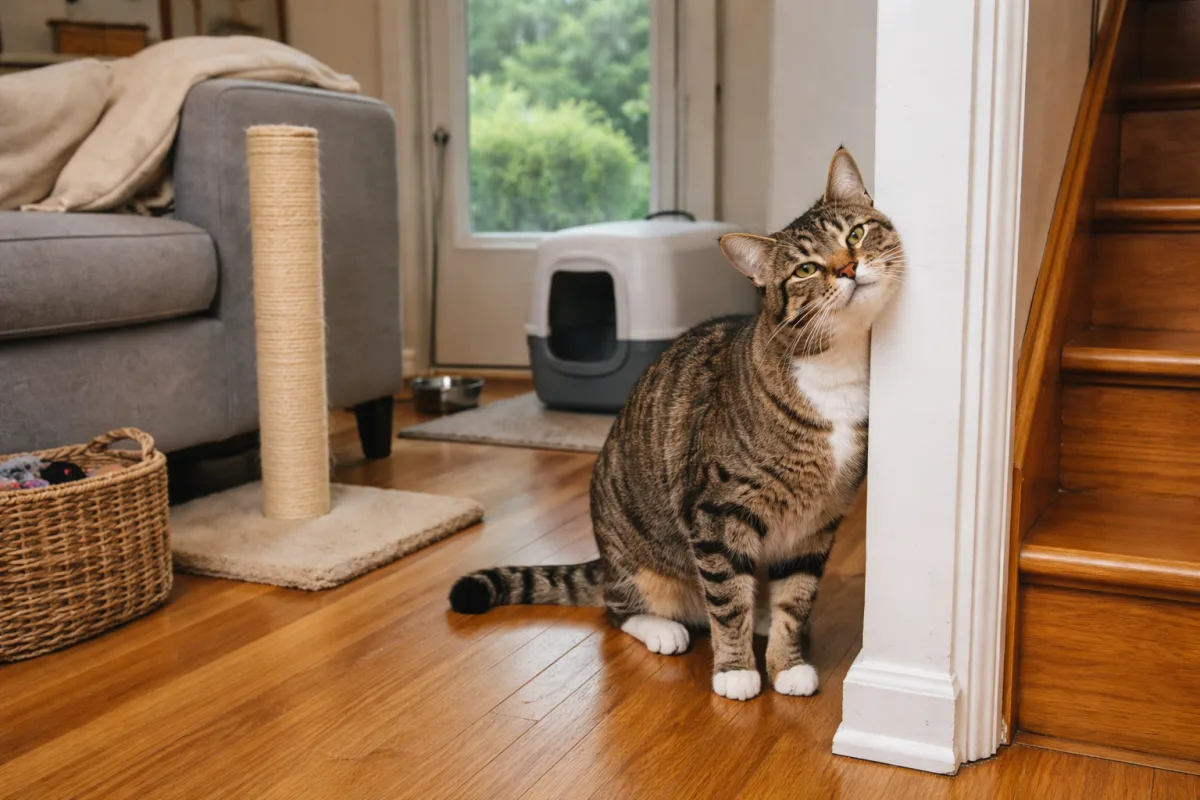
When a cat rubs its cheeks on furniture, walls, people, or corners, it is leaving facial pheromones from glands around the face. This is one of the most familiar kinds of marking. It usually appears relaxed and calm.
Facial rubbing often happens near favorite resting spots, entryways, or places where the cat wants to blend its scent with the home’s scent. It is a normal way of making space feel known.
Scratching
Scratching is not only for claw maintenance. It also leaves both visual and scent-based signals. The paw pads carry scent glands, so scratching a post, rug edge, or doorframe can communicate presence.
Many cats scratch after waking, after greeting a person, or after noticing activity nearby. It can be a neutral part of daily routine, but it can also increase when a cat feels tension in the home.
Urine spraying
Spraying is one of the most misunderstood forms of marking. It usually involves a small amount of urine on a vertical surface, often with the tail held upright and a quivering motion. Unlike normal urination, it is typically meant for scent communication.
This behavior may appear near windows, doors, new objects, or areas that smell like another animal. It can happen in both male and female cats, neutered or not, although intact cats may do it more often.
Chin and body scent transfer
Some cats press the chin, sides, or entire body against corners, chair legs, or people. This behavior helps mix the cat’s scent with objects and familiar surfaces. It is usually gentle and does not signal distress on its own.
These marks can be so subtle that owners overlook them. Yet they are part of the same territorial system as more obvious behavior.
What the Behavior May Signal About the Cat’s State
Territorial marking is not a single emotion. It can reflect confidence, curiosity, tension, insecurity, or a combination of all of them. The context is what gives the behavior meaning.
A cat that rubs around the living room after a nap may simply be refreshing familiar scent markers. A cat that starts spraying near the front door after neighborhood cats appear outside may be responding to outside competition. A cat that scratches heavily after a household change may be coping with stress and trying to restore normalcy.
Marking becomes more important when a cat’s environment feels less predictable. The same behavior can be routine in one setting and stress-related in another.
Owners sometimes assume marking always means anger or bad behavior. In many cases, it is closer to a coping strategy. The cat is not trying to “punish” anyone. It is managing the world the only way it knows how.
How Context Changes the Meaning
The same action can mean different things depending on when and where it happens. A scratch on a post beside the cat tree is very different from urine spraying on a bedroom door. Timing, location, and frequency all matter.
For example, a cat that marks near windows may be reacting to outdoor cats, wildlife, or unfamiliar scents drifting in. A cat that marks on a new piece of luggage may be responding to smells from outside the home. A cat that marks after a vet visit may be reacting to the altered scent of another pet or person.
Multi-cat homes create even more layers. Cats may mark to establish spacing, reduce tension, or remind each other of boundaries. Even cats that appear peaceful can still keep scent rules in place.
Indoor homes
Indoor cats often mark around transitions, thresholds, and high-traffic areas. These are the places where the environment changes the most. Doors open, smells enter, and people pass through repeatedly.
Because indoor cats rely heavily on a managed environment, they may be especially sensitive to new objects or new routines. A shift in litter box placement, cleaning products, or furniture arrangement can affect marking behavior.
Outdoor access
Cats with outdoor access may mark in response to animals they encounter outside, territorial overlap, or familiar scent trails they want to reinforce. They may also bring stronger outdoor smells back indoors, which can change how they interact with the home space.
Even a cat that spends part of the day outside may still mark inside if the indoor environment feels crowded, changed, or contested.
Subtle Signals That Often Appear With Marking
Territorial marking rarely happens in complete isolation. Cats often show small body-language clues that reveal what kind of marking is happening.
- Tail held upright with a relaxed curve often appears during friendly scent transfer or confident marking.
- Side rubbing against furniture or people usually suggests comfort and familiarity.
- Raised tail base, treading, or a brief pause near a vertical surface can appear before spraying.
- Repeated sniffing of the same area may mean the cat is checking old scent information.
- Increased scratching near doors or windows can point to outside triggers.
These signals are useful because they show the difference between ordinary scent maintenance and behavior driven by unease. A cat that marks while moving calmly through the house is often in a very different state from a cat that patrols, sniffs, freezes, and then sprays.
Common Reasons Territorial Marking Increases
Several practical changes can increase marking. Some are obvious. Others are easy to overlook.
- New pets in the home
- Visiting animals or unfamiliar people
- Construction noise or home repairs
- Moving to a new home
- Changes in routine, such as travel or schedule shifts
- Outdoor cats visible through windows or doors
- Changes in litter box cleanliness or location
- Strong new smells from cleaning products, paint, or furniture
These triggers do not affect every cat equally. One cat may ignore a new couch entirely. Another may start rubbing, scratching, or spraying near it within hours. Temperament, past experiences, and the layout of the home all play a part.
What Owners Often Misread
It is easy to misunderstand marking because it is so connected to scent, and scent is invisible to us. A cat may seem to “choose” a random target, but the target usually has meaning within the cat’s smell map.
One common mistake is treating all marking as a litter box problem. A cat that sprays on a wall and a cat that urinates outside the box may need different kinds of attention. Spraying is communication; inappropriate elimination often points more toward medical, behavioral, or litter box concerns.
Another mistake is assuming the cat is acting out of spite. Cats do not mark to get revenge. They react to pressure, change, competition, or the need to make a place feel familiar again.
If marking starts suddenly, increases quickly, or looks different from the cat’s usual habits, it is worth paying attention to the full context instead of the surface behavior alone.
How Multiple Cats Shape Marking Behavior
In homes with more than one cat, marking can become part of a quiet negotiation. Cats may not fight openly, but they still maintain boundaries through scent. This can happen in shared sleeping spots, hallway corners, feeding areas, and doorways.
One cat may scratch more after another cat uses a favored perch. Another may begin cheek rubbing along a route that crosses a sibling’s path. These acts do not always signal conflict. Sometimes they are simply part of keeping the household scent in order.
Problems are more likely when one cat feels blocked from resources or cannot move through the home comfortably. The behavior may then become more frequent, more intense, or directed at the most contested spots.
When Marking Seems Calm and When It Seems Defensive
Calm marking tends to look smooth and repetitive. The cat may enter a room, rub several surfaces, scratch a post, and settle down. The body remains loose. The cat may eat, nap, or groom soon afterward.
Defensive marking often looks more urgent. The cat may sniff repeatedly, scan the room, stay tense, or mark the same place more than once. Spraying is more likely to show up in this pattern, especially if the cat perceives a boundary or competitor.
Mixed signals are common. A cat may appear relaxed one moment and then mark again after hearing a noise outside or detecting a new scent. That shift does not make the behavior contradictory. It means the environment changed in a way the cat noticed.
Why the Same Spot Gets Marked Repeatedly
Some places become repeated marking zones because they hold strong meaning. Entry doors, window ledges, hall corners, and the edges of shared spaces often collect the most attention. These areas are easy to scent-check and easy to refresh.
If another animal is visible outside, the chosen spot may become a long-term marker. If a piece of furniture sits in a high-traffic area, it may absorb both human and cat smells and become part of the home’s scent language. Repetition is often about reinforcement, not stubbornness.
Cleaning can also play a role. If a surface is cleaned too strongly or with a scent the cat finds unfamiliar, the cat may return to the area to replace that lost scent information.
Long-Term Patterns and Stability
Territorial marking can be stable in one cat and highly changeable in another. Some cats mark in predictable patterns for years. Others only do it during transitions. A cat’s age, confidence, health, household structure, and daily rhythm all affect the pattern.
Over time, many cats settle into marking habits that match the home’s normal activity. A cat may always greet the front hall with cheek rubbing. Another may scratch after meals. Another may spray only during periods of outside cat pressure. These patterns are often consistent for a reason.
Sudden changes deserve attention. A cat that has never marked before and then begins doing so frequently may be responding to stress, a change in routine, or a medical issue that needs to be ruled out. Long-term consistency is useful, but new behavior is where context matters most.
Closing Thoughts on the Behavior
Territorial marking is one of the clearest ways cats organize their world. Some of it is social. Some of it is practical. Some of it is tied to tension the cat cannot express any other way. The behavior only starts to make sense when the home, the schedule, and the cat’s own sensitivity are considered together.
A cat that marks is usually saying something about space, comfort, or change. The message may be soft, like a cheek rub on a chair leg. It may be stronger, like spraying near a doorway. Either way, the behavior belongs to the cat’s way of reading and reshaping the environment around it.
Once those patterns are easier to notice, the marks themselves stop looking random. They become part of a quiet system the cat uses every day to keep the home familiar.