Some cats seem affectionate one moment and impossible to read the next. They lean into petting, knead with their paws, and purr softly, then suddenly twist away, swat, or dash across the room. That quick change is often a sign of overstimulation, not bad behavior.
Overstimulation happens when a cat receives more sensory input than it can comfortably process. Touch, sound, movement, scent, and even excitement can build up quickly. A cat that has reached its limit may not pause to think before reacting.
Because cats are subtle communicators, the change can look abrupt to people. In reality, there are usually early signs. The challenge is that those signs are easy to miss when the cat is purring or sitting still.
What overstimulation looks like in everyday life
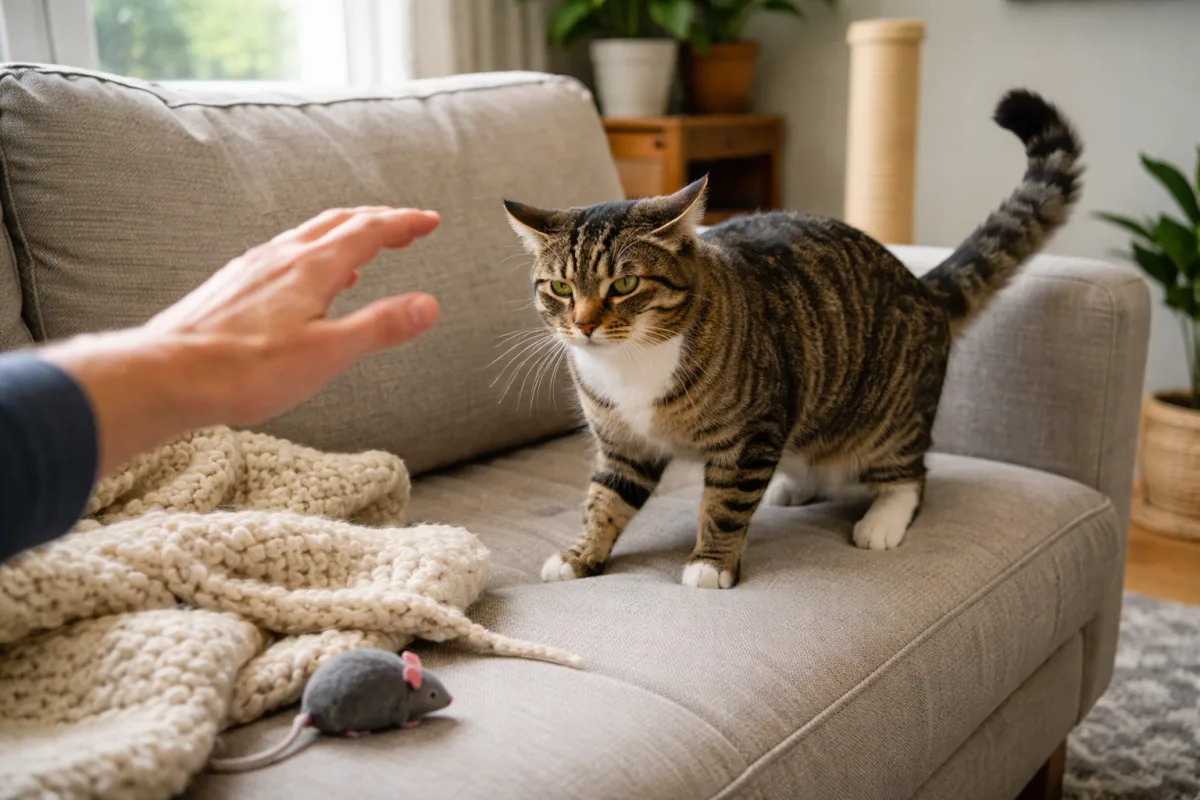
In a home setting, overstimulation often appears during petting sessions. A cat may enjoy a few strokes along the head or cheeks, then become tense when the touch continues too long or moves to a less comfortable area, like the belly or lower back.
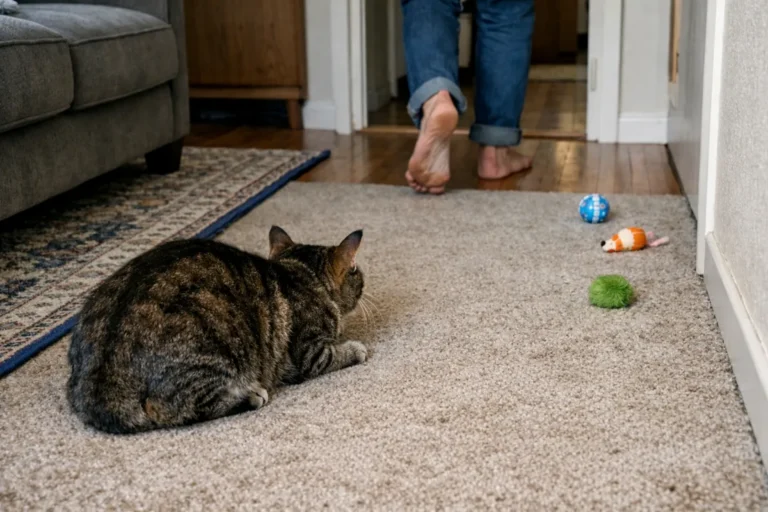
Some cats react to fast movement around them. A person walking by, another pet rushing past, or a child making sudden motions can push a cat from relaxed to edgy in seconds. Noise matters too. Vacuum cleaners, loud television, or constant conversation can wear down a cat that prefers a quiet environment.
Other cats become overstimulated during play. Chasing a wand toy is fun, but if the session gets too intense or lasts too long, the cat may switch from playful stalking to biting or kicking the toy aggressively. What starts as fun can become a stressful overload.
Common signs of overstimulation include tail twitching, skin rippling, ears turning sideways, sudden head turns, dilated pupils, tense muscles, and a quick escape from contact.
Not every cat shows all of these signals. Some are obvious and dramatic. Others are so subtle that the only clue is a sudden move away from the interaction.
Why some cats reach their limit so quickly
A cat’s nervous system is built for alertness. Cats are both hunters and prey animals, which means they stay highly aware of changes in their surroundings. That sensitivity helps them notice a bird outside the window or a footstep in the hall, but it also means they can become overloaded more easily than many people expect.
Individual temperament plays a big role. One cat may tolerate long brushing sessions and enjoy being handled all over. Another may prefer only a few seconds of contact before needing a break. Neither cat is broken. They simply have different thresholds.
Past experiences matter as well. A cat that was handled roughly as a kitten, or one that has had painful skin, joint, or dental issues, may be quicker to react because touch does not always feel safe. Even a cat with no obvious trauma may have a low tolerance for repeated contact on certain parts of the body.
Age can shape the response too. Kittens are often energetic and reactive, but they can also become overstimulated because their systems are still developing. Adult cats may appear calmer, yet they may be less forgiving of repeated petting if they are tired, stressed, or simply not in the mood. Older cats may have less patience when they feel sore or easily fatigued.
How touch can go from pleasant to too much
Many owners assume that a purring cat wants more and more petting. Purring does often signal comfort, but it does not always mean the cat wants the interaction to continue the same way. A cat can purr while becoming increasingly aroused or tense.
Touch is not just touch to a cat. It has pressure, rhythm, location, and timing. Gentle strokes on the cheeks may feel good, while repeated rubbing along the back or under the chin may become irritating after a while. Some cats like brief contact and then a pause. They want a conversation, not constant conversation.
Repetition is a big factor. A hand moving over the same spot again and again can create a sense of overload even if the cat initially enjoyed it. This is one reason a cat may tolerate a few pets and then suddenly snap. The reaction is often delayed, which makes it seem surprising.
Petting habits that can trigger a reaction
- Long, unbroken petting sessions without pauses
- Touching areas the cat does not prefer, such as the belly, tail base, or paws
- Holding the cat when it is trying to leave
- Using fast or heavy strokes instead of light, predictable contact
- Continuing to pet after the cat has started showing small warning signs
Some cats are especially sensitive around the base of the tail. Others dislike their whiskers, ears, or hindquarters being touched too much. Learning these preferences often matters more than learning a general rule.
Body language that usually comes before the switch
Overstimulation rarely appears without warning. The signals may be quiet, but they are there. A cat may start looking away, flattening the ears just slightly, or shifting the body as if preparing to move. The tail may begin to flick, first slowly and then faster.
Facial changes can be small. The eyes may open wider, pupils may enlarge, or the cat may stop blinking comfortably. The skin along the back may ripple. Some cats lick their nose, turn their head sharply, or give a brief nip that seems to come out of nowhere.
When a cat starts sending small “enough” signals, the safest move is to stop and let the cat reset. Waiting for a louder warning often means the cat has already passed its comfort point.
Those warning signs are easy to overlook when the cat seems otherwise relaxed. But they are often the most useful part of the interaction. They show the cat’s comfort level before the reaction becomes obvious.
How environment makes a difference
A quiet cat in a calm room may handle attention much better than the same cat in a busy home. Background noise, visitors, other pets, and changes in routine can all lower a cat’s tolerance. When the environment is already demanding, even normal affection may feel like too much.
Indoor cats are not automatically overstimulated, but they can become sensitive when their days lack predictable outlets for energy. If a cat has little climbing, hunting, or scratching activity, that unused energy can show up as restlessness. Then a friendly petting session becomes the final straw rather than the main cause.
Multi-cat households can add another layer. A cat may already feel the need to monitor other cats, guard a favorite resting spot, or stay alert to social tension. In that state, the cat may have less patience for human handling.
Routine matters more than many people realize. Cats often feel safer when meals, play, and rest happen at familiar times. A disrupted schedule can make a cat more jumpy, which reduces the threshold for overstimulation. A cat that was happy to be brushed yesterday may not want the same attention after a stressful day.
Playfulness and overstimulation can look similar
Play and overstimulation often overlap. A cat may chase a toy, pounce, grab, bite, and kick with intense energy. That behavior can be healthy and normal. But when the cat gets too aroused, the line between play and agitation blurs.
During active play, cats may ignore other cues and keep escalating. They may become more vocal, more rapid in movement, and less careful about where their teeth or claws land. If the energy level keeps building, the cat may no longer be playing in a relaxed way. It may be entering a state of overload.
This is one reason short, controlled play sessions tend to work better than endless high-intensity games. A cat that gets a chance to hunt, catch, and then cool down is less likely to tip into frustration. A predictable ending can be just as important as the toy itself.
Play can shift into overstimulation when
- The cat cannot “win” the game or catch the toy
- The session lasts too long without a pause
- The cat starts biting harder or lunging faster
- The body becomes tense instead of loose and springy
- The cat starts targeting hands, ankles, or moving feet
When this happens, the cat is not being difficult. The nervous system is simply going from engaged to overloaded.
Stress and overstimulation are related, but not identical
Stress lowers a cat’s tolerance. A cat that feels uncertain, bored, trapped, or on alert is more likely to overreact to touch or movement. Overstimulation can be the final visible response, but the buildup may have started much earlier.
Think of stress as background pressure. A cat may have had a visitor, a loud appliance, a schedule change, or another animal nearby. Later, a person reaches down to pet the cat. The reaction seems to be about the petting, but the cat may already have been near its limit.
That is why context matters so much. A cat’s behavior at 8 p.m. after a peaceful day may look very different from the same cat’s behavior after hours of noise or disruption. The trigger is not always the whole story.
A cat that reacts strongly to petting may not dislike affection. It may be telling you that its overall stress level is already high.
Different cats, different thresholds
There is no single overstimulation pattern for every cat. Some cats are social and still need frequent breaks. Others prefer brief contact from the start. A cat that arches into petting for ten seconds and then leaves is not less affectionate than one that sits for twenty minutes. The threshold simply differs.
Breed is sometimes mentioned in conversations about sensitivity, but individual personality usually matters more than labels. Household history, daily routine, early handling, and current health often shape behavior more strongly than breed alone.
Health issues deserve attention, especially when a cat suddenly becomes less tolerant of touch. Skin irritation, ear discomfort, dental pain, arthritis, or internal illness can all make a cat seem “touchy” when the real problem is discomfort. A cat that once accepted handling and now hates it may be communicating pain, not preference.
What owners often misunderstand
One common misunderstanding is assuming that a cat who seeks contact always wants the same kind of contact for the same length of time. Cats often initiate affection in short bursts. They rub against a leg, ask for a chin scratch, then move away. That cycle is normal.
Another common mistake is treating a purr as a green light to keep going. Purring should be read with the rest of the body, not alone. A purring cat with a twitching tail and stiff shoulders is not giving the same message as a purring cat with a loose posture and slow blinks.
People also tend to miss the difference between “I want attention” and “I want control over the attention.” Many cats like choosing when contact begins and when it ends. Being able to walk away is part of what makes the interaction feel safe.
That choice matters in daily life. Cats often do best when the human follows the cat’s lead rather than trying to extend a good moment indefinitely. Short, responsive interactions usually go farther than longer ones that ignore the cat’s limits.
Practical ways to reduce overstimulation at home
Reducing overstimulation does not mean avoiding affection. It means making interactions easier for the cat to process. Small changes can have a noticeable effect.
- Offer short petting sessions and pause often
- Focus on areas the cat clearly enjoys, such as cheeks or chin
- Watch for tail flicking, skin twitching, and head turning
- Give the cat room to leave without being followed
- Keep play sessions active but bounded, then let the cat cool down
- Provide quiet resting spaces away from household traffic
- Keep routines as steady as possible
It also helps to separate affection from handling. Some cats enjoy gentle petting but dislike being picked up, moved, or restrained. Respecting those differences can reduce tension quickly.
Brushing can follow the same principle. A few strokes may be fine, but long grooming sessions can cross the line. Paying attention to the cat’s posture during grooming is often more useful than finishing a set number of strokes.
When the reaction seems sudden
Sometimes a cat appears calm, then reacts with almost no visible warning. This can happen when the cat has been quietly building tension for a while. The signals were there, but they were small or too brief to catch.
In other cases, the cat may be startled by a sudden sound or movement at the exact moment of touch. A door slam, another pet jumping nearby, or a hand moving unexpectedly can combine with petting and create a reaction that seems out of proportion.
If a cat suddenly becomes much less tolerant than usual, it is worth looking at the bigger picture. Has the household changed? Has the cat been sleeping more, hiding, scratching differently, or eating less? Is the cat older than before, or might something be painful? Overstimulation can be part of the picture, but a change in behavior often has a larger cause.
Reading the pattern over time
The most useful clue is often consistency. If a cat always objects after a few strokes on the lower back, that is probably a personal boundary. If the cat only reacts on busy days or after rough play, the issue may be a lower stress threshold rather than a dislike of petting itself.
Watching patterns over several days gives a clearer view than judging one moment. Pay attention to when the cat is most relaxed, what kind of touch is accepted, and which situations lead to quick withdrawal. The cat’s preferred rhythm often stays stable once you see it clearly.
Even so, that rhythm can change with age, health, and environment. A cat may become more tolerant as trust grows, or less tolerant when pain or stress increases. The behavior is not random. It moves with the cat’s state.
In everyday life, the answer is usually not to push through the reaction. It is to notice the early signs, respect the limit, and let the cat decide whether the interaction continues. That simple adjustment often prevents the sharpest reactions and makes the cat feel safer in its own space.