A cat can seem perfectly ordinary for weeks, then suddenly latch onto one habit and repeat it with a level of focus that feels almost comical. One animal may obsess over a water bowl, another over a blanket corner, and another over a single routine like sitting at the same window at the same hour every day. What looks like stubbornness is often a mix of instinct, comfort, and emotional security.
These fixations are not random. Cats are creatures of habit, and they tend to return to behaviors that feel rewarding, predictable, or calming. When a certain action becomes especially important to them, it can start to crowd out other behaviors and become the thing they seek again and again.
That intensity can be harmless, or it can signal that something in the cat’s world has changed. The pattern matters as much as the behavior itself. A cat that kneads a blanket every evening is telling a different story from a cat that suddenly cannot stop licking one spot on its body.
What Obsessive Behavior Often Looks Like in Everyday Life
Obsessive behavior in cats does not always look dramatic. In many homes, it shows up as repetition so steady that it becomes part of the household rhythm. A cat may demand access to one room, one toy, one hiding place, or one person at a very specific time.
Some common examples are easy to miss at first because they can seem cute or routine:
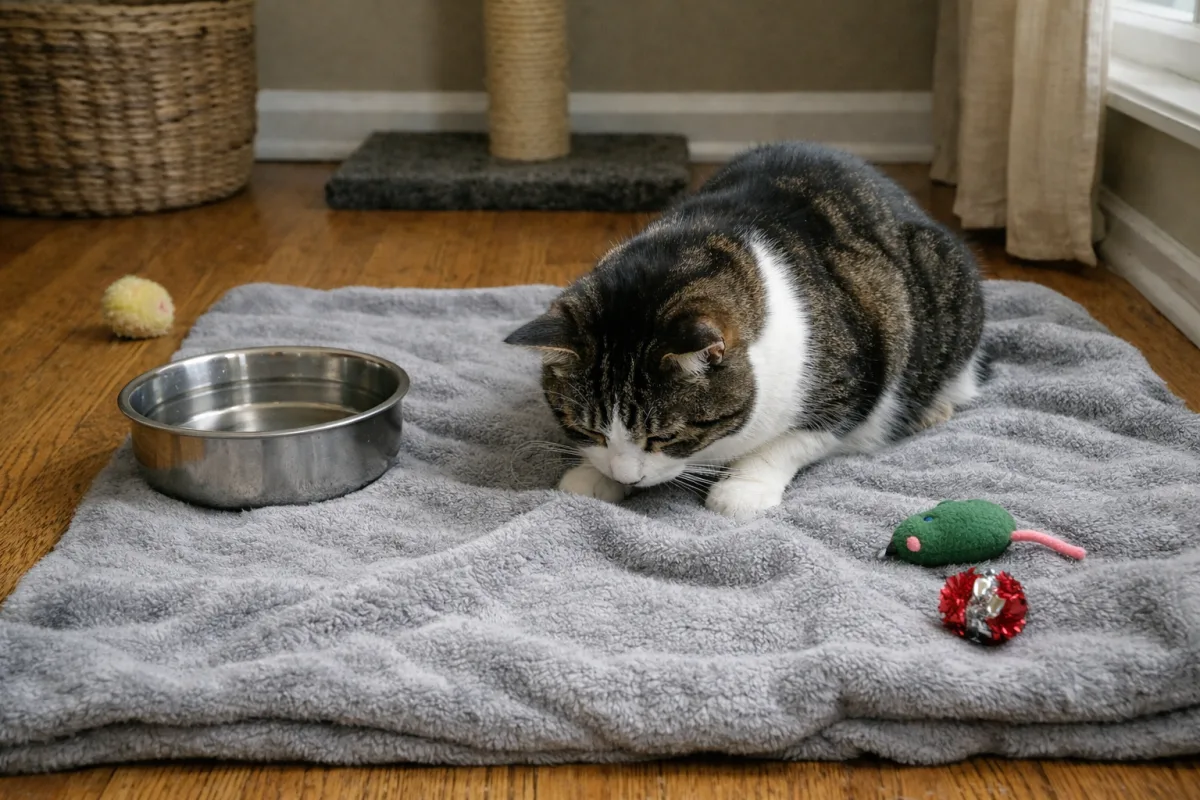
- repeatedly kneading a particular blanket or pillow
- obsessive grooming, especially in one area of the body
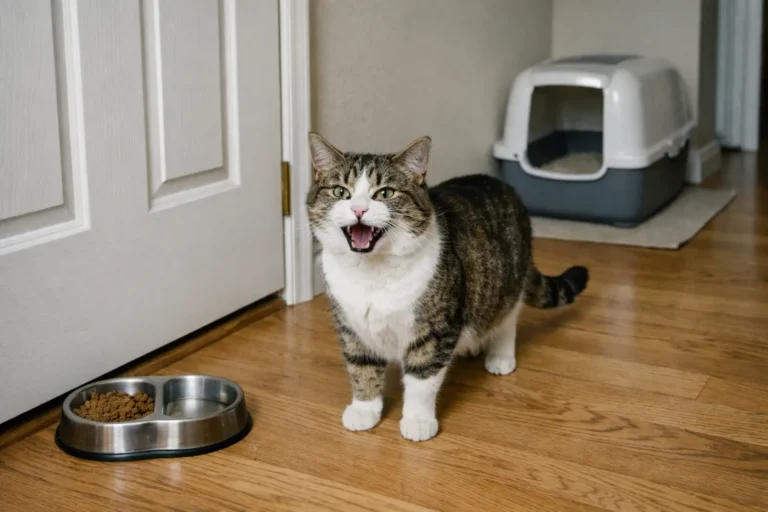
- fixating on food, treats, or a feeding location
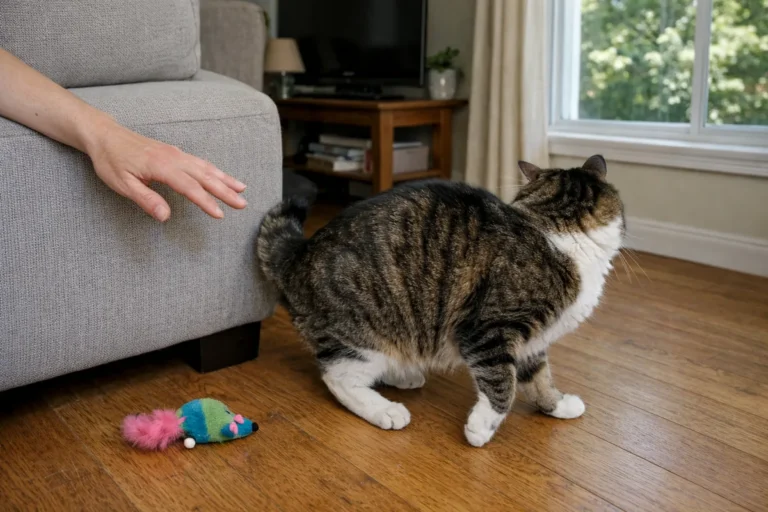
- chasing the same toy for long periods without interest in anything else
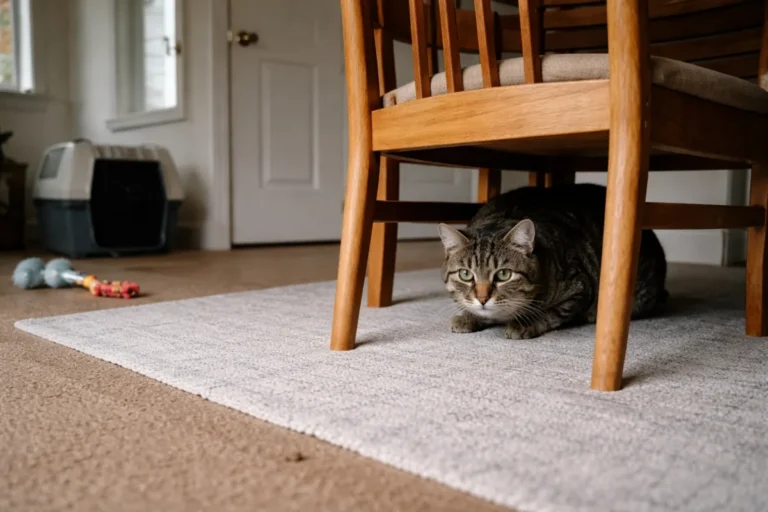
- staring at, pacing around, or guarding one spot in the home
- returning to the same licking, chewing, or rubbing pattern
The behavior becomes more notable when the cat seems unable to disengage. A cat can play enthusiastically, for example, without that being a concern. But if the play continues long after the cat is tired, or if it becomes the only thing the cat wants to do, the pattern deserves a closer look.
When a behavior becomes repetitive, narrow, and hard to interrupt, it is worth asking whether the cat is seeking comfort, relief, stimulation, or control.
Why Cats Get Locked Onto Certain Behaviors
Cats repeat actions that work for them. The reason may be simple pleasure, but it can also be about stress management or meeting a physical need. Once a cat discovers that a behavior creates a useful result, the habit can strengthen quickly.
Food-related fixation is one of the clearest examples. If a cat learns that begging leads to treats, the behavior gets reinforced. If a cat eats too quickly and feels more satisfied after scavenging or guarding the bowl, mealtime habits can become more intense. A cat that receives food at irregular times may also become preoccupied with feeding rituals because predictability matters to felines.
Some behaviors are tied to sensory comfort. Cats often repeat actions that feel good on the body, like scratching, rubbing, kneading, and licking. These behaviors can help regulate emotion and body tension. The repetition itself is the point, because it creates a familiar sensation.
Then there are behaviors shaped by instinct. Hunting, stalking, pouncing, carrying objects, and circling sleeping spots are all rooted in natural feline tendencies. In a domestic setting, those instincts do not disappear. They often narrow into a specific ritual, especially when a cat has limited outlets for them.
Internal Reasons Behind the Pattern
Comfort and self-soothing
Many cats turn repetitive behaviors into private coping tools. Kneading, sucking on fabric, grooming, and pacing can all help a cat settle itself. These actions may become stronger during times of uncertainty, noise, or change in routine.
For some cats, the behavior is almost like a reset button. A blanket, a familiar spot, or a specific movement can lower arousal and create a sense of control. That is one reason a cat may return to the same behavior during stressful moments, even if the behavior seems unrelated to the stress itself.
Reward and reinforcement
Cats are quick learners when a behavior produces a result. If a cat meows at the pantry and receives food, or paws at a door and gets access, the connection is reinforced. The behavior can become stronger not because it is “bad,” but because it reliably works.
This matters with human interaction too. Even negative attention can reinforce an action if it is still attention. A cat that gets talked to, picked up, or fed after repeating a behavior may keep repeating it.
Physical discomfort or irritation
Not every repetitive behavior is emotional. Sometimes a cat is responding to itchiness, pain, nausea, dental discomfort, allergies, or skin irritation. Overgrooming can begin as a response to a small irritation and gradually become habitual. Chewing on unusual objects can also point to discomfort, frustration, or nutritional issues.
That is why the details matter. A cat that obsessively licks one area, twitches its skin, or avoids being touched there may be dealing with more than a habit. The behavior can be the visible piece of an underlying problem.
Environment and lack of variety
Indoor cats especially may develop narrow behavioral loops when their days are too predictable or too quiet. If there are few climbing options, few games, and little environmental change, a cat may pour energy into one repeated behavior. The habit is not always a sign of distress, but it can reflect unmet needs for movement, hunting-like play, or exploration.
Cats like choice. When the environment is small or repetitive, one behavior can become the main outlet. That is why the same cat may seem calm in one home and obsessive in another.
How Context Changes the Meaning
The same behavior can mean different things depending on when it happens. A cat kneading a blanket while purring before sleep is usually showing comfort. A cat kneading frantically after hearing a loud sound may be self-soothing. A cat kneading while also drooling, hiding, or seeming restless may be more unsettled than relaxed.
Timing can reveal a lot. Behaviors that appear before meals, after visitors leave, during storms, or when the household routine shifts often connect to emotional triggers. Repetition that shows up at the same moment every day may be built around expectation and anticipation. Repetition that appears suddenly and grows quickly may point to stress or discomfort.
Intensity is another clue. Soft, brief, and easily interrupted repetition often looks different from behavior that is rigid and difficult to redirect. The stronger the fixation, the more carefully the full context should be observed.
A behavior becomes more meaningful when you notice what happens right before it, during it, and right after it.
How Different Daily Routines Shape the Habit
Indoor life, outdoor access, household noise, work schedules, and the presence of other pets all influence obsessive tendencies. A cat in a calm home with steady routines may still develop a favorite behavior, but it is less likely to become disruptive. A cat in a busy, unpredictable environment may use repetition to create stability for itself.
Some cats become focused on one person’s routine. They wait for the morning alarm, sit by the shower, and start circling the kitchen at dinner time. In these cases, the obsession is often a mix of anticipation and learned timing. The cat has mapped the household and knows when something useful is likely to happen.
Other cats fixate when their routine is suddenly changed. A move, a new pet, a different work schedule, or even a rearranged room can disrupt the cat’s sense of predictability. The repeated behavior then acts like an anchor.
What Owners Often Misread
People sometimes treat obsessive behavior as a personality quirk and nothing more. That is not always wrong, but it can hide important signals. A cat that loves one toy may simply be playful. A cat that cannot stop obsessing over that toy, ignores everything else, and becomes agitated when it is unavailable may be showing a stronger need.
Another common misunderstanding is assuming that repetitive behavior is always “cute” if the cat appears calm. Calmness does not always mean the behavior is harmless. A cat can look settled while still engaging in a habit that has become too narrow or too dependent on one trigger.
Owners also often miss the difference between preference and compulsion. Preference leaves room for flexibility. Compulsion tends to feel urgent, repetitive, and hard to interrupt.
Behavior Patterns That Deserve Closer Attention
Some obsessive habits are worth monitoring because they can point to medical or emotional problems. The line is not always obvious, but a few patterns stand out:
- the behavior appears suddenly and grows quickly
- the cat seems distressed if unable to perform it
- the habit interferes with eating, sleeping, or social interaction
- the behavior becomes physically damaging, such as hair loss or skin irritation
- the cat shows other changes, such as hiding, irritability, or reduced appetite
Grooming deserves special attention because it can start as normal self-care and slide into overgrooming. Food fixation can also become complicated if the cat is not eating enough, eating too quickly, or scavenging constantly. Even harmless-looking rituals may need review if they are escalating rather than staying steady.
| Behavior | Possible meaning | What to notice |
|---|---|---|
| Repeated kneading | Comfort, habit, or self-soothing | Timing, tension, and ability to relax afterward |
| Obsessive grooming | Itchiness, stress, or habit | Hair loss, skin changes, and sudden increase |
| Food fixation | Hunger, learned routine, or anxiety | Meal schedule, begging intensity, and scavenging |
| Stalking one toy or object | Play drive or narrowed focus | Whether the cat can switch activities |
How Mixed Signals Show Up
Cats rarely make their message simple. A cat may purr while obsessively licking a spot, or seem relaxed while pacing a familiar route. Mixed signals are common because feline behavior often combines comfort, habit, and tension at the same time.
A cat that rubs against furniture repeatedly may be marking territory and seeking reassurance. A cat that keeps returning to the same window may be engaging curiosity, but also guarding a visual zone that feels important. A cat that kneads and then bites the blanket may be moving between soothing and overstimulation.
Those mixed patterns are why one behavior should rarely be judged alone. The broader picture tells the story.
What the Behavior May Be Saying About the Cat’s State
When a cat becomes obsessive about one behavior, it is often trying to solve a problem with the tools it has. The problem may be boredom, uncertainty, frustration, irritation, hunger, or a strong need for sensory comfort. Sometimes the cat is not in danger at all; it is simply very attached to a routine that feels dependable.
That attachment can reveal a lot about the cat’s inner state. A cat that repeats a behavior in a soft, flexible way is often managing ordinary feline needs. A cat that does it with urgency, changes its body language, or seems unable to settle afterward may be signaling that the pattern has moved beyond preference.
Body language helps here. Tense ears, a tight tail, dilated pupils, rapid licking, vocalizing, or abrupt shifts in posture can all change the meaning of the repeated behavior. So can changes in sleep, appetite, litter box use, and willingness to interact.
Long-Term Patterns and Stability
Some obsessive habits stay stable for years without causing problems. A cat may always knead one blanket, sleep in one chair, or wait at the same door. Those fixed routines are often just part of the cat’s identity in the home.
Other behaviors are less stable. They appear after a change, intensify for a while, and then fade. Those temporary patterns often track the cat’s adjustment to a new environment, a medical issue, or a shift in household rhythm.
The key is whether the behavior stays flexible. A stable preference still allows the cat to do other things. A narrowing pattern keeps shrinking the cat’s options.
Stable habits are usually predictable and low-stress. Escalating habits are louder, narrower, and harder for the cat to leave behind.
Natural Instincts Behind the Fixation
Many obsessive behaviors are extensions of normal cat instincts. Hunting sequences can become repetitive stalking or chasing. Marking behavior can become rubbing and circling. Nesting behavior can become kneading, bedding rituals, or repeated movement around a sleeping place.
This is one reason cats can seem so particular. They are not just choosing random habits. They are often looping around behaviors that once served survival, comfort, or communication. In a home, those instincts find smaller outlets, and sometimes one outlet becomes especially important.
Even the smallest repetitive act can be meaningful when it meets an instinctive need. That is why a cat may seem “obsessed” with something that looks ordinary to a person, like a cardboard box corner or a soft piece of fabric.
A Calm Way to Read the Pattern
When a cat becomes strongly attached to one behavior, the most useful question is not whether the habit is strange. It is whether the behavior is helping the cat feel safe, stimulated, or relieved. That answer changes with time, environment, and health.
Some cats build favorite rituals and keep them for life. Others develop repetitive habits as a response to stress, discomfort, or missing stimulation. Watching the behavior in context usually tells you which is more likely. The cat’s timing, body language, and flexibility all matter.
What looks like obsession is often the cat’s way of creating order in a world that feels too small, too noisy, too sudden, or too unpredictable. Once that pattern is visible, the behavior becomes easier to interpret on its own terms.