Feet move in a cat’s world in a way many other body parts do not. They slide under blankets, step around corners, wiggle near the edge of a sofa, and suddenly become the most interesting target in the room. To a cat, that moving shape can look a lot like prey, play, or an invitation to react.
When a cat stalks, pounces on, or lightly bats at feet, the behavior is usually not random. It often comes from a mix of instinct, energy level, timing, and the way the cat has learned to interact with people. In some homes it stays playful and mild. In others it becomes a daily nuisance, especially at night or during busy routines.
Understanding why cats chase and attack feet starts with looking at how cats experience movement. A foot does not need to smell like food or feel threatening to trigger interest. It only needs to move in a way that catches attention. That small detail can explain a lot about what looks, from the human side, like an unprovoked ambush.
What the behavior looks like in everyday life
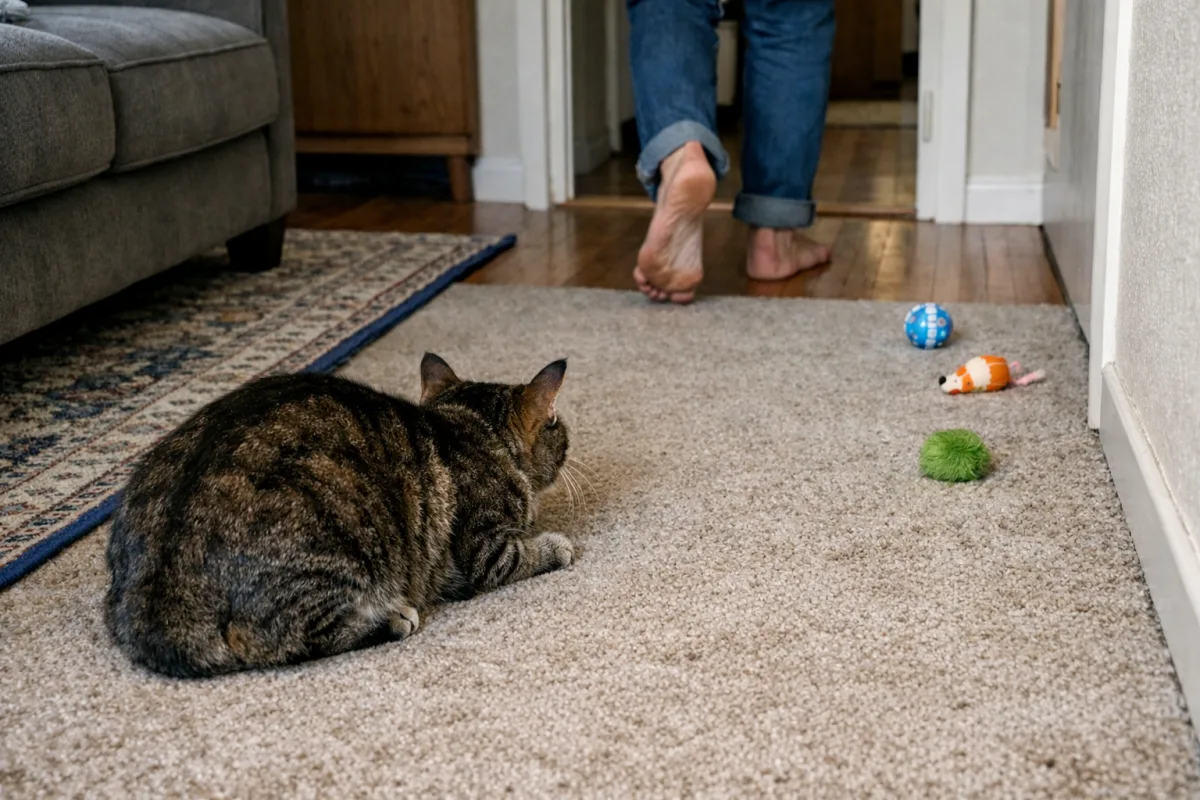
Foot chasing can show up in several familiar ways. Some cats wait behind a door and dart out at ankles as someone passes. Others follow people from room to room and make a quick swipe when bare feet move under a blanket. A few cats prefer to crouch beside a hallway and spring at anything that moves close to the floor.
The behavior is not always aggressive. Often it is closer to a game with a strong hunting shape. The cat watches, focuses, approaches, and then uses the front paws or a short bite. In some cases the cat runs off immediately afterward, which suggests excitement more than hostility.
There is also a difference between a cat that attacks moving feet and one that seems to target feet only at certain times. Many cats become more active in the evening, when the house gets quieter and people are moving less predictably. That is when feet may suddenly become the most obvious source of motion in the environment.
Common situations that trigger foot chasing
- Walking through a hallway or narrow space
- Feet moving under blankets, sheets, or rugs
- Sudden movements after a quiet period
- Play sessions that end too abruptly
- Times when the cat is under-stimulated and looking for activity
In these moments, the cat is not necessarily thinking about “feet” as an object. The cat is reacting to motion, shape, timing, and sometimes the reward of attention that follows. If people jump, laugh, or pull away quickly, the behavior can become even more attractive.
Why cats show this behavior in general
At the center of foot chasing is instinct. Cats are built to notice small moving targets and respond quickly. In the wild, those skills help with hunting. In a home, the same skills are often redirected toward socks, toes, ankles, and anything else that resembles quick prey-like movement.
Feet can be especially appealing because they are low to the ground and often move in short, uneven patterns. That kind of motion is easier for a cat to track than a hand that stays still. A foot can also appear and disappear behind furniture, doors, or bedding, creating the kind of stop-and-go action that keeps a cat interested.
What looks like “attacking feet” is often a blend of hunting instinct, play drive, and attention-seeking behavior.
Some cats are more prone to it because they are naturally energetic, curious, or easily stimulated. Others do it because they never learned a clear boundary between human movement and playtime. A young cat that chases toes and gets laughed at may repeat the behavior simply because it works.
Instincts that often sit behind the behavior
- Predatory interest in moving targets
- Play behavior that resembles stalking and pouncing
- Reaction to boredom or pent-up energy
- Learned association with human attention
- Curiosity about unfamiliar motion or sound
Even cats that seem calm most of the day may still switch into a chase mode when the right trigger appears. It does not always mean the cat is tense or poorly behaved. Sometimes it just means the cat is being a cat in a very ordinary way.
Playful chasing versus stronger attacks
Not every foot attack means the same thing. The tone of the behavior matters. A cat that pounces once, lets go, and comes back with loose body language is usually playing or practicing hunting skills. A cat that stays tense, hisses, or bites hard is sending a different message.
Playful behavior often includes a crouched posture, ears that are forward or neutral, and quick but springy movements. The cat may stop after a brief strike and look ready for another round. That pattern suggests excitement rather than fear or true aggression.
Stronger attacks can happen when the cat is overstimulated, frustrated, or startled. If the cat has been handled too much, interrupted during rest, or kept in a situation that feels cramped, the same foot movement can trigger a sharper response. The difference is usually visible in the body.
Signs that the cat may be playing
- Loose, flexible body posture
- Brief pounces without prolonged biting
- Repeated engagement followed by easy disengagement
- No vocalizing or only mild chirping
- Quick recovery after the interaction
Signs that the behavior may be defensive or stressed
- Tense muscles and low, stiff posture
- Flattened ears or dilated pupils
- Hard biting or repeated swatting
- Tail lashing or heavy twitching
- Refusal to settle after the incident
These differences matter because they change how the behavior should be read. A playful cat needs redirection and better outlets. A stressed cat may need more space, a quieter environment, or less stimulation overall.
How timing and routine influence foot attacks
Cats notice patterns. If a person walks down the same hallway every night at the same time, or always kicks off shoes in a certain place, a cat can learn exactly when and where movement will happen. That predictability can make feet an easy target.
Many cats become more active at dawn and dusk. These are natural hunting times, and even indoor cats often keep some of that rhythm. If a household is quiet in the evening, a cat may have more energy than people realize. Then a single pair of moving feet becomes the most interesting event available.
Routine also affects how persistent the behavior becomes. If the cat gets attention, chase games, or rough play after every foot attack, the habit may strengthen. If instead the cat regularly gets redirected to a toy or approved play session, the foot target may lose some of its appeal.
A cat that chases feet at the same time every day is often responding to pattern, not planning mischief.
Home life can make the behavior more noticeable too. Long workdays, limited play, or a cluttered environment may leave a cat with too little to do. Feet are convenient. They move often, they are easy to find, and they usually react fast.
How a cat’s internal state can shape the behavior
Energy level is one obvious factor, but it is not the only one. A cat may chase feet because it feels playful, but another cat may do it because it is aroused, frustrated, or uncertain. The behavior can look similar from the outside even when the emotional trigger is different.
Some cats are highly sensitive to motion and sound. A footstep on a wood floor, a sock sliding across a rug, or toes moving under a blanket can be enough to switch on a chase response. Other cats become more reactive when they have been alone too long and are looking for interaction of any kind.
Attention can also be part of the picture. Cats learn quickly which actions get a reaction. If a cat nips at feet and the person instantly talks, flinches, or starts a game, the cat may repeat the behavior because it changes the room’s energy. That reward does not have to be positive in a human sense to be effective.
Internal reasons that often matter
- High energy with no good outlet
- Boredom from lack of stimulation
- Frustration after interrupted play
- Strong response to movement or sound
- Desire for attention or interaction
A cat’s age and personality matter too. Kittens usually do this more often because they are learning through practice. Adult cats may keep the habit if it has been reinforced for years. Some cats never grow out of it fully; they just become less intense or more selective about when they do it.
How body language helps explain the meaning
Feet are only part of the story. The rest is in the cat’s posture. A cat that approaches low to the ground with focused eyes may be preparing to pounce. A cat that arches, hisses, or swats with a stiff tail may be communicating discomfort rather than play.
Watching the moments before the attack often gives better clues than the attack itself. Some cats stare at the feet for several seconds, then wiggle their hindquarters before springing. Others suddenly dart out from cover without warning because the movement itself was enough to trigger them. Different cats use different styles, but the pattern still reveals their state of mind.
It also helps to notice what happens right after the strike. Does the cat stay engaged, or does it run off? Does it return for more, or does it seem startled by its own behavior? Those small details can separate a fun chase game from a moment of overstimulation.
| Behavior clue | Likely meaning |
|---|---|
| Loose body, quick bounce | Playful chase |
| Tense body, hard bite | Overstimulation or stress |
| Hidden ambush from corners | Predatory play |
| Repeated swats after being disturbed | Frustration or discomfort |
Reading the whole picture makes the behavior easier to handle. Feet themselves are not the issue. The cat’s state, the timing, and the response from people all shape what happens next.
Why some homes see it more often than others
Household layout changes how often cats chase feet. Long hallways, narrow corners, and rooms with many hiding spots create perfect opportunities. A cat can wait, watch, and strike before a person has time to react.
Households with a lot of movement can increase the behavior too. Busy homes give cats more motion to track. Quiet homes can do the same if the cat is under-stimulated and starts seeking excitement wherever it can find it. Both extremes can make foot attacks more common for different reasons.
Indoor-only cats may show the behavior more often because feet become one of the easiest moving targets available. Outdoor access changes the balance of stimulation, but not every outdoor cat is less likely to chase feet. A cat that has a strong play or hunting drive may still bring that energy into the house.
The more a cat has to watch, stalk, and pounce on in daily life, the less likely feet are to become the main outlet.
Simple changes can sometimes reduce the habit. Regular interactive play, predictable routines, and less rewarding reactions to foot attacks often make a noticeable difference. The goal is not to erase instinct. It is to give that instinct a better target.
How owners often interpret it versus what it may mean
People often read foot attacks as stubbornness or defiance. That interpretation misses how automatic the behavior can be. In many cases the cat is not trying to “get” anyone. It is responding to a signal that feels exciting, familiar, or hard to ignore.
Some owners also assume that any foot attack is aggression. That is not always true. A cat can be perfectly affectionate and still ambush ankles when it is full of energy. At the same time, repeated hard bites should not be brushed off as a joke. Intensity matters.
The most useful question is not “Why is my cat being bad?” but “What is the cat getting from this?” The answer may be movement, attention, relief from boredom, or an outlet for hunting behavior. Once that is clear, the behavior often makes more sense.
Questions worth noticing
- Does it happen at certain times of day?
- Is the cat calm or tense before the pounce?
- Does the cat seem to want attention afterward?
- Is the behavior getting stronger over time?
- Does it happen more when play has been limited?
These observations are more useful than assuming the cat is simply being difficult. Cats communicate in patterns, not explanations. Feet are just one of the easiest patterns for them to use.
When the behavior changes over time
Foot chasing can shift as a cat moves from kittenhood into adulthood. Kittens tend to attack anything that moves because nearly everything feels like practice. Their bites are often clumsy, their pounces less controlled, and their interest easy to trigger. The behavior can look charming at first, then become tiring once it starts happening every day.
Adult cats may still do it, but with more precision. They may wait longer before striking, choose more strategic hiding places, or become highly predictable about when they want to play. Some cats grow out of the intensity, while others keep the habit for life because it satisfies a deep need for motion and engagement.
Older cats may chase feet less often, but not always. If discomfort or reduced mobility appears, the behavior can change shape. A cat that once leaped may begin with short swats or low grabs instead. If the pattern changes suddenly, it is worth paying attention to whether the cat is also showing changes in appetite, movement, or mood.
What makes the behavior consistent
One reason foot attacks last is that they are self-reinforcing. The foot moves, the cat pounces, the human reacts, and the cat learns that the game is active. That loop can be surprisingly strong. Even negative reactions can keep the behavior alive if they are dramatic enough to feel rewarding.
Consistency also comes from the cat’s natural preference for low, moving targets. Feet are always available. They do not need to be dragged out from a drawer, and they do not require special equipment. They show up in daily life repeatedly, which makes them an easy habit for a cat to revisit.
Some cats also have a strong play style that simply includes ambush behavior. They may chase strings, jump at toys, and attack ankles with the same energy. In those cases, foot chasing is part of a bigger pattern, not a separate issue.
If the same cat keeps targeting feet across many settings, the behavior is usually serving a stable purpose for that cat.
That purpose might be fun, stimulation, control of territory, or an outlet for energy. The exact reason can vary, but the usefulness of the behavior is what keeps it going.
How to read the behavior in daily life
Not every foot attack needs a serious explanation, but every foot attack has a context. A cat that lightly bats at toes during playtime is communicating something different from a cat that bolts from under the couch and bites hard when someone walks by. The first may want interaction. The second may need a calmer environment or more structured outlets.
Watching when the behavior happens helps most. Before meals, after naps, when guests arrive, or during quiet evening hours are all common windows. Patterns like these can point to energy, anticipation, or a need for more predictable play.
It also helps to notice the cat’s overall day. A cat that sleeps most of the day and then attacks feet at night is often under-stimulated. A cat that attacks during tense moments, grooming interruptions, or household noise may be responding to stress. The behavior is similar, but the reason is not.
Feet are simply the nearest moving target in a cat’s environment. What makes them interesting is motion, not meaning. Once that is understood, the behavior becomes easier to interpret, easier to manage, and less mysterious when a quiet walk across the room turns into a sudden chase.