Cats are experts at disappearing into quiet corners, and sometimes they do it for much longer than owners expect. A cat that slips under the bed for a few minutes is easy to understand. A cat that stays hidden for hours or even days can feel different, especially when the behavior seems new or more intense than usual.
Long periods of hiding are not always a sign of trouble. For many cats, it is a normal way to manage rest, noise, activity, or social pressure. Still, the reason matters. Cats hide for different causes depending on their personality, age, health, and surroundings, and the pattern can tell you a great deal once you know what to look for.
Some cats hide when they are overstimulated. Others retreat because they are unsure, tired, or trying to control contact with people and other animals. In some cases, hiding is linked to illness, pain, or a stressful change in the home. The behavior itself may look simple, but the meaning behind it can shift quickly.
What long hiding looks like in everyday life
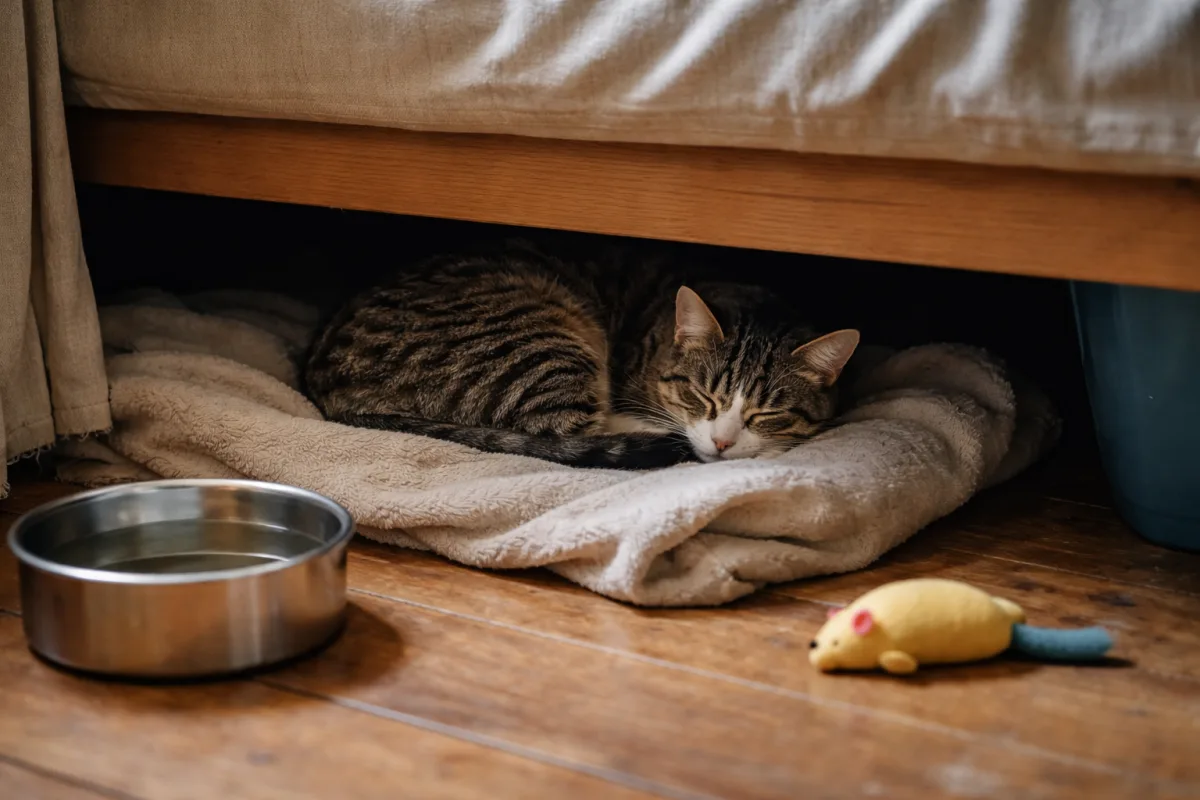
Hiding is not always dramatic. It often begins quietly, with a cat choosing one spot and returning to it again and again. That place might be under a bed, behind a couch, inside a closet, under a staircase, or in a box tucked into a corner.
In normal situations, the cat may still come out to eat, use the litter box, or check the room when things are calm. The cat may remain alert, with ears moving toward sounds and eyes watching the environment from cover. This is different from a cat that seems frozen, distressed, or unwilling to move even for food.
Some cats hide only during predictable events. A vacuum cleaner, visitors, children running through the house, or a home renovation can all trigger retreat. Other cats hide without an obvious cause, which makes the behavior harder to interpret.
Common hiding patterns owners notice
- Moving to the same hidden spot every day
- Coming out only at night or when the house is quiet
- Eating less in open areas but eating when no one is nearby
- Leaving the hiding place briefly, then returning right away
- Choosing one high-traffic event, such as dinner time, to stay hidden
These patterns matter because they show whether the cat is using hiding as a brief pause or as a more constant coping strategy. A cat that hides and still behaves normally at other times is very different from one that avoids almost all contact.
Long hiding is often less about “wanting to be alone” in a human sense and more about feeling safer where the cat can watch the world without being reached or startled.
Natural instincts behind the behavior
Hiding is deeply connected to the way cats evolved. In the wild, small predators also need to avoid larger threats, conserve energy, and choose secure resting places. A hidden spot gives a cat a sense of control over approach and escape, which is especially important for an animal built to react quickly.
This instinct has not disappeared in domestic cats. Even a well-fed indoor cat still carries the same preference for cover, elevated views, and narrow spaces that limit surprise. Hiding can therefore be a form of safety behavior, not a sign that the cat is being difficult or unfriendly.
Cats are also solitary by nature in many everyday decisions. They do not always seek group comfort the way dogs often do. A cat may prefer to process stress by withdrawing rather than by staying near people.
Instinctive reasons cats choose hidden places
- Protection from sudden movement or sound
- Opportunity to observe without exposure
- Rest in a place that feels enclosed and predictable
- Reduction of social pressure from people or other pets
- Control over when interaction begins and ends
That last point is important. A hidden cat often feels more in charge of the situation. The cat can decide when to watch, when to rest, and when to emerge, which is comforting when something in the environment feels uncertain.
How hiding connects to a cat’s personality
Some cats are naturally more private than others. A cat with a cautious temperament may take longer to settle into a new room, a new home, or a changed routine. Another cat may be outgoing most of the time but retreat quickly after a single stressful event.
Personality shapes both the frequency and the duration of hiding. A bold cat may only hide during obvious disruptions. A sensitive cat may need a much longer recovery period after something small, such as a stranger visiting or furniture being moved.
Age matters too. Kittens may hide because everything is new and the world feels large. Adult cats often hide more selectively, usually in response to specific triggers. Older cats may seek secluded spots because they want quiet, warmth, or relief from discomfort.
Temperament clues to watch for
- A confident cat usually returns sooner after stress
- A cautious cat may hide before and after a trigger
- A highly social cat may hide less often but more noticeably when upset
- A low-energy cat may hide for rest and avoid busy rooms by habit
Knowing the cat’s baseline makes the behavior easier to read. A cat who has always liked tucked-away places is not the same as a cat who suddenly begins avoiding everyone.
How the home environment influences long hiding
Indoor life can make hiding more common, especially in busy homes. Noise, foot traffic, children, dogs, unfamiliar guests, and competing pets all raise the amount of stimulation a cat has to manage. A cat may hide simply because the house never feels fully quiet.
Layout also matters. Homes with few vertical spaces, limited private rooms, or constant interruption can leave a cat with very little control over personal space. When that happens, hiding may become the easiest available escape.
Even small changes can matter. A new scent in the room, a different cleaning routine, rearranged furniture, or a loud appliance in a familiar place can be enough to make a cat retreat for longer than usual. Cats often notice these details before people do.
If a cat hides more often after a change in the home, the timing is often as important as the behavior itself.
Environmental factors that can extend hiding time
- New pets or unfamiliar animals nearby
- Visitors, repairs, or construction noise
- Recent moves or room rearrangement
- Litter box placement in busy or exposed areas
- Competition for sleeping spots, food, or attention
Some cats adjust quickly once the environment settles. Others need a much slower return to normal. The same house can feel very different to two cats living in it at the same time.
What the behavior may signal about the cat’s state
Hiding is sometimes a healthy response, but the details can reveal what the cat is feeling. A cat hiding peacefully may still groom, stretch, sleep, and eat normally when given space. A cat hiding because of stress often shows a tighter body, less curiosity, and reduced willingness to engage even in familiar routines.
Body language helps separate calm hiding from distressed hiding. A relaxed cat may have soft eyes, loose paws, and slow movement when it does come out. A stressed cat may flatten its ears, keep its body low, or dart between places instead of settling.
Changes in eating, litter box use, or grooming make the picture more important. A cat that hides and also skips meals, avoids water, or stops using the litter box should be taken more seriously than one that simply prefers a quiet corner.
Signs that hiding may be tied to discomfort or stress
- Reduced appetite or selective eating
- Less grooming or a coat that looks untidy
- Sudden irritability when approached
- Stiff posture or reluctance to jump
- Changes in litter box habits
These signs do not always mean the same thing, but they tell you the cat is not just resting. Something in the cat’s state has shifted.
When hiding is playful, neutral, or defensive
Not every hiding cat is anxious. Some cats turn hiding into a game, especially in homes with active people or other pets. They may dash in and out of cover, peek from behind furniture, or wait in a hidden place to spring out during play.
Neutral hiding is different. The cat chooses a private spot for rest and seems content there. There is no obvious tension, and the cat still participates in the household at its own pace. This is often the easiest kind of hiding to live with because it reflects preference more than alarm.
Defensive hiding is more serious. The cat is not simply resting or watching. It is trying to reduce the chance of being approached, handled, or startled. In those cases, the hiding place becomes a shield, not just a quiet room.
Three common forms of hiding
| Type | What it looks like | What it may mean |
|---|---|---|
| Playful | Peeps out, darts away, reappears quickly | Excitement or game-like behavior |
| Neutral | Calm, steady resting in a private spot | Preference for quiet and control |
| Defensive | Rigid body, avoids contact, stays hidden for long periods | Fear, stress, or possible discomfort |
The same hiding place can serve all three purposes on different days. That is why the cat’s posture, timing, and response to people matter so much.
How to read mixed signals
Cats often send mixed messages. A cat may hide all morning, then appear for food and rub against a leg, only to disappear again an hour later. That can make the behavior seem inconsistent, but it usually reflects a cat that is managing its comfort carefully.
Another common pattern is a cat that wants contact on its own terms. It may stay hidden if someone tries to coax it out, yet emerge naturally when the room is quiet. This does not necessarily mean the cat is bonded poorly. It often means the cat has a strong preference for control over timing.
Mixed signals can also happen during recovery from stress. The cat may begin to rejoin the household in small steps, then retreat again after a loud sound or unexpected touch. Progress is rarely a straight line.
A cat can be interested in the household and still need distance from it.
How long periods of hiding change with routine
Daily routine can make a big difference in how often a cat hides and how long it stays hidden. Cats like predictability. When meals, quiet time, play, and social contact happen at familiar times, the cat often feels less pressure to disappear for long stretches.
In a steady routine, hiding may be shorter and less frequent. In a chaotic routine, the cat may stay hidden simply because it cannot tell when the house will be calm. Even a cat that enjoys people may withdraw more when the day feels noisy or irregular.
Feeding schedule matters too. Cats that expect food at consistent times often appear sooner and spend less time in cover. When food arrives unpredictably, some cats become more watchful and avoidant.
Routine factors that can reduce prolonged hiding
- Regular meal times
- Predictable periods of quiet
- Separate safe spaces for each pet
- Gentle, non-forced interaction
- Stable sleeping and litter box locations
Consistency does not remove all hiding. It just makes the behavior easier for the cat to manage without feeling the need to stay out of sight for so long.
Why hiding can become more noticeable after changes
Some cats hide more after a specific life event. A move to a new home can lead to a much longer adjustment period. So can the arrival of another cat, a new baby, a new roommate, or a change in the owner’s schedule.
Even positive changes can trigger hiding. A cat may not immediately welcome new energy in the home. A busy holiday, a house full of guests, or more time spent away from home can all shift the cat into a quieter, more withdrawn pattern.
Sometimes the change is internal rather than external. Pain, aging, or an illness can make a cat prefer isolation more than it used to. That is why a new hiding habit in an older cat deserves attention, even if the cat still appears to be eating.
When hiding appears suddenly in a cat that was previously social, the change itself is often the most important clue.
What long-term patterns may mean
Long-term hiding can become a stable habit, especially in cats that have always been sensitive or reserved. Some cats build a life around a few trusted hiding places and only venture out during predictable, low-pressure times. That pattern can remain steady for years.
Stability does not always mean there is no issue. A cat may have adapted to a situation that still limits comfort. For example, a cat might spend most of the day hidden because the home is too active, because another pet dominates shared spaces, or because handling has become something the cat avoids.
At the same time, long-term hiding can simply be part of a cat’s style. The question is not whether the cat hides at all, but whether the pattern fits the cat’s usual behavior and daily needs.
Questions that help interpret a long-term hiding pattern
- Has the cat always preferred private spaces?
- Does it come out for food, grooming, and litter box use?
- Is the hiding linked to specific sounds, people, or animals?
- Has the cat’s appetite, mobility, or grooming changed?
- Does the cat still show interest at calm times?
These questions help separate personality from concern. A cat that hides by choice is different from a cat that hides because it feels unable to relax anywhere else.
Small changes that can matter a lot
Owners often notice the hiding spot before they notice the reason. A cat may suddenly prefer one closet shelf, one corner behind furniture, or one room that seems less busy. That shift can be subtle, but it often reflects how the cat is sorting out comfort and safety.
Helpful changes are usually simple. A quiet room, a covered bed, a higher perch, or an undisturbed resting area can make a cat feel less compelled to disappear for long periods. The goal is not to stop hiding entirely. The goal is to give the cat more than one place that feels secure.
Some cats also benefit from a calmer approach to interaction. Going directly into the hiding spot, reaching in, or forcing eye contact can make the retreat last longer. A cat that feels unpressured is more likely to return on its own.
Practical adjustments that may ease prolonged hiding
- Keep food, water, and litter boxes easy to reach
- Offer one or two quiet resting areas
- Avoid blocking the cat’s chosen escape routes
- Limit surprise handling or chasing
- Reduce noise around the cat’s favorite hiding spots
These changes do not guarantee immediate results. Cats often need time to decide that a place is truly safe.
When a hidden cat may need closer attention
Some hiding is ordinary. Some is not. A cat that remains hidden and also stops doing normal daily things may be signaling a bigger problem. The combination matters more than the hiding alone.
If the cat hides for long periods and also avoids food, ignores treats, shows pain when moving, or changes litter box habits, the behavior should not be brushed off as shyness. Cats often hide when they feel vulnerable, and illness is one of the strongest reasons for that response.
Even without obvious medical signs, a major change in behavior deserves note. A cat that suddenly becomes hard to find after being social for years is telling you something has shifted, even if the shift is subtle.
Persistent hiding becomes more concerning when it comes with appetite loss, reduced movement, grooming changes, or a sudden personality change.
Why the same cat may hide more at certain times
Hiding is not always constant. Many cats hide more in the evening, after activity, during storms, or when the household is busiest. These timing patterns can reveal what the cat is responding to.
A cat may hide after play because it is tired and wants a quiet finish. Another may hide before feeding because the kitchen becomes crowded. Some cats hide during specific household rhythms, like school pickup, dinner preparation, or bedtime noise.
Observing the timing can be surprisingly useful. It often shows whether the behavior is tied to energy level, social pressure, sound, or a predictable event.
Timing clues that often matter
- Hiding during loud or active parts of the day
- Hiding more after visitors arrive
- Hiding around feeding time or litter box cleaning
- Hiding after rough play or overstimulation
- Hiding more during changes in weather or storms
Once the pattern is clear, the behavior usually feels less mysterious. The cat is often responding to a repeated experience, not acting randomly.
A quiet pattern with many possible meanings
Long periods of hiding can mean comfort, caution, rest, stress, or discomfort. The same behavior can play different roles depending on the cat and the circumstances around it. That is why the context matters so much.
A cat that hides while still eating, grooming, and emerging on its own terms may simply be keeping life manageable. A cat that hides suddenly, stays withdrawn, or changes other habits at the same time may need a closer look at its environment or health. Both patterns deserve attention, but they do not carry the same message.
What matters most is the whole picture: the cat’s usual personality, the timing of the behavior, the location chosen, and the other signals that travel with it. Once those pieces line up, hiding becomes easier to understand in a practical way.