Cat bites during petting can feel confusing because the moment often starts out pleasantly. A cat leans in, purrs, rubs against a hand, and then suddenly turns and nips. That change can seem random, but it usually is not.
Most cats are not trying to be mean. They are often showing a limit, shifting from comfort to overstimulation, or reacting to a touch that no longer feels good. The same cat may enjoy petting one minute and dislike it the next.
Understanding this behavior is less about reading a single bite and more about noticing the pattern around it. Body language, timing, where the cat is being touched, and the overall mood all matter. Once those details become clearer, the nips start to make more sense.
What Petting Bites Usually Look Like in Daily Life
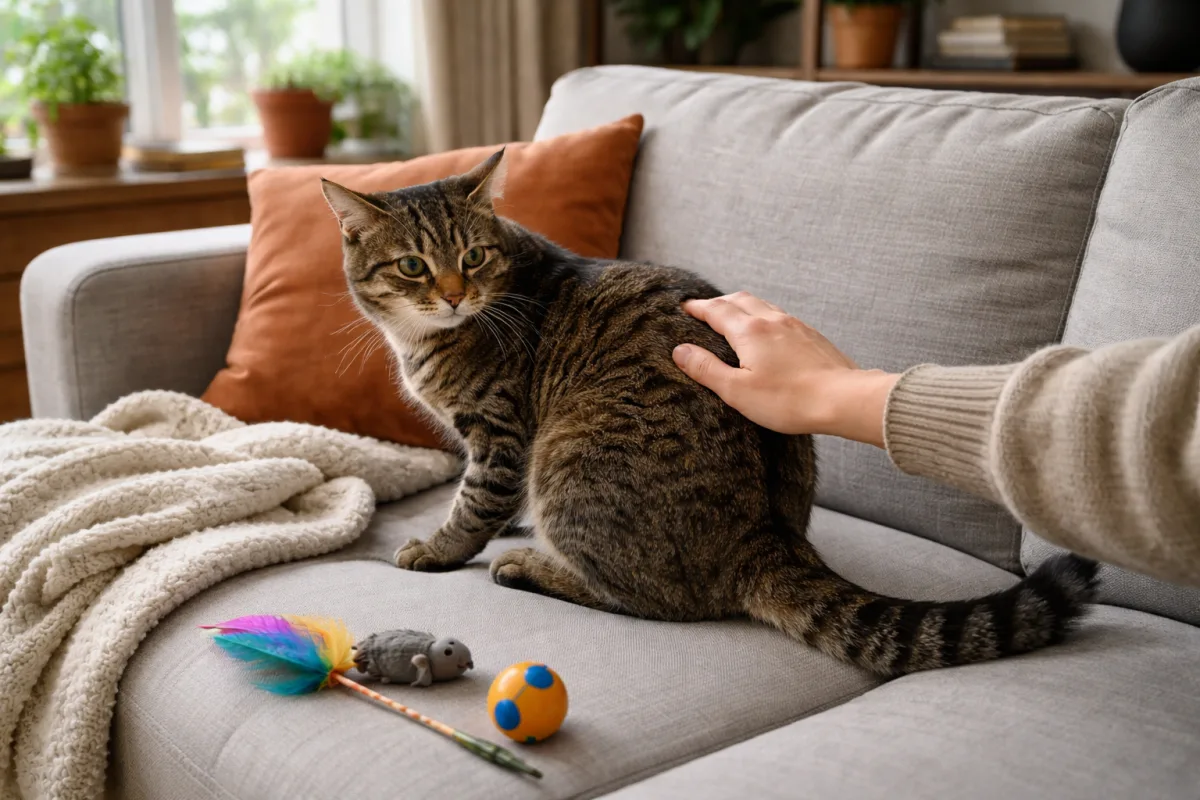
Petting bites often begin with calm contact. A cat may sit beside a person, press its head into a hand, or roll onto its side. The touch seems welcome, then suddenly the cat grabs the hand with its mouth or gives a quick nip.
Some cats do this softly. Others use stronger bites that make the message impossible to miss. The behavior can happen after a few seconds of petting or after several minutes, which is one reason it surprises people. The cat may seem affectionate right up until the moment it is not.
There are common scenes where this shows up:
- During head or back petting that goes on too long
- When a person keeps touching a favorite spot after the cat shifts position
- While the cat is resting and wants contact on its own terms
- After the cat becomes excited from repeated strokes
- When the cat is unsure about being handled but does not leave immediately
One important detail is that the bite often comes after small warnings. The warnings may be subtle: a tail that starts flicking, skin that ripples, ears that turn slightly back, or a body that stiffens. Many owners miss these signals because the cat is still near and still purring.
Petting bites usually mean the cat reached a limit, not that it suddenly changed personality.
Why Cats Bite During Petting
Several internal reasons can lead to this behavior, and they can overlap. A cat may be overstimulated, sensitive in a certain area, in a playful mood, or trying to control the interaction. Sometimes the bite is simply a quick way to say, “That is enough.”
Overstimulation
Overstimulation is one of the most common reasons. Cats have sensitive skin and a strong awareness of touch. Even pleasant petting can become too much after a while, especially if the strokes are repetitive or concentrated in one area.
Unlike people, cats do not always calm down from more touch. For some, the buildup is real and fast. The cat may enjoy the first few strokes, then become tense as the nervous system gets overloaded. A bite ends the situation quickly.
A preference for control
Many cats like affection, but they prefer to decide when it starts, how long it lasts, and where it happens. Petting can be enjoyable when it follows the cat’s lead. It can feel annoying when it continues beyond that point.
This is especially true for cats that enjoy closeness but dislike being fully handled. They may love being near a person, rubbing against legs, or sitting beside someone on the couch. That does not always mean they want ongoing full-body petting.
Sensitive spots and touch thresholds
Some areas are simply less comfortable. The belly is a common example, but so are the base of the tail, the legs, and sometimes the back near the hips. Even cats that like chin scratches may react to other areas.
The same cat can have different thresholds on different days. A touch that is fine after a nap may feel irritating when the cat is alert, anxious, or in mild discomfort. That is why the same routine can produce different results.
Play behavior mixed with affection
In some cats, petting turns into play. The mouth is part of how they explore and interact, especially if they have learned that hands move like toys. A nip may be more playful than aggressive, though it can still hurt.
This kind of bite often happens when a cat’s energy level rises. The cat may grab a hand with paws first, then follow with the mouth. It can look affectionate and rough at the same time.
Discomfort or pain
If a cat starts biting during petting more often than before, pain should be considered. Arthritis, skin irritation, dental problems, and other physical discomforts can all make touch unpleasant. A cat may tolerate petting for a short time and then bite when a sore area is reached.
This is especially worth noticing if the behavior is new, more intense, or tied to a specific body part. A cat that once enjoyed long sessions but now reacts quickly may be telling you something changed.
If biting appears suddenly or becomes more frequent, discomfort is worth ruling out before assuming it is just a personality quirk.
How Context Changes the Meaning
The same bite can mean different things depending on the situation. A cat that bites after relaxed petting on a quiet evening may be communicating something very different from a cat that bites while tense during a busy household moment.
Context includes the environment, the cat’s routine, and what happened right before the nip. A cat that was sleeping deeply, startled awake, and then touched may react faster. A cat that has been handled by several people in a short time may also have a lower tolerance.
Indoor life and daily routine
Indoor cats often live with predictable patterns, which can make their reactions easier to notice. When the routine changes, even slightly, their tolerance may shift. A missed meal, a noisy room, a visiting guest, or an energetic play session can all influence how a cat responds to petting.
Some cats are affectionate in the morning but less tolerant at night. Others are more open to touch after eating or after exercise. Many simply have narrow windows when petting feels good.
Quiet homes vs active homes
A calm environment often helps cats stay more relaxed during contact. In a busy home, petting may happen while the cat is already on alert. That extra tension can make a bite more likely.
Noise, sudden movement, other pets, and frequent interruptions can all shorten a cat’s patience. A cat that bites in a lively household may behave differently in a quiet room where it feels settled and secure.
Timing matters more than people realize
Petting at the wrong time can change everything. A cat that just woke up may not want touch. A cat that is already overstimulated from play may not want more physical input. Even a cat sitting nearby may be signaling a desire for proximity without direct contact.
Timing also includes the length of the session. Some cats want three strokes. Others may tolerate ten. The number matters less than the cat’s reactions along the way.
Body Language That Often Comes Before a Bite
Most cats give clues before they bite, but the clues can be easy to miss. The signs are often small and fast. Learning them helps owners stop petting before the cat feels forced to escalate.
- Tail flicking or a tail tip that starts twitching
- Ears turning sideways or flattening slightly
- Skin rippling along the back
- Sudden stillness after relaxed movement
- Head turning toward the hand
- Pupil widening or a sharp change in attention
- Whiskers shifting forward or back in a tense way
- Purring that continues even as the body stiffens
One of the biggest misunderstandings is assuming purring always means everything is fine. Cats do purr when content, but purring can also appear during stress or uncertainty. The body as a whole tells the fuller story.
A cat leaning into a hand with loose muscles is different from a cat leaning in with a rigid back and twitching tail. Both may look inviting at first glance, but only one is truly relaxed.
When the body stiffens, the cat is often asking for a pause even if it has not moved away yet.
What Owners Often Misread
Many people think a petting bite means the cat was affectionate one second and “mean” the next. In reality, the cat may have been communicating the whole time. The issue is often not sudden moodiness, but a missed boundary.
Another common misunderstanding is believing that if a cat comes close, it must want unlimited petting. Cats often seek closeness without wanting constant touch. Sitting beside someone, resting near a hand, or rubbing once does not always mean more is welcome.
Some owners also assume a cat should simply get used to more handling. But tolerance is not the same as enjoyment. A cat can endure touch for a while and still dislike it. The bite may be the point where endurance ends.
It is also easy to mistake a nip for random aggression. Often, it is a short, clear boundary. The cat is not necessarily rejecting the person. It may just be rejecting the current kind of contact.
Different Types of Petting Bites
Not all petting bites are the same. Some are gentle and quick. Others are firm and signal more tension. Looking at the pattern helps distinguish play, irritation, and discomfort.
| Type of bite | Common signs | Possible meaning |
|---|---|---|
| Light nip | Quick mouth contact, cat stays nearby | “Enough for now” or mild overstimulation |
| Playful grab | Paws engage first, energy rises, no retreat | Play is mixing with affection |
| Firm bite | Stiff body, tail twitching, clear break in mood | Strong boundary or irritation |
| Repeated bite | Happens in the same spot or during the same motion | Touch in that area may feel uncomfortable |
The same cat may show more than one type depending on the day. A soft nibble during a relaxed session is not the same as a sharp bite after prolonged touching. The details matter.
What Cats May Be Trying to Communicate
A petting bite can carry several messages. The most common one is simple: stop or slow down. That message may be about the current moment, not the relationship itself.
Sometimes the message is, “Pet me here instead.” A cat might move its head toward a preferred spot or pull away from a less comfortable one. Other times the message is, “Not now.” The cat may want attention later, but the timing is wrong.
In a few cases, the bite says, “I am excited and do not know what to do with it.” This is especially true in cats that get aroused quickly during play or close contact. Their behavior blends social connection, energy, and mild frustration.
And when pain is part of the picture, the message becomes more serious. A bite may be the cat’s fastest available response to a touch that hurts. That is one reason consistency matters so much when observing the pattern.
How to Read the Pattern Over Time
One bite does not define the cat. The repeated pattern tells the story. Notice when it happens, what kind of petting was happening, where the cat was touched, and how the cat behaved before and after.
Some cats bite only when overstimulated. Others do it when they are tired. A few bite mostly when touched on specific spots. These patterns are useful because they reveal boundaries that can be respected in daily life.
Questions that help reveal the pattern
- Does the bite happen after a certain number of strokes?
- Is it tied to one body area?
- Does it happen more during busy or noisy times?
- Does the cat give warning signs first?
- Has the cat’s behavior changed recently?
If the pattern is stable, the cat is likely communicating a consistent preference. If the pattern changes, the cause may be environmental or physical. Either way, the behavior becomes easier to understand once it is viewed over time rather than as a single event.
What Makes the Behavior More Noticeable
Petting bites often become more obvious when a cat is already on edge. A cat that is tired, bored, overstimulated, or physically uncomfortable may have a lower tolerance than usual. Even a familiar hand can feel like too much in that state.
Some cats also become more reactive as they age. A young cat may tolerate more handling, while an older cat may grow less patient, especially if joints or muscles feel stiff. On the other hand, some cats become softer and more affectionate with time. The pattern is not fixed for every cat.
Change in the home can matter too. A new pet, a different schedule, loud renovations, or even a shift in family routine can affect how safe and settled a cat feels. When the cat feels less settled, petting tolerance may shrink.
When the Bite Is More About the Cat Than the Petting
Sometimes the issue is not the hand but the state of the cat itself. A cat that is hungry, restless, anxious, or feeling unwell may react to petting faster than usual. The bite can be a sign that the cat is already near its limit before contact even begins.
Stress also changes how touch is received. A cat that is otherwise friendly may still bite if it feels trapped or pressured. This can happen when a person reaches in repeatedly, follows the cat, or continues after the cat has shifted away.
In a home with multiple pets, a cat may accept petting one moment and bite the next because its attention is split. The cat may be watching another animal, listening for movement, or trying to stay aware of its surroundings. Touch during that state can feel intrusive.
Petting bites often make more sense once the cat’s overall state is considered, not just the hand that was doing the touching.
Natural Limits Are Part of the Relationship
Many cats enjoy affection, but they do not always want it in the same way people expect. Their limits are part of how they interact. A bite can be a boundary, not a rejection of the bond.
Some cats prefer brief touch and frequent pauses. Others like being near a person more than being touched. Many enjoy a narrow range of petting and react when that range is exceeded. Once those limits are understood, the interaction becomes smoother.
The cat is not usually sending a mysterious mixed message. It is often giving a clear one in a cat-sized way. The challenge is noticing it before the bite happens, then adjusting the next interaction to fit what the cat has already shown.
That is why petting bites are often best understood as information. They reveal where the cat’s comfort ends, how quickly it shifts, and what kind of touch feels right in that moment. With time, the pattern becomes easier to read, and the hand learns where the boundary lives.