A cat that suddenly seems “too much” can be hard to read. One minute they are rubbing against your legs, the next they are twitchy, bitey, or racing from room to room like they have been startled by something you cannot see. That shift can look like mischief, but it often points to overstimulation.
Overstimulation in cats happens when normal feelings, sensations, or social contact pile up faster than the cat can comfortably process them. Petting, noise, movement, play, scents, or even a busy household can push a cat past their limit. The result is not always obvious at first. Some cats freeze. Some leave. Some swat. A few do all three in the same minute.
Understanding the signs matters because overstimulation is not a personality flaw. It is a response. Once you can recognize the pattern, the cat’s behavior starts to make more sense, and daily life gets easier for both sides.
What overstimulation looks like in everyday life
In a home setting, overstimulation rarely appears as one dramatic event. It usually builds in small steps. A cat may start by asking for attention, then enjoy a few strokes, then suddenly tense up. The change can be subtle: a tail that flicks faster, ears that rotate back, skin that ripples along the spine, or a head that turns sharply toward your hand.
Sometimes the cat looks almost torn between wanting more and wanting less. They may continue rubbing against you while also biting gently or batting your hand away. That mixed message is common. The cat is not being inconsistent for no reason; their nervous system is already near its limit.
Some situations make the pattern easier to spot:
- Long petting sessions that begin pleasantly and end in a swat
- Too much excitement during play, especially with fast-moving toys
- Busy household activity, such as guests, children, or loud cleaning tools
- Being touched while resting, grooming, or eating
- Multiple forms of stimulation happening at once, such as noise, movement, and handling
A cat does not need to be frightened to become overstimulated. Even a friendly, social cat may reach a point where more input feels unpleasant.
Overstimulation is often a threshold problem: the cat was fine until the amount of touch, noise, or activity crossed a line.
Common signs to watch for
Cats give off warning signals long before they bite or run away. The challenge is that those signals can be easy to miss if the interaction is moving quickly. Paying attention to body language helps more than focusing on the final reaction.
Early physical signs
These are often the first clues that a cat is shifting from comfortable to overloaded:
- Tail tip flicking or thumping
- Skin twitching near the back or hips
- Ears turning sideways or flattening slightly
- Pupils getting larger
- Head turning toward the hand
- Sudden stillness after a period of relaxed contact
In many cats, the body becomes noticeably less loose. Their muscles may tighten. They stop leaning into the touch. A cat that was purring may keep purring, which can confuse people, but purring alone does not always mean the cat is still enjoying the interaction.
Behavior changes during the interaction
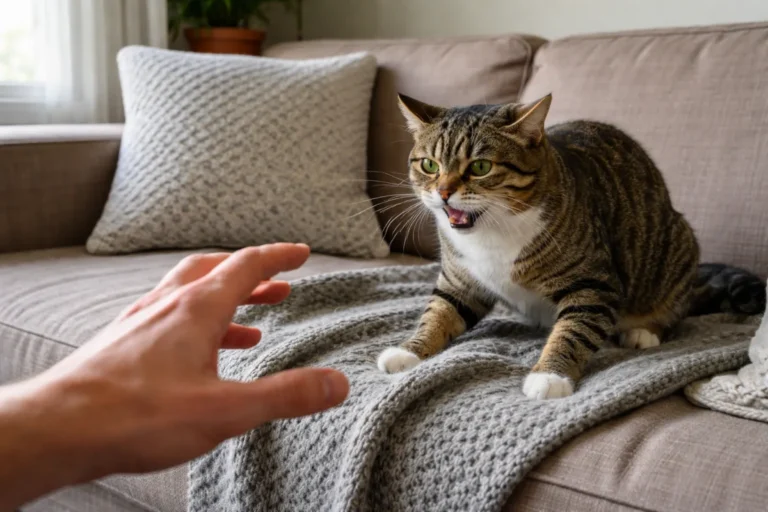
Once a cat is more activated, their behavior may shift in more obvious ways. They might nip, grab, or deliver a quick paw strike. Some cats lick a person’s hand and then bite. Others simply get up and walk away with visible irritation. A few start grooming themselves as a way to redirect their energy.
These changes are often brief and sudden. That speed is part of what makes overstimulation feel confusing. The cat may not look upset for long, but the reaction is real.
After the threshold is crossed
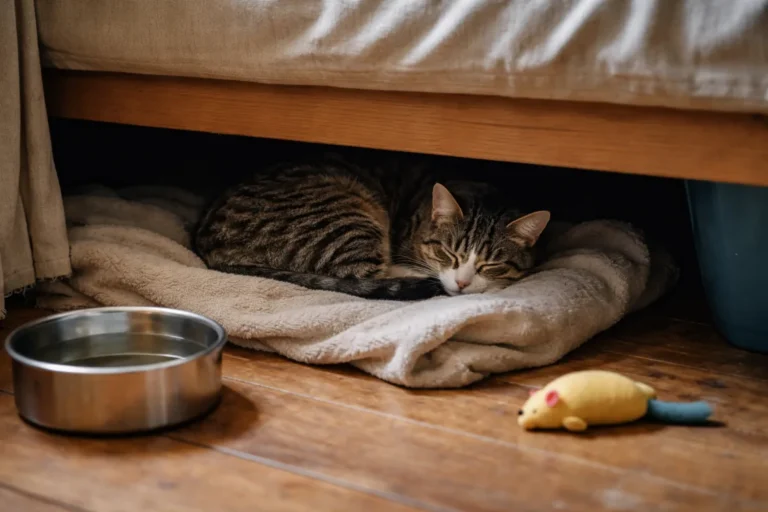
When a cat has gone past their comfort point, they may need space rather than more soothing. Continuing to touch them can intensify the response. A cat may retreat under furniture, pace the room, hide in another area, or keep watching from a distance before settling again.
Some cats recover quickly. Others stay tense for a while. The length of recovery often depends on what triggered the reaction in the first place and how intense it was.
Why cats become overstimulated
There is no single cause. Overstimulation usually comes from a mix of the cat’s sensitivity, the type of input they receive, and the setting around them. A cat can be calm in one situation and overwhelmed in another, even if the difference seems small to a person.
Too much petting in one area
Many cats enjoy being touched, but not always in the same way or for the same length of time. A cat may like slow strokes along the cheeks or under the chin and dislike touch near the belly, tail base, or lower back. Some cats enjoy contact for only a short burst before they have had enough.
The issue is not just where they are touched. Repetition matters too. Repeated strokes can become irritating, especially if the cat is already alert or trying to relax.
Sensory overload
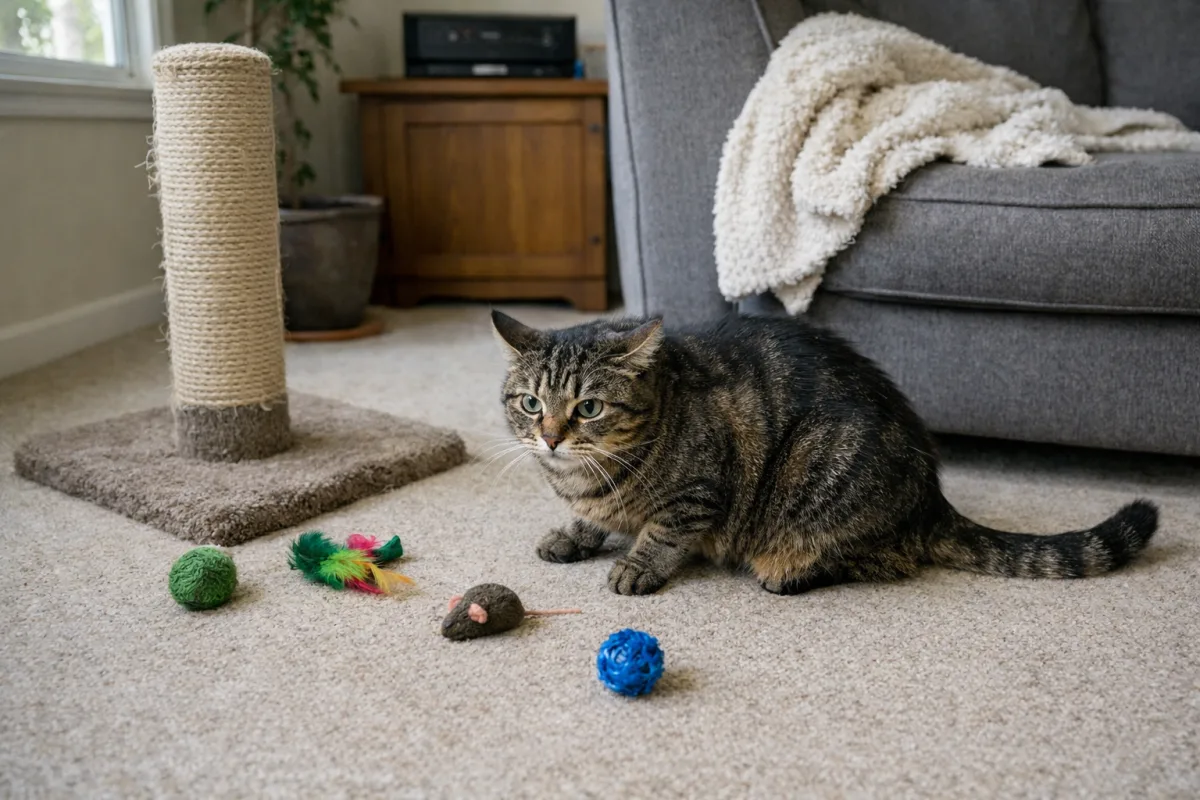
Cats live through their senses. Loud appliances, sudden movements, strong odors, unfamiliar sounds outside, and chaotic foot traffic can all add pressure. When several of these happen together, the cat may react even if each one alone would not be a problem.
This is one reason a cat may seem “fine” in a quiet room and restless elsewhere. The room itself changes how much input they have to manage.
Play that runs too hot
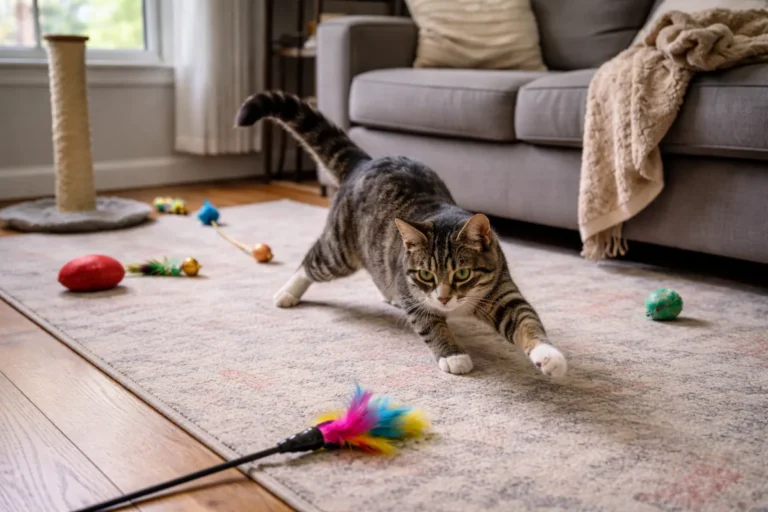
Play is healthy, but it can become overstimulating when it feels too intense or too repetitive. Fast toy movement can trigger a strong prey response, especially in younger cats or cats with a high drive to chase. If the play continues without pauses, the cat may flip from focused to frazzled.
What starts as fun can end with a bite, a hard stare, or a sudden exit. The cat is not necessarily bored. They may simply be over threshold.
Stress that lowers tolerance
Stress does not have to be dramatic to matter. A vet visit, a change in schedule, a new pet, a move, or even a small shift in routine can make a cat less tolerant of normal contact. When they are already on edge, less stimulation is needed before they react.
This is why a cat may tolerate petting one week and become touchy the next. Their baseline tolerance has changed.
A cat’s tolerance for touch and activity is not fixed. It shifts with mood, health, environment, and recent stress.
How body language can be easy to misread
People often think a cat’s purr, rubbing, or rolling over means “keep going.” Sometimes it does. Sometimes it does not. Cats can invite interaction and then become overstimulated partway through it.
Rubbing against a hand may be a request for attention, but it can also be a cat’s way of controlling the kind of contact they want. Rolling over is not always an invitation to touch the belly. A cat that arches into your hand may still want only a few seconds more.
The fastest clues are often the least dramatic. Look at the tail first, then the ears, then the rest of the body. A cat that is still enjoying contact usually looks loose and coordinated. A cat nearing overload often looks sharper, tighter, and more alert.
Signals that often show up together
- Affectionate behavior followed by a sudden bite or swat
- Purring with a tense body and flicking tail
- Rolling or leaning in, then stiffening immediately
- Accepting touch, then grabbing the hand with claws
- Approaching for attention, then leaving abruptly after a few seconds
These combinations do not mean the cat is sending false signals. They mean the cat’s interest and capacity are not the same thing.
Emotional state and context
Overstimulation is closely tied to emotional arousal. A cat can be excited, anxious, playful, irritated, or all of these at once. The important part is not the label but the level of activation. Once that level rises too far, even a small extra push can trigger a reaction.
A cat who is anticipating food may have less patience for petting. A cat who just woke up may be more easily overloaded than a cat who has been awake and settled for a while. A cat startled by a sudden noise may not want touch at all, even from a familiar person.
That is why timing matters. The same touch can feel welcome one minute and too much the next. Cats are sensitive to the context around them, not just the physical contact itself.
Home routines that change tolerance
Daily habits shape how often overstimulation appears. Cats in lively homes may learn to manage more background activity, but that does not mean they enjoy every bit of it. Cats in quiet homes may be more easily thrown off by visitors, loud cleaning equipment, or rough play.
Feeding schedules, sleep patterns, and attention patterns can also influence behavior. A cat that has been waiting for dinner may not want a long cuddle. A cat that has not had a good rest may be more reactive than usual. Even a long nap can change the mood of the next interaction.
Some cats are also more vulnerable when their environment lacks predictable escape routes. If a cat cannot easily leave a situation, they may feel trapped and more likely to react strongly.
Signs that it may be more than simple annoyance
Occasional swatting during play is not the same as a cat that is frequently on edge. Repeated or intense reactions can point to a broader issue with stress, discomfort, or frustration. The line between overstimulation and something deeper is not always obvious, but patterns matter.
If a cat seems unable to relax during normal interactions, if their tolerance has dropped sharply, or if they react even when touch is brief and gentle, it may be worth looking at the full picture. Health matters too. Pain, skin irritation, dental problems, or arthritis can all make touch feel worse and lower a cat’s patience.
A sudden increase in sensitivity should not be brushed off as “just personality.” A cat in pain may look overstimulated because contact has become uncomfortable.
When the reaction seems stronger than the trigger
Sometimes the trigger is small, but the response is large. A cat may react to a single pet or a quiet sound as if they have been pushed too far. In those cases, the cat may be dealing with accumulated tension, not just the moment in front of them.
It helps to notice whether the pattern is consistent. Does it happen in the same place? At the same time of day? After a certain kind of interaction? Repetition often reveals the real source faster than any single incident.
Differences between playful and stress-related overstimulation
Not every intense reaction is negative. Some cats become highly aroused during play and look wild, energetic, and a little rough. That can still be normal if the cat returns to calm easily and does not seem distressed. The issue is not energy by itself. It is whether the energy tips into discomfort or conflict.
Playful overstimulation
Playful overstimulation often happens during chase games, wrestling-style play, or when a cat becomes very focused on a moving object. The cat may pounce, bunny-kick, or grab. Their ears and tail may show intensity, but the overall mood still looks engaged rather than defensive.
Even so, the game can become too intense if it goes too long. Cats need pauses. They need moments where the brain can settle.
Stress-related overstimulation
Stress-related overstimulation looks less loose and less voluntary. The cat may pin their ears back, crouch, lash the tail, or quickly switch from contact to avoidance. Their reaction feels more like escape or self-protection than play.
In these cases, the cat is not asking for more excitement. They are signaling that the current level of stimulation has become hard to manage.
How to read the pattern over time
One reaction does not tell the whole story. What matters is the pattern across days and settings. A cat that only gets overstimulated during long petting sessions is different from a cat that becomes reactive in many situations. A cat that recovers in minutes is different from one that stays agitated for hours.
Watching for consistency can make the behavior easier to understand. Many owners notice that the same cat is fine in the morning but touchy at night, or calm with one person but reactive with another. That kind of pattern usually points to differences in pressure, routine, or the cat’s state at the moment.
Helpful details to notice
- What happened right before the reaction
- How long the interaction had already been going on
- Whether the cat was resting, eating, or playing
- Whether the cat tried to leave before reacting
- How quickly the cat returned to a relaxed state
These details can reveal whether a cat is being overhandled, overexcited, or simply interrupted at the wrong time.
What the cat may be trying to communicate
At its core, overstimulation is a message about limits. The cat may be saying that the current amount of touch, movement, noise, or emotional intensity has become too much for now. That message is often brief. Cats tend to communicate with small shifts first, then stronger ones if the earlier signals are missed.
When people learn to notice the earlier signs, the cat’s behavior often becomes less dramatic. Not because the cat is being trained out of having a limit, but because the limit is being respected sooner. That can change the entire feel of the relationship in day-to-day moments.
Simple adjustments that often help
- Shorten petting sessions before the cat becomes tense
- Pause often during play
- Let the cat initiate contact more often
- Avoid touching areas the cat clearly dislikes
- Give the cat an easy path to step away
Small changes can matter more than grand ones. A cat who feels understood in small moments is often easier to live with in the large ones.
Natural ending of the pattern
Overstimulation in cats is less about being “too sensitive” and more about having a threshold that was crossed. The signs can be quiet at first: a tail flick, a stiff body, a change in the eyes, a pause in the purr. Then the cat either asks for space or makes space for themselves.
Once those signals become familiar, the behavior stops seeming random. It starts to read like a clear boundary. And in most homes, that boundary is what helps the cat stay comfortable in the first place.