Destructive scratching can turn a quiet home into a place full of shredded corners, frayed fabric, and scuffed doorframes. One day a cat uses the scratching post with no issue, and the next it seems like the sofa has become a target. That shift can feel sudden, but the behavior usually has layers behind it.
Scratching is not a random habit and it is rarely just about “bad behavior.” Cats scratch to mark territory, stretch their bodies, sharpen and shed claw sheaths, and release energy. When the scratching becomes destructive, the real question is usually not whether the cat should scratch, but why the current outlets are not working well enough.
The answer often lives in small details. A post may be too short, a location may feel wrong, a cat may be overstimulated, or daily routines may not give enough activity. Sometimes the furniture is simply the most rewarding surface in the room. In other cases, scratching grows more intense because the cat feels uncertain, bored, or crowded by the environment.
What Destructive Scratching Looks Like in Everyday Life
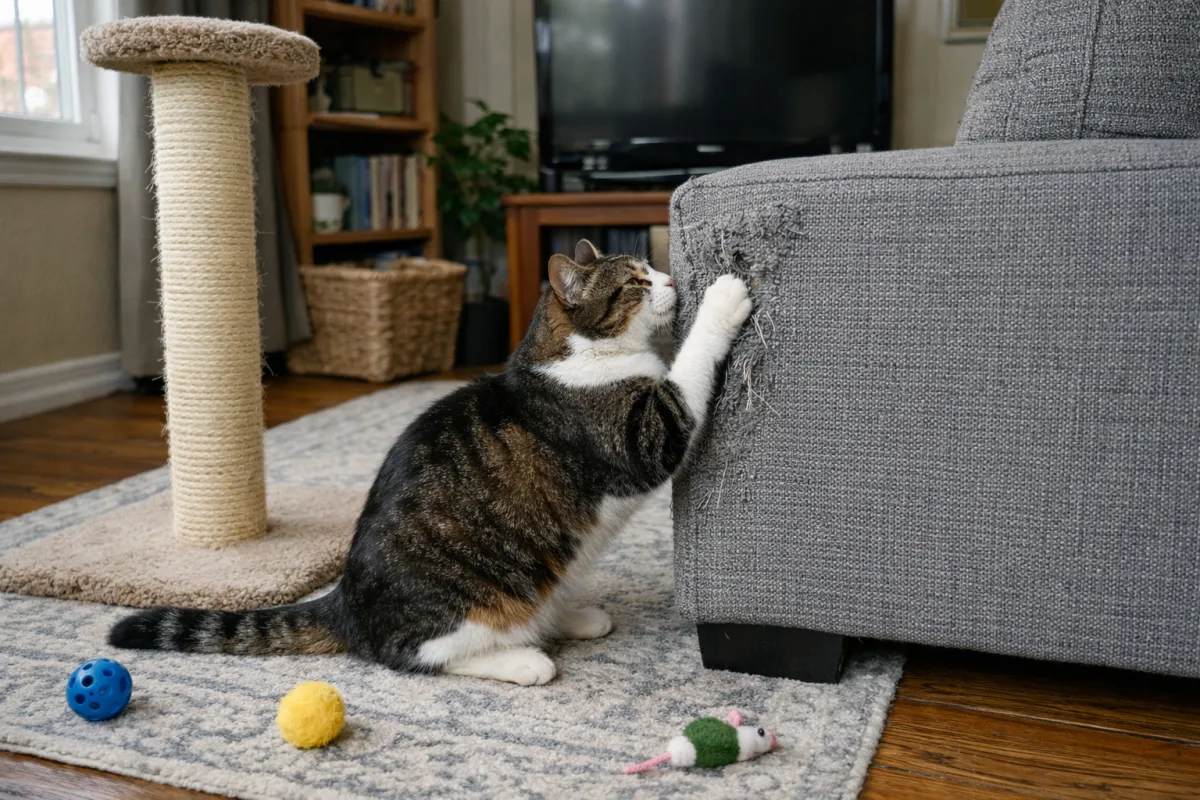
Destructive scratching can take many forms. Some cats dig into the same arm of the couch every morning. Others attack carpets at hallway corners, peel wallpaper near doors, or rake claws down wooden posts and trim. The pattern often becomes obvious once the cat picks a favorite place and returns to it repeatedly.
In a calm home, scratching may look purposeful and brief. The cat stretches, scrapes a few times, and walks away. When it is destructive, the behavior tends to be more repeated, more forceful, or more directed at surfaces the owner wants protected. The cat may also scratch at moments that seem inconvenient, such as right after feeding, when visitors arrive, or when everyone is getting ready to leave.
A few common signs stand out:
- Repeated scratching in the same area of furniture
- Scratching near doors, windows, or main walkways
- Ragged fabric, pulled threads, or visible claw marks
- Scratching combined with rubbing, rolling, or vocalizing
- Preference for textured surfaces like carpet, upholstery, or sisal
Not every example means the cat is distressed. Some cats simply choose the easiest, most satisfying surface available. The problem grows when the home makes that choice too convenient.
Why Cats Scratch in the First Place
Scratching is built into normal cat behavior. It supports claw health, helps the cat leave visual and scent-based marks, and gives the body a chance to fully extend. A cat that scratches is often doing several useful things at once.
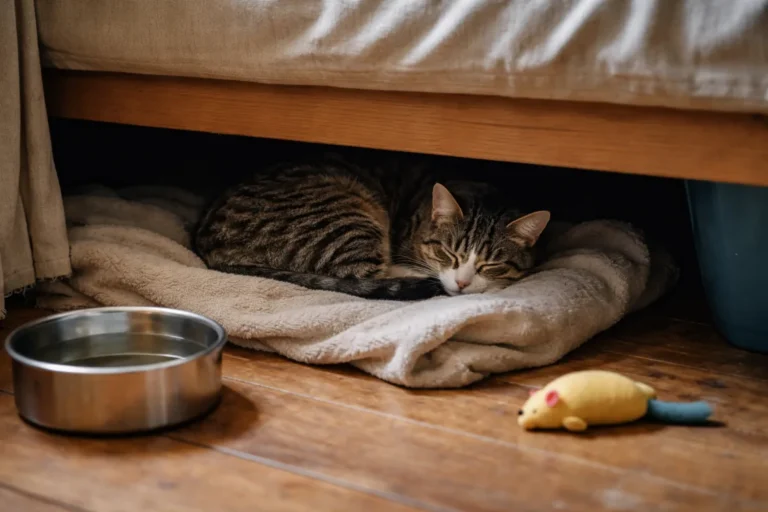
Claws naturally develop worn outer layers, and scratching helps remove those shed pieces. The movement also works the shoulders, spine, and back legs. After a nap, many cats scratch as part of a full-body reset. That is one reason scratching often appears after sleep, before meals, or when a cat moves from rest into activity.
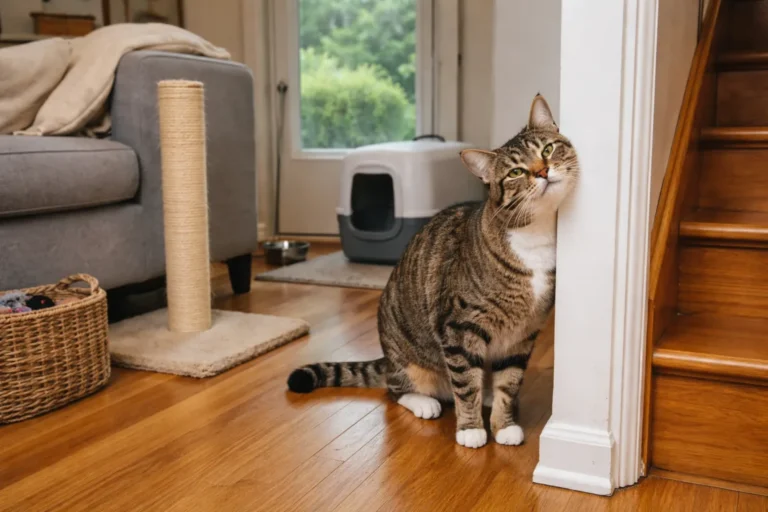
Territory matters too. Cats have scent glands in their paws, and scratching leaves both a visible mark and a scent signal. To a cat, a scratched area can say, “I was here.” That message is normal, even when humans dislike the evidence.
Scratching is not a behavior to stop completely. The real goal is to make it happen in places and ways that fit both the cat and the home.
When Normal Scratching Becomes Destructive
The difference between regular scratching and destructive scratching is often about location, intensity, and repetition. A cat scratching a designated post is using an approved outlet. A cat repeatedly targeting a sofa arm or a stair runner is creating damage in a place that is hard to ignore.
Destructive scratching is also more likely when a cat has few alternatives. If the only scratching post wobbles, sits in a quiet corner, or feels too short to stretch on, the cat may ignore it. A couch corner near a busy room may offer a much better angle, firmer resistance, and more traffic-related scent cues. From the cat’s perspective, that can make perfect sense.
Sometimes the behavior grows because the cat has learned that a certain place gives a satisfying result. Fabric that loosens easily, wallpaper that peels, or carpet that pulls up can be especially rewarding. Once a cat realizes a surface reacts well, it often becomes a favorite.
Common reasons the behavior escalates
- Insufficient scratching posts or pads
- Posts that are too short for a full stretch
- Scratchers placed in low-traffic or hidden areas
- Stress from changes in the household
- High energy with too little daily play
- Overly attractive furniture materials
- Unclear boundaries because scratching options are inconsistent
Internal Reasons Behind the Behavior
Some cats scratch more when they are excited, while others scratch more when they are uncertain. The emotion behind the behavior is not always obvious. A cat may look relaxed and still be using scratching to regulate arousal or claim space. Another may seem restless, pace a little, then attack a doorway with unusual force.
Energy level is a major factor. Young cats and highly active adults often scratch with more intensity simply because their bodies are ready to move. A cat that spends hours asleep and then bursts into activity may need a quick outlet for the back legs, shoulders, and paws. Scratching becomes part of that release.
Stress can also shape the pattern. Cats often respond to environmental shifts such as a new pet, visitors, rearranged furniture, construction noise, or changes in schedule. In those cases, scratching may increase because the cat is trying to steady itself through familiar marking behavior. It may not be about anger. It may be about reassurance.
There is also a communication side. Some cats scratch more where people gather, especially around entrances, living rooms, or the places where daily life feels busiest. That does not always mean defiance. It can mean the cat is choosing the spots that feel most relevant.
When scratching increases suddenly, look at the cat’s routine before assuming it is just habit. Changes in play, sleep, access, or household noise can matter a lot.
How Context and Environment Influence Scratching
The same cat may scratch very differently in two homes. A quiet apartment with one or two stable scratching posts can produce predictable behavior. A busy household with kids, guests, dogs, and moving schedules may create more frequent scratching simply because the cat has more to process.
Placement matters more than many owners expect. Cats often scratch near important zones: bedroom doors, couch ends, windows, hallways, and spots where they turn corners. These are places that help them monitor movement and leave a message in a high-value area. A scratcher hidden in the basement is less appealing than one standing beside the favorite sleeping spot.
Surface texture also changes the outcome. Some cats prefer vertical sisal posts. Others like horizontal cardboard or angled scratchers. A cat may reject one option and use another immediately. That does not mean the cat is being stubborn; it simply means the surface does not match the body position or texture the cat wants.
Home life can either support or worsen the behavior. If a cat gets enough play, has appropriate scratchers, and feels safe moving around the space, destructive scratching often drops. If the cat is under-stimulated or unable to express normal behavior on approved surfaces, the furniture starts filling the gap.
What the Behavior May Be Signaling About the Cat’s State
Destructive scratching often tells a story about timing. A cat that scratches after waking may just be stretching. A cat that scratches hard after a noisy household event may be trying to settle down. A cat that scratches the same door at the same hour every evening may be responding to a predictable routine cue.
Body language helps with interpretation. Relaxed ears, a loose tail, and a long full-body stretch often point to normal scratching. A tense posture, rapid movement, flattened ears, or repeated hard strikes may suggest frustration or agitation. The difference is subtle, but it matters.
Watch for patterns around feeding, play, and transitions. Some cats scratch more before meals. Others do it after being left alone. A cat that scratches at the front door every afternoon may be reacting to the sound of neighbors, delivery workers, or family arrival times. The behavior can be tied to anticipation as much as emotion.
Signals that can accompany stronger scratching
- Pacing or restless movement before scratching
- Vocalizing near a specific spot
- Repeated returns to the same surface
- Overstretched body posture with more force than usual
- Scratching after sudden noise or household activity
How Owners Often Misread It
It is easy to think a cat is being destructive on purpose. In reality, the cat is usually following a strong natural pattern and choosing the most effective place available. The problem is not the motivation; it is the mismatch between cat needs and the environment.
Another common misunderstanding is assuming one scratching post should solve everything. Many cats need more than one option, especially in homes with multiple levels or active routines. A single post in one corner does not always compete with the sofa, the rug, and the bedroom door.
Owners also sometimes mistake scratching intensity for aggression. The behavior can look forceful, but force alone does not tell the full story. A cat may scratch hard because the surface feels good, because the body needs a deep stretch, or because the area has become an important mark point.
Destructive scratching usually reflects a practical mismatch, not a personality flaw.
What Helps Without Turning the Home Into a Battle
A better approach starts with making approved scratching surfaces more appealing than the wrong ones. That means choosing sturdy posts, varied textures, and placements that match the cat’s habits. A tall vertical post near the couch may work better than a decorative scratcher hidden in a corner.
Clipping away loose fabric or covering favorite damaged spots can reduce the reward of the target surface. Some cats respond well when the tempting area becomes less satisfying and a more suitable option stands nearby. The goal is not punishment. It is redirection that makes sense to the cat.
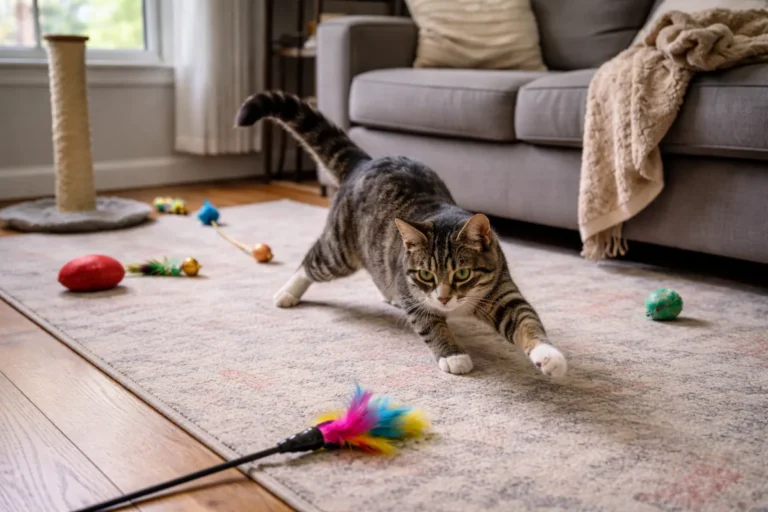
Routine also helps. Regular play sessions, especially before known scratching times, can reduce the need to release energy through furniture. A cat with a predictable rhythm often scratches less destructively because the day already includes movement, rest, and interaction in a stable pattern.
Practical adjustments that often help
- Place scratchers near existing problem spots
- Use both vertical and horizontal options
- Choose sturdy materials that do not wobble
- Offer scratchers tall enough for a full stretch
- Keep the cat’s favorite surfaces less rewarding
- Increase interactive play before peak scratching times
When the Pattern Changes Over Time
Kittens often scratch with obvious enthusiasm because everything is practice. They are learning how to use their bodies, and their impulses can be quick and messy. In adult cats, the behavior may become more deliberate and tied to favorite spots or routines. In older cats, scratching can still remain strong, though the style may become shorter or less explosive depending on mobility and comfort.
Changes in intensity over time are worth noticing. A cat that suddenly scratches more, changes locations, or starts targeting unusual surfaces may be reacting to something in the home. It can be useful to think in terms of timing rather than blame. When did the change begin? What changed in the household around that time? Did the cat’s play, resting, or access to preferred areas shift?
Long-term patterns are often more revealing than single incidents. A cat that scratches the same door every evening is showing a stable routine link. A cat that only scratches when guests arrive may be responding to social pressure or excitement. A cat that scratches wildly after being confined for hours may need a different daily rhythm.
Long-Term Meaning and Consistency
Destructive scratching can stay stable for years if the underlying conditions do not change. That makes observation useful. The goal is not to watch for a miracle shift, but to notice what keeps the pattern alive. Surface, location, energy level, and household movement all matter.
Some cats will always prefer particular materials. Others will always scratch after sleeping or before eating. Once owners understand those preferences, the behavior becomes much easier to manage. The same cat that ruins one couch may calmly use a tall post if it sits in the right place and feels solid under the paws.
Consistency in the home can help the cat feel confident, but consistency also applies to the scratching setup itself. Frequent changes in furniture arrangement, moving the scratchers, or removing favored options can create confusion and push the cat back to the nearest convenient target. Stable options usually work better than occasional fixes.
A cat’s scratching pattern often reveals what the home repeatedly offers, not just what the cat prefers in isolation.
Natural Instincts in a Modern Home
Modern homes create a strange mix for cats. They provide comfort, but they also limit movement, territory, and opportunity for normal marking. That is why scratching can become more noticeable indoors. The cat still has the same instincts, but fewer natural surfaces to use.
In outdoor settings, trees, rough bark, and varied terrain give cats more choices. Indoors, the best stand-in may be a couch arm or a hallway rug unless better options are available. That is why the home setup matters so much. The cat is not inventing a new behavior. It is adapting an old one to a smaller world.
Understanding that shift changes how owners respond. Instead of asking how to stop scratching, it helps to ask where the cat should scratch, how often, and on what surfaces. Those decisions shape the outcome more than any single correction.
When scratching is redirected well, the home stays more intact and the cat still gets to be a cat. The behavior remains normal. The damage does not have to be.