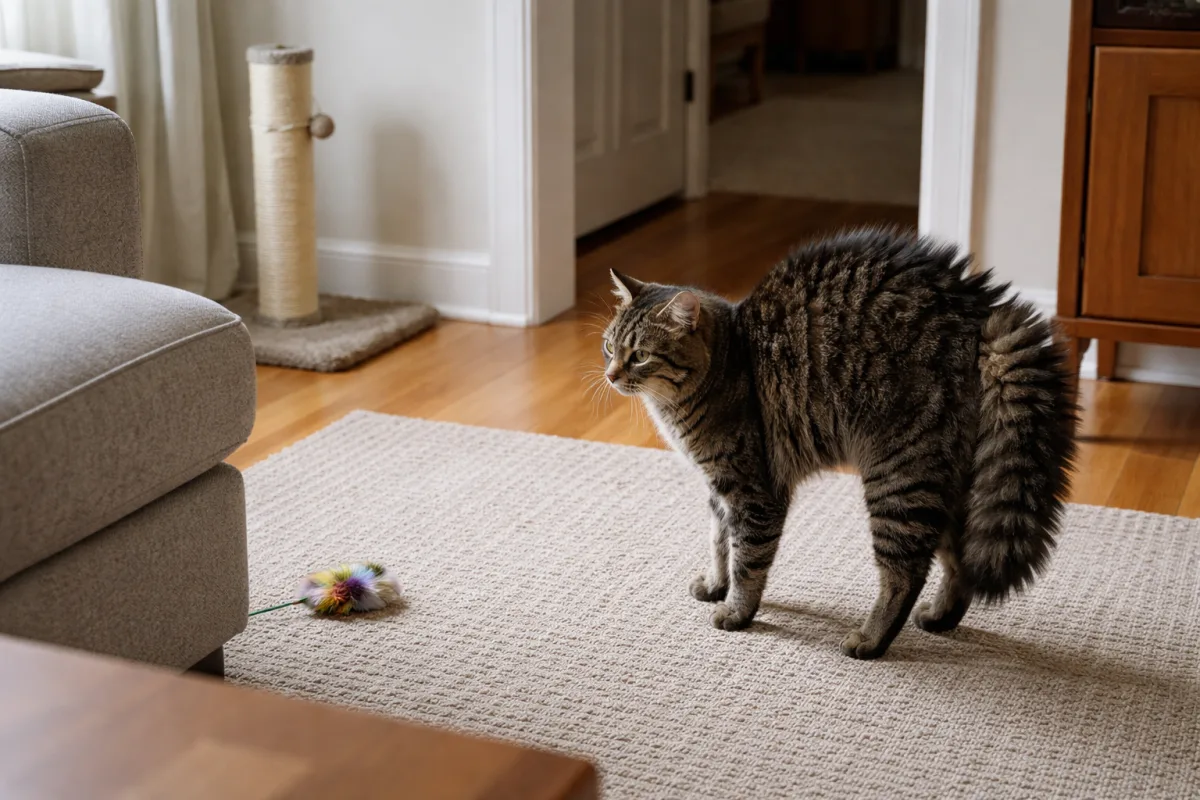
A cat that suddenly arches its back, flattens its ears, or gives a hard stare is not being “difficult” for no reason. Defensive behavior usually means the cat feels unsure, cornered, overstimulated, or protective of itself. The reaction can look dramatic, but it is often a practical response to something the cat does not like or does not understand.
In many homes, defensive behavior appears during very ordinary moments: reaching under a couch, picking up a cat that did not want to be held, bringing a new pet into the house, or even walking too quickly toward a resting cat. The cat may hiss, swat, freeze, or back away. These signals are worth paying attention to because they reveal how the cat is experiencing the moment, not just what it is doing on the outside.
Understanding why a cat becomes defensive helps owners respond in a way that lowers tension instead of increasing it. Some reasons are emotional, some are physical, and some come from past experiences or current surroundings. The behavior is rarely random. More often, it is the end point of smaller stress signals that were easy to miss at first.
What Defensive Behavior Looks Like in Everyday Life
Defensive behavior does not always start with a hiss. It often begins with subtle changes in posture. A cat may turn its head away, stop purring, become very still, or keep a close eye on a nearby person or animal. These are often early signs that the cat is preparing to protect itself.
When the feeling grows stronger, the reaction becomes more obvious. The cat may crouch low, tuck its tail, flatten its ears, show teeth, swat with one paw, or lash out if approached too closely. Some cats do not attack at all; they simply retreat to a hidden spot and stay there. That is still a defensive response.
Common visible signs
- Hissing or growling
- Swatting or scratching
- Flattened ears
- Dilated pupils
- Body held low and tense
- Tail puffed up or tucked tightly
- Backing away while keeping eyes fixed on the trigger
Not every cat uses the same signals in the same order. One cat may warn early and loudly. Another may stay quiet until it suddenly feels forced to react. That difference matters, because quiet cats are sometimes mistaken for relaxed cats when they are actually holding a lot of tension.
Defensive behavior is often a warning, not a challenge. The cat is usually saying, “I need more space,” rather than trying to dominate the situation.
Possible Internal Reasons Behind the Behavior
Some defensive reactions are rooted in emotion. Fear is one of the most common. A cat that has not fully learned that a person, sound, or object is safe may treat it as a threat. This is especially common with shy cats, newly adopted cats, or cats that have had a rough start in life.
Pain is another major reason. A cat that hurts may become touchy, jumpy, or more protective of certain areas of the body. A cat with arthritis, dental pain, stomach discomfort, or an injury may react defensively when touched because contact feels risky. In these cases, the defensive behavior is not just about temperament. It is often about avoiding more pain.
Overstimulation can also play a role. Some cats enjoy petting for a short time and then suddenly become tense. Their skin may twitch, the tail may flick, and the cat may turn and nip if the contact continues. The cat is not confused; it is reacting when the amount of touch becomes too much.
Internal triggers that can matter
- Fear of unfamiliar people, animals, sounds, or movements
- Pain or physical discomfort
- Past negative experiences
- Low tolerance for handling
- Stress from too much activity or noise
- Feeling trapped or unable to escape
A cat’s personality shapes how these triggers show up. Some cats are naturally cautious and will defend themselves quickly. Others are more tolerant until a very specific line is crossed. A confident cat can still act defensively if something hurts or feels too sudden.
How Context and Environment Influence It
Where the cat is and what is happening around it can change everything. A quiet room with familiar smells may help a cat stay calm. A hallway full of moving feet, unfamiliar bags, loud voices, or another pet blocking the way can make the same cat defensive in seconds. The environment often determines whether the cat feels in control.
Many cats become more protective when they are near a resting place, food bowl, litter box, or favorite hiding area. These spaces matter because they offer safety. If a cat thinks that space might be invaded, it may guard it. That can show up as hissing at another cat near a window perch or swatting at a hand that reaches into a bed.
New changes in the home are a frequent trigger. Furniture rearrangement, a new baby, guests staying over, construction noise, or a different daily schedule can all unsettle a cat. Even small disruptions can matter if the cat already feels fragile or uncertain.
A cat that seems “suddenly defensive” is often reacting to a change the human has overlooked, not acting without reason.
Environmental factors that can raise tension
- Loud or sudden noises
- Too many people in one space
- Blocked escape routes
- Competition with another pet
- Unfamiliar smells or objects
- Repeated handling without breaks
Some cats also become more defensive in certain parts of the day. Morning energy, evening zoomies, or post-nap confusion can all affect how a cat responds. Timing can reveal whether the issue is linked to routine, fatigue, or stress buildup.
What Defensive Behavior May Signal About the Cat’s State
Defensive behavior is usually a signal that the cat’s comfort level has been crossed. That crossing may be temporary, or it may reflect a larger pattern. A single hiss during a stressful moment is not the same as a cat that remains tense for days. The pattern matters.
If the reaction appears only during specific handling, the cat may dislike being touched in that way. If it happens around every visitor, the cat may be socially cautious. If the behavior appears when the cat moves, jumps, or is picked up, pain should be considered. The cat is giving clues about what feels unsafe.
Some cats are defensive because they are under-socialized. They may not have had enough early exposure to people, sounds, or normal household activity. That does not make them unmanageable. It simply means their comfort zone is narrower, and they need more space and predictability.
What the behavior can be telling you
- The cat feels threatened
- The cat does not trust the current interaction
- The cat may be in pain
- The cat needs more distance or time
- The cat is trying to prevent escalation
Sometimes the message is mixed. A cat may approach, rub against a leg, then suddenly hiss when touched too long. That does not mean the cat is inconsistent in a confusing way. It usually means interest and discomfort are happening at the same time. Cats can want contact and still need control over how much contact continues.
How Defensive Behavior Differs From Play or Normal Alertness
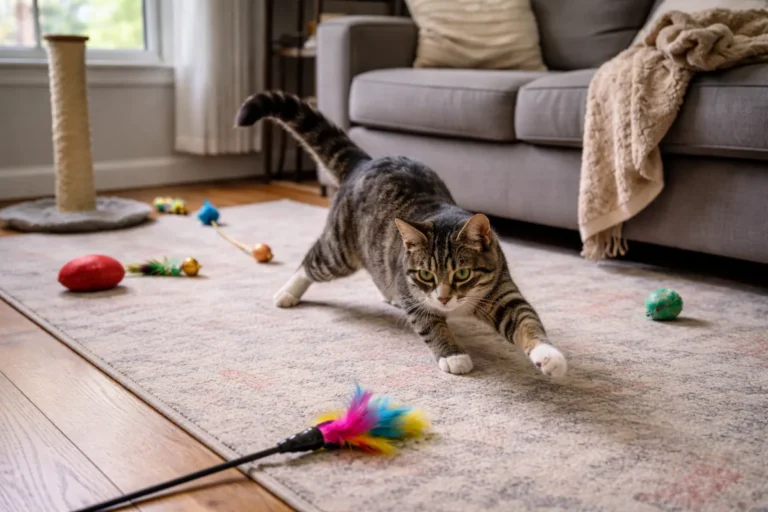
Not every tense-looking cat is defensive. Some cats look intense when they are playing, stalking a toy, or tracking movement outside the window. The difference is in the overall body language and the outcome of the interaction. Play usually has an elastic quality. Defensive behavior feels tighter and more protective.
A playful cat may crouch low but stay loose, with ears moving naturally and pauses between bursts. A defensive cat is often stiff, fixed, and ready to react quickly. The tail and face usually tell the story. A playful cat tends to look engaged. A defensive cat looks guarded.
| Situation | More likely playful | More likely defensive |
|---|---|---|
| Body posture | Loose, springy, ready to chase | Tense, low, ready to protect itself |
| Facial expression | Focused but relaxed | Hard stare, flattened ears, wide pupils |
| Response to approach | May re-engage | May retreat, swat, hiss, or freeze |
| After the interaction | Returns to play or curiosity | Stays cautious or avoids the area |
Neutral alertness is different too. A cat may simply be observing a new person or sound without feeling threatened. In that case, the cat may watch quietly, take a few steps back, and then settle once it decides the situation is safe. Defensive behavior is more urgent and less flexible.
Why Pain and Medical Issues Matter So Much
Many people assume a cat that growls or swats is being territorial or moody. Sometimes that is true, but pain is a very common hidden cause. Cats often hide discomfort until something touches the sore area or until moving becomes hard. Then the defensive behavior shows up in ways that can seem sudden.
A cat with joint pain may dislike being lifted. A cat with dental pain may resist being touched near the face. A cat with a urinary issue may become tense in the litter box area. These reactions are protective, not stubborn.
If the behavior seems new, more frequent, or more intense than usual, a health issue should be considered. Appetite changes, hiding, reduced grooming, limping, or sensitivity to touch can point in that direction. A cat that is protecting itself from pain may look very similar to a cat that is protecting itself from fear.
When a cat’s defensive behavior changes quickly, especially with touch or movement, pain should be part of the first round of questions.
How Past Experiences Shape the Reaction
Experience matters. Cats learn fast. If a cat was handled roughly, chased, trapped, or forced into stressful situations, it may remember that feeling and respond defensively the next time something similar happens. The cat may not connect the event in human terms, but the body remembers the pattern.
Rescue cats often carry this kind of history, but so do many family cats that have had one bad experience with medication, trimming nails, or being restrained. After that, even a familiar hand may start to feel threatening in the wrong context. The cat is not being dramatic. It is protecting itself based on what it has learned.
This is why repetition matters. A cat that is repeatedly pushed past its limits can become quicker to defend itself over time. On the other hand, a cat that is given choice and space often becomes less reactive. Trust grows when the cat sees that backing away is allowed.
How Daily Routines Can Increase or Reduce Defensiveness
Routine makes many cats feel safer. Predictable feeding times, quiet rest periods, and familiar household patterns lower uncertainty. When the day stays relatively steady, a cat often has less reason to guard itself so intensely.
Changes in routine can have the opposite effect. Delayed meals, visitors during usual nap time, noisy morning departures, or repeated interruptions can leave a cat on edge. A cat that cannot predict what comes next may start reacting more quickly to small disturbances.
Some cats also become more defensive when they are tired, hungry, or overstimulated from play. A cat that has no easy path to rest can become irritable. This is especially common in busy households where the cat is approached many times in a row. The reaction may look like attitude, but it is often exhaustion.
Routine-related factors that matter
- Meal timing changes
- Irregular sleep or rest periods
- Too much handling in a short time
- Noise during normally quiet hours
- Introducing new pets or guests without transition
A predictable environment does not remove all defensive behavior, but it can reduce how often it appears. Cats generally do better when the day has structure and when they can control how close they want to be to people and other animals.
When Defensive Behavior Becomes More Noticeable
Some cats show defensive behavior only in clear trigger moments. Others become generally guarded over time. The difference often depends on how often the cat feels forced into uncomfortable situations. If the cat gets regular chances to escape, relax, and recover, the behavior may stay limited.
If the cat lives with constant noise, rough handling, or another pet that invades its space, the behavior may become easier to trigger. The cat may start reacting sooner and more intensely because it has little reserve left. Once stress builds, small things can set off a bigger response.
Age can matter too. Kittens may defend themselves when they are frightened or overwhelmed, but many of them become more tolerant with gentle handling and steady experiences. Adult cats may become more cautious if life changes suddenly. Senior cats may react defensively more often if movement hurts or if their senses are less sharp.
How Owners Often Misread the Signals
One common mistake is assuming a defensive cat is being “mean.” That interpretation makes it easy to miss the real issue. A defensive cat is communicating limits, and those limits usually make sense from the cat’s point of view. Ignoring the warning signs often makes the next reaction stronger.
Another mistake is treating every defensive response as a behavior problem that needs correction. Sometimes the right answer is not to push through it. It may be to slow down, change the environment, reduce handling, or check for medical pain. The most useful response depends on the reason behind the behavior.
Owners also sometimes miss the early signals. By the time the cat hisses, the cat may have already shown discomfort through stillness, tail flicking, or moving away. Recognizing those smaller signs gives the cat a better chance to feel safe before the situation escalates.
What looks like “random attitude” is often a cat’s final warning after several quieter signals were ignored.
How to Read the Pattern Over Time
The key is not one moment but the pattern. Ask when the behavior happens, who or what is present, and whether it is becoming more frequent. A cat that only reacts during nail trims is different from a cat that guards every doorway. A cat that reacts once after a loud crash is different from one that seems tense every afternoon.
Look for consistency in the trigger, the body language, and the recovery time. Does the cat calm down quickly once left alone? Does the cat stay defensive for hours? Does it happen only around one person, or around anyone who tries to touch a certain area? These details point to different causes.
Keeping the cat’s world predictable, watching for pain, and respecting distance when needed can make a meaningful difference. A cat that feels understood usually has fewer reasons to defend itself. The behavior then becomes less frequent, less intense, or limited to moments when the cat truly needs space.
In the end, defensive behavior is often a message about comfort, trust, or physical state. The cat is not always asking for less affection. Sometimes it is asking for a better pace, a safer distance, or relief from something that hurts.