A cat that watches you constantly can feel both sweet and slightly unsettling. One minute they are lying across the room, the next they are tracking every move you make with complete focus. That steady gaze often makes owners wonder whether the cat is curious, affectionate, bored, worried, or waiting for something important.
In many homes, this behavior becomes part of the daily rhythm. A cat follows you with its eyes while you make coffee, sits in the hallway as you walk by, or stares from the couch while you work. The habit can look simple on the surface, but it often reflects a mix of instinct, routine, attachment, and the cat’s reading of the environment.
Constant watching is not one single message. It can mean your cat feels safe, wants interaction, is trying to predict what comes next, or is reacting to something in the home. The details matter: body position, ear movement, tail behavior, the time of day, and what happens right before and after the staring.
What Constant Watching Looks Like in Everyday Life
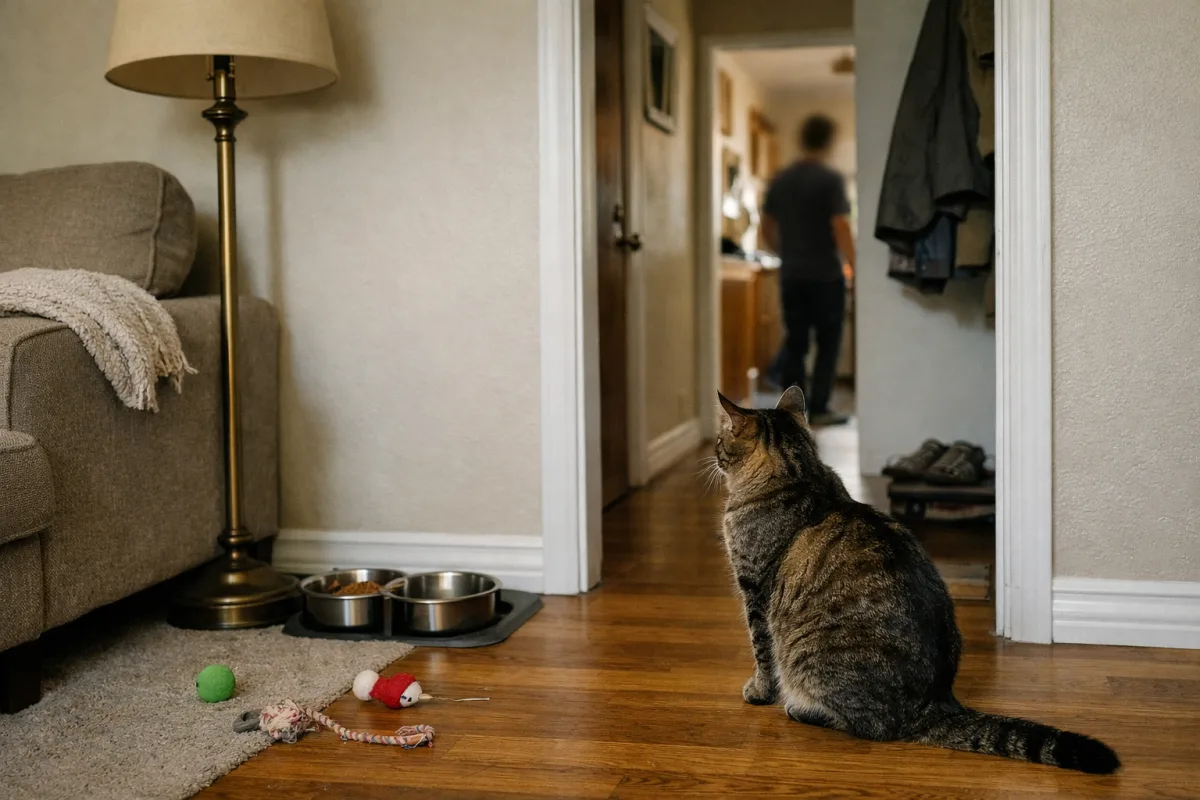
This behavior shows up in many small ways. Some cats sit in a doorway and stare without moving. Others keep their eyes on you while you work, cook, or read. A few seem to appear in every room just to maintain visual contact, even if they do not want to be touched or picked up.
Sometimes the watching is calm and loose. The cat’s body stays relaxed, the eyes are soft, and the ears point forward or slightly to the side. In other situations, the stare is intense and fixed, with a still body and very little blinking. Those two versions can mean very different things.
- Quiet observation: your cat tracks your movement from a distance.
- Room-to-room monitoring: the cat keeps showing up wherever you go.
- Waiting behavior: the stare centers around feeding time, play, or a routine event.
- Alert watching: the cat seems focused on your hands, feet, or actions.
Not every cat makes the same kind of eye contact. Some are subtle and only glance over when something changes. Others are openly attentive and seem to study every habit you have. The pattern itself is important, because it often points to what your cat expects from the moment.
Why Cats Watch People So Closely
Cats are observant animals by nature. In the wild, attention to movement helps them evaluate safety, track food, and notice changes before those changes become problems. Indoors, that same instinct often gets redirected toward the people they live with.
A cat watches you because you are a major part of its world. You open doors, fill bowls, change routines, bring out toys, and react in ways the cat learns to predict. Over time, your movements become meaningful signals. A hand reaching for a drawer may mean treats. Sitting in a certain chair may mean lap time. Grabbing shoes may mean you are about to leave.
That learned connection is powerful. Cats pay attention to patterns because patterns help them feel prepared. A constant stare can simply mean your cat is trying to read the next event before it happens.
Many cats watch people as a way to predict outcomes, not because they are being dramatic or “possessive.” They are gathering information.
Attachment can also play a role. Some cats follow a favorite person visually because they feel most secure near that person. The watching may increase when the cat is especially bonded, or when the home feels busy and the cat wants to stay oriented to you.
Emotional Reasons Behind the Behavior
Emotion matters, but it is rarely just one emotion. A cat that watches constantly may be feeling content, curious, cautious, needy, or lightly stressed. The same behavior can appear in all of those states, so the surrounding clues are what give it meaning.
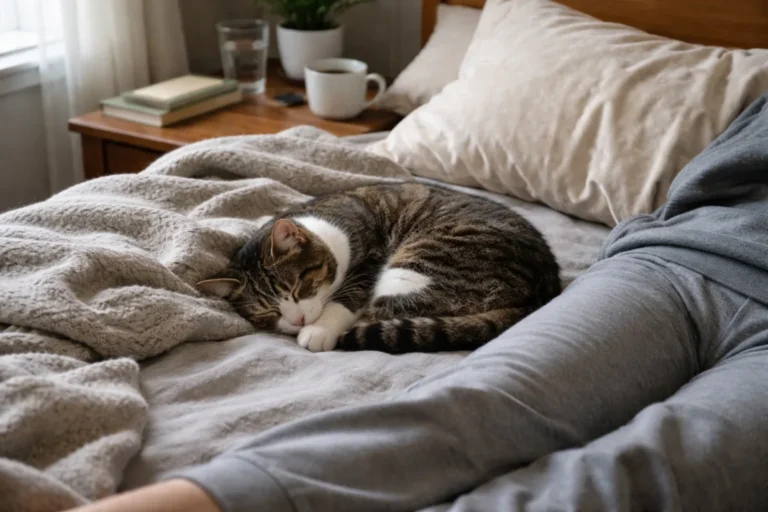
A relaxed cat often watches with a soft face and slow blinks. This kind of gaze usually fits a cat who is comfortable and engaged. The cat may not want action every moment, but it is still interested in what you are doing and where you are going.
Another common reason is anticipation. Cats are excellent at noticing the sequence of household events. If you always feed them after turning on the kettle, they may stare at you around kettle time. If play usually follows your laptop closing, they may watch that same motion closely. In those cases, the stare is less about emotion and more about expectation.
Some cats watch more when they are uncertain. A new sound, unfamiliar visitor, furniture rearrangement, or change in schedule can make a cat track you more than usual. Your movements become a reference point. The cat may be using you as a stable signal in an environment that feels less predictable.
An intense, unblinking stare with a rigid body can mean tension, not affection. The full body picture is more reliable than the eyes alone.
Body Language That Changes the Meaning
To understand constant watching, look beyond the eyes. The rest of the body often tells a clearer story. A cat’s posture, tail, ears, whiskers, and movement give useful context that turns a simple stare into something more specific.
Signs of a calm, comfortable watch
- Loose body posture
- Slow blinking
- Tail resting quietly or curled around the body
- Ears facing forward or gently angled
- Light movement, not stiffness
This version often appears when the cat is resting near you or casually checking in while you move around. The cat is engaged, but not tense.
Signs of a more urgent or stressed watch
- Stiff legs or a crouched posture
- Wide eyes with fixed focus
- Tail held tightly or flicking sharply
- Ears pulled back or swiveling constantly
- Little to no blinking
This pattern can show up when something feels off. The cat may be reacting to noise, a stranger, another pet, or a change in the room. In some cases, the cat is watching you because your actions matter to what happens next, and the cat is trying to stay ready.
How Daily Routine Shapes the Behavior
Routine has a huge effect on how often a cat watches you. Cats notice habits quickly, and they become especially attentive when your schedule is predictable. If you wake at the same time each day, feed at similar hours, or follow a certain evening pattern, your cat may begin monitoring you closely around those moments.
Indoor cats often show this behavior more strongly than outdoor cats because the home environment concentrates their attention on people and daily events. With fewer outside distractions, your movements become more important. A cat may spend a lot of time watching simply because there is not much else to compare with your presence.
Busy homes and quiet homes can create different versions of the same behavior. In a lively household, the cat may watch to keep track of children, visitors, or other pets. In a very calm home, the cat may watch because your actions are the main source of stimulation.
Changes in routine often make the watching more noticeable. A late dinner, a missed play session, or a shift in work hours can cause a cat to stay visually close. That does not always mean distress, but it does suggest the cat is tracking the new pattern carefully.
Different Meanings in Different Situations
The same stare can mean different things depending on what is happening around it. A cat that watches you while you prepare food is different from a cat that watches you after a loud sound. A cat staring from the window perch has a different purpose than one that sits in the bathroom doorway.
| Situation | Possible meaning | What to notice |
|---|---|---|
| Before meals | Expectation or learned routine | Clock-watching behavior, following you to the kitchen |
| During quiet time | Interest, companionship, or boredom | Relaxed body, casual blinking |
| After a change at home | Uncertainty or increased alertness | Stiffness, hiding nearby, extra checking |
| When you pick up objects | Association with treats, play, or leaving | Tracking hands closely, moving ahead of you |
| Near other pets | Monitoring social space or tension | Ear direction, tail tension, distance from others |
A cat may also watch more at specific times of day. Early morning and evening are common because those periods often connect to feeding, movement, and interaction. For some cats, watching becomes part of the “opening” and “closing” of household activity.
When Watching Is About Communication
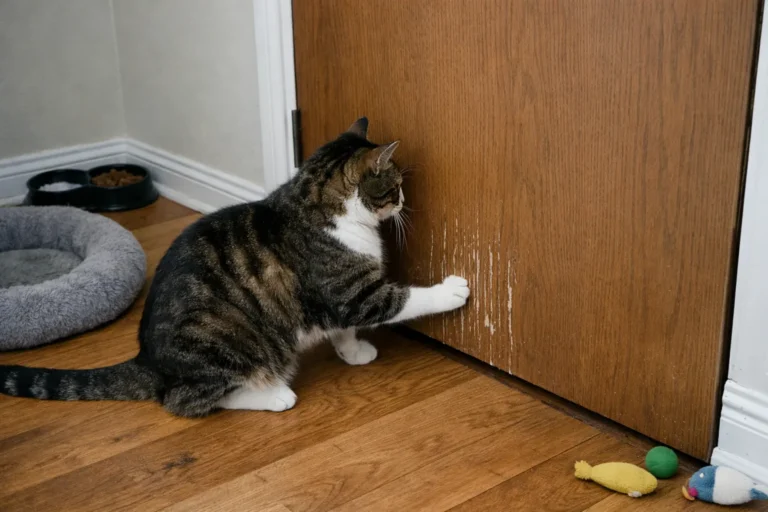
Cats cannot ask for things directly, so they often use attention as a signal. Constant watching can be a quiet way of saying, “I noticed you,” or “I want something to happen.” The message may be food, play, a door opening, reassurance, or simply acknowledgment.
Many cats watch the person they trust most when they want to engage but do not want to be intrusive. They may be waiting for an invitation. A soft stare from across the room can be the first step toward interaction, especially in cats that prefer to approach on their own terms.
Sometimes the watch is more practical than emotional. If a cat has learned that a certain person provides care, the cat may keep that person in sight to avoid missing the next useful event. That habit can be strong in multi-person households where one person handles feeding and another handles play.
Watching can be a form of quiet communication. The cat may be asking for attention without making a sound or moving in obvious ways.
When Constant Watching May Point to Stress
Not all watching is harmless. If your cat is staring in a tense way and seems unable to relax, the behavior may reflect stress or discomfort. This is especially true if the cat is also pacing, hiding, over-grooming, vocalizing more than usual, or reacting strongly to small changes.
A cat under stress may watch you because you are the most predictable element in the room. Your behavior becomes a reference point when everything else feels uncertain. The cat may not want closeness as much as stability.
Stress-related watching can appear after:
- Moving to a new home
- Introducing a new pet
- Changes in feeding schedule
- Visitors or renovation noise
- Illness, pain, or reduced mobility
If the stare comes with withdrawal, flattened ears, reduced appetite, or unusual stillness, the issue may be more than curiosity. Cats are often quiet about discomfort, so a change in how they look at you can be one of the first clues that something has shifted.
How Age and Personality Affect the Behavior
Kittens often watch intensely because they are learning everything. People, routines, sounds, and motion all matter to a young cat that is still mapping the world. The gaze may seem constant simply because the kitten is collecting information at a rapid pace.
Adult cats usually settle into more specific patterns. One cat may watch mostly around feeding. Another may observe from a favorite perch whenever you are home. A confident adult cat may glance over now and then, while a more cautious cat may monitor from a distance for much of the day.
Senior cats can also become more watchful, especially if their hearing, vision, or comfort level changes. Some older cats stay closer visually because they want to stay oriented to their person. Others watch more because movement is easier to track than sudden approach.
Personality matters as much as age. An affectionate cat may watch because it likes being near you. A reserved cat may do it from a distance. A highly sensitive cat may monitor every shift in the room. None of these patterns is unusual on its own.
What Owners Often Misread
People often assume constant watching always means love or always means hunger. In reality, the truth is usually more layered. A cat that seems glued to you might be affectionate, but it may also be bored, unsure, or simply highly alert to routine.
Another common mistake is reading the stare in isolation. Eyes alone do not explain the full message. A quiet cat with relaxed posture is very different from a cat with a fixed stare and a tense tail. The surrounding behavior changes the interpretation.
It is also easy to think the cat is trying to “control” you. That view gives the behavior too much human meaning. Cats do learn how people behave, but what looks like control is often just observation plus strong memory. The cat is watching because it is useful to watch.
If your cat watches you constantly but still eats, rests, plays, and uses the litter box normally, the behavior is often part of its ordinary way of staying connected to the household.
What Helps You Read the Behavior More Clearly
Pay attention to patterns instead of single moments. Notice when the watching happens, how long it lasts, and what the cat does afterward. A cat that watches before meals may be following a routine. A cat that watches after a loud sound may be responding to stress. A cat that watches during quiet evenings may simply be sharing the space with you.
It can help to ask a few simple questions:
- Did anything change in the home recently?
- Does the staring happen around a predictable event?
- Is the cat relaxed or tense while watching?
- Does the cat approach afterward, or stay distant?
- Has the cat’s appetite, grooming, or energy changed?
Those details usually tell more than the stare itself. A cat that watches with relaxed interest is sending a very different message from a cat that watches because it is bracing for something unfamiliar.
The Quiet Meaning of Being Kept in Sight
When a cat watches you constantly, it is often because you matter in a very practical way. You are part of the cat’s map of the home, part of its routine, and sometimes the easiest way to understand what happens next. That kind of attention can feel intimate without needing to be dramatic.
At the same time, constant watching can also be a small signal that something in the cat’s world deserves attention. The difference lies in the details: relaxed or rigid, predictable or sudden, affectionate or cautious. Once you start reading those cues together, the stare becomes easier to understand in everyday life.
In many homes, the cat’s gaze is less about mystery than about constant awareness. The cat is checking the room, checking the routine, and checking you. That habit can stay soft and peaceful, or it can sharpen when the environment changes. Either way, the message usually lives in the pattern, not just the look itself.