A cat that suddenly hisses or growls can seem to change in a split second. One moment everything is quiet, and the next there is a sharp warning that stops the room cold. It often surprises people because the cat may not have seemed upset at all.
These sounds usually are not random. Cats use hissing and growling to say that something feels wrong, too close, too fast, or too confusing. The message can be brief and direct: back off, give me space, or I do not like this situation.
What makes the behavior tricky is that the trigger is not always obvious to people. A cat may hiss at a visitor, another pet, a hand reaching from above, a sudden noise, or even a familiar person after a stressful day. The sound is only one part of the picture; the rest is written in posture, timing, and the setting around it.
Why Cats Hiss or Growl Suddenly in Daily Life
Hissing and growling are defensive communication tools. Cats do not use them to be difficult. They use them when they feel the need to create distance or protect themselves before a situation gets worse.
In everyday life, these sounds often appear in moments that feel small to humans. A cat may hiss when another cat approaches a favorite spot, when a child reaches too quickly, or when someone picks up the cat while it was relaxed and not expecting it. The suddenness is usually about the cat’s internal alarm system, not about the size of the event itself.
Many cats try quieter signals first. They may freeze, narrow their eyes, flatten their ears slightly, turn away, or move a little distance away. If those signals are missed, hissing or growling becomes the next, louder step.
Hissing and growling are usually warning signals, not attacks. They often mean the cat wants space before it feels forced to escalate.
What the Behavior Can Look Like
Sudden hissing and growling can take different forms depending on the cat and the situation. Some cats give one short hiss and leave. Others growl low and steady while holding their ground. A few do both at once, especially if they feel cornered or uncertain.
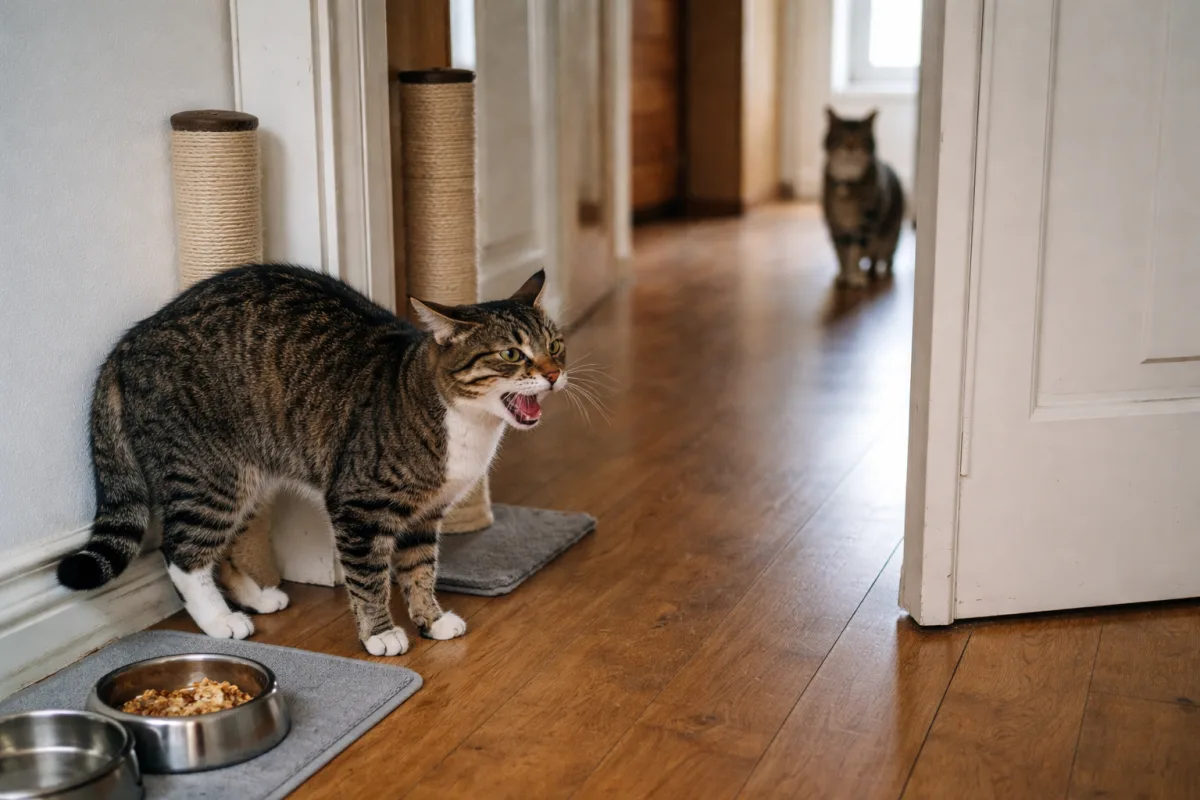
The sound may happen with or without visible movement. One cat may arch its back and puff up. Another may stay very still, with only the tail twitching and the eyes fixed on the trigger. Stillness does not always mean calm. In cats, a frozen posture can be a sign that tension is rising.
It helps to notice the timing. If the sound begins the moment a vacuum turns on, another pet comes near a food bowl, or a carrier appears, the reaction is probably connected to the immediate environment. If it happens after a cat has been sleeping, eating, or recovering from a vet visit, the cat may be more sensitive than usual.
Common body language that appears with hissing or growling
- Flattened or rotated ears
- Wide eyes or a hard stare
- Tensed body or crouched posture
- Tail lashing or held low and stiff
- Raised fur along the back or tail
- Backing away slowly or refusing to move
- Swatting if the warning is ignored
Internal Reasons Behind the Sound
Sometimes the reason is obvious, and sometimes it is buried under a mix of emotions and physical discomfort. Cats are very good at hiding pain, so a sudden hiss or growl may be one of the first clear signs that something is physically bothering them. A sore joint, dental pain, abdominal discomfort, or a skin issue can make a cat far less tolerant of touch or movement.
Fear is another major reason. Cats can react strongly when they do not know what to expect. A new object, a loud appliance, a strange smell, or a change in routine may be enough to make a cautious cat feel unsafe. Even a well-socialized cat can react this way if the situation feels unfamiliar.
Frustration also plays a role. A cat may growl near a closed door, hiss at another pet near a window, or react badly when interrupted during rest. In these moments, the sound is not just about fear. It is also about blocked access, pressure, or a situation that feels unfair from the cat’s point of view.
If the behavior appears out of nowhere and does not match the cat’s usual personality, pain should be considered early.
How Context Changes the Meaning
The same sound can mean different things depending on where it happens. A hiss at the veterinary clinic has a different weight than a hiss in the living room during a normal evening. The cat’s body language, the environment, and what happened just before all shape the meaning.
For example, a cat that hisses when another cat steps too close to a food bowl is probably setting a boundary. A cat that growls while being brushed may be saying the touch is uncomfortable or that the session has gone on too long. A cat that hisses at a stranger by the doorway may be responding to fear, territorial caution, or both.
Some environments make this behavior more likely. Busy homes, unpredictable schedules, too much handling, and a lack of safe retreat spaces can keep a cat on edge. On the other hand, quiet homes are not always peaceful for every cat either. A very shy cat may feel trapped in a still environment if it has no way to avoid attention.
Situations that commonly trigger sudden hissing or growling
- Being touched while asleep or startled awake
- Encountering a new cat, dog, or unfamiliar person
- Handling during grooming, medication, or bathing
- Protecting food, a bed, or a hiding place
- Reacting to loud sounds or sudden movement
- Feeling pain when picked up or petted
- Being cornered with no easy escape route
What Cats Are Communicating When They Suddenly Growl
Growling is often the cat’s stronger, lower-intensity warning before a hiss or a swat. It can be steady and long, almost like a rumble of protest. In many cases, the cat is asking for distance before its tolerance runs out.
Some cats growl when they are guarding something important. This may be a meal, a resting place, or a kitten. Other cats growl when they are tense but do not want to flee. The sound helps them hold a boundary without immediately engaging in physical conflict.
People sometimes assume a growling cat is being aggressive in a broad sense. Usually, the cat is communicating something narrower and more practical. The message is often: do not come closer, do not touch me right now, or I need this to stop.
How Sudden Hissing Differs From Chronic Tension
A single hiss in a specific moment is not the same as a cat living in a constant state of stress. Some cats are naturally more reactive, but repeated incidents can point to a deeper pattern. When hissing starts happening often, the cat may be carrying too much tension through the day.
Chronic stress can show up through patterns like hiding, overgrooming, tension around mealtimes, bathroom issues, or repeated conflict with other animals. In that setting, the hiss is less of a surprise and more of a symptom. The cat has already been stretched thin.
That does not mean every hiss signals a major problem. Cats have boundaries, and healthy cats should be able to say no. The key is whether the reaction makes sense in context, resolves once space is given, or keeps repeating without a clear reason.
How Owners Often Misread the Signal
One common mistake is assuming the cat is being mean. That interpretation misses the point of the behavior. Hissing and growling are often more about self-protection than hostility.
Another common misunderstanding is pushing through the warning because the cat “needs to get used to it.” Sometimes gentle exposure helps over time, but forcing contact during a tense moment usually teaches the cat that warning signals are ignored. That can make future reactions sharper, not softer.
Owners also sometimes miss the smaller clues that happen before the sound. A cat that stiffens, averts its face, stops purring, or watches a hand closely is already communicating discomfort. The hiss may come only after those earlier signs fail to change the situation.
Signals that often come before the sound
- Pausing mid-motion
- Turning the head away
- Tail flicking more quickly
- Shoulders tightening
- Reduced blinking or a fixed stare
- Moving away in short, cautious steps
Why Sudden Reactions Sometimes Happen After Routine Changes
Cats rely on predictability more than many people realize. A slight shift in routine can affect them. Changing feeding times, moving furniture, introducing a new pet, or having guests stay over can make an otherwise steady cat feel unsettled.
Even positive changes can bring out hissing or growling at first. A new scratching post, a new bed, or a newly adopted animal may be interesting and stressful at the same time. Cats often need time to assess whether the change is safe.
In multi-cat homes, sudden vocal warnings are especially common around resources. Cats are sensitive to spacing, timing, and access. If one cat feels blocked from a litter box, hallway, window perch, or food area, the warning sounds may appear quickly.
When a cat starts hissing in places or moments that used to be fine, look for changes in routine, health, or social pressure.
How Pain Can Change a Cat’s Tolerance
A cat in pain may react with much less patience than usual. A pet that normally enjoys being held may hiss when lifted. A cat that tolerates brushing may suddenly growl when the brush touches a sore area. These changes can be subtle at first, then more obvious.
Pain does not have to be severe to affect behavior. Even mild discomfort can make a cat defensive, especially if the discomfort appears during handling. Because cats hide illness well, the behavior change may be more noticeable than the physical signs at first.
This is one reason sudden hissing or growling should be taken seriously when it appears without an obvious trigger. A cat that has always been gentle and then begins reacting sharply may be communicating a health issue rather than a personality shift.
Different Triggers in Kittens and Adult Cats
Kittens may hiss or growl when they are overwhelmed, tired, or learning limits. Their reactions can appear dramatic because they are still building confidence and experience. A kitten might hiss during rough play, after being startled, or when an older cat sets a boundary.
Adult cats usually have more defined preferences. They may know exactly what they do not like and react faster when they recognize a trigger. An adult cat that suddenly growsl s might be reacting to memory as much as the present moment. A smell, sound, or handling method can remind the cat of a past unpleasant experience.
Over time, many cats become more efficient at warning before escalation. Some become quieter, not because they feel less, but because they have learned that a small sign is enough. Others become quicker to react if they have been ignored too often.
What To Notice Instead of Focusing Only on the Sound
The sound itself matters, but the whole event matters more. A cat’s posture, setting, and recovery time give much better clues than the hiss alone. Some cats hiss once and then relax when space is given. Others stay tense for a long time, which tells you the stress has not passed yet.
It helps to ask a few practical questions. What happened right before the reaction? Was the cat sleeping, cornered, handled, or approached by another animal? Did the cat return to normal quickly, or did it remain guarded?
Those details often show whether the event was a one-time warning or part of a larger pattern. They also help separate harmless boundary-setting from a reaction that needs a closer look.
When the Behavior Becomes More Noticeable
Some cats become more vocal during certain life stages. Senior cats may growl more if they have arthritis, poorer vision, or lower tolerance for chaos. Recently adopted cats may hiss more while they adjust to new people, smells, and sounds.
Seasonal or household changes can also make a difference. More guests, more noise, holiday decorations, or shifts in daily routine can raise tension. Cats notice details that people often overlook, and they may react to the buildup before anyone else sees the pattern.
If the behavior becomes more frequent, it is worth observing whether it clusters around one activity. The cat may be fine most of the day but react during grooming, feeding, bedtime, or multi-cat interactions. That pattern gives much better information than a single isolated episode.
What a Calm Response From Owners Looks Like
The best response is usually simple. Stop the action, give the cat room, and let the situation settle. Speaking softly can help, but the most important part is reducing pressure. A cat that has already given a warning needs relief, not a debate.
After the moment passes, it is useful to think about what led to it. Was the cat surprised, confined, touched in a sensitive area, or competing for space? If the trigger is clear, small changes can prevent the same reaction from repeating.
That might mean offering more distance between pets, slowing down handling, changing the timing of a care routine, or making sure the cat has easier access to a quiet hiding place. The goal is not to eliminate every hiss or growl. The goal is to understand what the cat is trying to avoid.
Natural Boundaries in Cat Behavior
Hissing and growling are part of how cats keep themselves safe. They are not flaws, and they are not always signs of a major behavioral problem. In many homes, they are simply brief moments when a cat says enough.
What matters most is the pattern behind the sound. A cat that feels secure, healthy, and respected usually has less need to defend itself suddenly. A cat that has been startled, pressured, or hurt may rely on these warnings more often. The sound is small, but the message is clear.
Once the reason is understood, the behavior makes more sense. It is a form of communication shaped by timing, comfort, health, and trust. When those pieces shift, a cat’s voice can change in an instant.